
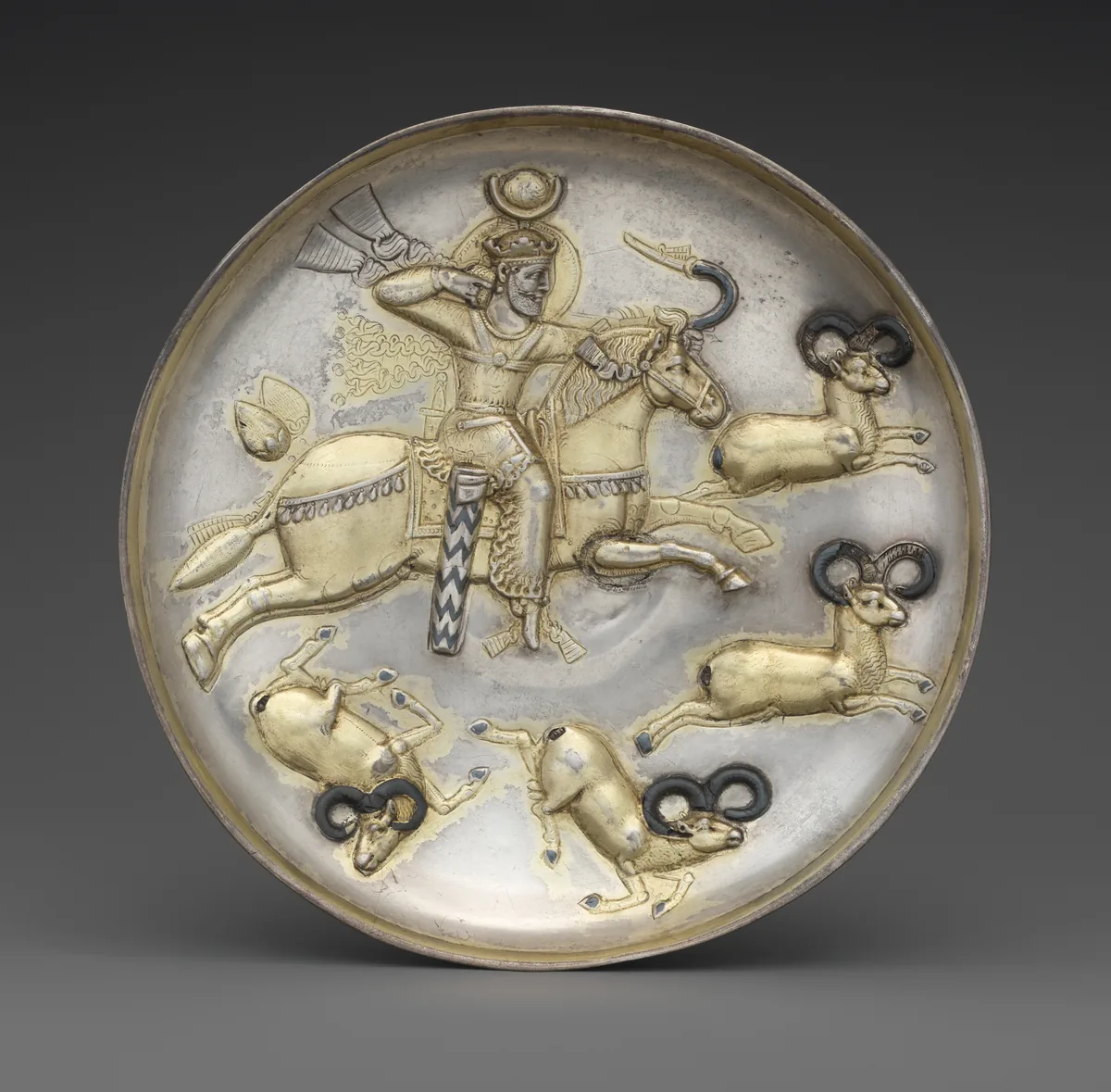
The Chinese histories describe the skill among the steppe peoples over more than a thousand years. The Shiji, completed about 90 BC, says that Xiongnu children rode sheep and shot at birds and mice with the bow.[1] The Sui Shu says that the Göktürks were good at riding and shooting.[2] A Muslim writer of the ninth century has the Turks in the caliph’s army shoot at the gallop in every direction.[3] Courts of the settled states liked to watch the skill, and three of them had it shown before them.[4]
Learning on sheep
The Shiji gives the training of a Xiongnu in three steps.[1] The child who could ride a sheep drew the bow and shot birds and mice.[1] As he grew older, he shot foxes and hares, which were eaten.[1] Every man strong enough to draw the bow became an armoured horseman, 甲騎. The Han Shu writes the phrase with 彎弓, to bend the bow.[5] Zhonghang Yue was a Han eunuch from Yan who had gone over to the chanyu. Speaking for the Xiongnu to the Han envoys, he described how the system ran. In times of danger the people practised riding and shooting, and in times of ease they enjoyed their leisure.[1] The bow was the long weapon of the Xiongnu, and the knife and the short lance were the short ones.[1] The Han Shu copies the Shiji and is not a second witness.[6] The Shiji also tells how the young Modu trained his horsemen with a whistling arrow. They had to shoot wherever his arrow struck. He shot first at game, then at his own good horse, then at his favourite wife, and then at the chanyu’s good horse. Last he shot at his father the chanyu, and his men shot with him.[1] One account calls the tale half legend, a song that Sima Qian may have taken over.[7]
The Göktürks and their neighbours
The Sui Shu lists the weapons of the Göktürks: the horn bow, the whistling arrow, armour, the lance, the knife and the sword.[2] It adds that they were good at riding and shooting and cruel by nature.[2] The Bei Shi has the same sentence.[8] The Sui Shu says of the Tiele, who belonged to the eastern and western Göktürks, that they were skilled at riding and shooting. The Xin Tang Shu says it of the Uyghurs in the days when they served the Göktürks.[9] Soon after 582, a Göktürk envoy at the Sui court watched the general Cui Peng shoot a pigeon from a roof, and Tardu asked the emperor to send him. In the west the ten best archers of Tardu missed a flock of birds, while Cui Peng brought down every bird he shot at. Tardu kept him for more than a hundred days, and the emperor had him released with gifts of silk.[10]
The bow was also a livelihood. The Jiu Tang Shu tells of surrendered households that came south to the Tang protectorate. Its deputy protector Zhang Zhiyun took away all their weapons and made them cross the river.[11] The tribesmen complained to the inspector Jiang Hui that without bows and arrows they could not hunt, and Jiang Hui gave the weapons back.[11] Under Bilge Khan, Tonyukuk argued against building walls and temples. The Göktürks were few and not a hundredth of the Tang in number, he said. They had held out because they followed water and grass, lived by hunting and all practised war. When strong they raided, and when weak they hid in the forests.[11]
As a spectacle
The Wei Shu records that in the seventh month of 426 the Northern Wei emperor Taiwu built a terrace for mounted archery at Changchuan, 馬射臺.[12] He climbed it himself to watch horses run, while the princes, the dukes and the chiefs of the subject states galloped and shot.[12] Those who hit the mark received gold, brocade, silk and floss in graded amounts.[12] In 439 Taiwu marched west against Juqu Mujian. At Shangjun he feasted his ministers and held a review of his troops with mounted shooting.[12]
Soon after 599 the Sui court staged a match in the Wu’an Hall between two sides of archers. The khan Yami took the side of the envoy Zhangsun Sheng.[13][2][14] The Tang court showed the same interest in the Göktürks’ skill. In 725, on the road to Mount Tai, the emperor Xuanzong led the Göktürk envoy Ashide Xielifa and the chiefs of the foreign peoples into his guard and gave them bows and arrows.[15] A hare started up before his horse. He shot it with one arrow, and the envoy dismounted, held up the hare and danced.[15] The envoy had come from the court of Bilge Khan, who had feasted the Tang mission earlier that year.[11] From then on, the emperor often had Göktürks gallop and shoot inside his guard.[11] Lü Xiang, who kept the record of the emperor’s acts, objected in a memorial. The emperor then sent the foreign chiefs ahead of the procession.[11]
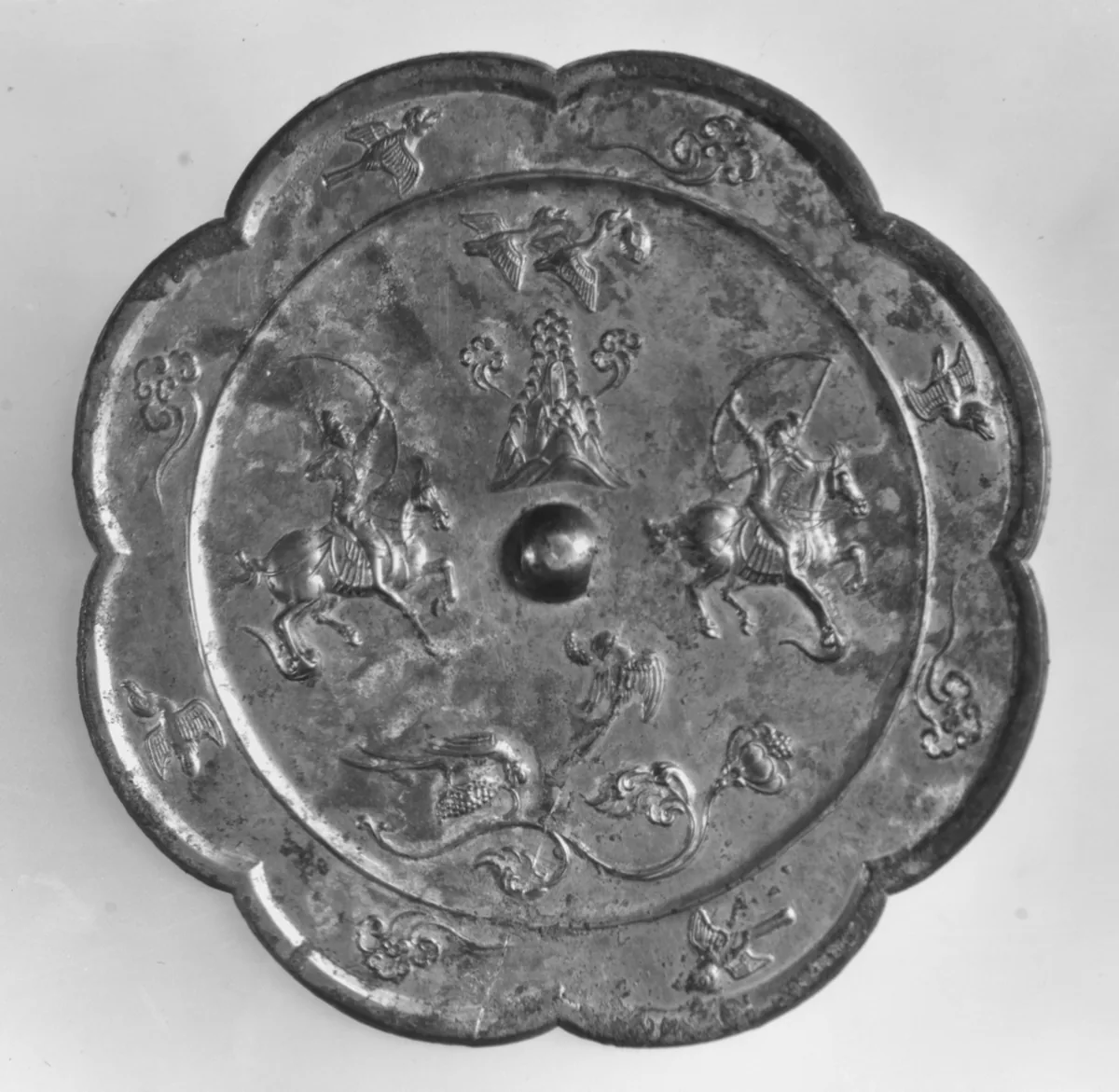
In 835 Uyghur envoys at the Tang court presented seven women who shot from horseback, 馬射女子, and two Shatuo boys. They were gifts of the princess Taihe.[16]
An Arab account
The Arabic treatise of al-Jāḥiẓ on the merits of the Turks compares the Turkish horseman in the caliph’s army with the Kharijite and the Khorasani.[3] The Turk shoots at beasts and birds, at targets set on spears, at crouching game and at figures set up on the ground.[3] He lets his horse go at the gallop backwards or forwards, to right or left, uphill or down. He shoots ten arrows before the Kharijite has laid one on the string.[3] When he retreats, his arrows still hit, so that his flight is as dangerous as his charge.[3] The Turks teach their horsemen to carry two or three bows with strings to match.[17] The treatise is a writer’s praise of his subject. It was not written as a report.[18]
Skill and contest
Mounted archery appears in the sources far more often as a skill than as a contest. Every contest the histories describe was put on by the court of a settled state: at Changchuan, in the Wu’an Hall and in the guard of Xuanzong.[4] For the steppe itself, the sources name no rules and no prizes. A target is named once. One account reports from the Han Shu that after the death of the Han governor of Yanmen, Zhi Du, the Xiongnu made a figure of him and ordered their riders to gallop and shoot at it. None of them hit the middle, and they were frightened.[19]
Arrow and bow as tokens
A Turkish study of the arrow as a legal symbol considers the arrow that the khan sent to each of the ten chiefs of the western Göktürks for a summons to a campaign or an assembly. It understands the arrow as the token of a chief’s subordination and the bow as the sign of the lord. The study rests on the Chinese notice that each of the ten shads received an arrow.[20] The same study interprets the shooting of arrows at the sky as an appeal to the spirits for help. It compares the Gaoche, who shot arrows at the sky when lightning struck, with a Buryat rite in which a vessel with an arrow in it is turned towards the east to call a sick man’s soul.[21]
References
- ^ a b c d e f g Shiji, juan 110
- ^ a b c d Sui Shu (Book of Sui), juan 84
- ^ a b c d e al-Jāḥiẓ, Manāqib al-Turk, p. 666; Walker 1915, p. 666
- ^ a b Wei Shu, juan 4; Sui Shu (Book of Sui), juan 51; Jiu Tangshu (Old Book of Tang), juan 194
- ^ Shiji, juan 110; Han Shu, juan 94
- ^ Han Shu, juan 94; Shiji, juan 110
- ^ Ögel 2015, p. 152–156
- ^ Bei Shi (History of the Northern Dynasties), juan 99
- ^ Sui Shu (Book of Sui), juan 84; Xin Tangshu (New Book of Tang), juan 217
- ^ Taşağıl 1995, p. 86–87
- ^ a b c d e f Jiu Tangshu (Old Book of Tang), juan 194
- ^ a b c d Wei Shu, juan 4
- ^ Sui Shu (Book of Sui), juan 51
- ^ Taşağıl 1995, p. 56–60
- ^ a b Jiu Tangshu (Old Book of Tang), juan 194; Tongdian, juan 198
- ^ Jiu Tangshu (Old Book of Tang), juan 195
- ^ al-Jāḥiẓ, Manāqib al-Turk, p. 667; Walker 1915, p. 667
- ^ al-Jāḥiẓ, Manāqib al-Turk; Walker 1915
- ^ Ögel 2015, p. 400–401
- ^ Turan 1945, p. 306–308
- ^ Turan 1945, p. 311–312
Sources
- Shiji, juan 110
- Han Shu, juan 94 (after Shiji)
- Sui Shu (Book of Sui), juan 51, 84
- Bei Shi (History of the Northern Dynasties), juan 99 (after Wei Shu, Zhou Shu and Sui Shu)
- Wei Shu, juan 4
- Jiu Tangshu (Old Book of Tang), juan 194, 195
- Tongdian, juan 198 (after Sui Shu and Zhou Shu)
- Xin Tangshu (New Book of Tang), juan 217 (after Jiu Tangshu)
Literature
- al-Jāḥiẓ, رسالة في مناقب الترك Risāla fī Manāqib al-Turk (9th c.)
- C. T. Harley Walker, Jāḥiẓ of Basra to al-Fatḥ ibn Khāqān on the 'Exploits of the Turks and the Army of the Khalifate in General' (1915)
- Bahaeddin Ögel, Büyük Hun İmparatorluğu Tarihi I (2015)
- Ahmet Taşağıl, Gök-Türkler, Bd. I (1995)
- Osman Turan, Eski Türklerde okun hukuki bir sembol olarak kullanılması (1945)
What links here5
- Persons
- Princess Taihe
- Institutions and Titles
- Warfare of the Steppe Empires
- Customs & Pastimes
- Culture of the Turkic Peoples
Cite this article
Yavuz, Emre-E. “Mounted Archery.” Turkic Atlas, revised 8 November 2026. https://turkicatlas.org/customs/mounted-archery/
Last revised: 8 November 2026

