
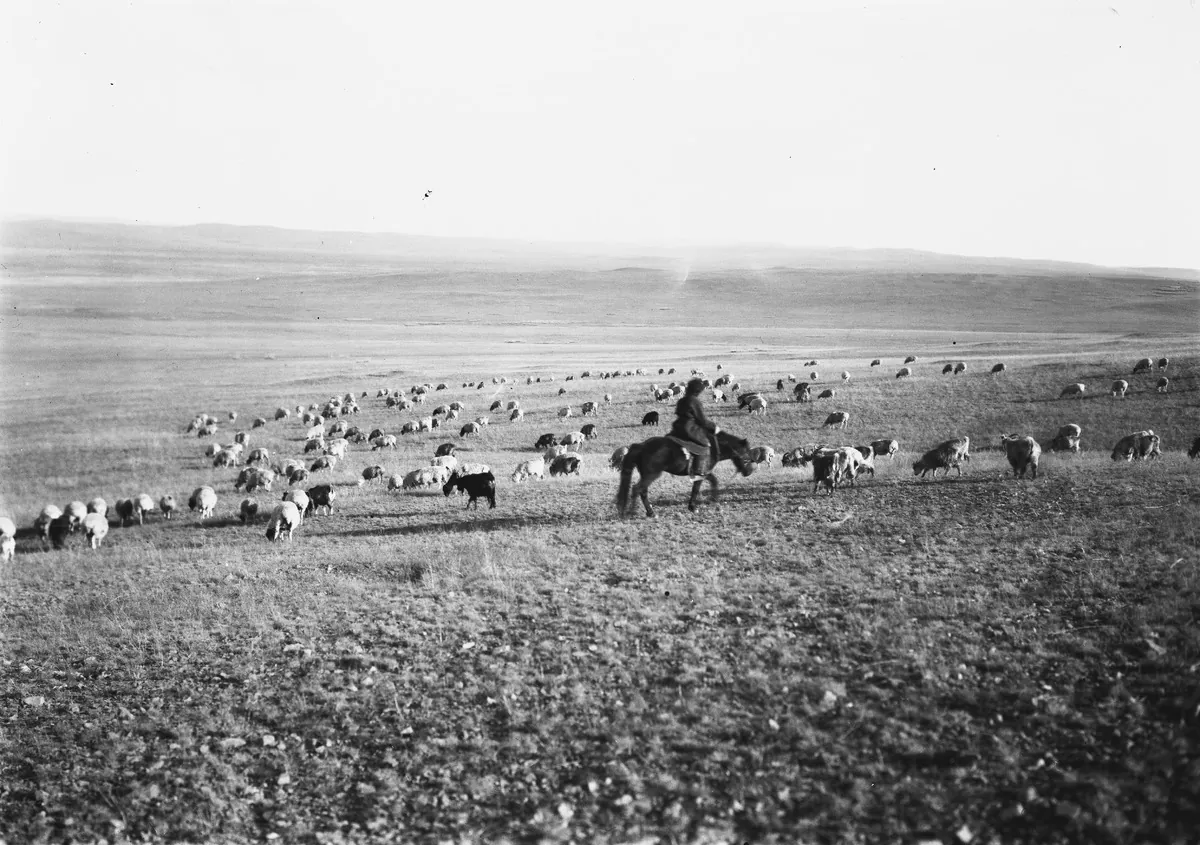
The Eurasian nomads were the herding peoples of the steppe belt that runs from the Hungarian plain to Manchuria.[1] They lived from herds of sheep, horses and other animals, and they moved the herds between fixed pastures through the year.[2] The way of life took shape at the turn of the second to the first millennium BC.[3] The nomads could not make everything they needed, and the settled states wanted their horses.[4] Trade, tribute and raiding between the two shaped the history of the steppe empires.[5]
Name and scope
The word nomad has a wide and a narrow sense. The wide sense covers every people that moves about, hunters and gatherers included. The narrow sense covers only mobile herders, and Turkic Atlas uses it.[6] A nomad herds in the open all year, moves at regular times within set grazing areas, takes most of the community along, and produces mainly for its own needs.[7] Semi-nomads herd stock and also farm, but farming is secondary. The Scythians, the Xiongnu and the Khazars included such groups.[8]
Nomadism is a way of life and not a language family. The Scythians and Sarmatians spoke Iranian.[9] The little that survives of the Xianbei language is best explained as Mongolic.[10] The Xiongnu are often taken for a Turkic-speaking people and for forerunners of the Göktürks.[11] Other scholars place their language among the Yeniseian or the Mongolic languages, and the debate on the language sets the positions out.[11] The Turkic peoples took shape inside the steppe empires, the Göktürk empire among them.[12]
Geography
South of the northern forest, the steppe reaches from Manchuria to the Hungarian Basin.[1] The western steppe includes Ukraine, the north Caucasus, the southern Urals and the Kazakh steppe.[13] The eastern steppe includes the grasslands of Mongolia and Manchuria.[13] The natural zones lie in bands from north to south: tundra, taiga, wooded steppe, steppe, desert steppe and desert.[14]
Only the steppe could support a powerful state. Tundra, forest and desert cannot feed enough people to raise a large force.[15] The grass is rich, and the land has few natural obstacles to movement.[16] Rain is scarce, between 10 and 20 inches a year, or about 250 to 500 millimetres.[17] Farming is limited by water and by short growing seasons, and it is confined mostly to oases and the moister edges of the steppe.[18] Older theories explained historical change by long-term shifts of climate. They lack support, and the real changes in moisture were short-term.[14] Newer measurements are set out in Climate and the steppe empires.
Prehistory
Horses were domesticated in the steppe of southern Russia no later than the fourth millennium BC.[19] Riders who followed herds over hundreds of kilometres appear about the middle of the second millennium BC.[20] The Bronze Age steppe cultures combined herding and farming, and they were not nomadic.[20] In South Siberia the Andronovo and Karasuk cultures kept herds and lived in permanent settlements.[21]
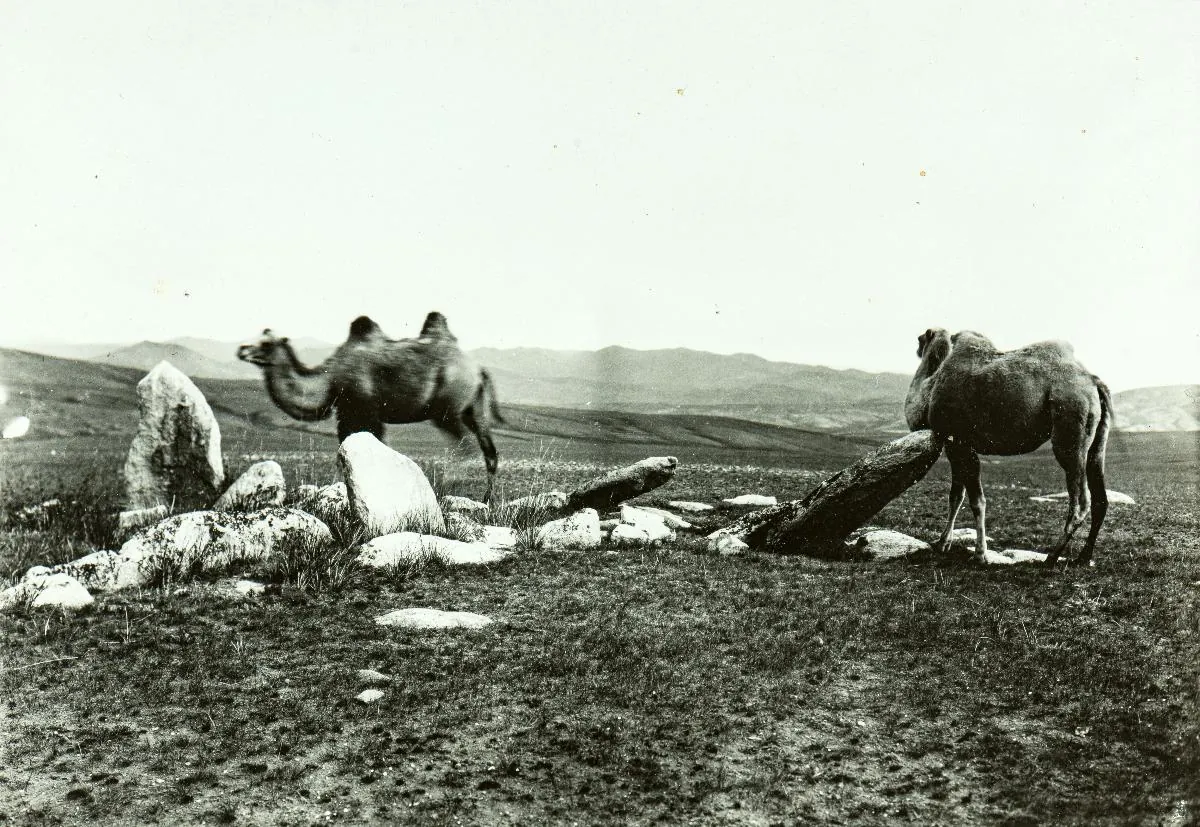
Full nomadism appears at the turn of the second to the first millennium BC, when the climate was at its driest.[3] At that time settled states arose north of the Black Sea and in Middle Asia, and they offered the nomads economic opportunities.[3] How nomadism began is disputed. One theory has herds growing until herders had to move with them. A second theory has stronger neighbours pushing herders into the steppe. A third theory finds neither enough and counts several causes together.[22]
In the west the Cimmerians, an equestrian nomadic people, held the steppe about 1000 to 800 BC, before the Scythians came.[23] The Scythians held the north Pontic steppe from the end of the seventh to the third century BC.[24] The Persians called the eastern branch of these Iranian nomads Saka.[23] A fuller account is in The steppe before the Xiongnu.
Economy
The herds of the Eurasian steppe are led by sheep and horses, with cattle, goats and camels in smaller numbers.[25] The horse gives transport, meat and milk, and it paws through snow to reach grass.[26] The nomads moved on a yearly cycle, mostly from north to south. In summer they went north to fresh grass, and in winter south, where there is less snow.[27] The Chinese sources describe this as wandering after grass and water, but the routes were fixed and the moves planned.[2] The diet rests on meat and milk with plant food as a supplement. Horse meat marks the Eurasian nomads off from other nomads.[28] See Steppe diet.
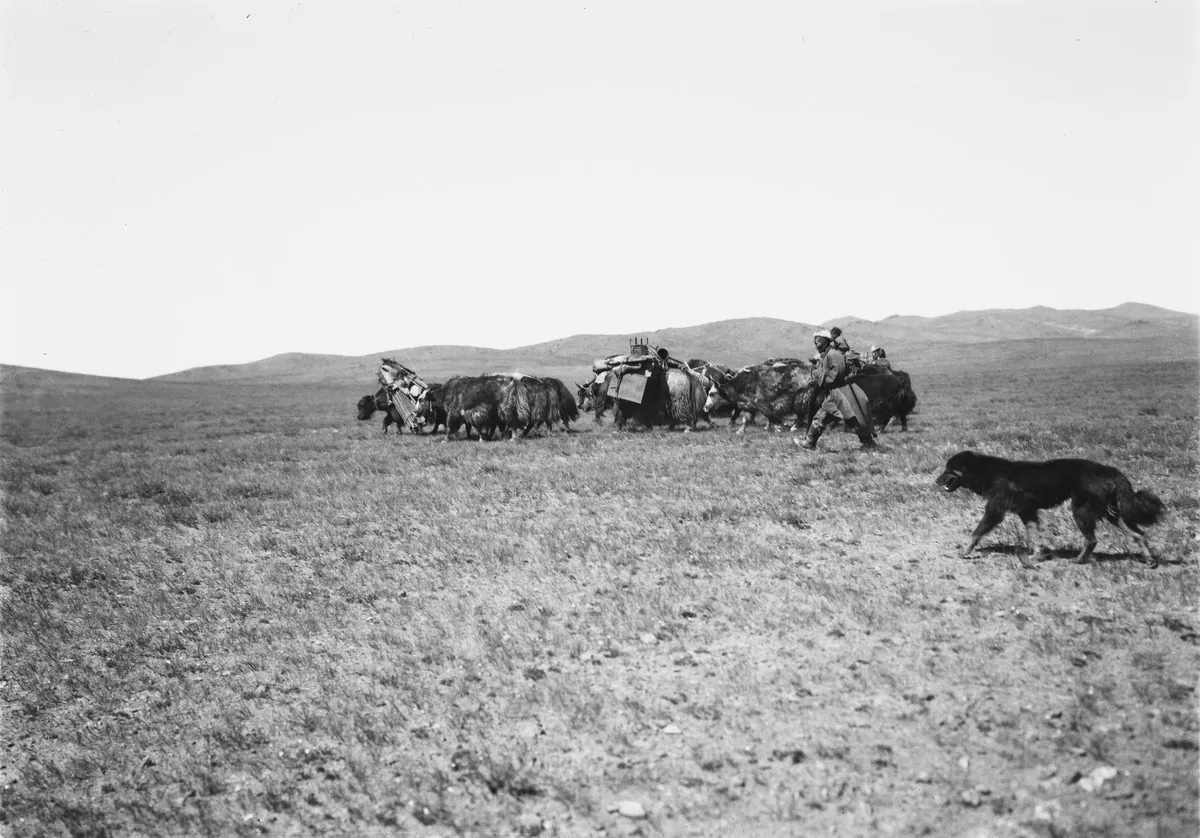
Herding alone does not supply everything. A pastoral economy cannot match the variety and quantity of food that farming gives, and it cannot support as large a population.[29] Nomads also failed to build craft production in their own societies.[30] They wanted textiles, tea and grain, and grain was desperately needed when disaster struck the herds.[31] A Chinese report puts the losses of the Xiongnu in 72 BC, after heavy snow and enemy raids, at three of every ten people and five of every ten animals.[32] A household needed a minimum herd of about 60 to 100 head.[5] Those who fell below it hired themselves out to relatives as herders, settled, or turned to raiding.[5]
The steppe had three ways to obtain what it lacked. The first was trade, and the horse was the main item the steppe sold. The Xianbei sold 70,000 horses to the kingdom of Wei in AD 222.[33] The second was tribute from a settled state. China paid it to the Xiongnu.[34] The third was raiding.[35] A strong steppe power could force frontier markets open, as the Xiongnu did in their treaties with Han China.[36] China, for its part, used trade as a means of control and closed markets to nomads who refused to submit.[36] See heqin and Border markets.
Society and power
Kinship ordered nomadic life. The family had two generations of adults and children. The elder sons took their share and left, and the youngest inherited his father’s home.[37] Related families grazed together in a camp of about eight to twelve households.[2] Clans formed tribes, and tribes formed unions. Clans in one tribe could quarrel, but they faced outsiders together.[37]
Kinship was also a political choice. A tribe was whatever following a chief could gather, and unhappy families could leave and join another chief. The genealogies were rewritten to fit the politics of the day.[38] Many groups had little or no formal government, and a state was not a necessary condition of nomadic life.[39]
Steppe empires arose when several political units were joined together, usually by force.[40] Scholars differ on the trigger. One theory ties each empire to a strong, united China whose wealth the nomads could take.[41] A second theory gives the lead to long-distance trade and to rulers who guaranteed the safety of caravans.[42] The Xiongnu case is discussed in Xiongnu: Making the First Steppe Empire. On one typology, most steppe empires took tribute and left the settled lands as they were. The Göktürks belong to this type.[43] Because the empire lived on tribute and booty, a failure of that income could end it. When the revenue from outside dried up, Ilig Khan taxed his own tribes heavily, and they rose against him.[44]
The empire was the common property of the ruling clan, and any member could claim the throne or a share. Succession was therefore settled by fighting.[45] The ruling clan could grow into a separate estate. The Ashina of the Göktürks are an example.[46] The khan was said to rule by heavenly decree and to hold the good fortune called Kut.[45]
Culture
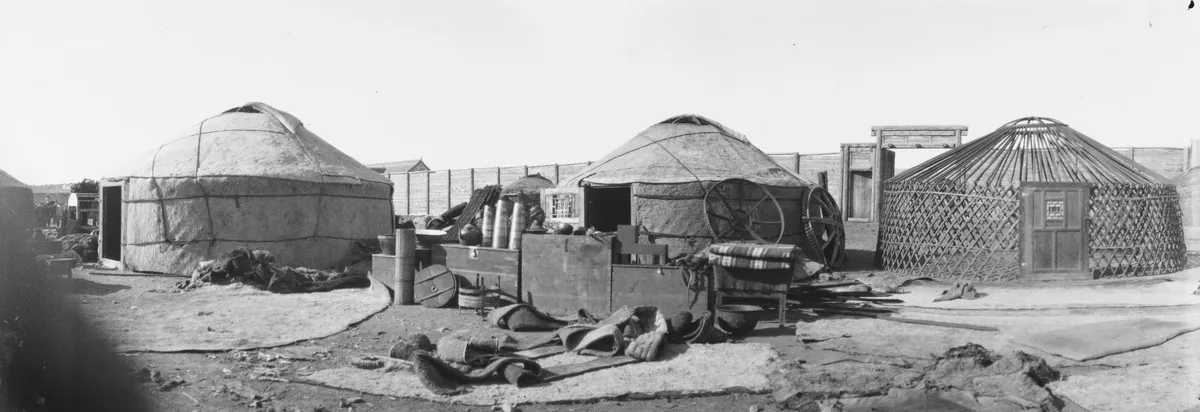
The home moved with the herd. The steppe peoples lived in portable felt tents and carried their goods in covered carts.[47] The horse was the mainstay of the steppe economy.[33] The armies relied on light cavalry with relay horses, and the sources give three to eighteen mounts for each warrior.[48] The Xiongnu fought with the composite bow, which gave them an edge over other nomads.[49] See felt, composite bow and mounted archery.
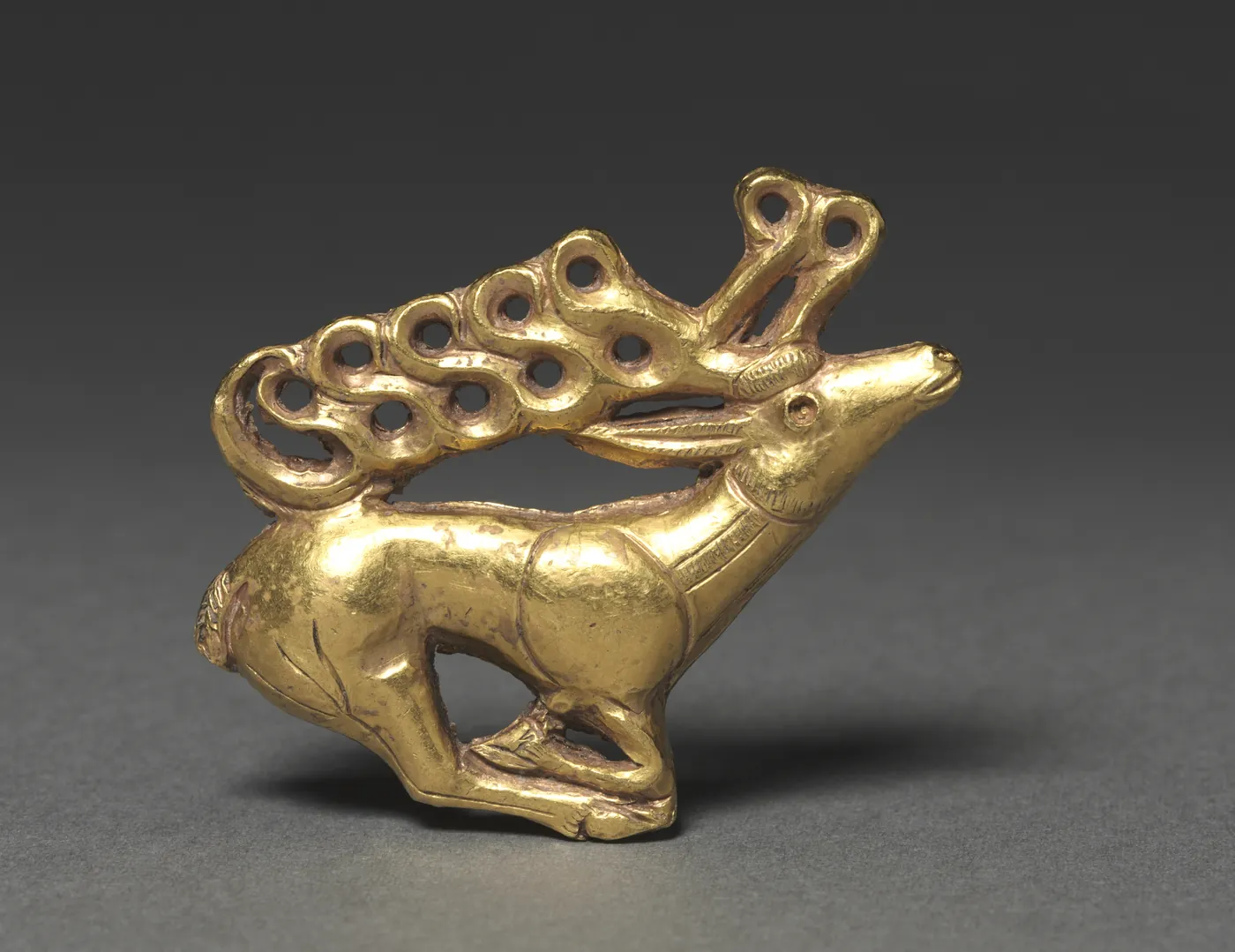
Scythian chiefs were buried under mounds, called kurgans, with their mounted bodyguards.[50] The graves of the aristocracy held gold and silver, and the graves of ordinary people held little.[51] The word kurgan is Turkic and reached the archaeological literature through Russian.[52] Weapons, horse gear and the animal style of art spread across the whole steppe, each region with its own variant.[53] See kurgan.
The Xiongnu ruling class sacrificed twice a year to their ancestors, to Heaven and Earth, and to the gods and spirits.[54] The Orkhon inscriptions of the Göktürks name Tengri, and the cult of the sky god was widespread among the Turkic peoples.[55] Whether the claim to a heavenly mandate came from China or from a shared Inner Asian tradition is not settled.[54] See Tengri and Tengrism.
The nomads knew the pull of settled wealth. The minister Tonyuquq is reported to have advised Bilge Khan against building cities.[42] Mobility made the Göktürks stronger than the Tang, he said, and after a single defeat in a city they would be captured.[42]
History in brief
In the west the Scythians gave way to the Sarmatians.[56] The turmoil that drove the Sarmatians west may have come from the rise of the Xiongnu.[57] In the east the Xiongnu built the first steppe empire.[12] Modu Chanyu took power in 209 BC and defeated the Donghu and the Yuezhi.[58] In a letter of 176 BC he counted all who “live by drawing the bow” as one family.[59] In 198 BC the Han agreed to a heqin treaty.[60] It gave the Xiongnu a princess, yearly gifts of silk, wine and food, and equal status.[60] Han offensives and civil strife broke the empire, and the Southern Xiongnu submitted to China.[61]
After the Xiongnu the Xianbei filled the power vacuum on the Chinese frontier, and the Tuoba Xianbei founded the Northern Wei.[10][62] In the early fifth century the Rouran became masters of the steppe from the Gobi north to Lake Baikal.[63] In the same century the Huns occupied Pannonia, on the Danube.[64] Whether the Huns descend from the Xiongnu is debated.[12]
The Göktürks came next, and in 552 Bumin’s victory over the Rouran made the Ashina the new power of the steppe.[65] They ruled other nomad peoples through tribute and left the local aristocracies in place.[66] Sogdian colonies farmed, made crafts, traded and founded towns on Göktürk land.[44] The Tang took the last khan of the eastern khaganate in 630.[67] Ilterish restored the state in 682 as the Second Göktürk Khaganate, which fell in 744.[67]
The Uyghurs rose on its ruins and held Karluks, Tatars, Khitan, Kirghiz and others in tribute dependence from 744 to 840.[68] In 840 the Kirghiz destroyed the khaganate.[69] In the west the Khazars emerged within the Göktürk order, and after its decline they and the Bulgars contended for the Ponto-Caspian steppes.[70] The Khazar ruling house has been derived from the Göktürks.[71]
The history of the steppe empires is not a single line of development. Continuity was often broken, and successor states often took other directions.[68]
References
- ^ a b Sinor 1990, p. 23
- ^ a b c Golden 1992, p. 3
- ^ a b c Khazanov 1994, p. 95
- ^ Sinor 1990, p. 8-9
- ^ a b c Golden 1992, p. 8
- ^ Khazanov 1994, p. 15-16
- ^ Khazanov 1994, p. 16
- ^ Khazanov 1994, p. 19,21
- ^ Sinor 1990, p. 97
- ^ a b Golden 1992, p. 69
- ^ a b Golden 1992, p. 57-59
- ^ a b c Golden 1992, p. 57
- ^ a b Sinor 1990, p. 34
- ^ a b Sinor 1990, p. 30
- ^ Sinor 1990, p. 4
- ^ Sinor 1990, p. 20,34
- ^ Sinor 1990, p. 35
- ^ Sinor 1990, p. 26
- ^ Khazanov 1994, p. 91
- ^ a b Khazanov 1994, p. 92
- ^ Sinor 1990, p. 83,85
- ^ Khazanov 1994, p. 88-89,95
- ^ a b Golden 1992, p. 46
- ^ Sinor 1990, p. 97-98,107
- ^ Khazanov 1994, p. 46-49
- ^ Khazanov 1994, p. 47,49-50
- ^ Khazanov 1994, p. 50-51
- ^ Khazanov 1994, p. 52-53
- ^ Golden 1992, p. 7-8
- ^ Khazanov 1994, p. 202-203
- ^ Sinor 1990, p. 9
- ^ Khazanov 1994, p. 73
- ^ a b Sinor 1990, p. 8
- ^ Khazanov 1994, p. 224
- ^ Khazanov 1994, p. 222-223
- ^ a b Khazanov 1994, p. 206-207
- ^ a b Golden 1992, p. 4
- ^ Golden 1992, p. 4,7
- ^ Golden 1992, p. 7
- ^ Khazanov 1994, p. 238
- ^ Golden 1992, p. 9
- ^ a b c Golden 1992, p. 10
- ^ Khazanov 1994, p. 231,254-255
- ^ a b Khazanov 1994, p. 256
- ^ a b Golden 1992, p. 11
- ^ Khazanov 1994, p. 146
- ^ Sinor 1990, p. 94-95
- ^ Sinor 1990, p. 10
- ^ Golden 1992, p. 60
- ^ Sinor 1990, p. 100
- ^ Sinor 1990, p. 105
- ^ Khazanov 1994, p. 90
- ^ Sinor 1990, p. 109
- ^ a b Golden 1992, p. 65
- ^ Golden 1992, p. 3,65
- ^ Sinor 1990, p. 107
- ^ Golden 1992, p. 50
- ^ Sinor 1990, p. 120-121
- ^ Golden 1992, p. 61
- ^ a b Sinor 1990, p. 122
- ^ Golden 1992, p. 62
- ^ Khazanov 1994, p. 259
- ^ Golden 1992, p. 77
- ^ Sinor 1990, p. 3
- ^ Zhou Shu (Book of Zhou), juan 50
- ^ Khazanov 1994, p. 255
- ^ a b Jiu Tangshu (Old Book of Tang), juan 194
- ^ a b Khazanov 1994, p. 257
- ^ Khazanov 1994, p. 257-258
- ^ Golden 1992, p. 236
- ^ Golden 1992, p. 237
Sources
- Zhou Shu (Book of Zhou), juan 50
- Jiu Tangshu (Old Book of Tang), juan 194
Literature
- Anatoly M. Khazanov, Nomads and the Outside World (1994)
- Denis Sinor (ed.), The Cambridge History of Early Inner Asia (1990)
- Peter B. Golden, An Introduction to the History of the Turkic Peoples (1992)
What links here2
- Institutions and Titles
- The Economy of the Steppe Empires
Cite this article
Yavuz, Emre-E. “Eurasian Nomads.” Turkic Atlas, revised 8 November 2026. https://turkicatlas.org/ethnicities/eurasian-nomads/
Last revised: 8 November 2026

