
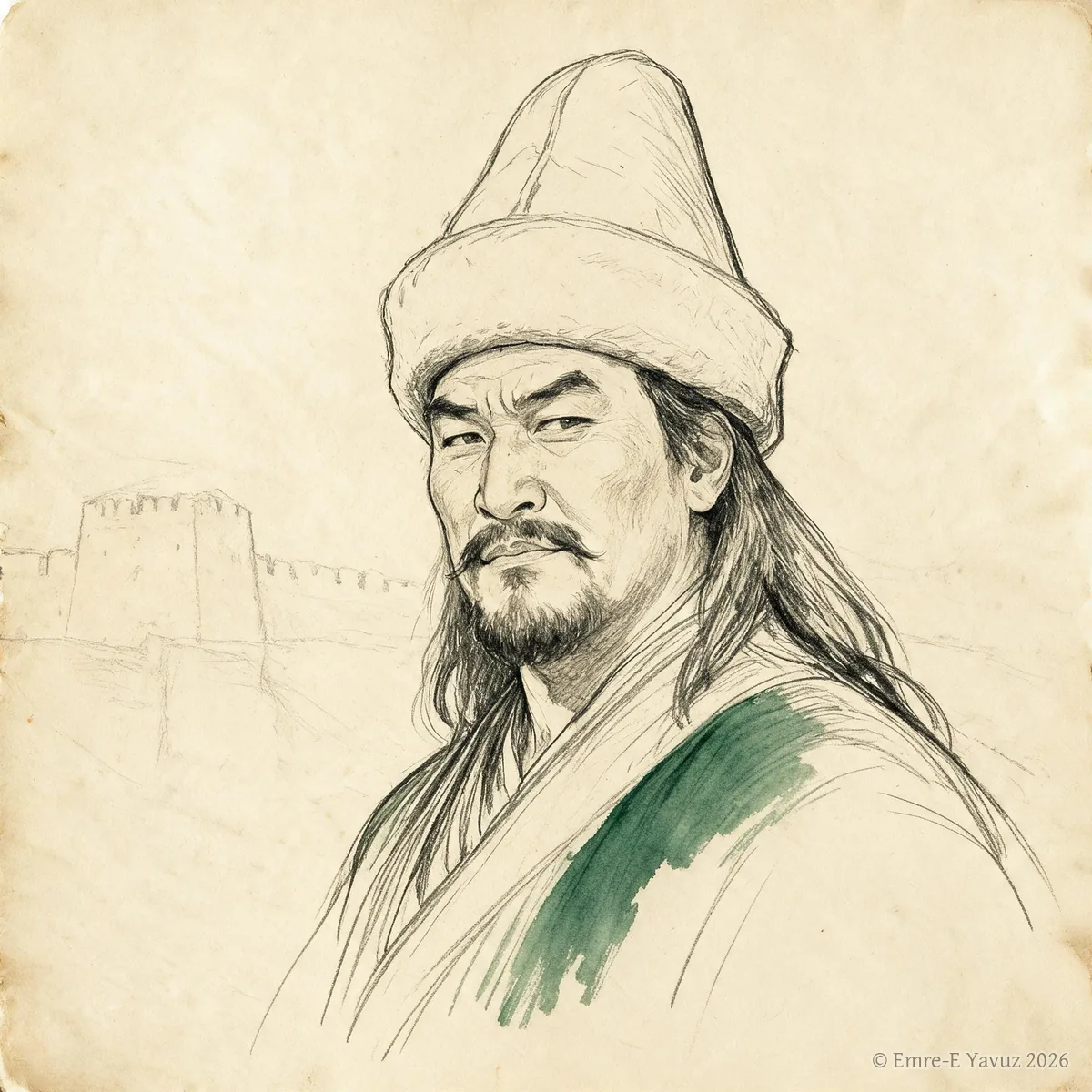
If Kutlug Bilge Kül founded the Uyghur state, his son made it one.
Hold over the Basmıl and the Karluks
The Basmıl and the Karluks had been allies in 744, and by the end of that year they were subjects. They did not accept this arrangement.[1] The Šine-Usu inscription has Bayanchur strengthening the Uyghur hold over both of them. It is his own account, in the first person, of his campaigns and his wars.[1]
The stone names the speaker as Tengride Bolmış İl Etmiş Bilge Kagan and calls Kül Bilge Khan his father. According to its text, his father the khan died after the fighting it describes.[2][3] On one analysis, the element il etmiş means “who has organised the tribes”. The throne name of the first khan of the Second Göktürk Khaganate, El-teriš, is built the same way and means “who gathers the tribes”.[4]
On one interpretation of the stone, the khan dates his campaigns by animal years. In the sheep year, 743 on Ramstedt’s conversion, he marched against Özmiš Tegin, who had become khan. He fought a second battle on the sixth day of the first month and took the khan’s wife there.[5][6] The Tariat stone dates the capture of the khan a year later, to the monkey year, 744.[7] The text goes on to say that in the rooster year the Three Karluks took fright and fled west, where they went over to the On Oq. It names the pig year for a further battle and says that his father the khan died after it.[5][8] In the tiger year, 750 on the same conversion, he marched against the Çik and had his camp and palace built on that ground.[9] It has been asked whether the Çik, whom he subdued and set a tutuq over, were the people from whom the Kimek later came. The Kimek chiefs too bore the title tutuq.[10]
One account of the stone adds the Oguz. His father had put the Nine Oguz under him, and he joined his father’s march against Özmiš with their forces.[11] When he became khan, most of the Oguz turned against him. The stone calls them the Eight Oguz, so that only one tribe stayed loyal.[12] The Oguz joined the Nine Tatars. The khan beat the allies by night in a wood and again the next day. He spared the common people among the prisoners and punished only their leaders.[13]
The inscription credits him with building the Uyghur capital and the imperial palace.[1] On its south side, the palace appears to have been built about the same time as the city itself.[14] On its west side, Bayanchur orders some Chinese and Sogdians to build a city called Bay Balïq on the Selenga, a tributary of the Orkhon. They were presumably to act as supervisors rather than labourers.[15] Work on Bay Balïq began in 757. Karabalghasun was built about the same time.[14] That city, the walled place on the Orkhon later known as Karabalghasun, is what most distinguishes the Uyghur state from the two Göktürk khaganates that preceded it on the same ground.
The Chinese connection
He ruled through the years in which the Tang were nearly destroyed by the An Lushan rebellion. The Uyghur intervention on the Tang side belongs to his reign and his son’s. The Chinese histories treat that intervention at length because it mattered to China. What mattered to the Uyghurs they largely leave out. He ordered his eldest son to give the Tang military service against the rebellion. The rebellion lasted from 755 to 763.[16]
That imbalance is why the Šine-Usu stone matters. It was found in northern Mongolia in 1909 and is covered in runiform Turkic. It is badly worn. Even so, it gives information that exists nowhere else, and it gives it from the inside.[1]
The Chinese marriage and his death
His katun was the princess of Ningguo, a daughter of the emperor Suzong. It was considered a great honour that the emperor gave a foreign ruler one of his own daughters. Suzong was the first Tang emperor to do so.[17] When the khan died in 759, the Uyghur court asked that she be buried with him, as the khan’s wives were.[18] She refused. She calmed the courtiers by slashing her face, an ordinary sign of grief.[18] She went back to China in 759.[17] The younger princess of Ningguo had escorted her to Karabalghasun and had become the khan’s concubine. She was made the katun of his successor.[17][19]
The first marriage between the two courts came in 756, when Bayanchur offered a daughter to a member of the Tang house. The court chose Li Chengcai, a prince’s son who had come to the Uyghurs as envoy. The khan gave the younger sister of his katun the standing of a daughter, so that she could marry him.[20][21] In 758 Suzong named his youngest daughter Princess Ningguo and sent her north. His envoy Li Yu, Prince of Hanzhong, carried the decree that conferred the title Yingwu Weiyuan Bilge Khan on the khan.[20] At the khan’s tent he asked Li Yu how he was related to the emperor. He then asked who stood above him. Li Yu named the eunuch Lei Luqun. The khan said that a eunuch is a slave and has no right to stand above an envoy. Lei Luqun jumped back in fear. The khan asked why Li Yu did not bow. Li Yu answered that Ningguo was the emperor’s own daughter, not a clan princess as in earlier marriages. The khan was therefore the emperor’s son-in-law and should stand to receive the decree. The khan rose and received the title.[22] Modern accounts take the exchange as a sign that both courts treated each other as equals.[23]
The succession
His second son followed him in 759.[24] He took the state to the height of its power and to the decision that changed it: the adoption of Manichaeism.[22] The second son succeeded only because the elder was dead. This suggests that the Uyghurs followed primogeniture.[25]
The four years in his own words
The Tariat inscription was found in 1970. At the time when the Chinese material was first worked through, it was not known. It gives what no other source gives: the fall of the Göktürk state, told year by year by the man who commanded the army that brought it down.[26]
In the snake year, 741, he was appointed commander of a thousand. He threw the Göktürk realm into disorder. His father was khan at the time.[26] In the monkey year, 744, he marched and fought. He took the khan and captured his katun.[7] The cock year brought a further claimant. In 746 he brought the Basmıl under his rule. He sent the Three Karluks fleeing west to the Ten Arrows. In 747 nine ministers, a thousand commanders and the common people came to his father the khan.[27]
In the mouse year, 748, he was named khagan at the burial ground of the ancestors. His full title was Tengride Bolmış İl Etmiş Bilge Kagan. His wife was named İl Bilge Katun.[27] He set up his camp in the middle of the Ötüken, west of the holy summit of Süngüz Başkan.[27]
That year does not agree with the Chinese histories. They put his accession in 747.[22] The disagreement is between a khan’s own monument and a foreign chancery. Under the inscription, Turkic Atlas sets it out. Other works give his reign as 745 to 759 or as 746 to 759, without saying why the count starts earlier.[28][29]
References
- ^ a b c d Šine-Usu inscription
- ^ Tekin 2003, p. 227–228
- ^ Orkun 1994, p. 163
- ^ Tekin 2003, p. 97
- ^ a b Tekin 2003, p. 228
- ^ Orkun 1994, p. 166–167, 184
- ^ a b Saadettin 1995, p. 72
- ^ Orkun 1994, p. 166
- ^ Orkun 1994, p. 171
- ^ Sümer 1972, p. 31–32
- ^ Sümer 1972, p. 19
- ^ Sümer 1972, p. 20
- ^ Sümer 1972, p. 20–21
- ^ a b Sinor 1990, p. 337
- ^ Sinor 1990, p. 321
- ^ Sinor 1990, p. 317
- ^ a b c Sinor 1990, p. 325
- ^ a b Sinor 1990, p. 326–327
- ^ Jagchid 1989, p. 159
- ^ a b Jiu Tangshu (Old Book of Tang), juan 195; Xin Tangshu (New Book of Tang), juan 217
- ^ Jagchid 1989, p. 157
- ^ a b c Jiu Tangshu (Old Book of Tang), juan 195
- ^ Jagchid 1989, p. 158
- ^ Kwanten 1979, p. 309
- ^ Sinor 1990, p. 324
- ^ a b Saadettin 1995, p. 71
- ^ a b c Saadettin 1995, p. 73
- ^ Rásonyi 1993, p. 106
- ^ Orkun 1994, p. 184
Sources
- Jiu Tangshu (Old Book of Tang), juan 195
- Xin Tangshu (New Book of Tang), juan 217 (after Jiu Tangshu)
- Šine-Usu inscription
- Tariat inscription
Literature
- Colin Mackerras, The Uighur Empire According to the T'ang Dynastic Histories (1972)
- Peter B. Golden, An Introduction to the History of the Turkic Peoples (1992)
- Emre-E. Yavuz, The Gokturk Empire: 2nd Edition (2025)
- Gömeç, Saadettin, Terhin Yazıtı'nın Tarihi Açıdan Değerlendirilmesi (1995)
- Denis Sinor (ed.), The Cambridge History of Early Inner Asia (1990)
- Talât Tekin, Orhon Türkçesi Grameri (2003)
- Hüseyin Namık Orkun, Eski Türk Yazıtları (1994)
- Faruk Sümer, Oğuzlar (Türkmenler). Tarihleri, boy teşkilâtı, destanları (1972)
- Sechin Jagchid; Van Jay Symons, Peace, War, and Trade Along the Great Wall. Nomadic-Chinese Interaction through Two Millennia (1989)
- Luc Kwanten, Imperial Nomads. A History of Central Asia, 500–1500 (1979)
- László Rásonyi, Tarihte Türklük (1993)
What links here22
- Persons
- Kutlug Bilge Kül Khan
- Battles & Events
- Uyghur victory over the Kirghiz (758)
- Places
- Bay Balïq · Kögmen · Ordu-Balık · Orkhon valley · Ötüken
- Institutions and Titles
- Chur · Gold and Silver Vessels as Tang Gifts to the Uyghurs · Uyghur Farming · Women among the Turkic Peoples
- Religions
- Sacred Mountains · Water Cult
- Customs & Pastimes
- Seating at the Feast
Cite this article
Yavuz, Emre-E. “Bayanchur Khan.” Turkic Atlas, revised 8 November 2026. https://turkicatlas.org/persons/bayanchur-khan/
Last revised: 8 November 2026

