
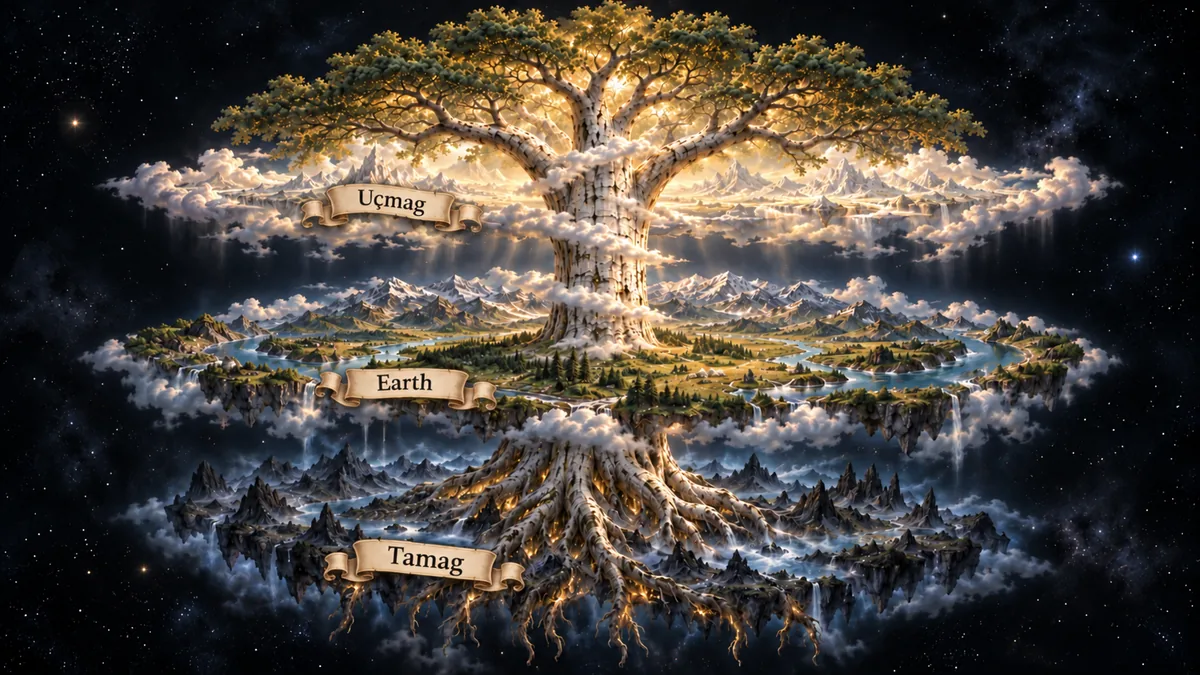
The three worlds are the upper, middle and lower realms through which many modern accounts explain Turkic cosmology. The upper world contains celestial beings. The middle world is inhabited by people. The lower world is associated with the dead and underworld powers. This model draws heavily on traditions recorded among the Turkic peoples of the Altai and Siberia in the modern period. Its application to the Göktürks depends on how those later traditions are connected to the earlier evidence.
The Kül Tegin inscription names the sky above and the earth below, with humanity between them.[1] It does not describe a separate subterranean realm in this passage. The formula therefore provides no direct account of the three worlds familiar from later ethnography.[2]
Sky and earth in the inscriptions
The Kül Tegin inscription begins with the formation of sky, earth and humanity. Its terms establish a spatial relationship: üze means above, asra below, and ekin ara between the two.[1] The earth below is not identified as an underworld inhabited by the dead.[3]
Sky and earth also appear in passages concerning the survival of the Göktürk realm. One asks who could destroy the realm and its law unless the sky collapsed or the earth gave way. Another associates disorder between sky and earth with hostility among the Khan’s people.[1] These passages connect cosmic order with political order. Their purpose is to explain the position and fortunes of the realm, rather than to catalogue every region of the cosmos.[4]
Eastern orientation
The sources also describe the importance of the east. According to the Zhou Shu, the Khan’s tent faced the rising sun as an expression of reverence.[5] In the Kül Tegin inscription, east is the direction in front. The vocabulary of movement also associates forward and backward with east and west.[1]
These references show how direction entered ritual and political language. They concern orientation across the earth and do not determine whether the Göktürks also imagined realms above or beneath it.
Later traditions
Ethnographic accounts from the Altai and Siberia describe heavens divided into several levels and a lower world beneath the earth.[6][7][8] Seven and nine occur among the recorded counts. The arrangements vary between traditions.[9] Accounts of the world tree, journeys undertaken by the kam, and Erlik as an underworld ruler belong to this broader material.[10]
These traditions supply much of the detail used in modern descriptions of the three worlds. Their later recording does not establish when each belief arose. Connecting a particular feature to the Göktürk period requires evidence for that connection.
According to one modern account, the lower layer entered the Turkic cosmos only later, under the influence of shamanism. On this account, the older scheme was sky, earth and mankind.[11]
Death and the underworld
The Kül Tegin inscription uses expressions of flying away for death.[1] Such language can suggest departure or ascent. By itself, it does not identify a destination or describe a system of heavenly levels.
The absence of an explicit underworld in the passages discussed here limits what can be reconstructed from them. It does not establish that every Göktürk community lacked such a belief.[4] The relationship between the inscriptions and the later three-world traditions remains a question of historical continuity.
References
- ^ a b c d e Kül Tegin inscription
- ^ Dallos 2004, p. 77; 62, 67; Şen 2018, p. 77; 62, 67
- ^ Dallos 2004, p. 77
- ^ a b Dallos 2004, p. 78
- ^ Zhou Shu (Book of Zhou), juan 50
- ^ Radloff 1893 (zweite Ausgabe), p. 3,6
- ^ Radloff 1884, p. 361–362
- ^ Holmberg 1927, p. 340,404–406
- ^ Şenesen 2024, p. 1524–1525
- ^ Şenesen 2024, p. 1523–1524; 62; Şen 2018, p. 1523–1524; 62
- ^ Şen 2018, p. 61–62
Sources
- Kül Tegin inscription
- Bilge Khan inscription
- Zhou Shu (Book of Zhou), juan 50
- Sui Shu (Book of Sui), juan 84
Literature
- Emre-E. Yavuz, The Gokturk Empire: 2nd Edition (2025)
- Uno Harva, Die religiösen Vorstellungen der altaischen Völker (1938)
- Abdülkadir İnan, Tarihte ve Bugün Şamanizm: Materyaller ve Araştırmalar (2017; first edition 1954)
- Edina Dallos, Shamanism or Monotheism? Religious Elements in the Orkhon Inscriptions (2004)
- Ali Ahmetbeyoğlu, Hüseyin Şen, Eski Türk Dininin Kozmolojisi ve Kozmogonisi (2018)
- İsmail Şenesen, Tengri İnancında Üç Dünya İle İlgili Ritüeller (2024)
- Wilhelm Radloff, Aus Sibirien. Lose Blätter aus meinem Tagebuche. Zweiter Band (1893 (zweite Ausgabe))
- Wilhelm Radloff, Aus Sibirien. Lose Blätter aus meinem Tagebuche. Erster Band (1884)
- Uno Holmberg (Harva), The Mythology of All Races, Volume IV: Finno-Ugric, Siberian (1927)
What links here3
- Religions
- Shamanism · Turkic Mythology
Cite this article
Yavuz, Emre-E. “The three worlds.” Turkic Atlas, revised 8 November 2026. https://turkicatlas.org/religions/three-worlds/
Last revised: 8 November 2026

