
- 400
- 500
- 600
- 700
- 800
- 900
- Rouran 400–554
- First Göktürk 552–630
- Tang rule 630–682
- Second Göktürk 682–744
- Uyghur 744–840
- Kirghiz 840–924
- Huns 370–469
- Western Göktürk 552–659
- Türgesh 699–766
- Karluk 766–800
- Khazar 650–969
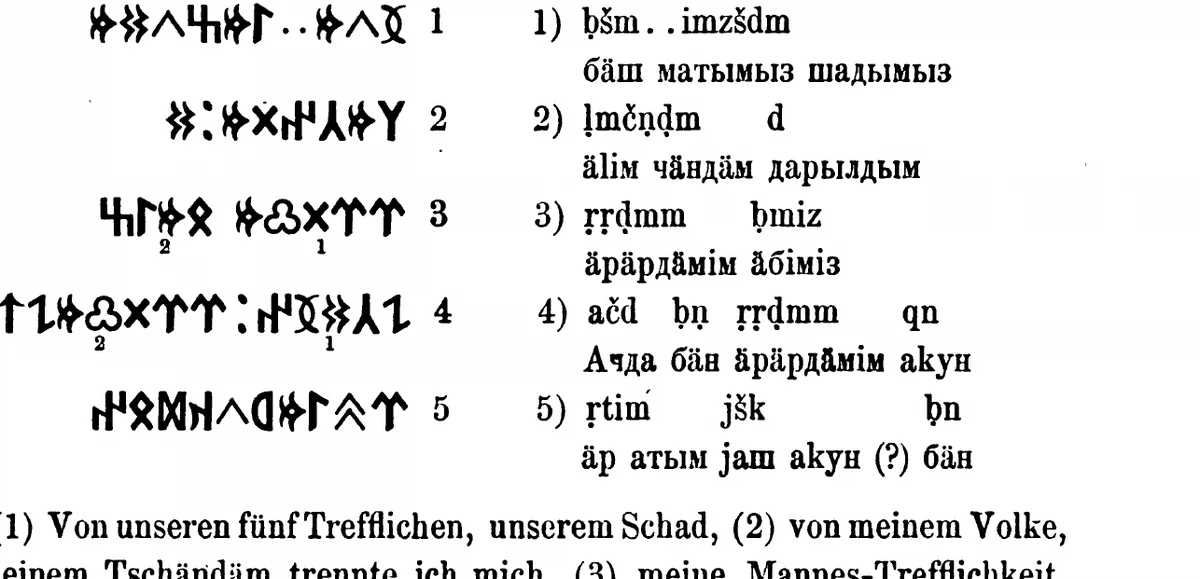
The Yenisei inscriptions are the runiform texts cut on stone along the upper Yenisei, in Tuva, the Minusinsk basin and Khakassia.[1] More than 150 monuments are counted. They belong to the time of the Kirghiz state.[1] A count of 1993 gives more than 160 inscriptions found on the Yenisei since the 1720s.[2] A list of 2011 runs from E 1 to E 154. It adds about twenty unnumbered pieces, among them rock inscriptions, silver vessels, bronze mirrors and coins. It puts the number at about 250.[3] A journey of 1991 to Khakassia and Tuva found five more.[4] Most are epitaphs on stelae at the graves of the medieval nobility. Beside them stand short texts. Some commemorate an event, some mark a stage on a road, some name the owner of an object, and some record that a visitor came to a place of worship.[1][5]
The script
The Kirghiz wrote the Old Turkic runiform script, the script of the Orkhon stones. The Yenisei texts show it in a regional variety.[6] The Kirghiz did not write the script that was then spreading among the Uyghurs and that the Mongols took over later.[6] That script, the Uyghur script, descends from Sogdian.
The Xin Tangshu says of the Kirghiz that their writing and their language are exactly those of the Uyghurs.[7] The sentence does not mean the Uyghur script, which was only beginning to spread among the Uyghurs themselves at that time. It means the older script, to which the Orkhon inscriptions gave the key.[6] The many inscriptions of the Yenisei basin show that the Kirghiz knew this script.[6]
The stones were known long before the Orkhon monuments and could not be read. In July 1675 Nicolae Milescu, a Romanian from Moldavia in Russian service, travelled to the Chinese court as the tsar’s envoy. His diary describes a steep cliff above the Yenisei. The cliff bears writing that nobody could read, and figures of men holding staffs.[8][9] In the early eighteenth century the geographer Semion Remezov announced such “runiform stones” to Swedish scholars.[10] The German scholar Daniel Gottlieb Messerschmidt, who explored Siberia for Peter the Great, found an inscribed stele in the Uibat valley in 1721.[10] In 1722 the Swedish officer Philipp Johann von Tabbert-Strahlenberg found three inscribed pillars between the Erba and the Tes. In 1730 he published copies of both finds.[11] A later summary dates both finds to 1721 and names the stones Uibat I and Uibat III.[2] The letters were called runes, after the Scandinavian runes they resembled.[12] They became readable when the Orkhon stones supplied the key to the script.[6] Vilhelm Thomsen deciphered the Orkhon script in 1893.[13] Wilhelm Radloff then attempted a translation of the Yenisei texts.[14]
The rougher and more varied letter forms of the Yenisei, Tuva and Altai inscriptions are not taken as a sign of greater age. They are explained by their place on the edge of the writing area.[15]
A second alphabet
Beside the Yenisei alphabet, scholars know a second runiform alphabet from the Sayan–Altai uplands. They call it South Yenisei. Seventeen short texts in Khakassia and Tuva use it. They are cut on rock faces, on stelae and a menhir, and on objects found in graves.[16] It has a full set of letters of its own.[17] Of fifty-six sign forms compared with the Yenisei alphabet, thirty-two show a likeness and fourteen agree fully.[18] The authors who compared them say that the likeness does not prove a common descent.[19]
The graves and stelae that bear the texts place them between the eighth and the tenth century. None of the texts gives a date.[20] None has been read with confidence.[21] The same authors tie the alphabet to the Göktürks of Tuva on the evidence of the graves and stelae. They add that the texts name no people and that the script need not have had a single bearer.[22]
Content of the epitaphs
The epitaphs speak in the voice of the dead. They express grief over a life not fully enjoyed. They name the deeds of the man in the grave.[1] Two stones show how much a short text can carry.
The two stelae found in 1878 near Lake Altyn-köl in Khakassia tell of a man named Bars of a khan’s family, killed in an unequal battle. The stelae may belong to Bars Beg, the first Kirghiz khagan, who fell in 711 in battle with the Göktürks.[1] A different explanation takes them for monuments of twin siblings of the Bars, the ruling clan of the Kirghiz. It dates them to the end of the ninth century on the letter forms.[23]
One editor reads a stone from the Uibat valley, found in the early 1960s, as a lament for a beg named Tirig Beg.[24] Reports give the year of the find as 1963 or 1964.[25] In the third line this editor reads that Tirig Beg took the league of the Üč-Kurıqan. He went as envoy to the Göktürks. He also killed units of a pack of grey wolves. The same editor dates the stone to the first half of the eighth century.[24] A second editor reads the third line with an Uyghur khan in the place of the league, [küç] uyγur kan yärin aldukda.[26] Both versions keep the comparison with a boar and the name Tirig Beg.[26] They name different enemies. The dating of the stone therefore depends on which is right.
Three Tuvan epitaphs contain the words tokuz ogdamdam. The words may be the name of a people, “the Nine Ogdamdam”, on the model of the Nine Oguz and the Nine Tatar. An older explanation translates them as “nine wounds”.[27]
The attribution to the Kirghiz
No inscription of the corpus names the Kirghiz. Almost all are grave inscriptions with no historical information. The word Kirghiz does not occur in them.[6] Radloff assigned most of the stones to the Kirghiz only because, according to the sources, Kirghiz lived on the Yenisei.[6]
Two further points support the assignment. First, the tamgas cut on the stones match the property marks that the Kirghiz clans of the Tuvans and the Khakas used into the twentieth century.[8] In Tuva more than forty of some sixty epitaphs bear one of five tamga types. The types fall into a western and an eastern group. The groups follow the valleys.[28] The monuments of Tuva lie along some 200 kilometres.[29] Second, in Tuva there are more cremation graves of the ninth and tenth centuries with runiform epitaphs than in the Minusinsk basin.[30][31]
The upper Yenisei basin is also reckoned the domain of the Chik tribes beside the Kirghiz.[32]
Dating
No inscription bears a date. The Kirghiz kept the twelve-animal cycle, however: the Xin Tangshu reports that they named the year by it, so that a year in the tiger position was called the year of the tiger.[7] The cycle would have served for a date. It is remarkable that no stone uses it.[6]
Radloff put the stones in the seventh century, for the most part in its second half. One inscription says that the dead man went to the Chinese emperor at the age of seven. Radloff held that this could not have happened before 648, the year of the first Kirghiz embassy to China.[6] Sergey Malov said in Baku in 1926 that they were two to three centuries older than the Orkhon stones. That is the less likely of the two placements.[6]
Within the corpus the single datings already reach across several centuries. Some put the Altyn-köl stelae at 711. Others put them at the end of the ninth century.[33] Depending on the reading of its third line, the Uibat stone is put in the first half of the eighth century.[34] The Begre stele is put in the second half of the ninth.[35] The corpus is therefore not one monument with one date. Where a stone is not dated, its placement rests on content, letter forms or the mound beside it.[36]
Preservation
Some rock inscriptions on the upper Yenisei have been lost since they were first copied. In one cave an earthquake destroyed them. Others lie below the water of the Yenisei reservoir.[37]
Language
There are three theories about the language of the Yenisei epitaphs. The first holds that the Yenisei monuments were written in the single literary language of the Old Turkic world of the eighth and ninth centuries, the language of the Orkhon stones.[8] The second sees in the language of the epitaphs a neighbouring dialect. The third regards it as the ancestor of the Kirghiz material of later centuries. Because the texts are short, formulaic and mostly undated, the question remains open. Old Turkic treats the question further.
Two features of the texts can be set against the Orkhon stones. The future in -gAy, which the Orkhon stones do not have, occurs in some Yenisei inscriptions.[38] Some inscriptions of the Yenisei area are also more explicit than most runiform texts in having special letters for the vowels e and ä. Most runiform texts write ä with the letter used for a.[39]
Reliability
For the years 840 to about 924 the corpus gives little that can be fixed. No stone is dated, and none names the Kirghiz. The runiform text that may point to the war with the Uyghurs stands in Mongolia, not on the Yenisei: the Suji inscription.[40]
What the stones give is the Kirghiz account of their own order. The begs, to whom the epitaphs are dedicated, were the ruling class. Their power rested on retinues of hereditary warriors. They served their el, whose head was a khagan.[41] The Chinese histories describe the Kirghiz from outside. The stones give their own voice. It is the voice of the dead.
References
- ^ a b c d e Butanaev 2015, p. 5
- ^ a b Sertkaya 1993, p. 67
- ^ Erhan 2011, p. 5, 6–10
- ^ Sertkaya 1993, p. 68
- ^ Kızlasov 1990, p. 85–87, 104–105
- ^ a b c d e f g h i j Barthold 1927, p. 22
- ^ a b Xin Tangshu (New Book of Tang), juan 217
- ^ a b c Butanaev 2015, p. 4
- ^ Constantin 1985, p. 3
- ^ a b Constantin 1985, p. 1
- ^ Constantin 1985, p. 2
- ^ Tekin 1968, p. 12
- ^ Thomsen 1896
- ^ Tekin 1968, p. 13–14
- ^ Vásáry 1993, p. 53
- ^ Kızlasov 1990, p. 104–105, 109–116, 129
- ^ Kızlasov 1990, p. 129
- ^ Kızlasov 1990, p. 122
- ^ Kızlasov 1990, p. 124
- ^ Kızlasov 1990, p. 124–125
- ^ Kızlasov 1990, p. 127–128
- ^ Kızlasov 1990, p. 131–133
- ^ Kormuşin 2013, p. 11–12
- ^ a b Butanaev 2015, p. 6–8
- ^ Butanaev 2015, p. 6–8; 16; Aydın 2007, p. 6–8; 16
- ^ a b Aydın 2007, p. 16
- ^ V. 2000, p. 259–261
- ^ V. 2000, p. 258–259
- ^ V. 2000, p. 259
- ^ Savinov 1978, p. 212
- ^ V. 2000, p. 257, 261
- ^ Erdal 2004, p. 7
- ^ Butanaev 2015, p. 5; 12; Kormuşin 2013, p. 5; 12
- ^ Butanaev 2015, p. 8
- ^ Tishin 2019, p. 200
- ^ Kormuşin 2013, p. 11; 124; Kızlasov 1990, p. 11; 124
- ^ Sertkaya 2000, p. 313
- ^ Erdal 2004, p. 10
- ^ Erdal 2004, p. 42–43
- ^ Butanaev 2015, p. 9–10
- ^ Butanaev 2015, p. 12
Sources
- Yenisei inscriptions
- Xin Tangshu (New Book of Tang), juan 217 (after Jiu Tangshu)
Literature
- V. V. Barthold, Kirgizy: istoričeskij očerk [Киргизы: исторический очерк] (1927)
- V. Ja. Butanaev, Literaturnoe nasledstvo enisejskich kyrgyzov vremën drevnetjurkskich kaganatov [Литературное наследство енисейских кыргызов времён древнетюркских каганатов] (2015)
- V. V. Tishin, K datirovke enisejskoj runičeskoj nadpisi Begre (E 11) [К датировке енисейской рунической надписи Бегре (Е 11)] (2019)
- D. G. Savinov, Etnokul'turnye svjazi enisejskich kyrgyzov i kimakov v IX–X vv. [Этнокультурные связи енисейских кыргызов и кимаков в IX–X вв.] (1978)
- Wilhelm Radloff, Die alttürkischen Inschriften der Mongolei (1894–1895, parts 1–3)
- Vilhelm Thomsen, Inscriptions de l'Orkhon déchiffrées (1896)
- Marcel Erdal, A Grammar of Old Turkic (2004)
- Talât Tekin, A Grammar of Orkhon Turkic (1968)
- Gh. I. Constantin, Yenisey Eski Kırgız Yazıtlarının İlk Zikri: Çin'e Giden Romen Seyyahı Nicolaie Milesco (Spathary)'nin Günlüğü – 1675 (1985)
- Leonid R. Kızlasov; İgor L. Kızlasov, Sayan-Altay Türklerinin Yeni Runik Yazısı (1990)
- Osman Fikri Sertkaya, Yenisey Yazıtlarının Yayınlarındaki Bazı Okuma ve Anlamlandırmaların Düzeltilmesi, Yeni Okuma ve Anlamlandırma Teklifleri (1993)
- István Vásáry, Doğu Avrupa'nın Runik Alfabe Sistemleri Üzerine (1993)
- Kormuşin, İgor V., Kuzey Tuva Öğök-Turan Vadisindeki Göktürk Anıtlarının Bazı Özellikleri (2000)
- Osman Fikri Sertkaya; Sartkocaulı Harcavbay, Hoyto Tamir (Moğolistan)’dan yeni yazıtlar (ön neşir) (2000)
- Erhan Aydın, Uybat VI (E98) Yazıtında Geçen Azıglıg Kelimesi Üzerine Bir Anlamlandırma Denemesi (2007)
- İgor Kormuşin (Igor V. Kormushin), Türk Runik Yazısının Yenisey Değişkesinin Orhun ve Doğu Türkistan’daki Benzerleriyle Münasebetleri (2013)
- Aydın, Erhan, Yenisey Yazıtlarında Geçen Unvanlar ve Unvan Niteleyicileri (2011)
Articles resting on this source 6
Altın Köl Inscriptions · Çigşi · Er At · Kunçuy · Saŋun · Terken
What links here14
- Peoples
- History of the Turkic peoples · Kurykan
- Languages
- The Old Turkic script
- Customs & Pastimes
- Culture of the Turkic Peoples · Er At
Cite this article
Yavuz, Emre-E. “Yenisei inscriptions.” Turkic Atlas, revised 8 November 2026. https://turkicatlas.org/sources/yenisei-inscriptions/
Last revised: 8 November 2026

