
- 400
- 500
- 600
- 700
- 800
- 900
- Rouran 400–554
- First Göktürk 552–630
- Tang rule 630–682
- Second Göktürk 682–744
- Uyghur 744–840
- Kirghiz 840–924
- Huns 370–469
- Western Göktürk 552–659
- Türgesh 699–766
- Karluk 766–800
- Khazar 650–969
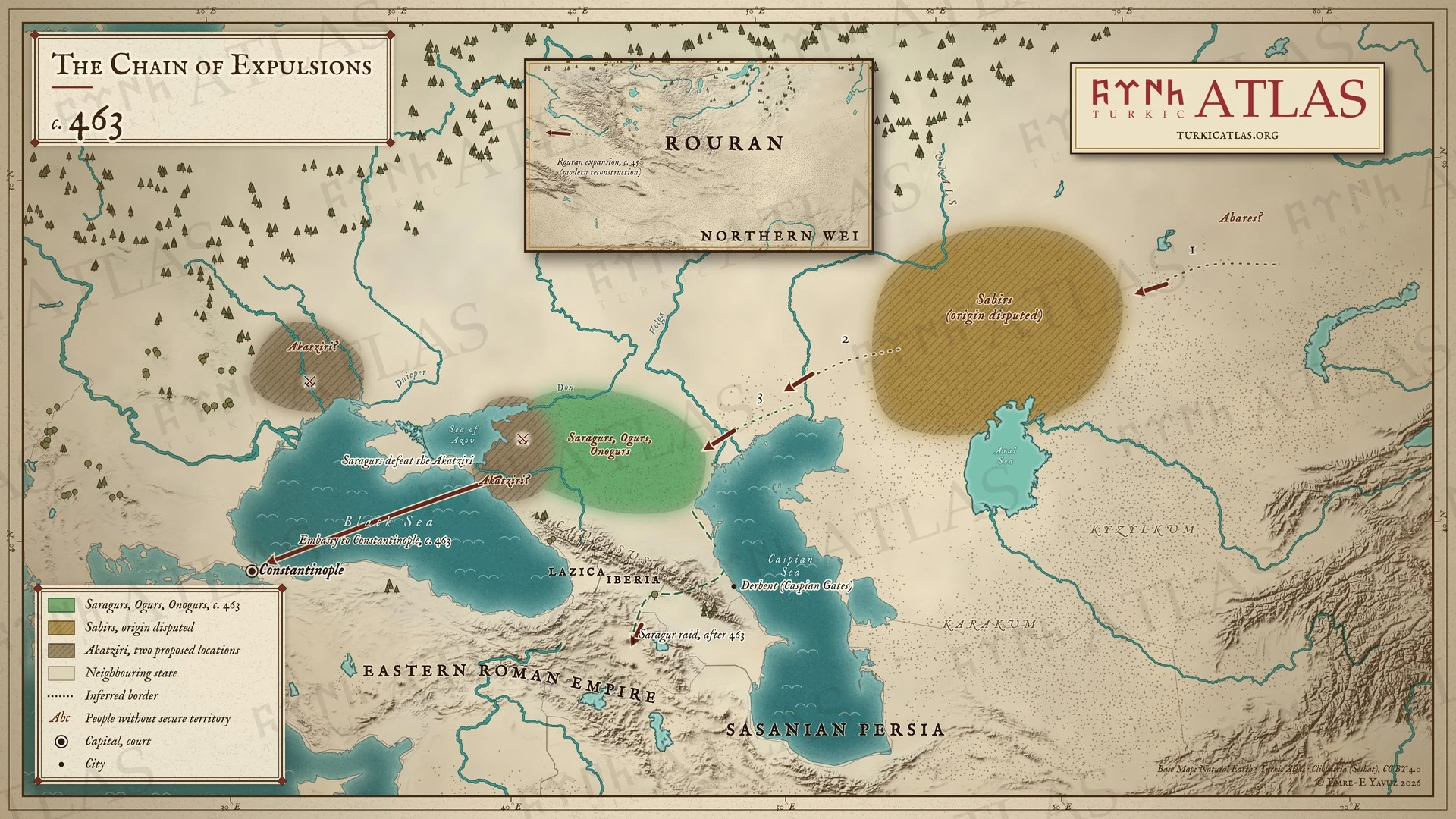
The Saragurs were an Oguric people who appeared on the steppe north of the Black Sea about 463. Priscus tells that the Saragurs, the Urogi and the Onogurs sent envoys to Constantinople. The Sabirs had driven them from their lands. The Avars had driven out the Sabirs. The Avars in turn had been expelled by peoples living on the shore of the Ocean, fleeing from sea mists and a multitude of griffins. The Saragurs, looking for new homes, came to the Akatziri. They defeated them in many battles and asked the Romans for an alliance. The emperor received their envoys kindly and sent them home with gifts.[1] The griffins are a mythical detail taken from Herodotus. The peoples are historical.[2] Some scholars conjecture that the Saragurs, the Ogurs and the Onogurs were part of the western Tiele.[2] Others look for the start of the whole movement north or north-east of the Altai, or perhaps no farther away than the Aral Sea.[3]
In the Latin of the edition, the Saragurs then led an army against Persia together with the Akatziri and other peoples. They found a Persian garrison at the Caspian Gates and turned aside. They ravaged the land of the Iberians and raided the towns of the Armenians.[4] Modern accounts read the name as Oguric, with sara meaning white. The Saragurs may have attacked Persian Transcaucasia at the prompting of Constantinople. Beyond these notices nothing is known of them, and they were probably absorbed into stronger tribal unions.[5] The internal troubles that kept Attila’s son Ernak from war about 466 were presumably with the Saragurs.[6]
References
Sources
Literature
- Karl Müller (ed.), Fragmenta Historicorum Graecorum, Bd. IV (darin: Menandri Protectoris fragmenta, griechisch mit lateinischer Übersetzung) (1851)
- Peter B. Golden, An Introduction to the History of the Turkic Peoples (1992)
- Otto J. Maenchen-Helfen, The World of the Huns: Studies in Their History and Culture (1973)
- E. A. Thompson, A History of Attila and the Huns (1948)
What links here3
- Peoples
- Sorosgi · Turkic Tribes in Europe
- Sources
- Priscus
Cite this article
Yavuz, Emre-E. “Saragurs.” Turkic Atlas, revised 8 November 2026. https://turkicatlas.org/ethnicities/saragurs/
Last revised: 8 November 2026

