
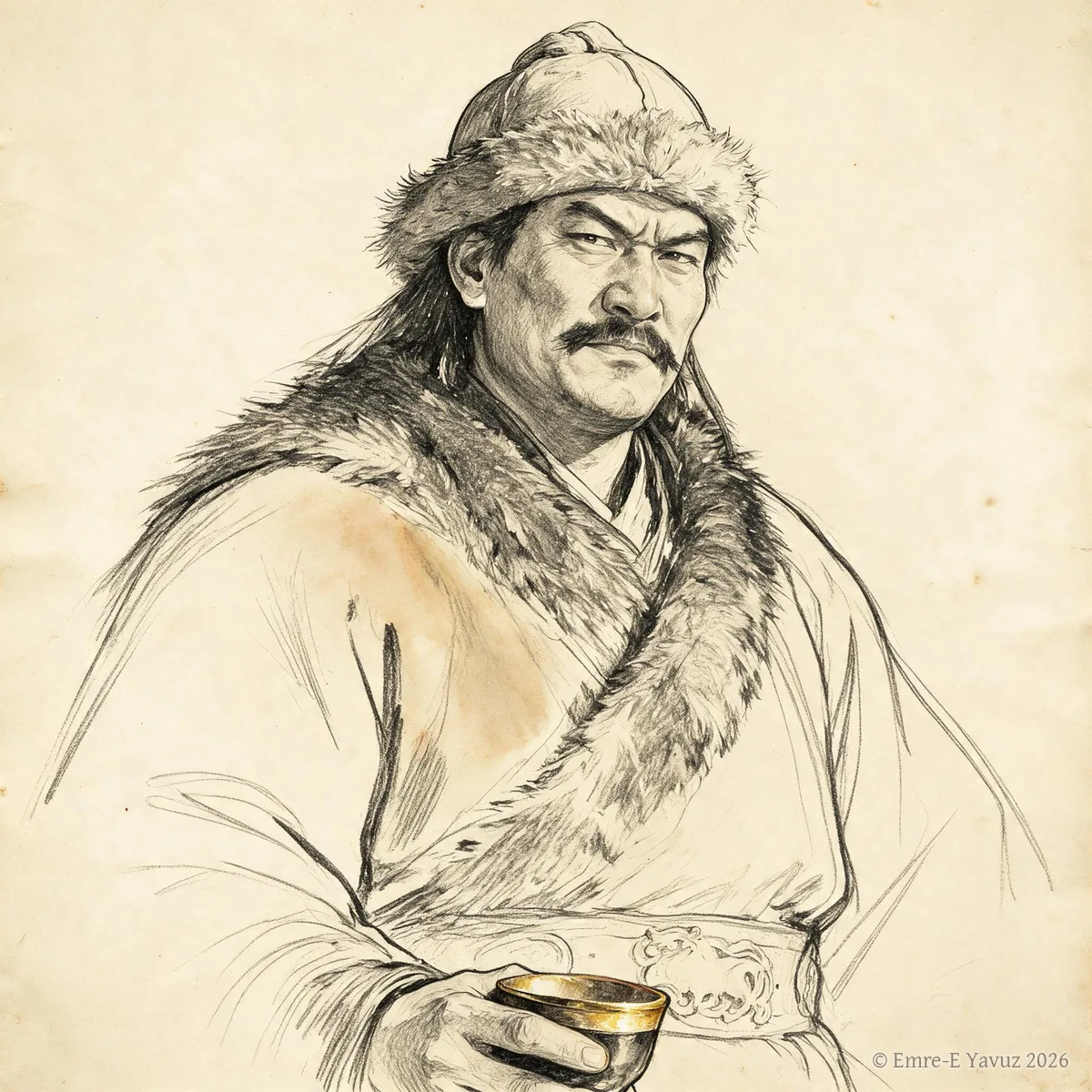
Laoshang inherited the empire his father had made and spent his reign proving that it could be held. He destroyed the Yuezhi king. He drove the Yuezhi people west out of the corridor between the Qilian and Dunhuang. In 166 BC he rode to within sight of the imperial parks outside Chang’an.[1] His personal name was Jiyu. Laoshang is the title, and the Shiji uses it throughout.[1] Laoshang can be rendered as “old and superior” and understood as a title beside the personal name. This leaves open whether it was instead a name given after death.[2]
The Yuezhi
Bagatur had defeated the Yuezhi, and they were defeated again under his son. According to the Shiji, Laoshang killed their king. He made the king’s head into a drinking vessel.[3][4] The Han Shu names the cup among the vessels drunk from at the oath sworn on Mount Nuoshui a century later. This means that the cup was still in use at the Xiongnu court in 43 BC.[5] The Yuezhi went far west. Their movement carried them through the Ili valley and eventually into Bactria.[6] The resulting displacement began the chain of events that later produced the Kushan state. It is also the clearest case in the period of a steppe defeat that rearranged the map of a region the victors never entered. Another dating puts the Yuezhi departure from the Dunhuang country to the Ili not in Laoshang’s reign but in his father’s western campaign of 177 to 176 BC.[7] A third account has the Yuezhi split in two after a late defeat under Bagatur. The Great Yuezhi settled in the Ili valley, and the Small Yuezhi settled among the Qiang of the Qilian mountains. In 162 BC Laoshang attacked the Great Yuezhi again and killed their king. He attacked together with the Wusun, whom the Xiongnu had just subdued. The Wusun then took the Ili valley, and the Great Yuezhi went on west to the south of Sogdiana.[8]
Zhonghang Yue
At his accession the Han sent another princess. With her went a eunuch of Yan named Zhonghang Yue. He did not wish to go and was forced to. Before he left he said that if he must go, he would be a plague to the Han. He arrived, went over to the chanyu and was taken into high favour.[1]
What the Shiji then reports of him is the most explicit statement of steppe economic policy in any ancient source. The Xiongnu had come to like Chinese silk, floss and food. Zhonghang Yue told the chanyu that the Xiongnu could not match the population of a single Han commandery. Their whole strength, he said, lay in eating and dressing differently and in depending on the Han for nothing. If the taste for Chinese goods took hold, the Xiongnu would pass wholly into Han hands. He had the chanyu ride through thorn scrub in Chinese silks until they tore, to show that silk was not the equal of felt and hide. He had the chanyu throw away Chinese food, to show that it was not the equal of curds.[1] He then taught the chanyu’s officers to keep written records. He also taught them to count the people and the animals by account.[1][9] This count may be the basis for the first levy on the Xiongnu. The argument admits that this is the only mention of a levy in the sources and that the burden in Xiongnu society itself was small.[10]
He also rewrote the diplomatic form. The Han wrote to the chanyu on a tablet one foot one inch long. The letter opened: ‘the emperor respectfully asks after the health of the great chanyu of the Xiongnu’. Zhonghang Yue had the Xiongnu reply on a tablet one foot two inches long, with a broader and longer seal. The opening ran: the great chanyu of the Xiongnu, born of Heaven and Earth and ordained by the sun and moon, respectfully asks after the health of the emperor of Han.[1][11] It cannot be settled whether this heavenly mandate is borrowed from China or is an Inner Asian idea in its own right. Steppe rulers kept using its language, from the Xiongnu to the Chinggisids.[12] The formula has been found close to the Göktürk phrase teŋride bolmıš, “born in Heaven”. In it, Heaven is the main element of the formula and Earth stands second, as it does among the Göktürks.[11]
The Shiji also shows Zhonghang Yue answering Han envoys who complained of Xiongnu custom. Told that the Xiongnu despise the old, he replied that Han families too give the best food to the young men marching out. The Xiongnu, he said, do the same for the same reason. Told that a son takes his father’s widows and a brother his brother’s, he replied that the Xiongnu do it so that the stock is not lost. By contrast, Chinese families refuse the custom, grow distant and end by killing each other and changing the surname of the house.[1] This is the one place in the chapter where a steppe institution is argued for rather than described. The argument is put in the mouth of a Chinese defector.
The raid of 166 BC
In the fourteenth year of Emperor Wen, the chanyu entered Zhaona and the Xiao pass with a hundred and forty thousand horse. He killed the commandant of Beidi, carried off great numbers of people and animals, and reached Pengyang. A flying column burned the Huizhong palace. Xiongnu scouts were seen at Yong and at the Sweet Springs, within a day’s ride of the capital.[1] The Han put a thousand chariots and a hundred thousand horse in the field around Chang’an. They appointed five generals to the frontier. The chanyu stayed a month inside the line and then withdrew. The Han followed him out past the frontier and came back without having killed anyone.[1] After that, the Shiji says, the Xiongnu grew more arrogant every year. They came in every year.[1]
The letters of 162 BC
The correspondence that followed is quoted at length. It is the fullest statement of what the heqin settlement was understood to mean. Emperor Wen wrote that the former emperor had laid down a division: north of the wall, the states that draw the bow take their orders from the chanyu, and within the wall, the house of cap and sash, the emperor rules.[1] The letter proposes that both sides drop the small grievances and let old men rest and children grow. It also proposes that emperor and chanyu together be father and mother to the people.[1] An edict followed that proclaimed the agreement throughout the empire. The Xiongnu were not to enter the frontier, and the Han were not to go out of it. Whoever broke the present treaty was to die.[1] Four years later Laoshang died. His son Junchen was set up.[1] The year of his death is reckoned in two ways. One reckoning gives 161 BC. A second holds that the sources allow only 160 BC, the fourth year of Emperor Wen’s later era.[13][14] Counted literally from the letters of 162 BC, however, the Shiji’s “four years later” would lead to 158 BC, which fits neither reckoning.[1]
References
- ^ a b c d e f g h i j k l m n o Shiji, juan 110
- ^ Ögel 2015, p. 355–356
- ^ Shiji, juan 123
- ^ Ögel 2015, p. 251
- ^ Han Shu, juan 94
- ^ Golden 1992, p. 51
- ^ 内田吟風 1938a, p. 313
- ^ Sinor 1990, p. 127
- ^ Ögel 2015, p. 357–358
- ^ Khazanov 1994, p. 254
- ^ a b Ögel 2015, p. 358
- ^ Golden 1992, p. 61
- ^ 内田吟風 1938a, p. 319
- ^ Ögel 2015, p. 391
Sources
Literature
- Peter B. Golden, An Introduction to the History of the Turkic Peoples (1992)
- Emre-E. Yavuz, The Gokturk Empire: 2nd Edition (2025)
- Uchida Ginpū 内田吟風, 月氏のバクトリア遷移に關する地理的年代的考證(上) (1938)
- Denis Sinor (ed.), The Cambridge History of Early Inner Asia (1990)
- Bahaeddin Ögel, Büyük Hun İmparatorluğu Tarihi I (2015)
- Anatoly M. Khazanov, Nomads and the Outside World (1994)
What links here16
- Persons
- Bagatur (Modu Chanyu) · Dou Xian · Huhanye Chanyu · Yizhixie Chanyu · Zhonghang Yue
- Battles & Events
- The Han–Xiongnu heqin treaties
- Peoples
- Yuezhi
- Lineages
- Luandi
- Religions
- Kün Tengri
- Foods
- Ayran · Qurut · Steppe Diet
- Controversies
- The Göktürks and the Xiongnu
Cite this article
Yavuz, Emre-E. “Laoshang Chanyu.” Turkic Atlas, revised 8 November 2026. https://turkicatlas.org/persons/laoshang-chanyu/
Last revised: 8 November 2026

