
Duman is the first ruler of the Xiongnu whom any source names. In the Shiji he appears as the chanyu whom the Qin pushed north. He leaves it as a man shot by his own guard on his own hunting ground.[1] What lies between is four sentences of narrative. They cover one of the most consequential reigns in steppe history, because the state that his son took from him was the state he had held together.
Name
- 頭曼ChineseShiji
- DumanTurkish
The Chinese wrote his name as 頭曼. In every language the name is written Duman, after the Turkish tradition. Neither Touman nor Douman appears in the lemma. The Chinese form stays in the title in brackets. It is what the sources give, and the identification of the two forms is all that can be said about the name. Scholars differ on how the name sounded. In the eighteenth century the characters were read Teoman.[2] One older proposal takes the name for the Turkic word tümen, “ten thousand”, which is also used for persons and tribes.[3] A third proposal rests on the old Chinese dictionaries, which are said to allow the sound Toban for the same characters.[2]
The Qin frontier
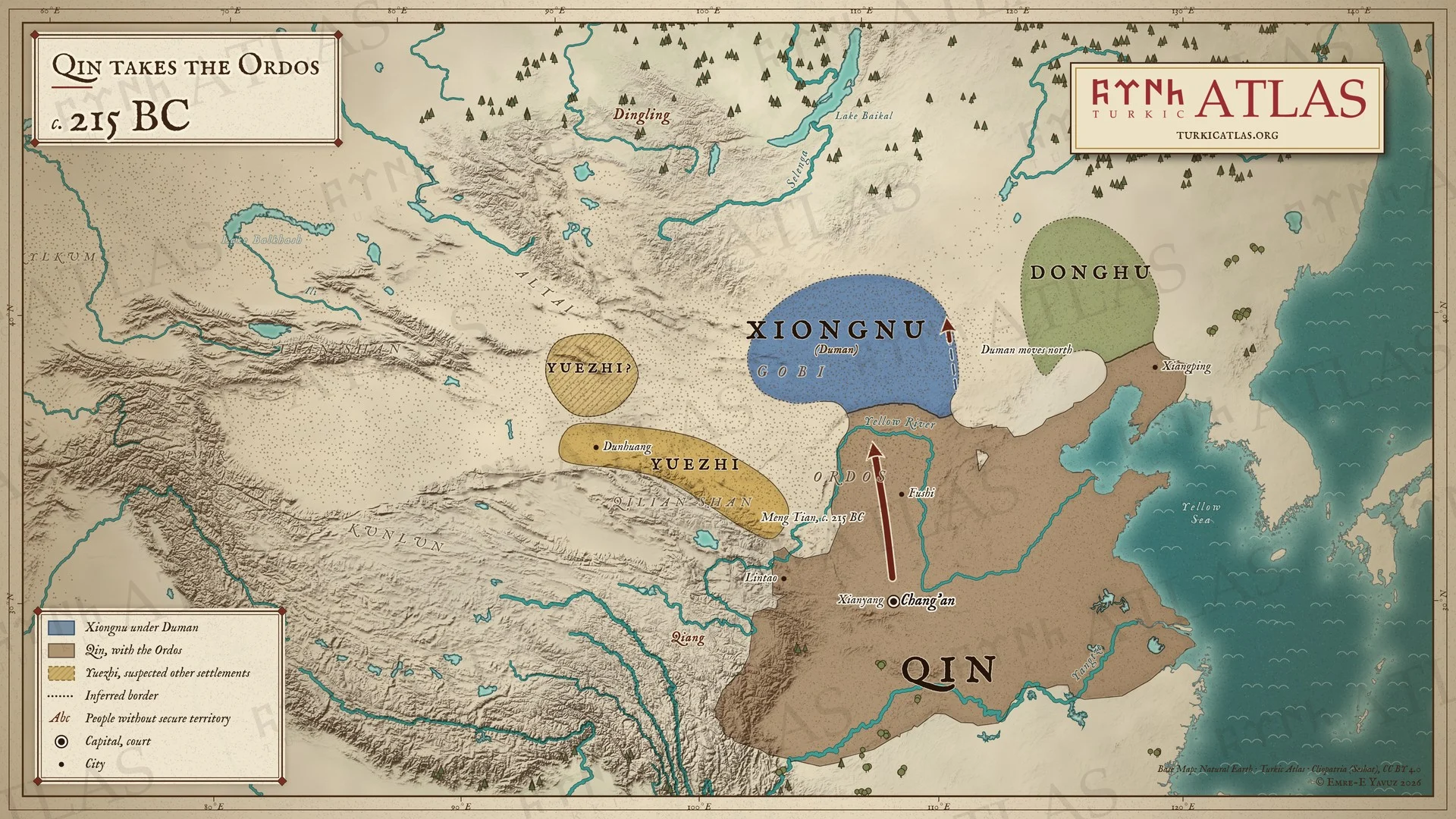
The Shiji places him at a moment of Chinese strength. The Qin had destroyed the six states. The First Emperor then sent Meng Tian north with a hundred thousand men against the Hu. They took the whole of the land south of the bend of the Yellow River and made the river itself the frontier. Along it they built forty-four walled counties and moved convict settlers in to fill them.[1][4] The line of works ran from Lintao to Liaodong. It was more than ten thousand li long.[1] The chapter then states the situation directly. At that time the Donghu were strong and the Yuezhi were flourishing. The chanyu of the Xiongnu was called Touman. Touman could not match the Qin and moved north.[1][5]
The Shiji also gives the Qin side a motive. In 215 BC a man of Yan named Lu, who had travelled on the sea, gave the First Emperor a book. It said that the Hu would destroy Qin. The emperor then ordered Meng Tian north with an army.[6] The prophecy has been interpreted in two ways. One takes the Hu for the northern peoples. The other takes the word for Huhai, the emperor’s own son, whose reign ended the dynasty.[7]
One theory treats the union of the Xiongnu as a response to that pressure. In this theory, a strong China forced the tribes of the north to combine, and they came back better organised when China fell.[8][9] A different theory denies that the tribes united of themselves. It holds that Bagatur united them later.[10] A third theory makes China the active partner. It holds that the frontier took its shape from Chinese growth, which came before the great nomadism of the steppe, and that pressure from the nomads was not of acute importance in the fall of the Qin or the rise of the Han.[11] A fourth account lets the steppe empire grow out of the margins. Groups of half-nomads from the edges of China, the Altai forests and the oases moved into the open steppe. There, once they had left the compromises of border life behind, they took the form that appears with Duman and Bagatur.[12] The Shiji supports the second half of this theory clearly enough. More than ten years later, Meng Tian was dead, the vassal kings had turned on the Qin, and the country was in disorder. All the convict settlers on the frontier went home. The Xiongnu again had room, crossed the river and came back to the old line.[1][13]
A place named after Duman is on record from these years. A fort called Duman’s city lay on the road that ran north-west from Wuyuan commandery. It stood among the forts and beacon towers that guarded the way into the steppe.[14] The sources do not decide whether the union itself was made under pressure or was only tested by it. The positions are set out under steppe empire formation.
The killing of 209 BC
Duman had an heir named Bagatur, and a favoured consort who bore him a younger son. He wished to set the younger son in the heir’s place. He sent Bagatur to the Yuezhi as a hostage. He then attacked the Yuezhi in haste. The attack would have ensured the hostage’s death without any act of Duman’s own.[1] Bagatur stole a good horse from the Yuezhi and rode home. Duman thought him brave for it and gave him ten thousand horsemen.[1] What Bagatur did with those horsemen is told in his own article. It ended on a hunt in 209 BC, when Duman’s son loosed a whistling arrow at his father and every rider in the escort shot with it.[1] The stepmother, the younger son and the ministers who would not follow were killed the same day.[1]
Reliability of the account
Everything above rests on one chapter of one work. The Shiji was written some ninety years after the events, and from the Chinese side. The Han Shu repeats the account and is not a second witness. No Xiongnu account exists. The story of the whistling arrow has the shape of a founder’s tale told backwards from a successful reign. That shape does not make it false, and nothing in the sources contradicts it. The chapter does establish the frame. Before 209 BC a Xiongnu ruler was already in place, a Chinese army had already pushed him out of the Ordos, and he already had a court, an heir and a guard.[1] It has been doubted that he already used the title chanyu. The title imitates the Chinese huangdi, which the First Emperor adopted in 221 BC. For a ruler who had just been beaten by Meng Tian it would be an arrogant claim. Bagatur may have been the first to take the title, and the Shiji’s “Touman chanyu” may have been written back into the text later.[15]
References
- ^ a b c d e f g h i j Shiji, juan 110
- ^ a b Ögel 2015, p. 83
- ^ Lattimore 1951, p. 450
- ^ Ögel 2015, p. 101
- ^ Ögel 2015, p. 118
- ^ Ögel 2015, p. 97
- ^ Ögel 2015, p. 99
- ^ Golden 1992, p. 60
- ^ Ögel 2015, p. 103, 106–107
- ^ Ögel 2015, p. 145
- ^ Lattimore 1951, p. 460–461
- ^ Lattimore 1951, p. 452–454, 523–527
- ^ Ögel 2015, p. 118–119
- ^ Ögel 2015, p. 104–105
- ^ Kurakichi 1930, p. 76–77
Sources
Literature
- Peter B. Golden, An Introduction to the History of the Turkic Peoples (1992)
- Emre-E. Yavuz, The Gokturk Empire: 2nd Edition (2025)
- Nicola Di Cosmo, Ethnogenesis, Coevolution and Political Morphology of the Earliest Steppe Empire: The Xiongnu Question Revisited (2011)
- Bahaeddin Ögel, Büyük Hun İmparatorluğu Tarihi I (2015)
- Owen Lattimore, Inner Asian Frontiers of China (1951)
- Shiratori Kurakichi, On the Territory of the Hsiung-nu Prince Hsiu-t'u Wang and His Metal Statues for Heaven-worship (1930)
What links here11
- Persons
- Bagatur (Modu Chanyu) · Meng Tian
- States
- Five Divisions of the Xiongnu · Xiongnu
- Lineages
- Luandi
- Institutions and Titles
- Women among the Turkic Peoples
- Controversies
- The Göktürks and the Xiongnu
Cite this article
Yavuz, Emre-E. “Duman (Touman).” Turkic Atlas, revised 8 November 2026. https://turkicatlas.org/persons/touman/
Last revised: 8 November 2026

