
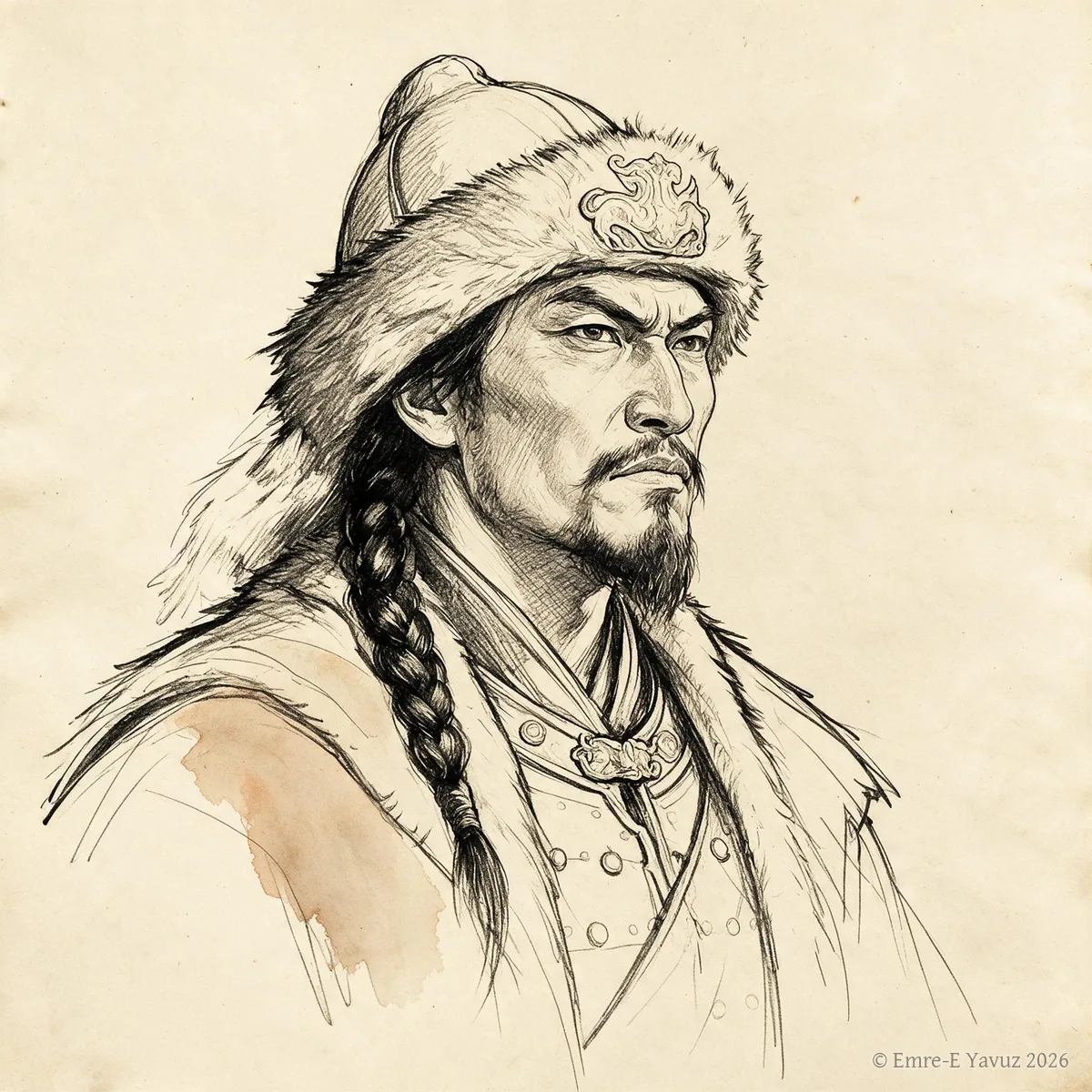
Zhizhi and his younger brother Huhanye took opposite courses. Huhanye went to Chang’an, bowed to the Han and kept the steppe. Zhizhi refused and went west. He conquered more country than any Xiongnu ruler since Bagatur. A Han army that had been raised without authority killed him at the far end of that country.[1] His march is the first recorded case of a defeated steppe power moving west rather than submitting. After him, every group that lost the eastern steppe travelled the same route again.
The break with his brother
His name was Hutuwusi. He was the elder brother. After the first round of the civil war, Huhanye found him living among the common people. He raised him to Left Guli King.[1] When Huhanye was defeated a second time, Hutuwusi declared himself Zhizhi Gudu Marquis Chanyu in the east. A rival, the Runzhen Chanyu, came against him from the west. Zhizhi killed him and took his troops. He marched on Huhanye, broke him and occupied the chanyu’s court.[1][2] Modern accounts date his proclamation to 56 BC and his victory over Huhanye to 54 BC.[2]
Then Huhanye submitted to the Han, and the balance shifted. Zhizhi sent tribute too. He was received, but less well.[1] In about 44 BC, he sent for his hostage son, and the Han officer Gu Ji brought him. Zhizhi killed the envoy.[1] After that, no reconciliation was possible. The chapter has him say so himself. Knowing that he had wronged the Han and hearing that Huhanye was growing stronger, he feared an attack and wished to go far away.[1]
The northern conquests
He had already started moving away. He reckoned that he could not settle the Xiongnu by his own strength. He therefore went west towards the Wusun and tried to make common cause with them. The lesser Wusun king judged that Huhanye had Han protection, while Zhizhi was a fugitive. He also judged that killing Zhizhi’s envoy would please the Han. He killed the envoy and sent the head to the Protector General. Then he rode out with eight thousand horse to meet Zhizhi. Zhizhi saw that the Wusun were many and that his own envoy had not come back. He drew up his troops, met the Wusun and beat them.[1][3]
From there he went north and took three peoples. The Wujie surrendered. He broke the Jiankun. He received the submission of the Dingling.[1][4] The Wujie, the Kirghiz and the Dingling have been called kin of the Xiongnu, without a ground being named.[5] He repeatedly sent troops against the Wusun and repeatedly defeated them. The chapter then says where he made his seat. Jiankun lies seven thousand li east of the chanyu’s court and five thousand li north of Jushi. Zhizhi stayed there and made it his capital.[1] Jiankun is the country of the Yenisei Kirghiz. This is the earliest notice of anyone ruling it from outside. Jiankun may instead lie south of the Altai, on the northern slope of the Tianshan. The Kirghiz of the Xiongnu period, it is argued, had spread as far as there, and the Kirghiz on the Yenisei belong to the Göktürk period. Then it is hard to think of Zhizhi as settled in the tundra north of the Altai.[6]
Kangju and the Talas
The invitation west came from Kangju. Its king was repeatedly hard pressed by the Wusun. He argued to his nobles that the Xiongnu were a great state to which the Wusun had always been subject. Zhizhi, he said, was in difficulties outside. He could be brought to the eastern border of Kangju, and the two forces could join to take the Wusun. Kangju would then be free of the Xiongnu problem for good.[1] An embassy went to Jiankun to put the plan to him. Zhizhi was afraid where he was and bore the Wusun a grudge. When he heard the Kangju plan, he was delighted. He made the alliance and led his troops west. Kangju sent nobles to meet him with several thousand camels, asses and horses.[1]
The march cost him almost everything. The Han Shu records it in a single clause. His people died of the cold on the road, and three thousand reached Kangju.[1][7] By comparison, he had once taken over more than fifty thousand troops from a defeated rival.[1]
The king of Kangju gave Zhizhi his daughter, and Zhizhi gave him a Xiongnu girl in return. Zhizhi raided the Wusun several times with Kangju support. He went as far as their capital, Chigu, and emptied their western border across a thousand li. Later he took offence when the Kangju king did not keep the seating protocol before him. He had the king’s daughter, several nobles and some hundreds of the people killed and threw their torn bodies into the Talas river.[8]
The fort on the Talas
The Han Shu chapter on Chen Tang describes the fort in which Zhizhi died. He had the walls built in two years by five hundred men working all day.[8] The fort had a palisade of tall timber and timber towers outside and an inner wall of earth.[9] The Han army camped three li from the wall. Zhizhi stood on the rampart under a banner of five colours. A few hundred men in armour stood on the wall, and more than a hundred horsemen and as many foot soldiers were drawn up at the gate.[10] Zhizhi and his wives shot from the wall. An arrow struck his nose, and he went back into the women’s quarters.[11] The foot soldiers drawn up at the gate in fish-scale order may have been a Roman-style phalanx. Armour, crossbows and drill are counted among the things that the horse peoples did not use.[12][13] The refusal to hold walled towns, in the counsel of Wei Lü and in Zhizhi’s failed defence, has been seen as the same rule that Tonyukuk later urged on the Göktürks.[14] Xiongnu court terms are also rendered in Göktürk words, and Xiongnu tactics treated as those of the later Turkic peoples.[15]
Death
In 36 BC, the Protector General Gan Yanshou and his deputy Chen Tang raised troops and went into Kangju. They killed and beheaded Zhizhi. For the details, the chapter refers the reader to their own biographies and gives no more.[1] The two generals raised about 40,000 men from the farming colonies, from men skilled in sieges and from Xiongnu who had gone over to the Han.[16] One column went by Kashgar over the northern Pamir to Ferghana. The other left Aksu, passed the Wusun capital and Lake Issyk Kul and reached the eastern border of Kangju.[17] The Han took the fort at dawn and burned the palace, and Zhizhi died there.[18] According to this account, 1,518 men died, 145 were taken alive and nearly a thousand surrendered.[18] The two generals reported that, if Zhizhi had not been punished, the country west of Daxia would have come under his command.[19] The biography of Chen Tang does not mention Zhizhi’s stay with the Jiankun or the invitation of the Kangju king, which the Xiongnu chapter gives.[20] It does record the effect on his brother. Huhanye was at once glad and frightened. He wrote to the emperor that he had always wished to attend at court. With Zhizhi in the west, however, he had feared that Zhizhi and the Wusun would come together against him, and he had therefore not come. Now that Zhizhi had suffered punishment, he wished to come in and be received.[1] He came in 33 BC. He received twice what he had been given before. He asked for a Han wife.[1]
Assessment
Zhizhi’s rule in Kangju may have lasted no more than six or seven years, which would make the picture of a great realm there too optimistic.[21] The centre of his realm is placed at about 71 degrees east and 43 degrees north, near the Talas, with an influence that reached Lake Issyk Kul.[22] The Xiongnu can be followed from the Altai over the Talas and the Volga to Hungary, with Zhizhi’s Talas as a station on that road. It rests on weapons and goldsmith’s work of Central Asian type.[23]
The two brothers can be set side by side as two strategies for the same problem. The southern tribes under Huhanye used the tributary system and rebuilt a Xiongnu state. The northern tribes under Zhizhi could not work the system as well, and Chinese pressure pushed them west. They moved along a road that other defeated Xiongnu groups had already taken.[24] That account does not quite match what the chapter shows. Zhizhi did not drift west. He reached the west by conquest. He held the Yenisei and beat the Wusun in the field more than once. He moved only when a foreign king paid him to. What ended him was not the steppe but a Han officer, who acted on his own judgement two thousand miles from his government.[1]
References
- ^ a b c d e f g h i j k l m n o p q Han Shu, juan 94
- ^ a b Ögel 2015, p. 140–143
- ^ Ögel 2015, p. 149
- ^ Ögel 2015, p. 147–150
- ^ Ögel 2015, p. 148, 224
- ^ Ögel 2015, p. 148–150, 155
- ^ Ögel 2015, p. 157, 159
- ^ a b Ögel 2015, p. 160
- ^ Ögel 2015, p. 164
- ^ Ögel 2015, p. 170
- ^ Ögel 2015, p. 172
- ^ Ögel 2015, p. 165
- ^ Ögel 2015, p. 165, 170
- ^ Ögel 2015, p. 114, 160–161, 163
- ^ Ögel 2015, p. 136, 147, 154, 165
- ^ Ögel 2015, p. 167–168
- ^ Ögel 2015, p. 168
- ^ a b Ögel 2015, p. 173
- ^ Ögel 2015, p. 174
- ^ Ögel 2015, p. 159–160
- ^ Ögel 2015, p. 166
- ^ Ögel 1984, p. 91–92
- ^ Ögel 1984, p. 91–106
- ^ Golden 1992, p. 62
Sources
- Han Shu, juan 94 (after Shiji)
Literature
- Peter B. Golden, An Introduction to the History of the Turkic Peoples (1992)
- Emre-E. Yavuz, The Gokturk Empire: 2nd Edition (2025)
- Bahaeddin Ögel, Büyük Hun İmparatorluğu Tarihi II (2015)
- Bahaeddin Ögel, İslâmiyetten Önce Türk Kültür Tarihi. Orta Asya Kaynak ve Buluntularına Göre (1984)
What links here11
- Persons
- Bi Chanyu · Huhanye Chanyu · Wang Zhaojun
- Conflicts
- The Xiongnu–Han Wars
- Battles & Events
- Han Reply to the Northern Xiongnu (AD 52)
- Lineages
- Luandi
- Institutions and Titles
- Diplomacy of the Steppe Empires · Skull Cup
- Controversies
- The Kirghiz descent from Li Ling
Cite this article
Yavuz, Emre-E. “Zhizhi Chanyu.” Turkic Atlas, revised 8 November 2026. https://turkicatlas.org/persons/zhizhi-chanyu/
Last revised: 8 November 2026

