
- 400
- 500
- 600
- 700
- 800
- 900
- Rouran 400–554
- First Göktürk 552–630
- Tang rule 630–682
- Second Göktürk 682–744
- Uyghur 744–840
- Kirghiz 840–924
- Huns 370–469
- Western Göktürk 552–659
- Türgesh 699–766
- Karluk 766–800
- Khazar 650–969
Samarkand is the city of the Sogdians, who founded it, and the head of Sogdiana. The Wei Shu records that the Xiongnu killed the king of Sute and took the country. It records that in 457 a Xiongnu king named Huni, the third of his line, held the throne.[1] These Xiongnu may be the Kidarites, whose name Kidara appears on the archer coins of Samarkand. On this identification their seizure of the city falls after 440, when Sogdian embassies to China break off until 457.[2] A different explanation takes Sute for the country of the Alans north of the Black Sea and these Xiongnu for the Huns.[3] The Wei Shu has a name of its own for Samarkand, Xiwanjin. It also records the city’s embassies.[4] Under the rule of these Xiongnu, in the second half of the fifth century, the new citadel was raised on a colossal platform of rammed-earth blocks four metres thick. Ceramics of the same half-century lie beneath it. The platform counts among the great works that only a strong new power could have mobilised the population to build.[2]
The ancient city
Samarkand stands on the site of Afrasiab. Afrasiab and Kök Tepe were two giant settlements on canals of the Zarafshan, each of more than two hundred hectares. Both were occupied from the eighth or the seventh century BC. Kök Tepe soon declined.[5] For two thousand years, Samarkand was the greatest city of Sogdiana. Together with Merv and Bactra, it was one of the very great cities of western Central Asia.[5] Cyrus took Sogdiana around 540 BC. Alexander conquered it at the beginning of 329 BC.[5]
Under the Hephthalites and the Göktürks
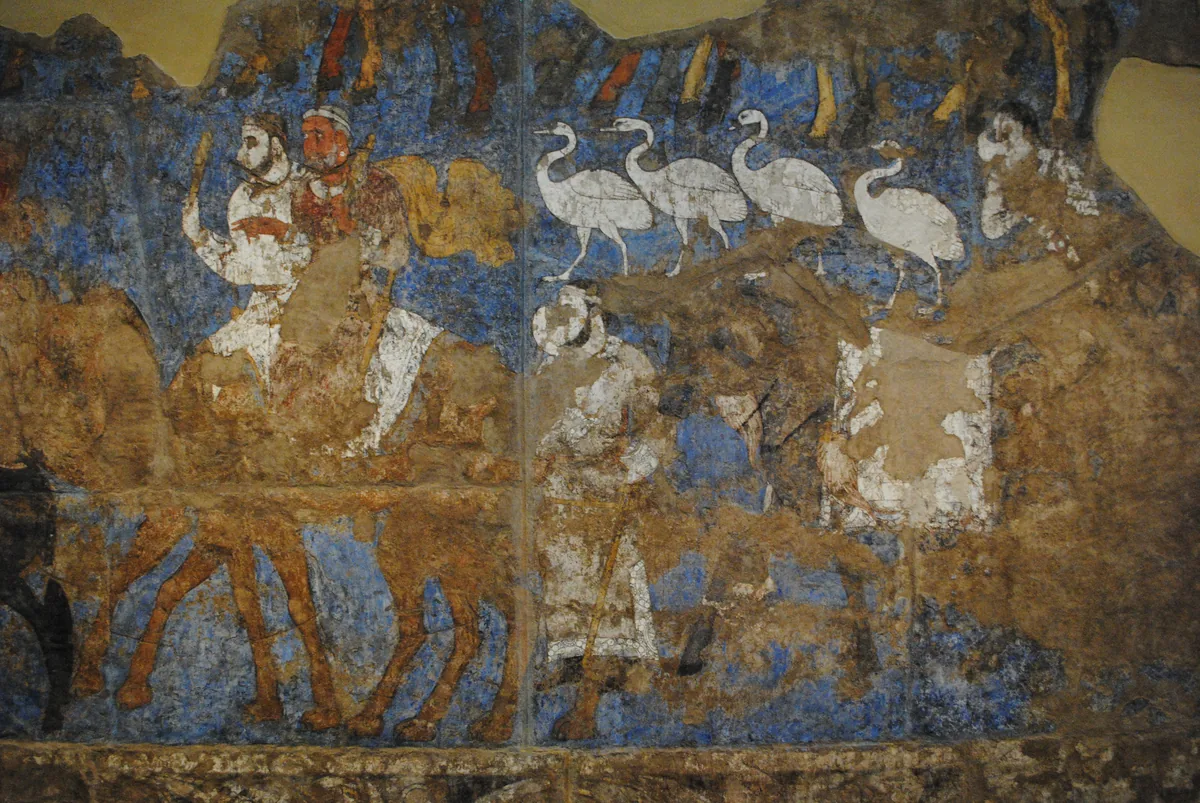
The city passed to the Hephthalites in 509. It passed to the Göktürks around 560. The great painting of Afrasiab, the ancient site, shows Göktürk warriors seated in a circle at the feet of a king or a lost deity. Chinese envoys and Sogdian nobles approach in procession. The painting is a witness to the fusion of Sogdians and Göktürks in the ruling strata of the sixth and seventh centuries.[2] Sogdian émigrés in China who came from Samarkand took the surname Kang. The wives of the Shi family of Guyuan were Kangs. The long walls of Navaket in Semirech’e enclosed twenty square kilometres, as at Samarkand. North of the city, the Hungry Steppe forced travellers to Chach to go along the piedmont by Zaamin. Cisterns laid across the steppe in the ninth century saved two days.
The Arab conquest
In 712 Qutayba ibn Muslim took Samarkand by a ruse.[6] The treaty of surrender bound the city to two million dirhams at once, three thousand slaves and a yearly tribute.[7] Qutayba broke it. He stayed in the town and drove out its inhabitants.[8] Part of the nobility of Samarkand took refuge with Dēwāštīč at Panjikent. A painting in the citadel there shows the capture of the city.[9] The lords of Samarkand made Ishtikhan their second capital.[10]
Under the Samanids
In the ninth and tenth centuries Samarkand was a market for Turkic slaves. Al-Yaqubi records that the future caliph al-Mu’tasim sent an agent to Samarkand, to Nuh ibn Asad, to buy Turks every year. He records that some three thousand pages had been gathered in this way under al-Ma’mun.[11] This recruitment of slave soldiers was of great consequence for later Muslim history. It began among the slave merchants of Samarkand.[11] Al-Muqaddasi lists silk brocade from Samarkand among the goods sold to the Turks.[12]
The city also sheltered a Manichaean community. Ibn al-Nadim reports that about five hundred Manichaeans gathered at Samarkand. The ruler of Khurasan wished to kill them. The king of China then threatened to slaughter the Muslims in his own land and destroy their mosques. Ibn al-Nadim supposes this king to have been the lord of the Tughuzghuz. The Manichaeans were left alone on payment of tribute.[13] The hinterland of Samarkand in the tenth and eleventh centuries was the western Tarim basin as far as Khotan and the Turkic lands west of the Tianshan.[14]
Later history
Al-Bīrūnī, al-Fārābī, Avicenna and al-Khwārizmī were educated in Sogdiana or in neighbouring Khorezm. Some manuscripts say that the Mongol great khan Güyük died at a town called Samarkand, seven days north of Beshbalik. This report has been rejected.
References
- ^ de la Vaissière 2005a, p. 107
- ^ a b c de la Vaissière 2005a
- ^ 内田吟風 1971, p. 254-255
- ^ Wei Shu, juan 102; 内田吟風 1971, p. 252
- ^ a b c de la Vaissière 2005a, p. 17
- ^ de la Vaissière 2005a, p. 266
- ^ de la Vaissière 2005a, p. 271
- ^ de la Vaissière 2005a, p. 276
- ^ de la Vaissière 2005a, p. 272
- ^ de la Vaissière 2005a, p. 283
- ^ a b de la Vaissière 2005a, p. 304
- ^ de la Vaissière 2005a, p. 302
- ^ de la Vaissière 2005a, p. 314
- ^ de la Vaissière 2005a, p. 331
Sources
- Wei Shu, juan 102
Literature
- Étienne de la Vaissière, Sogdian Traders: A History (2005)
- Uchida Ginpū 内田吟風, 魏書西域傳原文考釋(中) (1971)
What links here35
- Persons
- Afrasiab · Dēwāštīč · Irbis Ishbara Yabgu Khan · Nanai-vandak · Nasr ibn Sayyar · Qutayba ibn Muslim · Rudan Tegin · Tong Yabgu · Wei Jie
- States
- Samanids · The Umayyad Caliphate
- Battles & Events
- Music of Empress Ashina (568) · The capture of Samarkand, 712
- Institutions and Titles
- Coinage of the Huna Peoples · Ghulam
- Religions
- Fire Worship · Islam · Manichaeism
- Customs & Pastimes
- Turkic Songs at the Tang Court
- Sources
- Life of Xuanzang · Sogdian Ancient Letters
Cite this article
Yavuz, Emre-E. “Samarkand.” Turkic Atlas, revised 8 November 2026. https://turkicatlas.org/places/samarkand/
Last revised: 8 November 2026

