
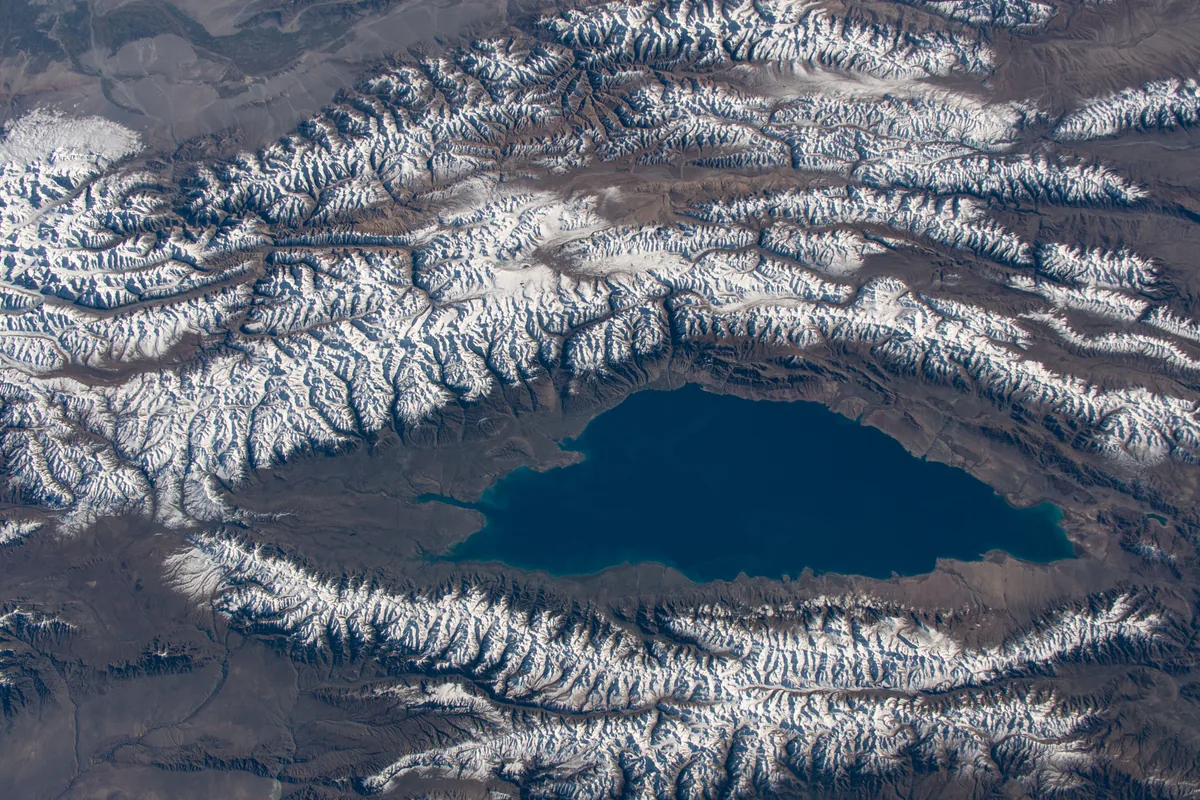
The Issyk-Kul is the lake that the Chinese pilgrim Xuanzang called the Great Clear Lake, 大清池.[1][2] It lies beyond the passes of the Tian Shan, on the road from Kucha to Suyab.[3][4] Xuanzang followed its shore to the court of the khan of the western Göktürks.[5]
The lake in Xuanzang’s Record
The Record of the Western Regions reaches the lake after the crossing of the Ling mountain, the northern edge of the Congling. The snow stays frozen there through spring and summer.[6] Four hundred li through the mountains bring the traveller to the Great Clear Lake. The Record also calls it the Hot Sea and the Salt Sea.[6] It measures more than a thousand li around. It is long from east to west and narrow from north to south.[6] Mountains surround it on all sides. Many streams flow into it.[6] Its water is bluish black and tastes salty and bitter. Great waves rise on it.[6]
Dragons and fish live in it together. Strange spirits appear from time to time.[6] For that reason travellers on the road pray there for good fortune.[6] The lake holds many creatures, but nobody dares to fish it.[6] From the lake the road runs some five hundred li north-west to the town on the Suye river, Suyab.[6]
The lake in the Life
The Life of Xuanzang tells the same stage of the journey.[7] The crossing of the Ling mountain took seven days. Many of the company died of hunger and cold, and even more of the oxen and horses.[7] Beyond the mountain lay a clear lake, which was also called the Hot Sea.[8] The Life explains that the lake was so called because it does not freeze, though it faces the Ling mountain. The name does not mean that its water is warm.[8] The Life gives a circuit of fourteen or fifteen hundred li. The lake is long from east to west and narrow from north to south.[7] Waves several zhang high rose on it even without a strong wind.[9] The Record gives the circuit as more than a thousand li. The Life gives it as fourteen or fifteen hundred.
Following the shore north-west for more than five hundred li, the pilgrim came to the town of Suye.[10] There he met the Yabgu Khan of the Göktürks, out hunting. He may be Tong Yabgu.[10][11] The reception at his court followed.[12] By one reckoning the pilgrim reached Suyab in the first months of 630.[11]
Route and identification
Xuanzang’s lake has been identified with the Issyk-Kul. The identification rests on the position of the lake beyond the mountains from Kucha, on its circuit and on its long east–west shape.[1] The French translation of the Life gives it the Mongol and Turkic names Temurtu and Issyk-Kul.[13][1] A Tang itinerary from Kucha to Suyab also passes a Hot Sea, which may be the same lake.[14]
How the pilgrim reached the lake is disputed. The pilgrim may have crossed the Muzart pass.[15] Another proposal takes him from Aksu over the Bedel pass.[2][4] The road to Suyab is disputed in the same way. The usual road goes first to the eastern end of the lake and then round its northern shore.[2] A different route runs along the southern shore.[2]
The lake and the western khaganate
One modern account counts the lands around the lake, in present-day Kyrgyzstan, with Dzungaria and Lake Balkhash. It places them in the western half of the realm after the death of Bumin.[16] In Xuanzang’s time the road past the lake led to the khan’s camp near Suyab, five hundred li to the north-west.[6][10]
Runiform stones
In 1926 a stone with runiform signs was found at Koy-Sary on the Issyk-Kul.[17] It was too worn to be studied.[17] An unknown hand soon carried it off, and nobody knows where it lies.[17] Before this find, no runiform text was known from the Issyk-Kul and Chu regions.[18] By 2000, more than thirty runiform inscriptions were known in Kyrgyzstan.[19] Nearly all are cut into stone.[19] The report of these finds dates none of them.[20] Turkic Atlas sets out the stones of the Talas valley under Talas. It sets out the whole group under the runiform inscriptions of Talas and the Tian Shan.
References
- ^ a b c Julien 1853, xlv
- ^ a b c d Chavannes 1903, p. 9
- ^ Chavannes 1903, p. 8–10
- ^ a b Kaiyrken 2026, p. 6–7
- ^ Life of Xuanzang, juan 2; Beal 1911, p. 41–42
- ^ a b c d e f g h i j Record of the Western Regions, juan 1
- ^ a b c Life of Xuanzang, juan 2; Beal 1911, p. 41
- ^ a b Life of Xuanzang, juan 2
- ^ Life of Xuanzang, juan 2; Julien 1853, p. 54
- ^ a b c Life of Xuanzang, juan 2; Beal 1911, p. 42
- ^ a b Chavannes 1903, p. 194
- ^ Life of Xuanzang, juan 2; Beal 1911, p. 42–44
- ^ Julien 1853, p. 54
- ^ Chavannes 1903, p. 10
- ^ Beal 1911, p. 41
- ^ Yavuz 2025, p. 252–253
- ^ a b c Çetin 2000, p. 72
- ^ Çetin 2000, p. 72–73
- ^ a b Çetin 2000, p. 69
- ^ Çetin 2000, p. 69–74
Sources
- Record of the Western Regions, juan 1
- Life of Xuanzang, juan 2
Literature
- Stanislas Julien (trans.), Histoire de la vie de Hiouen-Thsang et de ses voyages dans l'Inde (1853)
- Samuel Beal (trans.), The Life of Hiuen-Tsiang by the Shaman Hwui Li (1911)
- Édouard Chavannes, Documents sur les Tou-Kiue (Turcs) occidentaux (1903)
- Tursynkhan Zakonuly Kaiyrken; Abdulvahap Kara, Xuan Zang'ın Seyahat Notlarında Batı Göktürk Kağanı Tong Yabgu'nun Devlet Adamı Portresi (2026)
- Emre-E. Yavuz, The Gokturk Empire: 2nd Edition (2025)
- Çumagulov, Çetin, Göktürk Harfli Yazıtların Kırgızistan’daki Araştırılması, Muhafazası ve Bugünkü Durumu (2000)
What links here12
- Persons
- Irbis Ishbara Yabgu Khan · Sebüktegin
- Battles & Events
- Xuanzang's visit to Tong Yabgu
- Places
- Dzungaria · Suyab · Tuz Köl of the Karluks
- Institutions and Titles
- Trade Routes of the Steppe
Cite this article
Yavuz, Emre-E. “Issyk-Kul.” Turkic Atlas, revised 8 November 2026. https://turkicatlas.org/places/issyk-kul/
Last revised: 8 November 2026

