
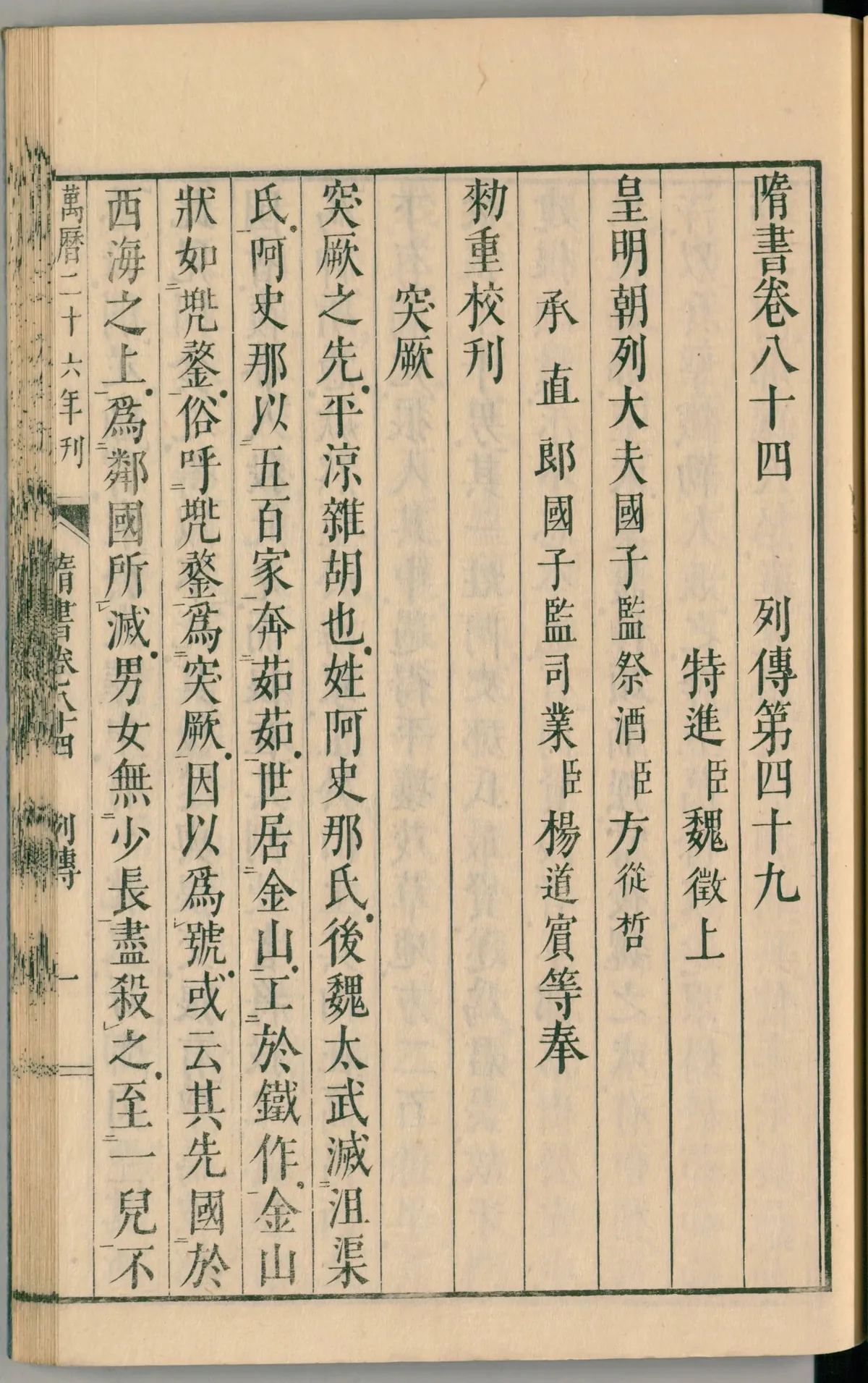
Xihai, 西海, the Western Sea, is the name the Chinese histories give to the water at the western end of the Göktürk world.[1] The Zhou Shu makes it the western bound of the realm of Mukan Khan.[1] The Sui Shu and the Bei Shi also set the beginning of the Ashina beside it.[2] None of these histories says where the sea lay.[3]
The origin legend
The Sui Shu gives the Western Sea in a second account of Göktürk origins. It introduces this account with the words “some say”.[4] In that account, the forebears of the Göktürks had a state upon the Western Sea. A neighbouring state wiped them out.[4] A she-wolf fed the one boy left alive.[4] When the enemy sent again to kill him, the wolf was suddenly east of the sea, as if carried by a spirit. She came to rest on a mountain north-west of Gaochang.[4] There, in a cave, she bore ten sons.[4] The Tongdian repeats the account.[5]
The Bei Shi opens its chapter with the statement that the ancestors lived on the right bank of the Western Sea.[6] In its version a divine being casts the wolf east of the sea.[6] The Zhou Shu tells the wolf story without the sea. Its wolf flees to a mountain north of Gaochang.[1]
The bounds of the realm
After Mukan’s wars the Zhou Shu describes the land that belonged to him.[1] In the east it began west of the Liao sea. In the west it reached the Western Sea, ten thousand li away.[1] The Bei Shi repeats the distance. The Tongdian gives more than ten thousand li.[7] The description follows Mukan’s wars against the Hephthalites in the west, the Khitan in the east and the Qigu in the north.[1]
The Tongdian uses the same bound for the western khaganate.[8] When Shegui became khan in the west, it says, he opened up the land from the Altai in the east to the Western Sea in the west.[8] All the states west of the Jade Gate served him.[8]
The Sui Shu’s chapter on the Tiele begins at the same water.[4] The Tiele, it says, lived from east of the Western Sea along the mountains and valleys, without a break.[4]
The roads to the west
The emperor Yangdi set Pei Ju over the trade with the western peoples at Zhangye. Pei Ju wrote a description of the western countries in three books.[9] In its preface all three roads from Dunhuang end at the Western Sea.[9] The northern road ran by way of Yiwu, the Tiele and the court of the Göktürk khan, across the Beiliu, the north-flowing river, to the state of Fulin.[9] The middle road ran by way of Gaochang, Kucha and the state of Kang to Persia.[9] The southern road ran by way of Shanshan, Khotan and Tuhuoluo to the northern Brahmin country.[9]
Proposed identifications
Which water the name means has been interpreted in several ways. One translation takes the Western Sea of the Zhou Shu for the Caspian.[10] The French translation of 1864 reads it the same way.[11] The modern translation adds that the name stood at different times for the Aral Sea, the Mediterranean and the Koko Nor.[10] In the chapter on the Tiele it renders the Western Sea as the Aral.[12]
A third explanation takes the sea of the origin legend for the delta of the Edzin Gol. Its waters run into the lakes Gashun Nor and Sogo Nor.[13] The name had that sense in the fourth and fifth centuries.[13] A further view notes that in the Sui period the Western Sea was thought to lie beside Fulin, the Byzantine empire.[13] The same discussion points out that a homeland set far from a people’s present seat is a common feature of foundation legends.[13]
The name is older than the Göktürk histories. The Han Shu says of Khotan that the waters west of it flow west into the Western Sea and the waters east of it east into the Salt Marsh.[14] That sea has been taken for the Persian Gulf and the Salt Marsh for the Lop Nor of the Han period.[15]
References
- ^ a b c d e f Zhou Shu (Book of Zhou), juan 50
- ^ Sui Shu (Book of Sui), juan 84; Bei Shi (History of the Northern Dynasties), juan 99
- ^ Zhou Shu (Book of Zhou), juan 50; Sui Shu (Book of Sui), juan 84; Bei Shi (History of the Northern Dynasties), juan 99
- ^ a b c d e f g Sui Shu (Book of Sui), juan 84
- ^ Tongdian, juan 197
- ^ a b Bei Shi (History of the Northern Dynasties), juan 99
- ^ Bei Shi (History of the Northern Dynasties), juan 99; Tongdian, juan 197
- ^ a b c Tongdian, juan 199
- ^ a b c d e Sui Shu (Book of Sui), juan 67
- ^ a b Mau-tsai 1958, Turkish edition, p. 19
- ^ Julien 1864, p. 331
- ^ Mau-tsai 1958, Turkish edition, p. 169
- ^ a b c d Golden 1992, p. 118
- ^ Han Shu, juan 96
- ^ Herrmann 1910, p. 61
Sources
- Zhou Shu (Book of Zhou), juan 50
- Sui Shu (Book of Sui), juan 67, 84
- Bei Shi (History of the Northern Dynasties), juan 99 (after Wei Shu, Zhou Shu and Sui Shu)
- Tongdian, juan 197, 199 (after Sui Shu and Zhou Shu)
- Han Shu, juan 96 (after Shiji)
Literature
- Liu Mau-tsai, Çin Kaynaklarına Göre Doğu Türkleri (1958, Turkish edition)
- Stanislas Julien, Documents historiques sur les Tou-kioue (Turcs) (1864)
- Peter B. Golden, An Introduction to the History of the Turkic Peoples (1992)
- Albert Herrmann, Die alten Seidenstrassen zwischen China und Syrien. Beiträge zur alten Geographie Asiens, Bd. 1 (1910)
What links here3
- Conflicts
- Mukan's Eastern and Northern Wars
- Places
- Cave of the ancestors · Liaohai
Cite this article
Yavuz, Emre-E. “Xihai.” Turkic Atlas, revised 8 November 2026. https://turkicatlas.org/places/xihai/
Last revised: 8 November 2026

