
- 400
- 500
- 600
- 700
- 800
- 900
- Rouran 400–554
- First Göktürk 552–630
- Tang rule 630–682
- Second Göktürk 682–744
- Uyghur 744–840
- Kirghiz 840–924
- Huns 370–469
- Western Göktürk 552–659
- Türgesh 699–766
- Karluk 766–800
- Khazar 650–969
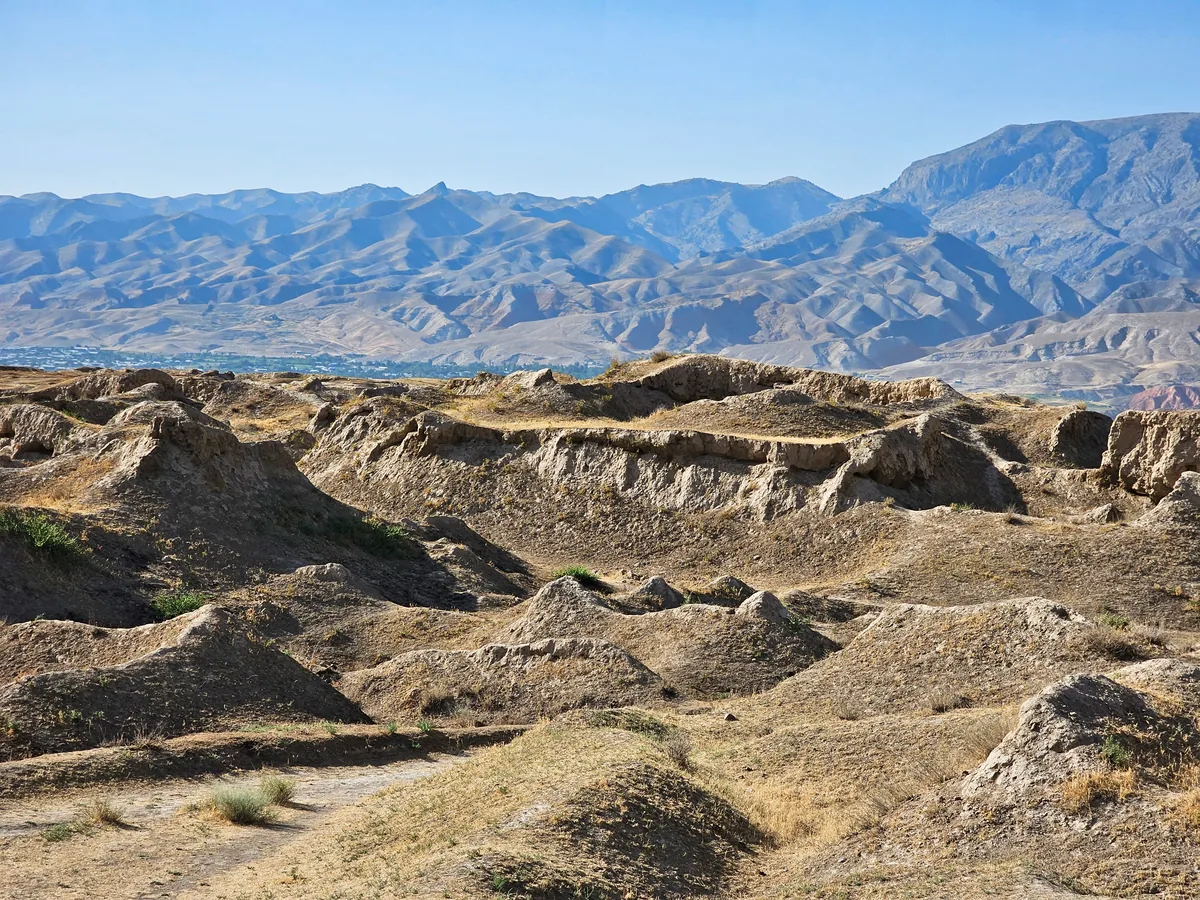
Panjikent was a Sogdian town in the upper valley of the Zarafshan, east of Samarkand. It is the most extensively and continuously excavated town of Central Asia. Its history can be told from three kinds of evidence at once: the accounts of the Arab conquest, the archive of its last lord and the excavation.[1]
Foundation and the fifth and sixth centuries
Panjikent was one of the small planned towns founded in Sogdiana in the Kidarite period, between 440 and 470.[2] When the Hephthalites took Sogdiana in 509, the walls and a temple of Panjikent were partly destroyed and at once repaired. A three-storey barracks for a permanent garrison was built against the outer wall.[3] The Göktürk conquest fifty years later was quick and seems to have caused hardly any damage.[3]
The paintings
The wall paintings of Panjikent show how Sogdian society wished to see itself. It saw itself as an aristocracy.[4] They show legendary combats, armoured heroes on horseback, banqueters with long swords, the epic of Rostam and Indian tales. A painting at the citadel shows the capture of Samarkand by the Arabs.[4] Commerce appears only in details. In one banquet scene a black purse at the waist replaces the noble’s customary sword. The archaeologists read the rich dress of the guests as the dress of merchants.[4]
Dēwāštīč and the Arab conquest
In the decade after 710 the lord of Panjikent was Dēwāštīč, who led the resistance of the Sogdian nobles against the Arabs.[1] Part of the nobility of Samarkand took refuge with him after 712. This led to the building of a whole noble quarter. In 721–722 he claimed the title of king of Sogdiana.[1] After his death in 722 the Arabs devastated the town.[1] His archive was found in 1933 on Mount Mugh. These are the Mount Mugh documents.[5]
Recovery and abandonment
The excavation shows the site abandoned for about fifteen years. About 740 the great houses were rebuilt with their ceremonial halls and pagan decoration. One palace was restored, though its walls never received their paintings. The share of houses in the noble style fell from 42 to 24 per cent.[1] The recovery fell in the years when the governor Nasr ibn Sayyar made peace with the Sogdians on their own terms.[6] It did not last. From the 760s the ceremonial halls and great houses were abandoned. People of a much lower station occupied the ruins of the old palaces.[1]
Some scholars draw a lesson from the contrast with Paykent. Paykent lay on the road of every army and was rebuilt quickly from the revenues of trade. Panjikent lay in a rich agricultural valley without great commercial links. It waited a generation for its nobility to gather the means, and was then left.[6]
References
Sources
Literature
- Étienne de la Vaissière, Sogdian Traders: A History (2005)
What links here16
- Persons
- Dēwāštīč · Nasr ibn Sayyar
- Battles & Events
- Battle of Bukhara · The capture of Samarkand, 712
- Peoples
- Hephthalites · Kidarites · Sogdians
- Sources
- Mount Mugh documents
- Controversies
- Turkic-Sogdian Synthesis
Cite this article
Yavuz, Emre-E. “Panjikent.” Turkic Atlas, revised 8 November 2026. https://turkicatlas.org/places/panjikent/
Last revised: 8 November 2026

