
- 400
- 500
- 600
- 700
- 800
- 900
- Rouran 400–554
- First Göktürk 552–630
- Tang rule 630–682
- Second Göktürk 682–744
- Uyghur 744–840
- Kirghiz 840–924
- Huns 370–469
- Western Göktürk 552–659
- Türgesh 699–766
- Karluk 766–800
- Khazar 650–969
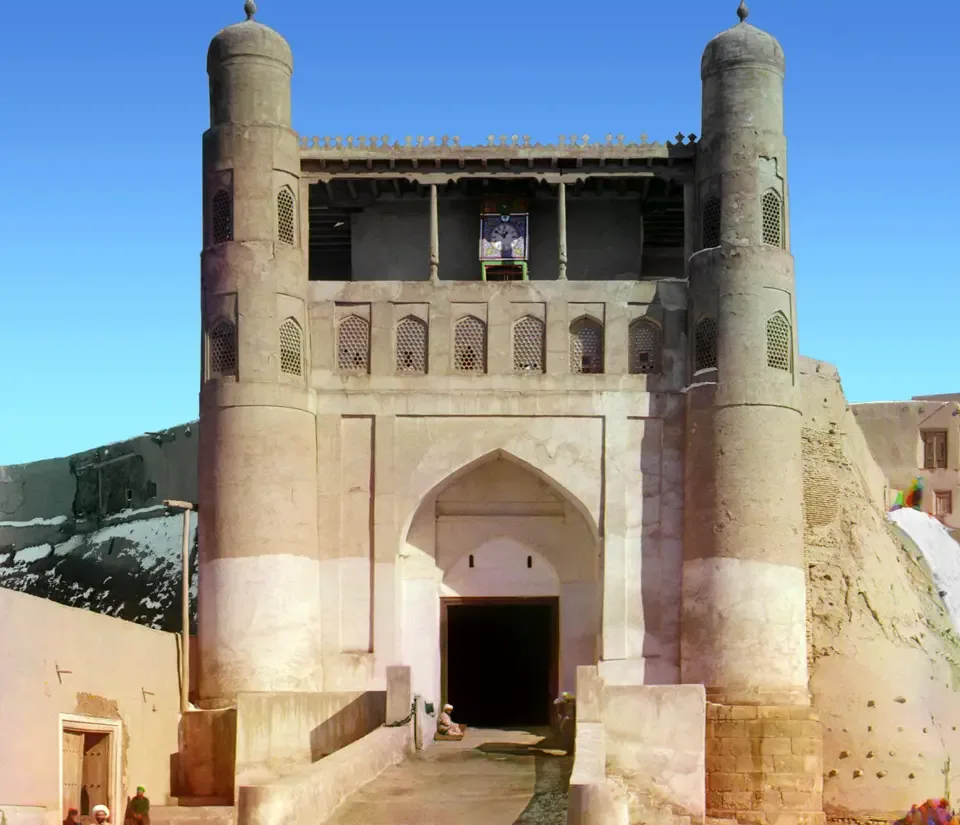
Bukhara lies in the lower valley of the Zerafshan, at the western end of Sogdiana. There the river spreads into an oasis before it fails in the desert. In Göktürk history Bukhara is the city of the battle that ended the Hephthalites. It was the residence of the Ashina in the west and the farthest point of Bahram Chobin’s counter-campaign. Its people were also among the western peoples who sent mourners to the Orkhon in 732.[1]
The city before the Göktürks
Samarkand was already old when the marshy lower valley of the Zarafshan was still thinly settled. Bukhara rose only in the fifth century AD.[2] Bukhara, Paikent and Panjikent belong to the towns of the Zerafshan valley that were built or rebuilt in the fifth century. Their plans were of the Hippodamian type, with rectangular walls and a grid of streets. Eastern Sasanian Iran has towns of the same kind.[3] The towns grew out of the demographic expansion of Sogdiana after the great invasions, under the Kidarite power of the years 440 to 470.[3] With these towns the country could defend itself against both the Sasanians and the Hephthalites. The Hephthalites had driven the Kidarites from their Bactrian bases from 456.[3] No written source mentions the Hephthalite conquest of Sogdiana. It is inferred from the replacement of Sogdian embassies by Hephthalite ones at the Chinese courts from 509. Hephthalite rule over the Sogdian cities was indirect. Garrisons stood along the settlements, and the largest and most important of them was at Bukhara.[1] This is surprising, because until the sixth century Samarkand had been the most important city of Sogdiana. The reasons are no longer recorded.[1] Another view dates the city’s rank in its oasis much later. On this view Bukhara did not become the centre of the oasis before the end of the fifth century at the earliest. Rival towns kept their own lords and their own trade. The city won its hegemony only shortly before the Arab conquest.[4] If so, the oasis of the sixth century was a group of towns and not one principality of Bukhara. Paikent, nearer the Oxus, was older. Narshakhi says that every ruler of the district made it his seat.[5] In the city’s own tradition, the citadel in the middle of the city dates from a time long before the Göktürks. The History of Bukhara ascribes it to Siyavush, the son of Kaikaus, who fled to Afrasiyab.[6] Bidun Bukhar Khuda, the husband of the Khatun, rebuilt it later. It served the rulers as residence, prison and chancellery.[7]
The battle and the Ashina residence
The war in which the city changed hands has its own article. Seven Sogdian kings assembled at Bukhara and called in the Göktürks, who appeared before its gates. The fighting lasted seven days and seven nights. On the eighth day the Göktürks broke in and took the citadel, the Ark. They found the Hephthalite commanders gone.[1] Narshakhi’s History of Bukhara is the one local history of the city to survive. It does not contain the seven kings or the siege, and it names neither the Hephthalites nor the Göktürk khaganate.[8] The Ark was a fortress at the centre of the city, like the one at Otrar. The local rulers planned and governed from it.[1] After the division of the Hephthalite lands the city lay exactly between the two empires on the Oxus. It gained political weight. Bukhara was not the capital of Sogdiana. The Ashina nobility quartered itself there, and Istemi too took up residence. He used the Ark as a planning centre while most of the army returned to the steppe.[1] The Göktürks built their garrison in Bukhara. The Sogdians had no army of their own and no common king, only a king or queen for each city. They turned back to trade. Tabari’s parallel tradition, in Dinawari, has Sinjibu occupy Chach, Ferghana, Samarkand, Kesh and Nasaf “as far as Bukhara”. This marks the city as the western limit of the Göktürk share.[9] The Sogdian envoys came back from Ctesiphon to Bukhara to report that Khosrow had burned their silk. The second embassy went out from Bukhara. The Maniakh article covers the scene. It is possible that Maniakh himself was the king of Bukhara, though the sources do not say so.[1]
The Persian war and after
In 589, after the Göktürk defeat of the year before, Bahram Chobin retook Herat. He crossed the Oxus and reached the country of Bukhara.[1] The Persian hold on the cities of Sogdiana that followed did not last.[1] Some scholars hold that Bahram took Paikent, then the old capital of Bukhara and in the hands of a western Göktürk dynasty. In that case, his advance into Transoxiana is certain. The accounts of it draw on the romance of Bahram.[10] Under the war with Persia, Turkic Atlas treats the campaign. The Kül Tegin inscription names, among the mourners who came to the Orkhon in 732 “from the peoples of the west, at the sunset”, the Sogdians, the Persians and the city-folk of Bukhara, led by the general Enik and Ogul Tarkan.[11] It is the one place in the runic corpus where the city stands by name, a century and a half after Istemi.[11]
Bukhara in the Chinese histories
The Chinese histories know Bukhara as An. The Sui Shu gives its king the family name Zhaowu, which is the name of the house of the king of Kang. It makes the queen a daughter of the king of Kang, and the king of Kang was himself married to a daughter of the khan Tardush.[12] The text does not name the city where the king of An sat. The country of Bi, west of it, had no ruler. An governed it.[12] The Xin Tang Shu names the seat of An as Alanmi. It says that its king declared, in the first years of Zhenguan, that twenty-two rulers of his family had followed one another.[13] Alanmi has been identified with Rāmēthan, a town of the oasis, and Bi with Paikent. Paikent would then be a small principality administered from An.[14] On this view, the family name Zhaowu means no more than that the princes of An saw themselves as successors of the hero Siyavush.[15]
The History of Bukhara names a lord of Bukhara, Kana, in the time of the caliph Abu Bakr, 632 to 634. It gives him thirty years of rule. He was the first to strike silver coins in Bukhara, with his image and a crown.[16] Some scholars take Kana for the Göktürk prince Jiana Shad of the Tang histories.[17] In one account the Tang histories make Jiana Shad a younger brother of Ishbara Tolis, and in the other they identify him with Nishu himself. They also say that his son became khan of the Nushibi in 639.[18] The article on the title sets this view out.
Under the Arabs
The first Arab attacks met a city ruled by a woman. Narshakhi tells that the Khatun held the regency for her young son Tughshada. When ʿUbaydallāh ibn Ziyād came in 673–4, she sent to the Turks for help.[19] An army of Turks arrived, and others joined it. The Muslims won. She bought peace for a million dirhams.[20] Some years later she called on the lord of Sughd against Muslim ibn Ziyād. He came. Bidun also came from Turkistan with a large army. Bidun was killed.[21]
Qutayba ibn Muslim took Bukhara in the course of his conquest of Sogdiana. According to the History, he came to the city four times. At the fourth, he held it.[22] He ordered the people to give half of their houses and fields to the Arabs. In this way the Arabs lived among them and knew their sentiments.[23] The peace bound the city to 200,000 dirhams a year for the caliph and 10,000 for the governor of Khurasan.[24] One modern account understands this as the expulsion of half of the inhabitants, among them the clan of the Kashkathan.[25]
Narshakhi describes the Kashkathan as an honoured and powerful group. They were not originally dihqans but of foreign origin, traders and rich. When Qutayba demanded a share of their houses and goods, they gave all of them to the Arabs. They built seven hundred villas outside the town.[26] Only two or three villas were left in Narshakhi’s time. They were called the villas of the Magians, and Magians lived in them.[27] The story of the gates is told of the seven hundred villas as well. The rich who lived in them did not come to the Friday prayer. The Muslims who went to call them were stoned from the roofs. When the Muslims won, they took down the gates, each carved with the figure of its owner’s idol. The gates were set up later in the great mosque with the faces of the figures scraped away. Narshakhi saw them there.[28] A modern account joins the two stories. It finds in the villas the centre of the old religion in Bukhara, and in their owners open hatred of the converts to Islam.[25] The same account adds that the episode is the only one that shows the political attitude of a merchant family in Sogdiana itself. It shows lasting hostility to Muslim rule.[29]
The house of the Bukhar Khuda, the lords of Bukhara, outlived the conquest. Qutayba made Tughshada ruler. Tughshada accepted Islam from Qutayba.[30] Just after the Abbasid revolution, the Bukhar Khuda Qutayba ibn Tughshada joined the Abbasid general Ziyād ibn Ṣāliḥ with ten thousand men. They acted against the rising of Sharik ibn Shaykh al-Mahri, which most of the people of Bukhara had joined. The rising was put down.[31]
Traditions of the oasis
Two later traditions of the oasis bear on the Sogdians of the steppe. The first is the tale of Abrui and Shir-i Kishvar. It is not in Narshakhi’s own text but in a section added from al-Nishapuri. When the tyranny of Abrui grew unbearable, it says, the landholders and the rich merchants of the district fled to Turkistan and Taraz. There they built a city and called it Jamukat after their leader Jamuk.[32] This is the pattern of the Sogdian colonies of Semirech’e, which nobles founded. Under Suyab, Turkic Atlas gives what excavation has made of it.[33] The tale goes on that a Turkish lord sent his son with an army to free the oasis.[34] Zandana, a village of Bukhara, gave its name to the Zandaniji cloth. Narshakhi says that it was exported to Iraq, Fars, Kirman and India, and that nobles and rulers bought it at the price of brocade.[35] A silk at Huy in Belgium bears the word in Sogdian on its back. Silks of the type have been found on the passes of the western Caucasus. Whether they were woven in Sogdiana or are Chinese work on Iranian models is disputed.
Assessment
Bukhara enters Göktürk history as a garrison town and leaves it as a name in a funeral list. Between the two it was the seat of the western Ashina among their Sogdian subjects. It was the city from which the silk went out that Khosrow burned. It was also the point where the Persian and the Göktürk shares of the Hephthalite inheritance touched.[1] The Göktürks took the city and did not sack it. Its merchants were in Constantinople within a decade. That says how the western Göktürks meant to hold Sogdiana: as landlords of a trade, not as conquerors of cities.
References
- ^ a b c d e f g h i j Yavuz 2025
- ^ de la Vaissière 2005a, p. 16
- ^ a b c de la Vaissière 2005a
- ^ Frye 1998, p. 15
- ^ Narshakhī, History of Bukhara; Frye 1954, p. 18
- ^ Narshakhī, History of Bukhara; Frye 1954, p. 23
- ^ Narshakhī, History of Bukhara; Frye 1954, p. 23-24
- ^ Narshakhī, History of Bukhara; Frye 1954, p. 3-101
- ^ Nöldeke 1879
- ^ Markwart 1938, p. 141–143,153
- ^ a b Kül Tegin inscription
- ^ a b Sui Shu (Book of Sui), juan 83
- ^ Xin Tangshu (New Book of Tang), juan 221
- ^ Markwart 1938, p. 150,152
- ^ Markwart 1938, p. 150
- ^ Narshakhī, History of Bukhara; Frye 1954, p. 35
- ^ Markwart 1938, p. 151
- ^ Jiu Tangshu (Old Book of Tang), juan 194; Xin Tangshu (New Book of Tang), juan 215
- ^ Narshakhī, History of Bukhara; Frye 1954, p. 37
- ^ Narshakhī, History of Bukhara; Frye 1954, p. 38
- ^ Narshakhī, History of Bukhara; Frye 1954, p. 41-43
- ^ Narshakhī, History of Bukhara; Frye 1954, p. 47-48
- ^ Narshakhī, History of Bukhara; Frye 1954, p. 48
- ^ Narshakhī, History of Bukhara; Frye 1954, p. 53
- ^ a b de la Vaissière 2005a, p. 278
- ^ Narshakhī, History of Bukhara; Frye 1954, p. 30
- ^ Narshakhī, History of Bukhara; Frye 1954, p. 30-31
- ^ Narshakhī, History of Bukhara; Frye 1954, p. 48-49
- ^ de la Vaissière 2005a, p. 279
- ^ Narshakhī, History of Bukhara; Frye 1954, p. 10
- ^ Narshakhī, History of Bukhara; Frye 1954, p. 62-64
- ^ Narshakhī, History of Bukhara; Frye 1954, p. 6-7
- ^ de la Vaissière 2005a, p. 114
- ^ Narshakhī, History of Bukhara; Frye 1954, p. 7
- ^ Narshakhī, History of Bukhara; Frye 1954, p. 15-16
Sources
- Kül Tegin inscription
- Tabari
- Menander Protector
- Narshakhī, History of Bukhara
- Wei Shu, juan 102
- Sui Shu (Book of Sui), juan 83
- Xin Tangshu (New Book of Tang), juan 215, 221 (after Jiu Tangshu)
- Jiu Tangshu (Old Book of Tang), juan 194
Literature
- Emre-E. Yavuz, The Gokturk Empire: 2nd Edition (2025)
- Étienne de la Vaissière, Sogdian Traders: A History (2005)
- Peter B. Golden, An Introduction to the History of the Turkic Peoples (1992)
- Theodor Nöldeke, Geschichte der Perser und Araber zur Zeit der Sasaniden. Aus der arabischen Chronik des Tabari übersetzt und mit ausführlichen Erläuterungen und Ergänzungen versehn (1879)
- Uchida Ginpū 内田吟風, 魏書西域傳原文考釋(中) (1971)
- Richard N. Frye (trans.), The History of Bukhara. Translated from a Persian Abridgment of the Arabic Original by Narshakhi (1954)
- Richard N. Frye, Early Bukhara (1998)
- Josef Markwart, Wehrot und Arang. Untersuchungen zur mythischen und geschichtlichen Landeskunde von Ostiran (1938)
What links here24
- Persons
- Arsilas · Bahram Chobin · Istemi · Khosrow I · Parmudha · Qutayba ibn Muslim · Wei Jie
- States
- Samanids · The Umayyad Caliphate
- Conflicts
- Göktürk Expansion along the Silk Road · Göktürk–Persian war, 588–589 · The Göktürk–Hephthalite war, 555–563 · The Göktürk–Sasanian Trade Conflict
- Battles & Events
- Abrui and Shir-i Kishvar · Battle of Bukhara · Music of Empress Ashina (568)
- Places
- Paikent · Sogdiana · Suyab · Transoxiana
- Peoples
- Sogdians
- Institutions and Titles
- Bukhar Khuda
- Religions
- Islam
Cite this article
Yavuz, Emre-E. “Bukhara.” Turkic Atlas, revised 8 November 2026. https://turkicatlas.org/places/bukhara/
Last revised: 8 November 2026

