
26 artículos
Costumbres y pasatiempos
Fiestas, música, caza, deporte y juegos de los pueblos de la estepa.
Esta página y el menú están en español. De 26 artículos, 4 existen en español; el resto está en inglés y así se indica.
- Cultura de los pueblos túrquicos Panorama de las costumbres de los pueblos de la estepa, de los xiongnu a los kirguises: fiestas, canciones, caza, comida, vestido, tienda de fieltro, matrimonio, entierro, escritura y nombres.
- Er at (el nombre de varón) El nombre de varón ganado por una hazaña, er at en túrquico antiguo. En la inscripción de Kül Tegin lo obtiene por el Kut de su madre, y los epitafios del Yeniséi lo ponen ante el nombre del muerto. Una lectura lo entiende como un ejército.
- La cetrería breve Hunting with falcons among the Turkic peoples. In the Irk Bitig a falcon hunts river birds; in al-Kashgari's dictionary a rider sets out with a sacer falcon in his hand.
- Banquetes y fiestas en el diccionario de al-Kashgari Feasts of the Turkic peoples as Kashgari recorded them in the 1070s. Küdän is the wedding feast, soγdič a winter feast held in turn, kästäm a feast for drinkers who came unasked.
- El juego «Catorce» (Köčürmä oyun) breve Game drawn on the ground and played with hazelnuts, called köčürmä oyun and glossed 'Fourteen' in Kashgari's dictionary of the 1070s. Four lines make the fortress and ten more the gates.
- Los juegos fúnebres de los hunos del Cáucaso Ritos junto a las tumbas de los hunos al norte del Cáucaso, tal como los encontró el obispo Israyēl en 681 a 682: tambores, cortes en las mejillas, combates de espada entre tropas, lucha y jinetes al galope.
- Juegos de los göktürk The pastimes the Chinese histories ascribe to the Göktürks: a men's game called chupu in Chinese and a ball game of the women. In 599 two refugees from the steppe played chupu at the Sui court.
- Carreras de caballos y camellos en los sacrificios de los xiongnu Carreras de caballos y camellos en los tres sacrificios anuales de los xiongnu del sur, en los meses primero, quinto y noveno. El Hou Han Shu dice que las tribus los hacían correr por placer después del consejo.
- La caza entre los göktürk Hunting as a livelihood and a pastime of the Göktürks. The Zhou Shu names it beside herding, and the Tonyukuk inscription has the first Göktürks of the restored khaganate living on game.
- Diversiones de los kirguises Cuatro espectáculos que el Xin Tang Shu enumera para los kirguises del alto Yeniséi: habilidades con camellos, una danza del león, proezas a caballo y artes de cuerda. Entre sus instrumentos había flautas y tambores.
- Juego de los astrágalos breve Game played with the astragali of animals. Bones scratched with tamga-like signs come from Xiongnu graves, and Kashgari's dictionary has the word said when a bone falls on its underside.
-
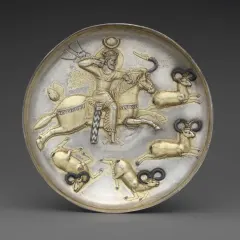 Tiro con arco a caballo Disparar desde el caballo, la destreza de los xiongnu, los göktürk, los tiele y los uigures en las historias chinas. Los niños xiongnu empezaban con ovejas. Las cortes de los Wei, los Sui y los Tang se lo hicieron exhibir.
- Polo breve Polo as Kashgari's dictionary records it in the 1070s: the stick čögän, the goal-rope talas, the boundary tasal and a match played for a pair of trousers.
- El orden de asiento en el banquete Order of rank among the guests at the feasts and audiences of the steppe rulers and at the Tang court. A guest's place showed his standing, and rival envoys quarrelled over it.
- Apuestas y envites Stakes in Turkic play: words for wagering in Kashgari's dictionary of the 1070s, and an omen of the Irk Bitig about a man who stakes his sons and women, whose reading is disputed.
- La batida Ring hunt in which people surround a stretch of country and drive the game together. The Wei emperor used the beaten Gaoche as the ring in 399; the Irk Bitig and al-Kashgari name the battue.
- La canción de los chile Song of the Chile, the people the Wei Shu calls Gaoche. The Chile general Hulü Jin sang it before the sick Gao Huan after the failed siege of Yubi in 546; its words survive in a Song anthology.
- La boda de los gaoche Marriage custom of the Gaoche as the Wei Shu records it. The bride's kin rode the groom's horses bareback out of a pen to win them, and both families feasted on mare's milk and meat.
- El banquete göktürk Feasting at the khans' courts as foreign guests saw it, from the Roman embassy to Istemi in 569 to Tong Yabgu's court at Suyab: drink and music, meat, rows of guests, silence while the khan spoke.
- El Año Nuevo en la estepa The beginning of the year on the steppe. The Xiongnu chiefs met in the first month. In 741 Tengri Khan sent the Tang emperor New Year wishes. The Kirghiz named their years after twelve animals.
- Las tres asambleas de los xiongnu Reuniones anuales de los jefes xiongnu. El Shiji nombra tres: en la corte del chanyu en el primer mes, en Longcheng en el quinto, en Dailin en otoño. Los reyes enemistados con el chanyu se quedaban fuera.
- La asamblea de primavera de los xianbei Great assembly of the Xianbei in the last month of spring, on the Raole river. The people drank and feasted there, and marriages were made at it.
- Canciones túrquicas en la corte Tang Göktürk songs at the Tang court, sung by Wu Yanxiu, whom Kapgan Khan held from 698 to 705. He came back knowing their language. Before him a Göktürk troupe had played at the Sui court.
- Caballos de madera Skis as the Chinese histories describe them: boards bound under the feet and a staff in the hand, for running down deer on snow and ice. Seven peoples of the northern forests are named as users.
- La lucha breve Contest of strength between two men. Kashgari's dictionary of the 1070s has the Turkic word čališ, and an Armenian history has Huns wrestling at their graves in 682.
- Los cantos fúnebres de los wuhuan Funeral custom of the Wuhuan. They wept at a death and saw the dead off with song and dance at the burial, and a fattened dog was to guard his spirit on the way to the Red Mountain.
Créditos de las imágenes
- Tiro con arco a caballo: Silver plate with a Sasanian king hunting rams from horseback, Iran, mid-fifth to mid-sixth century. The rider turns in the saddle and draws the bow at full gallop. The Metropolitan Museum of Art, New York, 34.33, Fletcher Fund, 1934. Open Access, public domain (CC0).

