
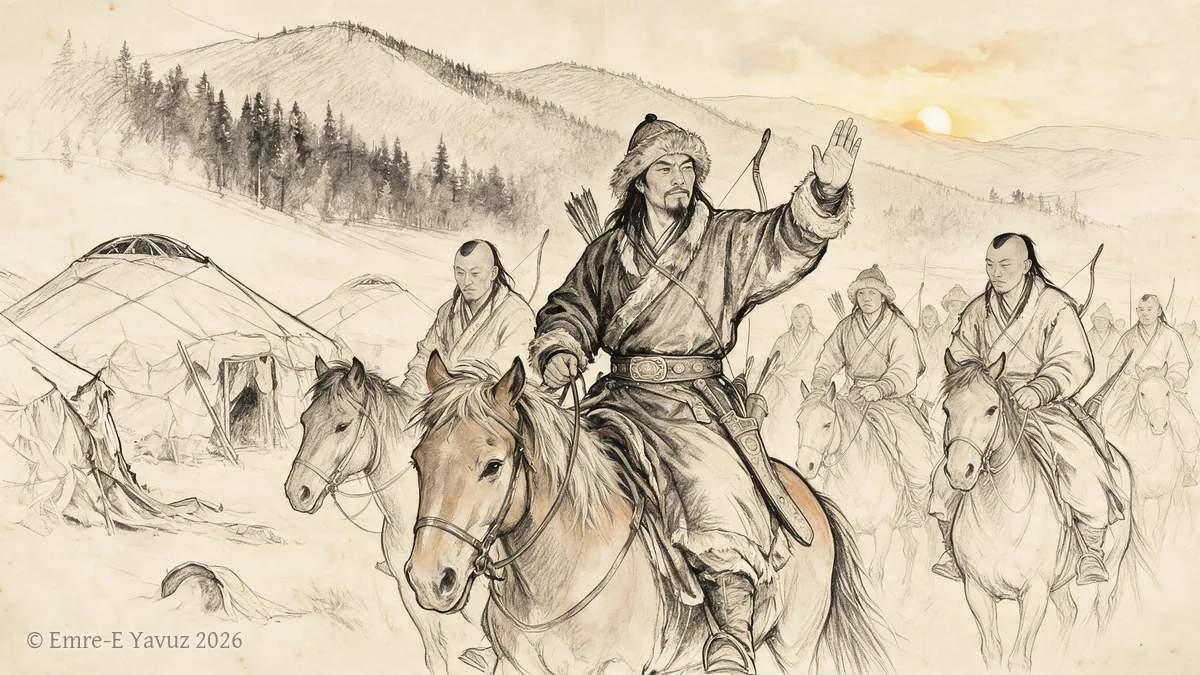
The Xianbei held the eastern steppe between the Xiongnu and the Rouran. By the reckoning of the Chinese histories, they were the ancestors of most of the dynasties that ruled northern China when the Ashina came out of the Altai. The chief account of them is chapter 90 of the Hou Han Shu.
Name, country and custom
- 鮮卑ChineseHou Han Shu 90
- 東胡ChineseHou Han Shu 90
The Hou Han Shu makes the Xianbei a branch of the Donghu, the Eastern Hu. They settled apart by the Xianbei mountain and took their name from it.[1] Their speech and their customs, it says, were those of the Wuhuan, the other branch of the same stock.[1] At the beginning of the Han, Bagatur broke them along with everyone else in the east. They fled far beyond the Liaodong frontier, where they touched the Wuhuan and had no dealings with China at all.[1]
The chapter gives only a short account of their custom, but it is worth having. At marriage they first shaved the head. In the last month of spring they held a great assembly on the Raole river, where they drank and feasted. Only afterwards were matches made.[1] Their country produced the wild horse, the yuan sheep and the horned duan ox. The horn of the ox was made into the bow that the Chinese called the horn-tip bow. The country also produced the sable and marten, whose fur China prized.[1]
Taking the place of the Xiongnu
The turn came at the end of the first century. Dou Xian’s campaigns drove the northern Chanyu out, and he fled. The Xianbei moved across and occupied his ground. The Xiongnu who stayed behind, more than a hundred thousand tents, all called themselves Xianbei. From this the Xianbei grew great.[1][2][3][4] Some scholars speak of a confederation of Xiongnu and Xianbei clans, in which Xianbei sometimes bear Xiongnu clan names and Xiongnu bear Xianbei names.[5] In their view, the southern Xiongnu did not dissolve in the Xianbei but mixed with them in both directions.[6] Modern accounts add that under Tanshihuai the Xianbei put an end to the northern Xiongnu, and that large groups of Xiongnu moved away after 91 and after 155.[7]
The sentence describes in one line what usually has to be inferred. A steppe people here succeeds another by taking its pastures and its name. The men who change the name are not conquered foreigners but the remainder of the defeated confederation.[1] Whatever else a steppe ethnonym is, it is a political label that can be put on and taken off. Every later name is best understood in the same light.
Tanshihuai
The Xianbei produced one ruler of the first rank, and the chapter treats him at length. Tanshihuai was born while his father was away for three years with the Xiongnu army. The father wanted to kill the child. The mother told a story about thunder and a hailstone she had swallowed, and the boy was given to her family to raise.[1][8] Some scholars identify the name Tanshihuai with the Turkic-Mongol title Tangsuk Khan, because of the hailstone the mother swallowed.[9] At fourteen or fifteen he rode alone after men of another tribe who had taken his mother’s family’s cattle. He drove them back and recovered everything. The tribes feared him and submitted.[1]
Then comes the part that makes him a ruler rather than a champion. He laid down prohibitions and judged between right and wrong, and no one dared break them. Therefore they raised him as their chief.[1] He set his court on the Danhan mountain by the Chuochou river, more than three hundred li north of Gaoliu. The chiefs of the eastern and western parts came over to him. He raided south along the Chinese border, held off the Dingling in the north, drove back the Buyeo in the east and struck the Wusun in the west. He took the whole of the old Xiongnu country, fourteen thousand li from east to west and seven thousand from north to south.[1][10]
The Han sent him a seal and a king’s patent and offered a marriage. He would not take it, and raided harder.[1][10] Some scholars think he refused because too few goods came with the title and the princess to hold together his alliance of clans.[11] He then divided his territory himself into three parts: east, middle and west. Each part had its own commander under him.[1] A steppe state that refuses a Chinese title and organises itself in wings has the shape that the Göktürk khaganate would take four centuries later. The resemblance is structural rather than genealogical.
Service to the Han
In AD 49 the Xianbei first sent envoys to the Han. After that their chief Bianhe came to Ji Rong, the Han governor of Liaodong, and asked to prove his loyalty. At Ji Rong’s order he struck the Northern Xiongnu and took more than two thousand heads. In the following years he went out against the northern enemy every year and brought the heads to Liaodong to receive his reward.[1][12] Later Ji Rong bribed him to strike the Wuhuan leader Xinzhifen of Chishan, who had often raided Shanggu. Bianhe killed him. After this all the Xianbei chiefs came to submit and went to Liaodong to receive their rewards. The text says that the two provinces of Qing and Xu paid 270 million cash a year for this as a matter of course.[1][12]
In the Yongchu years of the emperor An the Xianbei chief Yan Liyang came to court. The dowager Deng gave him the seal of a king and told him to stay at Ningcheng, where markets were held with the barbarians. She had two hostels built, one in the north and one in the south, for hostages. A hundred and twenty Xianbei clans each sent a hostage.[1][2]
In 220 the Wei emperor Wen made the Xianbei chief Kebineng prince of upright subordination. In 222 Kebineng came to the frontier markets of Dai with more than three thousand horsemen and drove more than seventy thousand head of horses and cattle to trade.[13]
Successor houses
Tanshihuai’s confederation did not survive him, and the Xianbei groups that followed went their own ways into northern China. From them came the Murong, the Tuoba and the Tuyuhun in the north-west. The Tuoba founded the Northern Wei and through it the Western Wei and the Northern Qi. The ruling house of the Rouran is derived from them as well. The Xianbei therefore stand behind both of the powers the Ashina had to deal with in 552: the overlord in the steppe and the courts in the south.
Language and the limits of the evidence
What the Xianbei spoke is known from personal names, titles and a handful of glossed words in Chinese transcription. No connected text survives. The usual classification is Mongolic or para-Mongolic. It is a classification of the same order as the one applied to the Rouran: an inference from a thin body of transcribed words, not a reading of a corpus.
Some class the Tuoba as Turko-Mongol and hold that the Ashina shared language and court dress with them. That is a position. Turkic Atlas treats it as one under the ethnogenesis debate. It is not what the Hou Han Shu says, and the Hou Han Shu is not in a position to say anything about it. A glossary of Xianbei words, reported in 1925 to have been found among the Chinese texts, has been judged wholly Turkic. The same kind of glossary showed the language of the Khitan to be Mongolic.[14] A further proposal counts the Xianbei as Turks who ruled in eastern Mongolia from 266 to 394 and explains their words from the Göktürk and Uyghur languages. It takes the Rouran to be probably Mongolic.[15] The court titles of the Tuoba are taken by some to be Turkic. They interpret the Chinese transcriptions of the titles of a secretary, a gatekeeper and an official of the belt as bitigči, kapaɣčı and kurlaɣčı.[16] A Tang geography of 814 glosses the name of a mountain in northern Shanxi as “thirty li” in the language of the barbarians. The name suits the Mongolic word for thirty, not the Turkic one, and has been taken as a trace of Mongolic speech among the successors of the Xianbei.[17] One scholar counts the Tuoba as a branch of the Asian Huns, regards their titles as Turkic and gives roughly three fifths of their clans as Turkic and a third as Mongolic.[18]
References
- ^ a b c d e f g h i j k l m n o p Hou Han Shu, juan 90
- ^ a b Jagchid 1989, p. 34
- ^ Litvinsky 1996, p. 313
- ^ Ögel 2015, p. 301,304
- ^ Ögel 2015, p. 304–305
- ^ Ögel 2015, p. 386
- ^ Kafesoğlu 1997, p. 67–68
- ^ Ögel 2015, p. 354–355
- ^ Ögel 2015, p. 354
- ^ a b Jagchid 1989, p. 35
- ^ Jagchid 1989, p. 36
- ^ a b Jagchid 1989, p. 33
- ^ Sanguozhi, juan 30
- ^ Barthold 2004, p. 25
- ^ Togan 1981, p. 41
- ^ Tekin 2003, p. 13–14
- ^ Pelliot 1929, p. 251–252
- ^ Kafesoğlu 1997, p. 90–93
Sources
- Hou Han Shu, juan 90
- Wei Shu, juan 103
- Sanguozhi, juan 30
Literature
- Emre-E. Yavuz, The Gokturk Empire: 2nd Edition (2025)
- Peter B. Golden, An Introduction to the History of the Turkic Peoples (1992)
- Sechin Jagchid; Van Jay Symons, Peace, War, and Trade Along the Great Wall. Nomadic-Chinese Interaction through Two Millennia (1989)
- Bahaeddin Ögel, Büyük Hun İmparatorluğu Tarihi II (2015)
- B. A. Litvinsky; Zhang Guang-da; R. Shabani Samghabadi (ed.), History of Civilizations of Central Asia, Vol. III (1996)
- İbrahim Kafesoğlu, Türk Millî Kültürü (1997)
- V. V. Barthold, Orta Asya Türk Tarihi Dersleri (Orta Asya Türk Tarihi Hakkında Dersler) (2004)
- Talât Tekin; Mehmet Ölmez, Türk Dilleri: Giriş (2003)
- Paul Pelliot, Neuf notes sur des questions d'Asie Centrale (1929)
- Zeki Velidi Togan, Umumi Türk Tarihine Giriş I (1981)
What links here40
- States
- Northern Wei · Southern Xiongnu · Suo · Western Wei · Xiongnu
- Conflicts
- Han campaigns against the Northern Xiongnu · Hegemony Wars in Northern China · The Rouran–Wei wars, 402–449
- Battles & Events
- Göktürk–Wei Campaign against Tuyuhun (556) · Xiongnu split of 48
- Places
- Berel
- Peoples
- Donghu · Eurasian Nomads · History of the Turkic peoples · Khitan · Rouran · The Great Empires of the Steppe · Tuoba · Tuyuhun
- Institutions and Titles
- Bone and Horn Working · Drums and Banners for the Khans · Khan (Khagan) · Women among the Turkic Peoples
- Foods
- Millet · Steppe Diet
- Customs & Pastimes
- The Chile Song · The Three Xiongnu Assemblies · The Xianbei Spring Assembly · Turkic Songs at the Tang Court · Wuhuan Funeral Songs
- Controversies
- The Göktürks and the Xiongnu · The Turkic ethnogenesis debate
Cite this article
Yavuz, Emre-E. “Xianbei.” Turkic Atlas, revised 8 November 2026. https://turkicatlas.org/ethnicities/xianbei/
Last revised: 8 November 2026

