
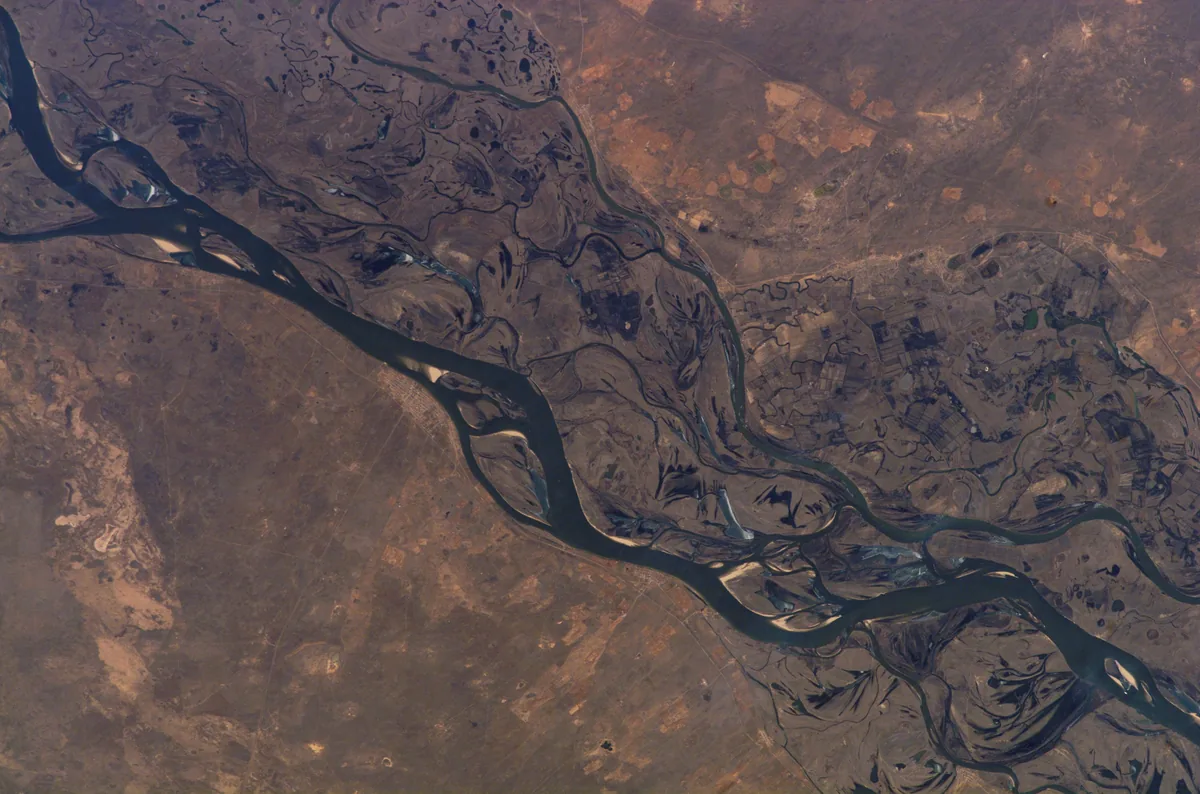
The Volga is the river that Menander calls the Attila.[1] Its Turkic name is Atïl or Itil.[2] The Roman envoy Zemarchos came to it in 571 on his way home from Istemi.[1][3] By then Göktürk power had passed the Volga.[3] Beyond it the chief of the Ugurs held the country for the Göktürk ruler.[1]
Before the Göktürks
The crossing of the Volga by the Huns is sometimes dated to 395. That is the year in which the Roman empire was divided.[4] A second has the European Huns cross it about 370. By 375 they had crushed the Alanic tribes of the Don region.[5] The Sabirs probably appeared in the steppe of the lower Volga in the early sixth century. They were there by 515.[6]
The Attila of Menander
Zemarchos returned from his embassy to Istemi along the sandy shore of a great lake for twelve days.[1] He came to the river Ikh, then to the Daikh. After passing other lakes, he came to the Attila.[1] The three rivers are the Emba, the Ural and the Volga.[3] Menander’s names render their Turkic names.[2]
Beyond the Attila the embassy came to the Ugurs.[1] Menander says that their leader maintained there the authority of Istemi, whom he calls Sizabul.[1] The leader gave the Romans skins of water for the crossing of the desert.[1] The Ugurs may have lived west of the Volga, with their ruler as the khagan’s principal deputy in that region.[7]
The Sogdian trade that Maniakh planned to carry to the Romans may have avoided the Persian market. The trade would take the more dangerous road across the Volga, where the Onogurs, the Bulgars and other Turkic peoples lived.[8]
The Til of Theophylact
In the letter of a Göktürk khan to the emperor Maurice, which Theophylact Simocatta preserves, the khan subdued all the Ogur.[9] They lived in the east, “by the course of the river Til, which Turks are accustomed to call Melas”, the Black.[9] The Til may be the Volga and the Ogur the Ogurs of the steppe near the Caucasus.[10] Alternatively, the Ogur are the Uyghurs and the Til the Tola in Mongolia. The Uyghurs lived on it at the time of the Sui.[11] In that case Til is simply the Turkic word atil or itil, “river”.[11] A third possibility is that the Til is the Tarim and the Ogur the Oghuz.[12]
The Atel of Theophanes
Theophanes, writing in the early ninth century, describes the Maeotid Lake, the Sea of Azov.[13][14] He says that “a huge river called Atel” flows into it. The river comes down from the Ocean through the land of the Sarmatians and is joined by the Tanais.[15] The Atel is the Volga. In fact the Volga neither flows into the Sea of Azov nor joins the Don.[16] In his account the old Great Bulgaria of the Bulgars and the Kotragoi lay from the same lake toward the river Kouphis.[17]
Under the Khazars
Al-Masʿūdī says that the Khazars moved their capital from Samandar to Atil on the lower Volga because of the Arab attacks.[18] In the north the Khazar khaganate took in the middle Volga, with the state of the Volga Bulgars.[19]
References
- ^ a b c d e f g h Menander Protector; Blockley 1985, fr. 10.4, p. 125
- ^ a b Golden 1992, p. 129–130
- ^ a b c Blockley 1985, p. 266
- ^ Yavuz 2025, p. 83, 95
- ^ Golden 1992, p. 87, 89
- ^ Golden 1992, p. 105
- ^ Golden 1992, p. 130
- ^ Yavuz 2025, p. 284
- ^ a b Theophylact Simocatta; Whitby 1986, vii.7.13, p. 189
- ^ Golden 1992, p. 102, 109
- ^ a b Chavannes 1903, p. 251
- ^ Whitby 1986, p. 189
- ^ Golden 1992, p. 102
- ^ Mierow 1915, p. 148
- ^ Theophanes the Confessor; Scott 1997, p. 497
- ^ Scott 1997, p. 500
- ^ Theophanes the Confessor; Scott 1997, p. 498
- ^ Golden 1992, p. 238
- ^ Golden 1992, p. 239
Sources
- Menander Protector
- Theophylact Simocatta
- Theophanes the Confessor (after Theophylact Simocatta)
Literature
- R. C. Blockley, The History of Menander the Guardsman: Introductory Essay, Text, Translation, and Historiographical Notes (1985)
- Ludwig Dindorf (ed.), Historici Graeci minores, Bd. II: Menander Protector et Agathias (1871)
- Peter B. Golden, An Introduction to the History of the Turkic Peoples (1992)
- Emre-E. Yavuz, The Gokturk Empire: 2nd Edition (2025)
- Édouard Chavannes, Documents sur les Tou-Kiue (Turcs) occidentaux (1903)
- Michael Whitby, Mary Whitby (trans.), The History of Theophylact Simocatta (1986)
- Cyril Mango, Roger Scott (trans.), The Chronicle of Theophanes Confessor: Byzantine and Near Eastern History AD 284–813 (1997)
- Charles Christopher Mierow, The Gothic History of Jordanes in English Version, with an Introduction and a Commentary (1915)
What links here23
- Persons
- Attila · Irbis Shegui Khan
- Battles & Events
- Flight of the Avars (557) · Funeral of Istemi (576) · The embassy of Zemarchos, 569 · The khan's letter to Maurice
- Institutions and Titles
- Ilteber · Trade Routes of the Steppe
- Sources
- Menander Protector
- Controversies
- The Huns and the Xiongnu
Cite this article
Yavuz, Emre-E. “Volga.” Turkic Atlas, revised 8 November 2026. https://turkicatlas.org/places/volga/
Last revised: 8 November 2026

