
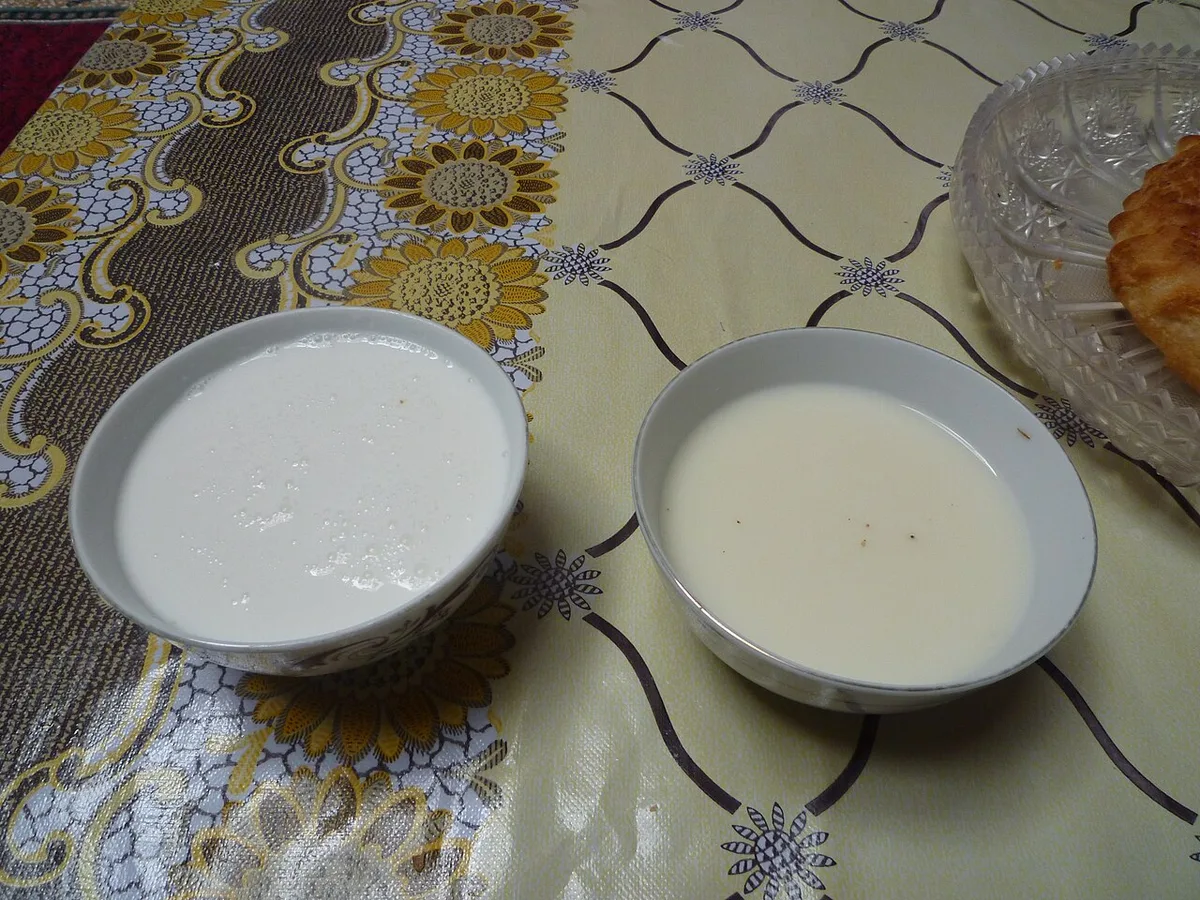
Kumys is mare’s milk fermented in a skin until it is slightly sour and slightly alcoholic. The fermentation preserves it, which plain milk on a summer steppe is not. It also breaks down the sugar that adults digest poorly. Mahmud al-Kashgari first writes down its Turkic name in the 1070s. He describes it in the same way: mare’s milk that is poured into skins, then fermented and drunk.[1]
A herd of mares thus gave its owners a food that needed no storehouse. The Chinese recorded the drink from the Han period onward. The Han court made it for itself.
Mare’s milk holds less of the protein that forms curd than the milk of cattle, sheep and goats, and it holds much more sugar. It makes poor curd and suits fermented drinks.[2] Proteins of mare’s milk appear in the teeth of herders on the Mongolian steppe from about 1200 BC.[3] The milk of the other animals went into curds, butter and ayran. Dried, the curd became qurut.[2]
Mare’s milk at the Han court
The Han Shu lists among the offices under the Grand Coachman, 太僕, one for the household horses.[4] In 104 BC Emperor Wu renamed it 挏馬.[4] Two early commentators on the Han Shu explain the name from the churning of mare’s milk.[4] Ying Shao says that the office kept the mares in milk, took their milk and churned it. He says that it tasted sour and could be drunk.[4] Ru Chun adds that the milk was poured into leather bags holding several measures and churned, and the fat on top was taken off.[4] In his own day, he says, the people of Liangzhou also called fermented mare’s milk “horse wine”.[4] The court musicians were cut back under Emperor Ai. The memorial on the music office proposed to dismiss seventy of its trainees.[5] It kept seventy-two others, who served the imperial kitchen with its mare’s-milk wine.[5]
For the period of the Xiongnu, fermented mare’s milk is the dairy product the Chinese records mention most often.[2] The Han Shu also gives the song of Xijun, a Han princess married to the king of the Wusun. The song runs: a tent is my house and felt my walls, meat is my food and 酪 my drink.[6] Some scholars identify her drink as fermented mare’s milk.[7]
The Gaoche and the Göktürks
The Wei Shu describes the Gaoche, the “high carts” whom the later histories call the Tiele.[8] They had no grain and made no wine.[8] On the day a bride was fetched, men and women went together. They carried fermented mare’s milk, 馬酪, and boiled meat cut at the joints.[8] The host received the guests without any order of seats. They sat in a crowd in front of the tent, feasted and drank the whole day, and stayed the night.[8] Since the Gaoche made no wine, what they drank was most probably the mare’s milk they had brought.
Of the Göktürks the Sui Shu says that they ate meat and drank soured milk.[9] The men liked a game of chance, and the women kicked a ball. They drank fermented mare’s milk until they were drunk, and they sang and shouted to one another.[9] The word is again 馬酪.[9] The Bei Shi and the Tongdian repeat the passage. Both copy the Sui Shu and add no second witness.[10] The drink is identified as kumys.[11]
The Roman envoys came to Istemi in 569 and feasted in his tent. They drank no wine from grapes, Menander says, because the land grew no vine. They drank their fill of another, sweet kind of wine.[12][13] It has been identified as kumys. Against this, it is objected that kumys is sour, and mead or rice wine are proposed instead. A third proposal is beer.[14]
On the embassy to Attila, Priscus records, the servants were given millet and a drink made from barley that the barbarians called kamos.[15] Kamos has been equated with the Turkic name of kumys. The equation is rejected by others, because the word has a Greek ending and kumys is made from milk, not from barley.[16] They hold all the same that the Huns, like all the steppe peoples, drank mare’s milk and made kumys.[17]
Kirghiz, Boma and Uyghurs
The Xin Tang Shu says of the Kirghiz that their tribes ate meat and fermented mare’s milk. It says that only their ruler had cakes served.[18] The Tongdian describes the Boma, the “Piebald Horses”, a people near the northern sea. One reached them by passing through five great tribes of the Göktürks.[19] They had three hundred thousand horses. They put horses and men to the plough but did not ride. They took the milk of the horses for their food.[19] The Xin Tang Shu repeats the notice.[18]
Early in the Yuanhe era, after 806, the embassies of the Uyghurs brought Manichaean priests to the Tang court for the first time.[18] Their rule, the Xin Tang Shu says, was to eat late in the day, to drink water and to shun milk and 酪.[18] The same passage says that the khan always shared the government with them.[18] Milk was thus forbidden to the priests with whom the khan shared his rule.
Kumys in the Kutadgu Bilig
The Kutadgu Bilig was finished at the Karakhanid court in 1069–1070. It names kımız first among the goods the herders supply, before milk, wool, butter, yoghurt and kurut.[20] It advises the prince to treat the herders well, because they also provide the army’s horses and the felt and rugs of the household.[21]
Kumys in Kashgari’s dictionary
Kashgari’s dictionary gives the Turkic name, qimiz, and glosses it with the Arabic al-āmiṣ.[1] Sour apples are called qimiz almila, apples resembling koumiss.[1] The comparison shows that kumys was known for its sour taste. Är qimiz bišdi means “the man stirred the koumiss so that it reached the proper consistency”.[22] The same verb is used of a pot of soup that is done and of fruit that has ripened.[22]
The vessels have their own words. Qorluq is “a skin for keeping koumiss”.[23] Qasuq is a thing like a water-skin, made of horse-hide and used to keep milk or koumiss. Qasuqluγ är is a man who has a skin of koumiss.[24] Butiq is a container made from the skin of a horse’s leg, used to keep koumiss and other things.[25] Qaltuq is the horn of the wild ox, the yak, which is pierced and used to drink koumiss.[26]
A verse in the dictionary praises the Oghrak, a Turkic tribe.[27] They are sturdy, their food is kids, and there is ever a cup over their milk, though their land is bare.[27] Kashgari renders the milk of the verse, süt, as koumiss. He says that the verse describes them as generous and brave.[27]
For the Göktürks the Sui Shu names fermented mare’s milk once, in its account of their customs.[9] Its Turkic name, qimiz, appears in writing five centuries later, in Kashgari’s dictionary.
A Turkish history of culture holds that kumys served the Turks as daily food. In the seasons when mare’s milk was plentiful, many travellers report, the people of Central Asia drank only kumys in place of meals.[28] The work rests this on the reports of travellers and not on a text of the khaganates.
References
- ^ a b c Dīvān Lughāt al-Turk; al-Kāshgharī 1072–1074, p. 282
- ^ a b c al. 2020, p. 14
- ^ al. 2020, p. 2
- ^ a b c d e f Han Shu, juan 19
- ^ a b Han Shu, juan 22
- ^ Han Shu, juan 96
- ^ Golden 1992, p. 51
- ^ a b c d Wei Shu, juan 103
- ^ a b c d Sui Shu (Book of Sui), juan 84
- ^ Bei Shi (History of the Northern Dynasties), juan 99; Tongdian, juan 197
- ^ Golden 1992, p. 152
- ^ Menander Protector; Blockley 1985, fr. 10.3, p. 121
- ^ Laufer 1919, p. 233
- ^ Blockley 1985, p. 264
- ^ Priscus; Müller 1851, fr. 8, p. 83
- ^ Maenchen-Helfen 1973, p. 425
- ^ Maenchen-Helfen 1973, p. 220
- ^ a b c d e Xin Tangshu (New Book of Tang), juan 217
- ^ a b Tongdian, juan 200
- ^ Kutadgu Bilig; Dankoff 1983, couplets 4441–4442
- ^ Kutadgu Bilig; Dankoff 1983, couplets 4439–4443
- ^ a b Dīvān Lughāt al-Turk; al-Kāshgharī 1072–1074, p. 393
- ^ Dīvān Lughāt al-Turk; al-Kāshgharī 1072–1074, p. 353
- ^ Dīvān Lughāt al-Turk; al-Kāshgharī 1072–1074, p. 293,369
- ^ Dīvān Lughāt al-Turk; al-Kāshgharī 1072–1074, p. 289
- ^ Dīvān Lughāt al-Turk; al-Kāshgharī 1072–1074, p. 354
- ^ a b c Dīvān Lughāt al-Turk; al-Kāshgharī 1072–1074, p. 350
- ^ Ögel 1978, p. 160
Sources
- Dīvān Lughāt al-Turk
- Han Shu, juan 19, 22, 96 (after Shiji)
- Wei Shu, juan 103
- Sui Shu (Book of Sui), juan 84
- Bei Shi (History of the Northern Dynasties), juan 99 (after Wei Shu, Zhou Shu and Sui Shu)
- Tongdian, juan 197, 200 (after Sui Shu and Zhou Shu)
- Xin Tangshu (New Book of Tang), juan 217 (after Jiu Tangshu)
- Menander Protector
- Priscus
- Kutadgu Bilig
Literature
- Shevan Wilkin, Alicia Ventresca Miller, William T. T. Taylor et al., Dairy pastoralism sustained eastern Eurasian steppe populations for 5,000 years (2020)
- Maḥmūd al-Kāshgharī, Dīwān Lughat al-Turk (1072–1074)
- Peter B. Golden, An Introduction to the History of the Turkic Peoples (1992)
- R. C. Blockley, The History of Menander the Guardsman: Introductory Essay, Text, Translation, and Historiographical Notes (1985)
- Karl Müller (ed.), Fragmenta Historicorum Graecorum, Bd. IV (darin: Menandri Protectoris fragmenta, griechisch mit lateinischer Übersetzung) (1851)
- Otto J. Maenchen-Helfen, The World of the Huns: Studies in Their History and Culture (1973)
- Berthold Laufer, Sino-Iranica. Chinese Contributions to the History of Civilization in Ancient Iran (1919)
- Bahaeddin Ögel, Türk Kültür Tarihine Giriş IV: Türklerde yemek kültürü (1978)
What links here14
- Foods
- Ayran · Bread · Grape Wine in Central Asia · Kamos · Millet Beer · Qurut · Steppe Diet
- Customs & Pastimes
- Culture of the Turkic Peoples · Feasts in Kashgari's Dictionary · The Gaoche Wedding · The Göktürk Feast
Cite this article
Yavuz, Emre-E. “Kumys.” Turkic Atlas, revised 8 November 2026. https://turkicatlas.org/foods/kumys/
Last revised: 8 November 2026


