
Justin II answered Maniakh’s embassy with one of his own.[1] Menander says that the Turks, who had formerly been called the Sacae, had sent an embassy to Justin about peace. The emperor decided to send an envoy in return.[1] He chose Zemarchos the Cilician, then general of the cities of the east.[1] Zemarchos left Constantinople with Maniakh and his party. After a journey of many days he reached the land of the Sogdians. From there the Göktürks led him to the camp of Istemi on a mountain called Ektag, which Menander renders as the Golden Mountain.[2][3]
The location of Ektag is disputed. It has been placed in the Altai, whose name the Greek would translate.[4] A second explanation takes the name as Ak tag, white mountain, and seeks it in the Tian Shan, by the Tekes or in the Yulduz valley.[4][5] A third takes Ektag and the Ektel of 576 for one mountain named after a Turkic word for lime.[6] A fourth takes Ektag, the Turkic Altın Dağ and the Chinese Baishan, the White Mountain, for one range in the Tian Shan.[7] One author puts Istemi’s camp on a mountain north of Kucha.[8][9] Another takes Ak Dag and Altın Dağ for two names of the same place.[3] Theophylact Simocatta, writing a generation later, says that the Göktürks call a mountain in the east golden, for its fruits and its flocks. By custom, he says, the most powerful khagan holds it.[10]
Date
Menander dates the departure three ways. He sets it near the end of the fourth year of Justin II, in the second year of the indiction, at the beginning of the month the Latins call August.[1] Justin came to the throne in November 565. His fourth year therefore ran from November 568 to November 569. The indiction year ended on the last day of August. The three calculations meet in August 569.[11][12] An older count puts the departure a year earlier, in August 568.[13][14]
John of Ephesus, a Syriac church historian of the same years, places the embassy in the seventh year of Justin, which began in November 571.[15] He adds that the envoys came home after an absence of two years.[16] Reckoned from Menander’s date of departure, the two years bring the return to late 571.[17] The Göktürk embassy that came back with Zemarchos is dated to 571 on the same ground.[18]
The purification
When the envoys dismounted in the land of the Sogdians, Göktürks who had evidently been told to do so offered them iron for sale.[2] Menander thought the offer was meant to show that the Göktürks had iron mines, since iron was said to be hard to come by among them.[2]
Other men of the same people, who were said to be averters of ill omens, then took the embassy’s baggage and set it on the ground.[2] They lit branches of frankincense and chanted words in their own tongue. They rang bells and beat drums. They waved the crackling branches over the baggage.[2] Falling into a frenzy, they believed they were driving off evil spirits.[2] Then they led Zemarchos himself through the flame. They thought that in this way they had purified themselves as well.[2] The purpose was to keep whatever the strangers might be carrying from entering the land with them.[19]
Before the embassy was admitted, Zemarchos had to walk through the fire, presumably between two flames, while those present made sounds that seemed shamanic.[20][21] Rubruck reports the same custom for envoys at the Mongol court.[21] Menander speaks of a single fire.[2] The rite took place on the edge of Sogdiana. Göktürk power in 569 may therefore have reached no further west.[4][22] It is the only description of a Göktürk rite by a man who stood in it. The observer had no doctrine to fit it into.
The court
Istemi was staying in a valley of the mountain. He received the envoys in a tent, seated on a golden throne with two wheels, which one horse could draw when needed.[2][23][9] Zemarchos greeted him as ruler of so many peoples. He delivered Justin’s wishes: good fortune and success, victory over his enemies, and no jealousy to destroy the laws of friendship.[2] The emperor said that the Göktürks and the peoples subject to them were his friends. He asked Istemi to think so of the Romans.[2] Istemi answered in like words.[2]
They feasted for the rest of the day in the same tent, which was hung with silk dyed in many colours.[2] They drank no wine from grapes, since the land grows no vines. They drank a sweet drink of another kind.[2][24] What the drink was is not known. Scholars have proposed kumiss, beer, mead and rice wine.[4][9] On the next day they met in another hut, also hung with silk, where statues of different shapes stood.[2] Istemi sat on a couch made entirely of gold. In the middle of the room stood golden urns, water-sprinklers and pitchers.[2] On the third day they came to a dwelling with gilded wooden pillars and a couch of beaten gold carried by four golden peacocks.[2][23] In front of it stood a long line of wagons loaded with silver dishes, bowls and statues of animals. Menander says they were no worse than those the Romans made, and concludes that the ruler of the Göktürks was wealthy.[2] The wealth was portable, and the court was a camp.
The march toward Talas
While the Romans waited, Istemi decided that Zemarchos should go with him on his campaign against Persia, together with twenty followers and attendants.[2] The other Romans were to go ahead to the land of the Kholiatai and wait there.[2] Istemi gave Zemarchos a female slave, a captive of the people called Kherkhir.[2] The name renders that of the Kirghiz.[4]
At a place called Talas a Persian envoy came to meet Istemi. Istemi invited both envoys to dine.[2] He gave the Romans the more honourable couch. He charged the Persians with the wrongs he had suffered, which, he said, were his reason for going to war.[2] The Persian envoy broke the custom of silence that held at their feasts and argued back in intemperate words.[2] The envoys parted. Istemi prepared his attack on Persia.[2]
The return
Istemi then summoned Zemarchos, reaffirmed the friendship with the Romans, and sent him home with a Göktürk embassy.[2] Its leader was Tagma, whose title was Tarkhan. With him went the young son of Maniakh, who had died.[2] Zemarchos caught up with the Romans sent ahead. He left the first city of the Kholiatai and travelled on through fortresses.[2] The news spread that Roman envoys were going home with a Göktürk embassy. The leaders of the neighbouring peoples then asked leave to send men of their own to see the Roman empire.[25] Istemi allowed only the leader of the Kholiatai.[25]
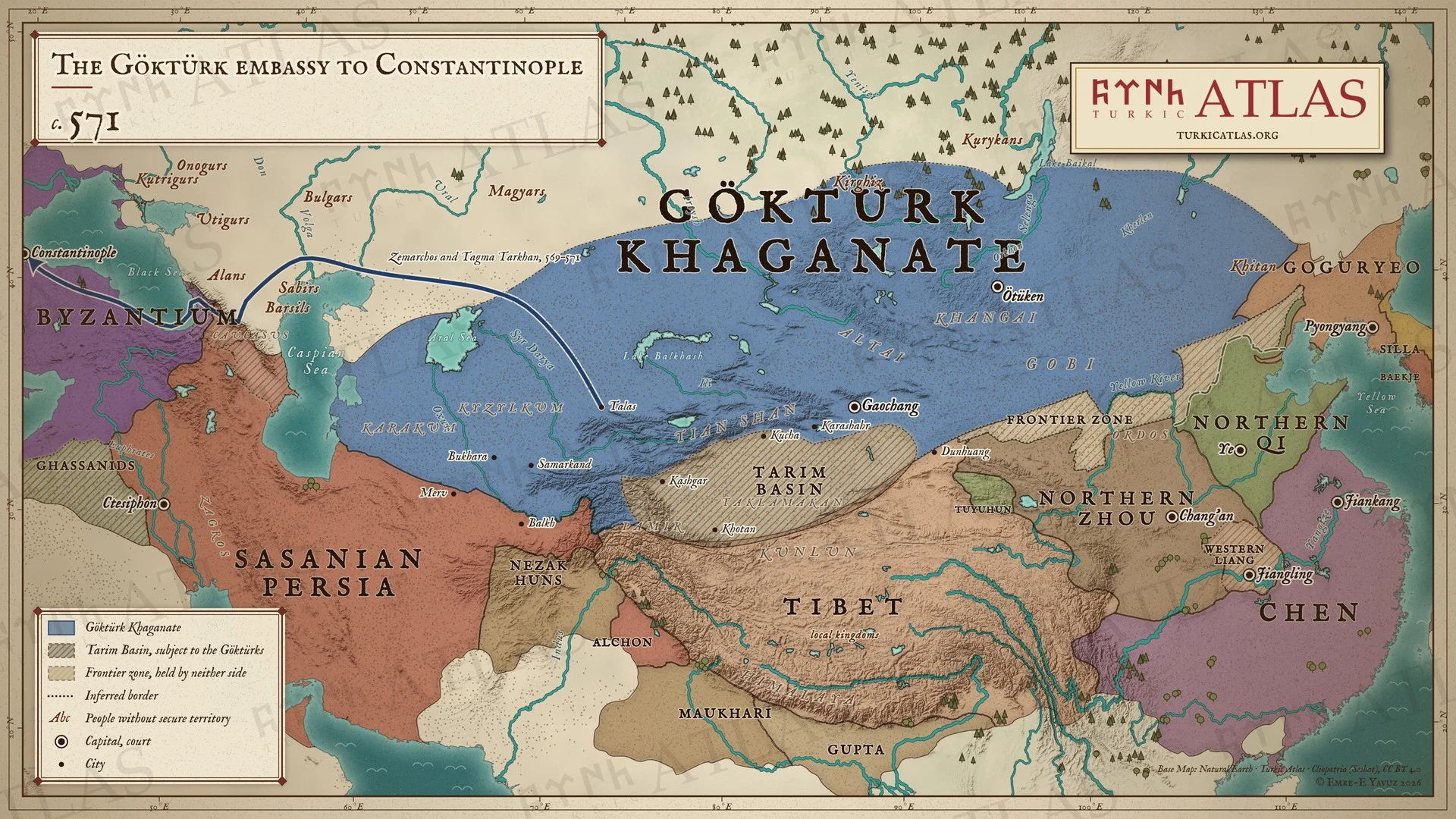
The Romans took him across the river Oekh and came, after a long way, to an enormous, wide lake.[25] The lake has been taken both for the Aral and for the Caspian.[26] There Zemarchos rested three days.[25] He sent a certain George ahead with twelve Göktürks, by a shorter road through waterless desert. George carried a brief letter telling the emperor that they were returning.[25] Zemarchos himself followed the sandy shore of the lake for twelve days. He came to the river Ikh, then to the Daikh, and after other lakes to the Attila.[25] The three rivers are the Emba, the Ural and the Volga.[27]
Then the embassy came to the Ugurs, whose leader held the country for Istemi.[25] The Ugurs warned that four thousand Persians lay in ambush in a wooded place by the river Kophen. They filled skins with water for the desert crossing.[25] Scouts sent ahead to the lakes into which the Kophen runs found no one.[25] The embassy went on in fear, above all of a people called the Oromuskhi.[25]
In the land of the Alans their ruler Sarosios, Sarodios in the older editions, received Zemarchos gladly. He would not admit the Göktürk envoys until they had laid down their arms.[28] They argued for three days. Then Zemarchos settled the dispute, and the Göktürks disarmed.[28] Sarosios warned that the Persians lay in wait in Suania, on the road through the land of the Miusimians. He advised the road called Dareine instead.[28] Zemarchos sent ten porters with silk along the road through Miusimia, so that the Persians would think the silk had gone ahead and expect him on the next day.[28] He himself went by Dareine to the land of the Apsilii and reached the Black Sea.[28] He took ship to the river Phasis and another ship to Trapezus. He rode the public post to Constantinople and told the emperor everything.[28]
The account of John of Ephesus
John of Ephesus tells the embassy in his church history. He wrote his account before Menander wrote his.[29] Justin, he says, sent the embassy under Zemarchos to the Turks. Never before had a Roman embassy gone to these numerous and powerful peoples.[15] The envoys arrived after a year’s journey.[15] One of the kings of the Turks, who had eight other chiefs dwelling farther inland, wept bitterly when he saw them and did not speak for two hours.[30] Then he told them why. A tradition handed down for generations said that when Roman envoys entered their lands, the whole world would pass away and all its kingdoms come to an end.[31]
The envoys spread out gifts of gold, silver, pearls and robes of state. The king chose the finest pieces and said that these were indeed the gifts of a great king.[31] Persian envoys at his court had told him that the Roman emperor was their slave and paid them tribute. The king asked whether this was true.[31] Zemarchos answered that many Roman emperors had invaded Persia. Since Trajan, he said, the Persians trembled before his statue in their land and would not ride past it.[32] The king called the Persians before him. They admitted that the statue stood there, and he dismissed them in anger.[33] When Khosrow heard of it he had the statue overthrown.[34] His hostility grew, because he believed that the Romans were stirring up these peoples against him.[16] John names the embassy to the Turks as the second cause of the war between Rome and Persia, after the surrender of the Persarmenians to Rome.[35]
The two accounts meet in the gifts, the Persian envoy and the quarrel over Roman honour. Menander sets the quarrel at Talas, on the march. John sets it at the king’s court.[36] The weeping king and the statue of Trajan appear only in John. Neither author can have used the other.[29]
Other witnesses
Theophanes of Byzantium, a contemporary whose history survives only in the summary of the patriarch Photios, records that Justin sent Zemarchos as envoy to the Turks.[37] According to the summary, Zemarchos feasted the Turks splendidly, was received with the greatest friendship, and returned to Byzantium.[37] The summary goes straight on to Khosrow’s campaign against the Homerites of southern Arabia, friends of the Romans. It joins the two with a “therefore”.[37]
Menander also names the Göktürks as the power that most encouraged Justin to go to war with Persia.[38] They had invaded the land of the Medes and laid it waste. They sent an embassy to urge Justin to join them against the common enemy.[38] This embassy may be the embassy of Tagma that came back with Zemarchos. The attack may be the one whose beginning Zemarchos saw at Talas.[39]
Reliability
Together with the embassy of Valentinos in 576, this journey gives almost everything known from the inside about the western khaganate in the sixth century. Menander wrote from the envoys’ reports. His exact date of departure points to an official record.[40] The strange details have parallels in other accounts of journeys to the steppe. There is no reason to think them invented.[41] Menander recorded the fire, the throne, the wheels, the silk and the manners because they were strange to him, not because they proved anything. For that reason the details can be used.
References
- ^ a b c d Menander Protector; Blockley 1985, fr. 10.2
- ^ a b c d e f g h i j k l m n o p q r s t u v w x y z aa ab Menander Protector; Blockley 1985, fr. 10.3
- ^ a b Kafesoğlu 1997, p. 100–101
- ^ a b c d e Blockley 1985, p. 264
- ^ Golden 1992, p. 129
- ^ Gedikli 2022b, p. 13
- ^ Taşağıl 1995, p. 33
- ^ Ögel 2000, p. 271
- ^ a b c Ögel 2000, p. 51–52
- ^ Theophylact Simocatta; Whitby 1986, VII.8.12
- ^ Blockley 1985, p. 263
- ^ Taşağıl 1995, p. 32–33
- ^ Yavuz 2025, p. 290
- ^ Ögel 2000, p. 51
- ^ a b c John of Ephesus; Smith 1860, p. 425
- ^ a b John of Ephesus; Smith 1860, p. 428
- ^ Blockley 1985, p. 267
- ^ Golden 1992, p. 130
- ^ Menander Protector
- ^ Yavuz 2025, p. 145
- ^ a b Ögel 1995, p. 522
- ^ Markwart 1938, p. 148
- ^ a b Ögel 2000, p. 271–273
- ^ Laufer 1919, p. 233
- ^ a b c d e f g h i j Menander Protector; Blockley 1985, fr. 10.4
- ^ Blockley 1985, p. 265–266
- ^ Blockley 1985, p. 266
- ^ a b c d e f Menander Protector; Blockley 1985, fr. 10.5
- ^ a b Dickens 2021, p. 543
- ^ John of Ephesus; Smith 1860, p. 425–426
- ^ a b c John of Ephesus; Smith 1860, p. 426
- ^ John of Ephesus; Smith 1860, p. 426–427
- ^ John of Ephesus; Smith 1860, p. 427
- ^ John of Ephesus; Smith 1860, p. 427–428
- ^ John of Ephesus; Smith 1860, p. 424–425
- ^ Blockley 1985, p. 265
- ^ a b c Theophanes of Byzantium; Müller 1851, p. 270–271
- ^ a b Menander Protector; Blockley 1985, fr. 13.5
- ^ Blockley 1985, p. 269
- ^ Blockley 1985, p. 6
- ^ Blockley 1985, p. 13
Sources
Literature
- R. C. Blockley, The History of Menander the Guardsman: Introductory Essay, Text, Translation, and Historiographical Notes (1985)
- R. Payne Smith (trans.), The Third Part of the Ecclesiastical History of John, Bishop of Ephesus (1860)
- Karl Müller (ed.), Fragmenta Historicorum Graecorum, Bd. IV (darin: Menandri Protectoris fragmenta, griechisch mit lateinischer Übersetzung) (1851)
- Michael Whitby, Mary Whitby (trans.), The History of Theophylact Simocatta (1986)
- Peter B. Golden, An Introduction to the History of the Turkic Peoples (1992)
- Emre-E. Yavuz, The Gokturk Empire: 2nd Edition (2025)
- Mark Dickens (Turkish trans.), Zemarkhos'un elçiliği hakkında Efesli Yuhanon (John of Ephesus on the Embassy of Zemarchus) (2021)
- Uno Harva, Die religiösen Vorstellungen der altaischen Völker (1938)
- Yusuf Gedikli, Göktürkçe Ektág, Ektél Dağ Adlarının Köken ve Anlamı (2022)
- Berthold Laufer, Sino-Iranica. Chinese Contributions to the History of Civilization in Ancient Iran (1919)
- Josef Markwart, Wehrot und Arang. Untersuchungen zur mythischen und geschichtlichen Landeskunde von Ostiran (1938)
- İbrahim Kafesoğlu, Türk Millî Kültürü (1997)
- Bahaeddin Ögel, Türk Mitolojisi (Kaynakları ve açıklamaları ile destanlar) II (1995)
- Bahaeddin Ögel, Türk Kültür Tarihine Giriş I: Türklerde köy ve şehir hayatı (2000)
- Bahaeddin Ögel, Türk Kültür Tarihine Giriş VII: Türklerde ordu, ordugah ve otağ (2000)
- Ahmet Taşağıl, Gök-Türkler, Bd. I (1995)
What links here28
- Persons
- Justin II · Maniakh · Tagma Tarkhan
- Conflicts
- Göktürk Expansion along the Silk Road · Göktürk Expansion into Europe · The Göktürk–Sasanian Trade Conflict
- Battles & Events
- Embassy of Valentinos (576) · Istemi's campaign against Persia, 569 · Khosrow's gift of maidens (573) · The embassies to Ctesiphon, 568 · The Göktürk–Byzantine alliance
- Peoples
- Ogurs · Yenisei Kirghiz
- Institutions and Titles
- Envoys and Embassies · Göktürk Ironworking · Post and Communication · Trade Routes of the Steppe · Wagons of the Steppe Peoples
- Religions
- Fire Worship · Purification by Fire
- Foods
- Grape Wine in Central Asia · Kumys · Millet Beer
- Customs & Pastimes
- Seating at the Feast · The Göktürk Feast
- Sources
- Menander Protector
Cite this article
Yavuz, Emre-E. “The embassy of Zemarchos, 569.” Turkic Atlas, revised 8 November 2026. https://turkicatlas.org/events/zemarchos-embassy-569/
Last revised: 8 November 2026

