
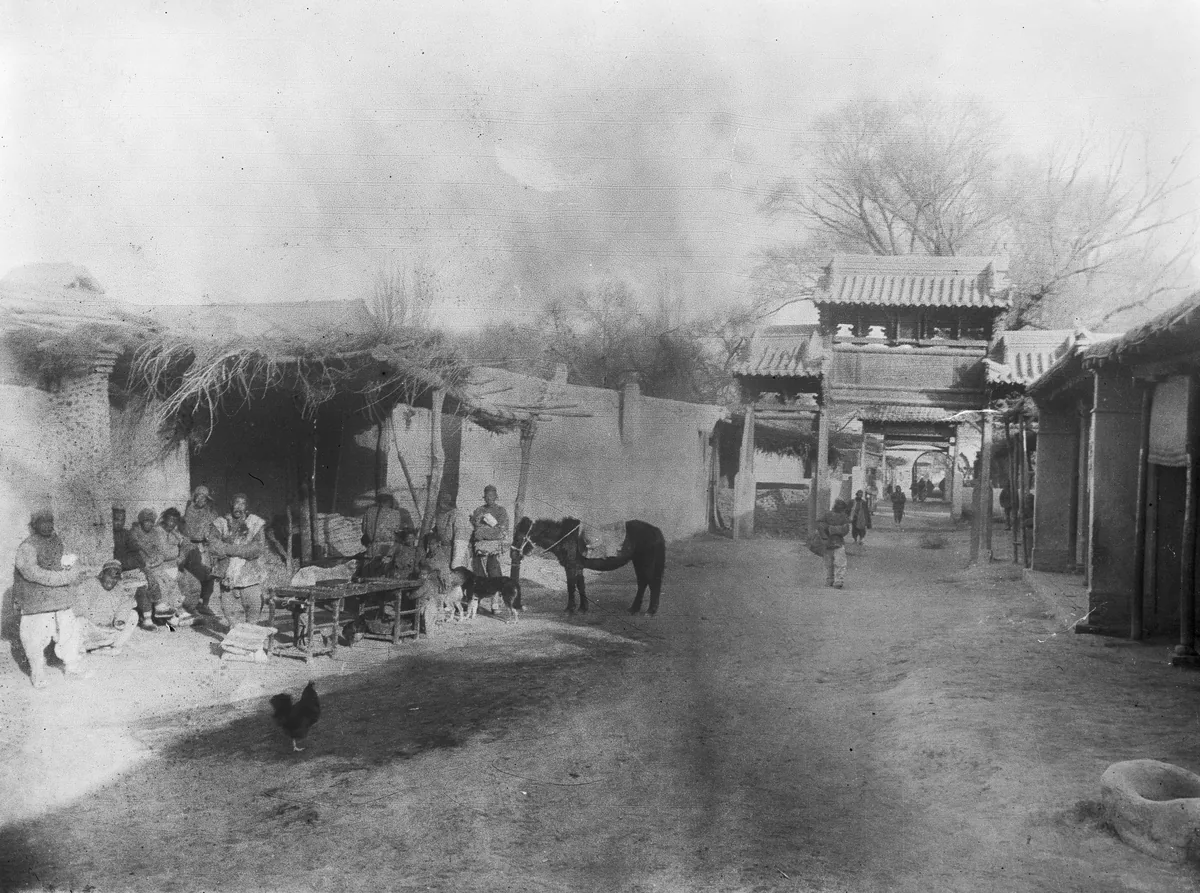
Yiwu, 伊吾, was an oasis town at the eastern end of the Western Regions. The northern road from Dunhuang to the west began there.[1] It is identified with Hami.[2][3] From the division of the Göktürk realm to the fall of the eastern khaganate in 630, Yiwu passed between the Göktürks, the Tiele and the Sui.
The road
Pei Ju, the Sui official who managed the trade with the western peoples, described three roads from Dunhuang to the western sea.[1] The northern road started at Yiwu. It ran by Lake Pulei, through the Tiele tribes and past the court of the Göktürk khan, across the Beiliu river to Fulin.[1] Yiwu, Gaochang and Shanshan, he wrote, were the gates of the Western Regions.[1] The Sui Shu adds that merchants bound for Gaochang mostly took the Yiwu road. The reason was that travellers were lost on the short cut across the desert from Wuwei.[4]
The Xin Tang Shu says that in Han times the city had been the seat of the Yihe commandant.[5] Foreign merchants lived there among the people. The city kept a thousand picked soldiers.[5] Its people were bold, and its soil was good. It was attached to the Tiele.[5]
The Hou Han Shu tells that in 73, the sixteenth year of Yongping, a Han army took the land of Yiwulu from the Xiongnu. It set up the commandant of Yihe there to farm military colonies.[6][7] The Hou Han Shu also gives the road. From Dunhuang one went out by the Jade Gate and the Yang Pass and through Shanshan. Then one went north over more than a thousand li to Yiwu.[6][3] From Yiwu it was twelve hundred li to the camp of Gaochang in the land of the Cheshi.[6][3] The Hou Han Shu calls these places the gates of the Western Regions.[6] The land of Yiwu, it says, suited the five grains, hemp, mulberry and the vine.[6] The Han and the Xiongnu fought again and again over the Cheshi and Yiwu to control the west.[6]
Under the Göktürks
The Sui Shu counts Yiwu among the lands that adhered to the western Göktürks after they split from the east, with Kucha, the Tiele and the Hu of the Western Regions.[8] The Jiu Tang Shu names the people of Yiwu among the peoples mixed with the western Göktürks.[9] The same passage lists with them the Dulu and the Nushibi, the Geluolu, the Chuyue and the Chumi.[9] The list may be tied to the reign of Chuluo, about 611. The six would then be the hordes of the western Göktürks of that time.[10] According to the Zizhi tongjian, the Sui sent Yuan Hui out in 581 by the Yiwu road to Tardush with a wolf-head standard.[11]
In 605 the Tiele rose against the western khan Heshana, then called Chuluo Khan. They raised a khan of their own at Tanhan Mountain.[8] Yiwu, Gaochang and Karashahr all went over to him.[8]
The Sui town
In 608 the Sui general Xue Shixiong marched on Yiwu from the Jade Gate.[12] Yami Khan of the eastern Göktürks was to join him. He did not come.[12] The people of Yiwu had believed that no army could cross the desert. When they heard that Xue Shixiong was across, they surrendered.[12] He built a walled town east of the old Han city of Yiwu. He left more than a thousand armoured soldiers in it.[12] Pei Ju went with him. He told the western states that the emperor had walled Yiwu only because the trade of the foreigners came from so far away.[1] They believed him and did not contest the place.[1]
In 609 the emperor Yang made his tour to the west.[12] At Mount Yanzhi the tudun shad of Yiwu came with the king of Gaochang and the envoys of twenty-seven western states to greet him by the roadside.[13] The title of the lord of Yiwu is formed of the Göktürk ranks tudun and shad.[14] This may show that a Göktürk tudun governed the town in 609.[15]
The end of Göktürk rule
At the end of the Sui, Yiwu submitted to China and was made the commandery of Yiwu.[16] When the empire fell into disorder, it became subject to the Göktürks again.[16] In the ninth month of 630 the lord of the city came to the Tang court.[17] The Xin Tang Shu’s chapter on the eastern Göktürks says that he had long been a subject of the Göktürks.[18] After the fall of Ilig Khan he surrendered the seven towns of his territory. The Tang made the land a prefecture.[19] The Xin Tang Shu calls it West Yi prefecture, and the Zizhi tongjian calls it Yixi prefecture.[19]
The Tang notices on Gaochang say that Yiwu had been subject to the western Göktürks before it came under the Tang.[20] Afterwards the king of Gaochang joined the western Yabgu against it.[20]
References
- ^ a b c d e f Sui Shu (Book of Sui), juan 67
- ^ Chavannes 1903, p. 14
- ^ a b c Herrmann 1910, p. 81
- ^ Sui Shu (Book of Sui), juan 83
- ^ a b c Xin Tangshu (New Book of Tang), juan 221
- ^ a b c d e f Hou Han Shu, juan 88
- ^ Herrmann 1910, p. 124
- ^ a b c Sui Shu (Book of Sui), juan 84
- ^ a b Jiu Tangshu (Old Book of Tang), juan 194
- ^ Markwart 1938, p. 150
- ^ Zizhi tongjian (Comprehensive Mirror in Aid of Governance), juan 175
- ^ a b c d e Zizhi tongjian (Comprehensive Mirror in Aid of Governance), juan 181
- ^ Sui Shu (Book of Sui), juan 67; Zizhi tongjian (Comprehensive Mirror in Aid of Governance), juan 181
- ^ Chavannes 1903, p. 169
- ^ Chavannes 1903, p. 263
- ^ a b Xin Tangshu (New Book of Tang), juan 221; Zizhi tongjian (Comprehensive Mirror in Aid of Governance), juan 193
- ^ Zizhi tongjian (Comprehensive Mirror in Aid of Governance), juan 193; Xin Tangshu (New Book of Tang), juan 221
- ^ Xin Tangshu (New Book of Tang), juan 215
- ^ a b Xin Tangshu (New Book of Tang), juan 215; Zizhi tongjian (Comprehensive Mirror in Aid of Governance), juan 193
- ^ a b Jiu Tangshu (Old Book of Tang), juan 198; Xin Tangshu (New Book of Tang), juan 221
Sources
- Sui Shu (Book of Sui), juan 67, 83, 84
- Zizhi tongjian (Comprehensive Mirror in Aid of Governance), juan 175, 181, 193 (after Wei Shu, Zhou Shu, Sui Shu and Bei Shi)
- Jiu Tangshu (Old Book of Tang), juan 194, 198
- Xin Tangshu (New Book of Tang), juan 215, 221 (after Jiu Tangshu)
- Hou Han Shu, juan 88
Literature
- Édouard Chavannes, Documents sur les Tou-Kiue (Turcs) occidentaux (1903)
- Albert Herrmann, Die alten Seidenstrassen zwischen China und Syrien. Beiträge zur alten Geographie Asiens, Bd. 1 (1910)
- Josef Markwart, Wehrot und Arang. Untersuchungen zur mythischen und geschichtlichen Landeskunde von Ostiran (1938)
What links here22
- Persons
- Ban Chao · Futu Khan · Pei Ju · Üç Tuğlu Khan · Yiwu Tudun Shad
- States
- Xiongnu
- Battles & Events
- Assembly at Mount Yanzhi (609) · Submission of Ishbara (585) · Submission of Yiwu (630) · Tiele Revolt (605)
- Places
- Gaochang · Jade Gate · Kucha · Qikou · Tanhan Mountain · Tarim Basin · Xihai
- Peoples
- Yenisei Kirghiz
- Institutions and Titles
- Trade Routes of the Steppe
- Sources
- Cefu yuangui
Cite this article
Yavuz, Emre-E. “Yiwu.” Turkic Atlas, revised 8 November 2026. https://turkicatlas.org/places/yiwu/
Last revised: 8 November 2026

