
- 400
- 500
- 600
- 700
- 800
- 900
- Rouran 400–554
- First Göktürk 552–630
- Tang rule 630–682
- Second Göktürk 682–744
- Uyghur 744–840
- Kirghiz 840–924
- Huns 370–469
- Western Göktürk 552–659
- Türgesh 699–766
- Karluk 766–800
- Khazar 650–969
After 840 a polity derived from the Uyghurs took shape in Eastern Turkistan. Its ruler spent the summer at Beshbalik in the north. The Turfan region, Qocho (Gaochang), lay in the south and served as the winter seat, where a settled population lived by farming and trade.[1] Qocho had been in the Uyghur sphere before 840. A Manichaean hymn-book lists its dignitaries among those of the places where Uyghur influence was strong. Sogdian letters to a Manichaean dignitary at Kocho also show a dissident group of monks in the west of the empire.[2]
The name Uyghur had designated the empire of the upper Mongolia from the middle of the eighth to the middle of the ninth century. After that it became the name of the Turkic kingdom of the Turfan region. Its centre was at Qara Qocho (Gaochang), and its other residence was Beshbalik. It dominated both slopes of that part of the Tianshan.[3]
The beginnings of the state are obscure. Menglig Tegin was in the area by 856, and the Tang recognised him as Huaijian Khan. One reconstruction, by contrast, has Toquz Oguz tribes entering in 866 and taking over from the Tibetans.[4] In the reign of Yizong (859–873), according to the Xin Tang Shu, the great chieftain Pugu Jun marched from Beiting (Beshbalik) against the Tibetans.[5] He killed Lun Shangre and took Xizhou (Turfan), Luntai and other towns.[5] One modern account dates the campaign to 865.[6] It holds that the Uyghurs took Gansu and pursued the Tibetans to Kokonor, and that from 865 or 866 they held Turfan, Kucha, Hami and Beshbalik.[6] In another account, the Uyghurs of the Tianshan proclaimed Menglig khagan before 848.[7] In 856 the Chinese court recognised him under the title Ulug Tengride Kut Bolmïsh Alp Külüg Bilge.[7] A further account has the Uyghurs of Gaochang choose Menglig as khagan under the same title and make Gaochang their capital.[8]
His successor, whom the Chinese call Pukutsiun, is thought to have died in 874.[7] After that the Chinese sources record nothing for a long time. An envoy of the Tianshan Uyghurs came in 951.[9]
The rulers of the kingdom took the old Basmil title iduq qut, idiqut.[10][11] In 981–983 the Sung envoy Wang Yen-te found Arslan Khan at Beshbalik. Arslan Khan’s uncle Ata Öge ran the affairs of state.[12][13]
The Sung court knew the kingdom from its embassies. The first reached China in 962 under Tutuq, and the second in 965 under the monk Fayuan. Others followed in 981, 983, 984 and 985, and the last of the Sung period came in 1004.[14] The embassy of 981 introduced Arslan Khan to the Chinese, who wrote his title as Shizi Wang, “Lion King”.[15] The capital of the kingdom is disputed. Some scholars think that it was Gaochang. Others argue that it was Beshbalik, because Arslan Khan treated Beiting as his permanent home, while only his relative Ata Öge lived permanently at Gaochang.[16]
The kingdom stayed on good terms with the Liao, the Jurchen and the Sung. It fought only the Muslim Karakhanids, whose poets sing of raids on Uyghur temples.[17] In the early 1130s the kingdom came under the Qara Qitai. In 1209 the idiqut Barchuq Tegin killed the Qara Qitai official and submitted to the Mongols.[18]
Donor portraits
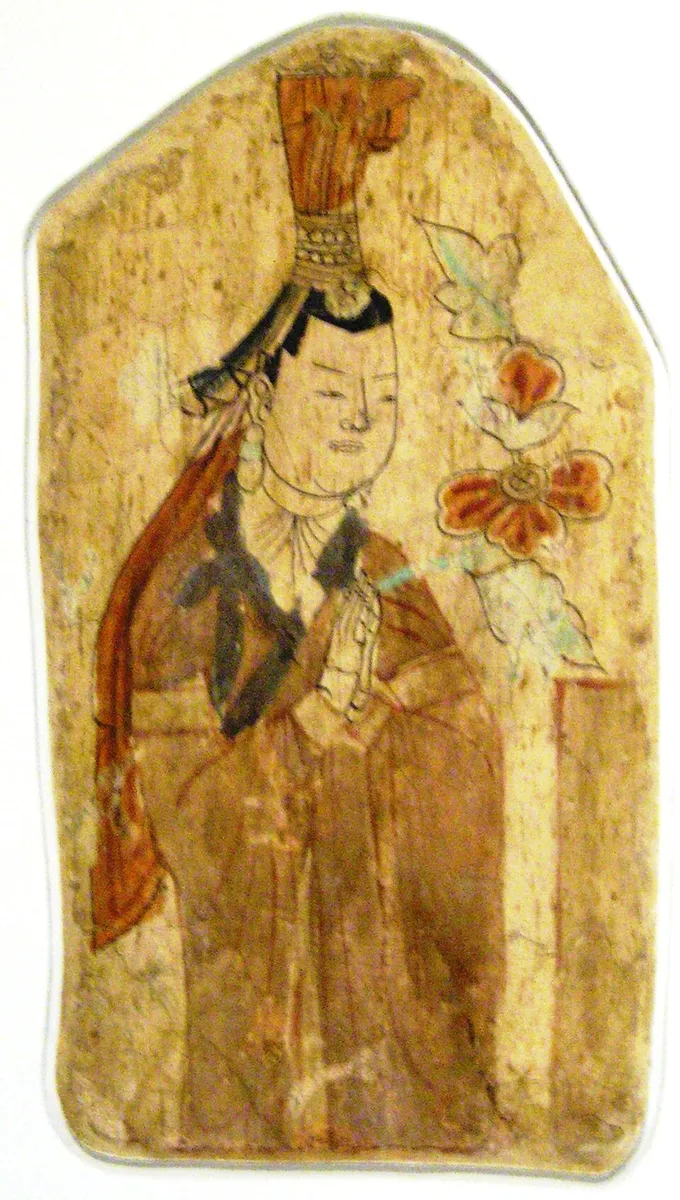
The Buddhist monastery of Bezeklik, near Murtuq in the oasis of Turfan, has wall paintings of donors. Each donor stands beside a name tablet in Old Uyghur script.[19][20] The excavators suppose that the donors wrote their names themselves. Many tablets were left empty, and the women filled theirs in every time and in a fine hand.[21][22] On a group of three men in long coats from temple 1, two of the three tablets carry the word inal. The middle tablet is scratched out.[23] The best preserved tablet reads särinč buga inal körki ol, “this is the likeness of the inal Särinč Buga”. The left one reads möngü k(?) inal ning körki bu ärür, with a doubtful letter after möngü.[23] At the door of the cella of temple 9, the tablet of the foremost of three painted men is read, with doubt, as buyra s(a)li tutug. The tablet of a lady is read as ögrüne tigin täŋrim körki, “the likeness of Her Highness the princess Joy”.[22] In the corridors of the same temple, tablets in Old Uyghur and in Chinese give the same content. They name monks as tutung bäg: singui tutung bäg ning iduq körki bu ärür, “this is the holy likeness of Tutung Bäg Singui”.[24] The date of the paintings is uncertain.
References
- ^ a b Golden 1992, p. 163
- ^ Sinor 1990, p. 322,334
- ^ Pelliot 1930, p. 351–352
- ^ a b Golden 1992, p. 164
- ^ a b Xin Tangshu (New Book of Tang), juan 217
- ^ a b Ögel 1984, p. 361–362
- ^ a b c Sümer 1972, p. 22
- ^ İzgi 1989, p. 29–30
- ^ Sümer 1972, p. 22–23
- ^ a b Golden 1992, p. 165
- ^ von Le Coq 1913, p. 4
- ^ Golden 1992, p. 170
- ^ İzgi 1989, p. 63–64
- ^ İzgi 1989, p. 38–40
- ^ İzgi 1989, p. 32, 39
- ^ İzgi 1989, p. 69–70
- ^ Golden 1992, p. 167
- ^ Golden 1992, p. 168,169
- ^ von Le Coq 1913, pl. 30, pl. 38
- ^ Grünwedel 1920, i 27–28
- ^ Grünwedel 1920, i 28
- ^ a b von Le Coq 1913, pl. 30
- ^ a b von Le Coq 1913, pl. 38
- ^ von Le Coq 1913, pl. 16
- ^ Golden 1992, p. 168–169
- ^ Golden 1992, p. 175
Sources
- Xin Tangshu (New Book of Tang), juan 217 (after Jiu Tangshu)
Literature
- Peter B. Golden, An Introduction to the History of the Turkic Peoples (1992)
- Denis Sinor (ed.), The Cambridge History of Early Inner Asia (1990)
- Albert von Le Coq, Chotscho. Facsimile-Wiedergaben der wichtigeren Funde der ersten Königlich Preussischen Expedition nach Turfan in Ost-Turkistan (1913)
- Albert Grünwedel, Alt-Kutscha. Archäologische und religionsgeschichtliche Forschungen an Tempera-Gemälden aus buddhistischen Höhlen der ersten acht Jahrhunderte nach Christi Geburt (1920)
- Paul Pelliot, Sur la légende d'Uɣuz-khan en écriture ouigoure (1930)
- Bahaeddin Ögel, İslâmiyetten Önce Türk Kültür Tarihi. Orta Asya Kaynak ve Buluntularına Göre (1984)
- Faruk Sümer, Oğuzlar (Türkmenler). Tarihleri, boy teşkilâtı, destanları (1972)
- Özkan İzgi, Çin Elçisi Wang Yen-te'nin Uygur Seyahatnamesi (1989)
What links here2
Cite this article
Yavuz, Emre-E. “Uyghur Kingdom of Qocho.” Turkic Atlas, revised 8 November 2026. https://turkicatlas.org/polities/qocho/
Last revised: 8 November 2026


