
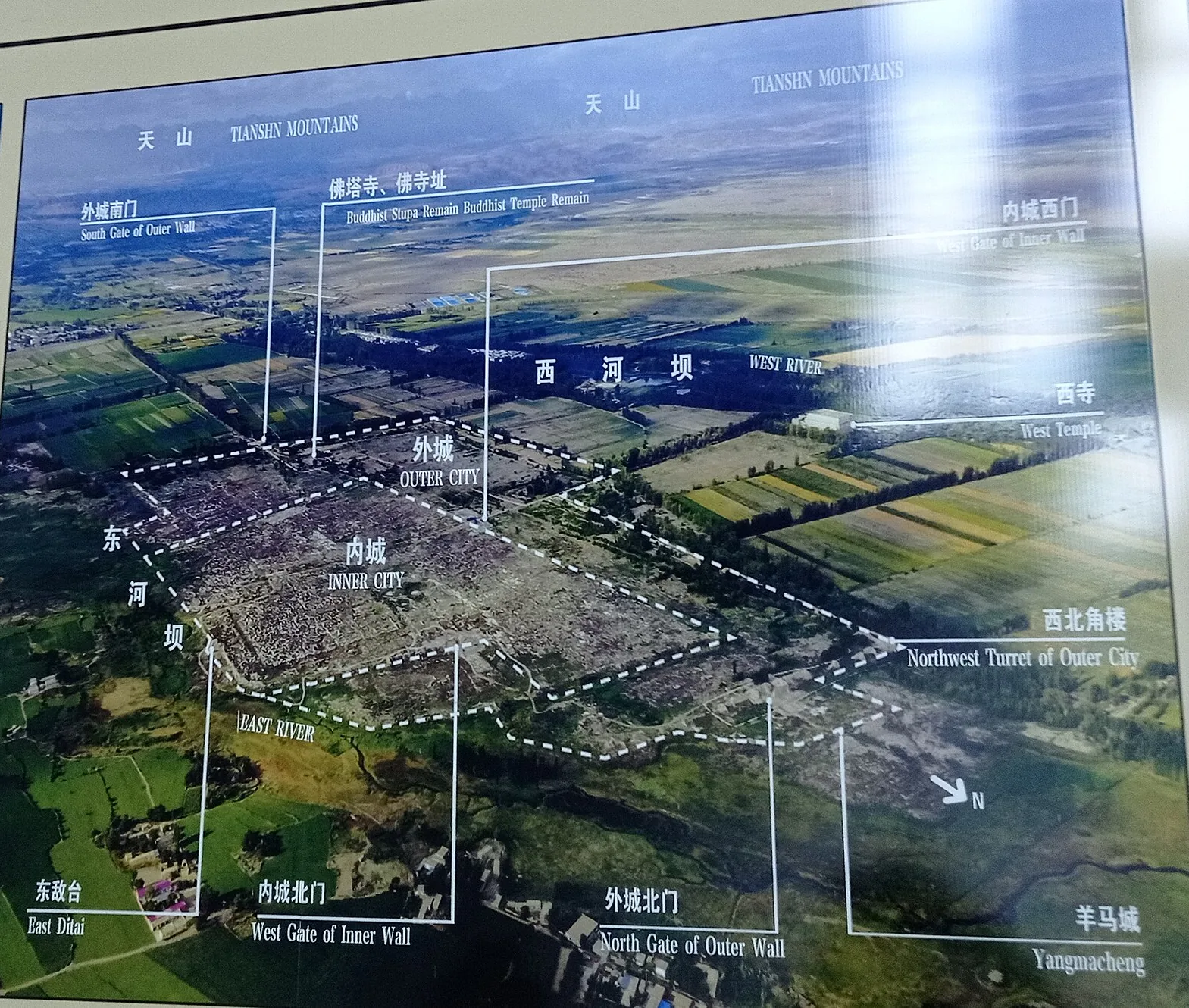
Beshbalik stood on the northern side of the Tian Shan, on the grass rather than in the oases. It was the Tang seat for everything north of the mountains. The Chinese chapters call it Beiting, the Northern Court. Two of the decisive episodes of the Second Göktürk Khaganate were fought in front of it.[1]
The attack of 714
In 714 Kapgan Khan was old. The Jiu Tang Shu says that his tribes were beginning to slip away from him. He had four hundred thousand men under arms, more than any khan since Ilig, and he used them harshly.[1] That year he sent his son Inel with Tongga Tegin and his sister’s husband, the ilteber Shi Ashibi, with picked cavalry to shut in Beiting.[1]
The Tang commander Guo Qianguan held the walls. Then he came out, took Tongga Tegin below them and beheaded him.[1] The army withdrew. Shi Ashibi did not dare go home. He came over to the Tang with his wife, and was made a general and given a princely title. His wife was given one of her own.[1]
The defection cost the khaganate a commander, his following and a marriage tie. It came on top of a siege that had already failed.[1]
Tonyukuk and the Basmïl, 720
Six years later the Tang put together a coalition to destroy the khaganate. It consisted of three hundred thousand men under the censor-in-chief and the Basmïl, the Xi and the Khitan, who were to come in from three sides to seize the khan’s own camp.[2] Bilge Khan was badly frightened.[2]
Tonyukuk told him what would happen. The Basmïl are at Beiting, far from the two peoples in the east, and they will not join with them. The Chinese commanders are at odds with each other and will not come. If they all do come, we move the camp three days north and their supplies run out. The Basmïl are rash and greedy for gain, so they will arrive first, and then they can be taken.[2]
The Basmïl came up to the Göktürk camp, found that the others had not come, and turned back. Tonyukuk followed them. Two hundred li from Beiting he split his force and took their town by another road. Then he struck the army hard.[2] The Basmïl ran for Beiting. They found it taken, had nowhere to go, and were captured to the last man.[2]
The campaign that was to have ended the khaganate ended instead with a Tang ally destroyed. The Göktürks plundered Liangzhou on the way home.[2] Twenty-four years later the Basmïl, with the Uyghurs and the Karluk, overthrew the last Göktürk khan.
Texts from the Tayhar rock
Painted runiform texts on the Tayhar rock at Hoyto Tamir in Arkhangay, Mongolia, speak of travelling to Beshbalik.[3] Three texts name the town, and two of these carry animal-year dates that have been reckoned as 753 and 756.[4] The readings are preliminary, and the dates rest on a reckoning of the animal cycle.[5] If the reading of the name holds, the Turkic name Beshbalik was in use by the middle of the eighth century. The Hoyto Tamir inscriptions have their own article.
The name
- beş balıkOld Turkic
- 北庭ChineseJiu Tangshu 194
The Xin Tang Shu also gives the name Beiting to the court that a khan of the western Göktürks built west of the Zuhe mountain. There the word means his northern camp rather than this town.[2] The two are not the same ground. The same two characters in the same chapter do not always name the same place. Which place a given passage means has to be read out of the passage. Turkic Atlas treats the name, the protectorate and its protectors under Beiting.
References
Sources
- Jiu Tangshu (Old Book of Tang), juan 194
- Xin Tangshu (New Book of Tang), juan 215 (after Jiu Tangshu)
Literature
- Édouard Chavannes, Documents sur les Tou-Kiue (Turcs) occidentaux (1903)
- Peter B. Golden, An Introduction to the History of the Turkic Peoples (1992)
- Colin Mackerras, The Uighur Empire According to the T'ang Dynastic Histories (1972)
- Emre-E. Yavuz, The Gokturk Empire: 2nd Edition (2025)
- Osman Fikri Sertkaya; Sartkocaulı Harcavbay, Hoyto Tamir (Moğolistan)’dan yeni yazıtlar (ön neşir) (2000)
What links here4
- States
- Uyghur Kingdom of Qocho
- Places
- Beiting
Cite this article
Yavuz, Emre-E. “Beshbalik.” Turkic Atlas, revised 4 November 2026. https://turkicatlas.org/places/beshbalik/
Last revised: 4 November 2026


