
Drums and horns sound in a few scenes of the steppe wars. In 119 BC the Han general Huo Qubing took a banner and a drum from a Xiongnu general.[1] The Xianbei chief Kebineng ordered advance and retreat by the beat of the drum.[2] In 642 the western Göktürk khan Üç Tuğlu led his troops out of a city to the sound of drums and horns.[3] A Tang report of 843 lists three horns and four drums among what the Uyghur khan still owned.[4] The scenes come from Chinese dynastic histories, Greek and Latin historians, the runic inscriptions and Arabic, Persian and Turkic works of the ninth to the eleventh century. They are set out here by people and in the order of time.
Terms
The Chinese histories name these instruments with a few set words. 鼓 is the drum and 角 the horn, and 鼓角 means drums and horns. 鼓吹, drums and pipes, is the band of drums and wind instruments.[5] In 623 the Tang court ordered such a band for the burial of the princess Pingyang.[5] The court official in charge of rites objected that by the rites a woman has no band of drums and pipes. The emperor Gaozu answered that 鼓吹 was army music, and that the princess had held the gongs and drums herself and had raised an army.[5] Banner and drum, 旗鼓, and drum and standard, 鼓纛, name the pair that marked a commander. The second pair is the subject of Drums and Banners for the Khans.
Xiongnu and Han
In 119 BC Huo Qubing turned on the Left Great General of the Xiongnu and took his banner and drum.[1] A colonel in the same campaign took the banner and drum of the Left Worthy King, and the emperor made him a marquis.[6] The histories count both prizes among the trophies of the campaign, which is described in the battle of Mobei. They do not say what the drum sounded.[7] A Xiongnu general and a Xiongnu king each had a banner and a drum, so the pair was probably part of a great commander’s equipment.
The Han histories describe drum signals for Han troops. At Junji Mountain in 99 BC Li Ling drew up his five thousand foot soldiers in front of the wagon camp. He ordered them to advance at the sound of the drum and to halt at the sound of the metal.[8] Later, when his men were worn down, he asked why the drums no longer roused them. On the last night he had the drum beaten to wake the men, and it did not sound.[8] These are orders to a Chinese army.
The Han court also gave drums to the Xiongnu. In AD 50 it sent the chanyu of the Southern Xiongnu, among other gifts, musical instruments and a drum carriage, 樂器鼓車, with ceremonial halberds, armour and weapons.[9] The gifts are listed in Han Bestowals on the Chanyu. In AD 52 the Northern Xiongnu asked the court for music.[9] The court’s answer is told in the Han reply of 52.
Kucha, 65 BC
In 65 BC Jiangbin, the king of Kucha, came to the Han court with his wife.[10] The court gave both of them seals and ribbons. His wife took the title of princess. She received carriages and riders, banners and drums, and dozens of singers and wind players, besides silks and rarities.[10] Back in Kucha the king built palaces. He had his comings and goings called out and had bells and drums struck, in the manner of the Han house.[10]
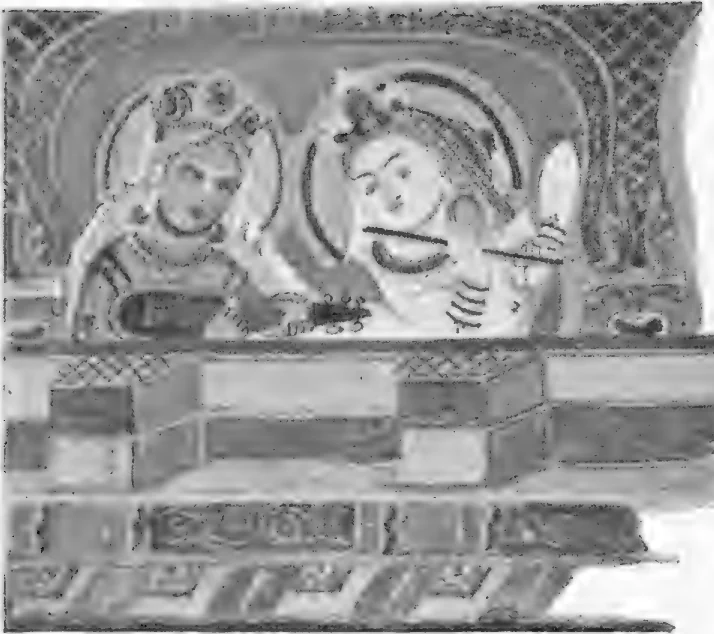
Music of Kucha reached the Chinese court in 568 with the bridal train of the Göktürk princess Ashina, as told in the music of the Ashina empress.[11] Painted musicians of Kucha survive in the cave temples of Kizil. The Prussian Turfan expedition called one of the caves the cave with the musician choir. A painted balcony runs along its side walls, and on it stand gods and goddesses in pairs. They play cymbals, panpipes, lutes, arched harps, transverse and pointed flutes, a zither and a tambourine.[12] The paintings are Buddhist. They show how the cave temples of the oasis pictured music, and they show no war.
Xianbei and Wuhuan
Kebineng began as the chief of a small tribe of the Xianbei.[2] The Sanguozhi explains his method. Chinese refugees had taught him to make weapons and armour, so he led his tribes on the Chinese model. When he rode out or hunted he raised banners and flags, and he ordered advance and retreat by the beat of the drum.[2] The author puts the practice down to Chinese influence.[2] The same chapter is cited in Chinese Weaponsmiths among the Xianbei.
In 233 Xieguini, another Xianbei chief, broke with Kebineng and surrendered with his people to the Wei.[2] The Wei court made him King of Returning to Duty. It gave him banners, a canopy and a band of drums and pipes, and he stayed in Bingzhou as before.[2]
Northern China in the sixth century
In 521 the Wei court gave the Rouran khan Anagui twenty sets of red-lacquered drums and horns for his return to the north.[13] The gift is told in Drums and Banners for the Khans.
At Hanling in 532 Gao Huan beat the army of Erzhu Zhao.[14] Murong Shaozong, who served Erzhu Zhao, then turned his banner round and sounded the horn. He gathered the scattered troops, restored the formation of the army and withdrew to the west.[14] The horn is a rallying signal here. The text does not say what call he sounded.[14]
At Shayuan in 537 the general Yuwen Tai of the Western Wei used the drum as a signal.[15] He hid his troops among the reeds in the bend of the Wei river and told them to rise at the sound of the drum. When the enemy came on, he beat the drum and they rose.[15] The enemy was the army of Gao Huan. The passage describes a drum order in a Chinese army.
The Sui Shu gives the one list of horn calls. Its music treatise describes the band of the Sui court, and in it a Great Horn with seven pieces. The pieces are called catching the horse, saddling it, mounting, marching, entering the battle line, gathering the army and making camp. Three rounds made one piece.[16] The words of the pieces, the treatise says, all go back to the Xianbei.[16] The Jiu Tang Shu says that the Great Horn of its own day was the piece the Later Wei called Boluohui, and that its songs had many words about the khan.[11] The seven pieces follow a day of march and battle in order. The treatise does not say whether an army sounded them in the field or only a court band at a procession.[16]
Music on horseback
The Jiu Tang Shu says that the Xianbei, the Tuyuhun and the Buluoji were the three peoples of the Northern Di whose music could still be known, and that all of it was music played on horseback.[11] It adds that drums and pipes were originally the sound of armies and were played on horseback, and that for this reason the music of the Northern Di had belonged to the Bureau of Drums and Pipes since the Han.[11] The songs of the Northern Di at the Tang court are the subject of Turkic Songs at the Tang Court.
The Han histories have the matching term. When Emperor Ai abolished the music office, the staff list drawn up for the court named twelve kinds of drum players, 128 men in all, for court audiences and banquets, and said that they answered to the old rules of war.[17] One kind, with three men, is called 騎吹, the mounted wind music.[17] Two Tang texts trace such music to the west. The Tongdian says in a comment that Emperor Wu of the Han took a tune that Zhang Qian had brought from the Western Regions and made it drum-and-pipe music.[18] The Jiu Tang Shu says that Emperor Wu, when he married a princess of his house to the Wusun, had the zheng and the zhu cut down into music for the saddle, to ease her longing for home.[11] Both texts were written many centuries after the Han, and neither is a record of steppe armies.
Göktürks
The courts of northern China gave drums to the khans. The Sui gave a band of drums and pipes to three Göktürk khans in 585, 587 and 607.[19] The Tang invested western and eastern Göktürk khans with a drum and a standard in the 630s and 640s.[20] Drums and Banners for the Khans lists the gifts.
In 587 Bagha, whom the Chinese call Chuluohou, marched west against Apa with the banners and drums of the Sui.[19] Apa’s men took them for a sign that Sui troops stood behind him, and many came over.[19] Bagha took Apa alive in the capture of Apa.
In 642 Üç Tuğlu Khan, whom the Chinese call Duolu, held the Sogdian town of Baishui.[3] Irbis Shegui sent the Nushibi against him. Duolu led his troops out of the city, had drums and horns sounded, and closed with them in hand-to-hand fighting. The Nushibi could not hold, and many were killed or taken.[3] The text does not say who sounded the drums and horns or what the calls meant.[3]
Drums also appear in tricks played on the Göktürks. In 615 the sixteen-year-old Li Shimin advised the relief commander at Yanmen to stretch banners over dozens of li by day and to answer with gongs and drums by night, so that the Göktürks would think a great army had come.[21] In 617 Li Yuan at Taiyuan sent troops out of the city at night.[22] By day they came back by another road with banners raised and drums beating, as if they were a relief army. The Göktürks stayed outside the city for two days, still suspicious, plundered and left.[22] Both tricks were Chinese, and they do not show how the Göktürks used drums themselves.
The runic inscriptions of Kül Tegin, Bilge Khan and Tonyukuk name no drum and no horn in an army.[23] The word for the drum, köbürge, stands once, in a mourning line on the west face of the Bilge Khan monument. Six damaged lines of that face survive, and they belong to Tengri Khan.[24] The line reads: “When spring comes, as the drum of Heaven rolls above, so [ … ]; as the deer bellows in the mountains, so [ … ]: I mourn.”[25] The word teŋri before köbürge is a restoration. The drum of Heaven belongs to nature here, and it is probably thunder.
Huns and Avars
On the morning after the battle on the Catalaunian Plains in 451 the field was heaped with the dead, and Attila of the Huns stayed in his camp.[26] Jordanes, who wrote a century later, says that Attila clashed his arms, sounded trumpets and threatened an attack.[26] The fight is told in the battle of the Catalaunian Plains.
The Avars used the drum for noise. Menander Protector reports that before a battle with the Romans they meant to raise a wild din, howl and beat their drums, so as to stun and terrify the Romans.[27] The Roman commander Bonus learned of the plan in advance and explained it to his soldiers, so that the sudden noise would not frighten them.[27] When the drums sounded, the Romans answered by beating on their shields. They raised the battle cry and the victory song and struck their wooden water canteens.[28] The fragment names neither the place nor the year, and a modern editor places it before the Avar siege of Sirmium.[29]
Uyghurs, 843
Before the Tang attack of 843 on the camp of the Uyghurs, the military governor of Zhenwu sent the chief minister Li Deyu a report from a Uyghur who had come over.[4] The man, Heluha, said that the khan had only 1,500 men left, sixty or seventy suits of armour, three horns and four drums.[4] The governor doubted the report and did not dare to present it to the throne. Li Deyu forwarded it to the emperor and asked him to be on guard.[4] The khan of those weeks was Ögä.[30] The attack freed Princess Taihe, as told in the rescue of Princess Taihe. The figures put the horns and drums in one list with men and armour. They count the instruments as equipment of the khan’s camp. The report does not say what the horns and drums were used for.[4]
The Uyghur inscription of Šine Usu names standards and no drum.[31] The standards are described in Tuğ.
After the khaganates
Texts of the ninth to the eleventh century carry the evidence beyond the Chinese frontier histories.
A speaker in al-Jāḥiẓ’s ninth-century treatise on the Turks and the army of the caliphate says that the Turks and the Khurasanis are the cavalry, and that the standard-bearers, banner-men and drummers are chosen from its picked horsemen.[32]
About 903 Ibn Rusta describes the Khazar king called Isha, who takes the field with 10,000 horsemen, with banners, spears and mail.[33] Before him a horseman bears a disc made like a drum, and the army sees the light of the disc.[33] The disc is a sign to be seen, and the account mentions no sound. The Isha’s place in the rule of the Khazars is described in Khazar Dual Kingship.
The Persian historian Gardīzī, writing about 1050, lists battle trumpets in the form of bulls’ heads among the possessions of the Pechenegs at the height of their power.[34]
Mahmud al-Kashgari wrote his dictionary of the Turkic languages between 1073 and 1077 for the caliph.[35] It gives the phrase tūγ uruldı, “the sentry drums were beaten”.[36] Under the same entry he quotes a verse that describes a battle: “when my banners of war [were set up and] the drums beat, there the enemy troops were mowed like grain”.[36] The brackets belong to the translators of the dictionary. For tavul, “drum”, Kashgari thinks that the word comes from the Arabic ṭabl, and he adds that he has heard it from genuine Turks in the farthest reaches of Islam.[37] The Kutadgu Bilig of 1069 to 1070 has the king give his vizier a standard and a drum, and it has the cloud beat the kettledrum when it thunders.[38] Both passages are set out in Kös and Nevbet.
Limits of the evidence
No source describes a system of signals of a steppe army, as the survey of steppe warfare also says of drill and order of march. The Chinese histories give drum and gong orders for Chinese armies, at Junji Mountain in 99 BC and at Shayuan in 537.[39] The one list of horn calls, the seven pieces of the Great Horn, belongs to the Sui court band.[40] In the accounts of fighting, the Xiongnu appear with a drum only as the owners of a captured one.[41]
No source describes a marching music of steppe armies in the later sense, with a band of ranked players or a fixed order of beatings. The sources count drums and horns as single items: twenty sets, ten, three horns and four drums.[42]
The Hou Han Shu and the chapter of the Sanguozhi on the Wuhuan name no drum and no horn in a Wuhuan army.[43] The accounts of Khazar and Oghuz armies in Ibn Faḍlān, al-Masʿūdī, Marvazī and the Ḥudūd al-ʿĀlam name no drum and no horn.[44] The shape and size of the great drum of the khans are unknown for the Göktürks, the Uyghurs and the Karakhanids.[45]
Later army bands of the Mongol, Seljuk and Ottoman states are sometimes traced back to the Xiongnu and the Göktürks.[46] The sources above do not link the two.
Assessment
The sources show drums and horns in the wars of the steppe peoples, as trophies, as gifts, as equipment of a camp and in single scenes of battle. They show the drum and the standard as marks of command. They do not show a described system of signals or a marching music. For the Göktürk khaganates the evidence is one sortie in 642, the gifts of the Sui and the Tang, and one word on a monument.[47]
References
- ^ a b Han Shu, juan 55; Shiji, juan 111
- ^ a b c d e f Sanguozhi, juan 30
- ^ a b c d Xin Tangshu (New Book of Tang), juan 215
- ^ a b c d e Li Deyu's Letters to the Kirghiz, juan 17
- ^ a b c Zizhi tongjian (Comprehensive Mirror in Aid of Governance), juan 190
- ^ Han Shu, juan 54; Shiji, juan 111
- ^ Han Shu, juan 55; Han Shu, juan 54; Shiji, juan 111
- ^ a b Han Shu, juan 54
- ^ a b Hou Han Shu, juan 89
- ^ a b c Han Shu, juan 96
- ^ a b c d e Jiu Tangshu (Old Book of Tang), juan 29
- ^ Grünwedel 1912, p. 64–65
- ^ Wei Shu, juan 103
- ^ a b c Bei Shi (History of the Northern Dynasties), juan 6
- ^ a b Zhou Shu (Book of Zhou), juan 2
- ^ a b c Sui Shu (Book of Sui), juan 15
- ^ a b Han Shu, juan 22
- ^ Tongdian, juan 200
- ^ a b c Sui Shu (Book of Sui), juan 84
- ^ Jiu Tangshu (Old Book of Tang), juan 194; Xin Tangshu (New Book of Tang), juan 215
- ^ Zizhi tongjian (Comprehensive Mirror in Aid of Governance), juan 182
- ^ a b Zizhi tongjian (Comprehensive Mirror in Aid of Governance), juan 183
- ^ Kül Tegin inscription; Bilge Khan inscription; Tonyukuk inscription
- ^ Tekin o. J., p. 13
- ^ Bilge Khan inscription
- ^ a b Jordanes; Mierow 1915, § 212, p. 110
- ^ a b Menander Protector; Blockley 1985, fr. 12.3, p. 131
- ^ Menander Protector; Blockley 1985, fr. 12.3, p. 133
- ^ Blockley 1985, p. 133 n. 155
- ^ Jiu Tangshu (Old Book of Tang), juan 195; Xin Tangshu (New Book of Tang), juan 217
- ^ Šine-Usu inscription
- ^ al-Jāḥiẓ, Manāqib al-Turk, p. 671; Walker 1915, p. 671
- ^ a b Ibn Rusta; Dunlop 1954, p. 105
- ^ Gardīzī (Zayn al-akhbār); Minorsky 1937, p. 314
- ^ Dīvān Lughāt al-Turk
- ^ a b Dīvān Lughāt al-Turk
- ^ Dīvān Lughāt al-Turk
- ^ Kutadgu Bilig; Dankoff 1983, couplets 86, 1036
- ^ Han Shu, juan 54; Zhou Shu (Book of Zhou), juan 2
- ^ Han Shu, juan 54; Zhou Shu (Book of Zhou), juan 2; Sui Shu (Book of Sui), juan 15
- ^ Han Shu, juan 55; Han Shu, juan 54
- ^ Wei Shu, juan 103; Li Deyu's Letters to the Kirghiz, juan 17
- ^ Hou Han Shu, juan 90; Sanguozhi, juan 30
- ^ Ibn Fadlan; al-Masʿūdī; Marvazī (Ṭabāʾiʿ al-ḥayawān); Ḥudūd al-ʿĀlam
- ^ Ögel 2000, p. 196
- ^ Ögel 2000, p. 37
- ^ Xin Tangshu (New Book of Tang), juan 215; Bilge Khan inscription
Sources
- Sui Shu (Book of Sui), juan 15, 84
- Jiu Tangshu (Old Book of Tang), juan 29, 194, 195
- Xin Tangshu (New Book of Tang), juan 215, 217 (after Jiu Tangshu)
- Hou Han Shu, juan 89, 90
- Ibn Fadlan
- al-Masʿūdī
- Marvazī (Ṭabāʾiʿ al-ḥayawān)
- Ḥudūd al-ʿĀlam
- Han Shu, juan 22, 54, 55, 96 (after Shiji)
- Shiji, juan 111
- Sanguozhi, juan 30
- Wei Shu, juan 103
- Bei Shi (History of the Northern Dynasties), juan 6 (after Wei Shu, Zhou Shu and Sui Shu)
- Zhou Shu (Book of Zhou), juan 2
- Tongdian, juan 200 (after Sui Shu and Zhou Shu)
- Zizhi tongjian (Comprehensive Mirror in Aid of Governance), juan 182, 183, 190 (after Wei Shu, Zhou Shu, Sui Shu and Bei Shi)
- Li Deyu's Letters to the Kirghiz, juan 17
- Menander Protector
- Jordanes (after Priscus and Ammianus Marcellinus)
- Ibn Rusta
- Gardīzī (Zayn al-akhbār)
- Dīvān Lughāt al-Turk
- Kutadgu Bilig
- Bilge Khan inscription
- Kül Tegin inscription
- Tonyukuk inscription
- Šine-Usu inscription
Literature
- R. C. Blockley, The History of Menander the Guardsman: Introductory Essay, Text, Translation, and Historiographical Notes (1985)
- Charles Christopher Mierow, The Gothic History of Jordanes in English Version, with an Introduction and a Commentary (1915)
- Douglas M. Dunlop, The History of the Jewish Khazars (1954)
- V. Minorsky, Ḥudūd al-ʿĀlam, "The Regions of the World": A Persian Geography 372 A.H. – 982 A.D., translated and explained, with the preface by V. V. Barthold (1937)
- al-Jāḥiẓ, رسالة في مناقب الترك Risāla fī Manāqib al-Turk (9th c.)
- C. T. Harley Walker, Jāḥiẓ of Basra to al-Fatḥ ibn Khāqān on the 'Exploits of the Turks and the Army of the Khalifate in General' (1915)
- Albert Grünwedel, Altbuddhistische Kultstätten in Chinesisch-Turkistan. Bericht über archäologische Arbeiten von 1906 bis 1907 bei Kuča, Qarašahr und in der Oase Turfan (1912)
- Robert Dankoff (trans.), Wisdom of Royal Glory (Kutadgu Bilig): A Turko-Islamic Mirror for Princes (1983)
- Yusuf Has Hacib; Text after Reşid Rahmeti Arat, Kutadgu Bilig Metni (Webseite „Kutadgu Bilig Dizini“, Ausdruck vom 2015-04-30) (2015-04-30 (Ausdruck))
- Talât Tekin, Orhon Yazıtları. Kül Tigin, Bilge Kağan, Tunyukuk (o. J.)
- Bahaeddin Ögel, Türk Kültür Tarihine Giriş VIII: Türklerde devlet ve ordu mehteri (2000)
What links here3
- Institutions and Titles
- Kös and Nevbet
- Customs & Pastimes
- Musical Instruments in the Sources · The Pipa and Music on Horseback
Cite this article
Yavuz, Emre-E. “Drums and Horns in War.” Turkic Atlas, revised 12 November 2026. https://turkicatlas.org/institutions/drums-and-horns-in-war/
Last revised: 12 November 2026

