
- 400
- 500
- 600
- 700
- 800
- 900
- Rouran 400–554
- First Göktürk 552–630
- Tang rule 630–682
- Second Göktürk 682–744
- Uyghur 744–840
- Kirghiz 840–924
- Huns 370–469
- Western Göktürk 552–659
- Türgesh 699–766
- Karluk 766–800
- Khazar 650–969
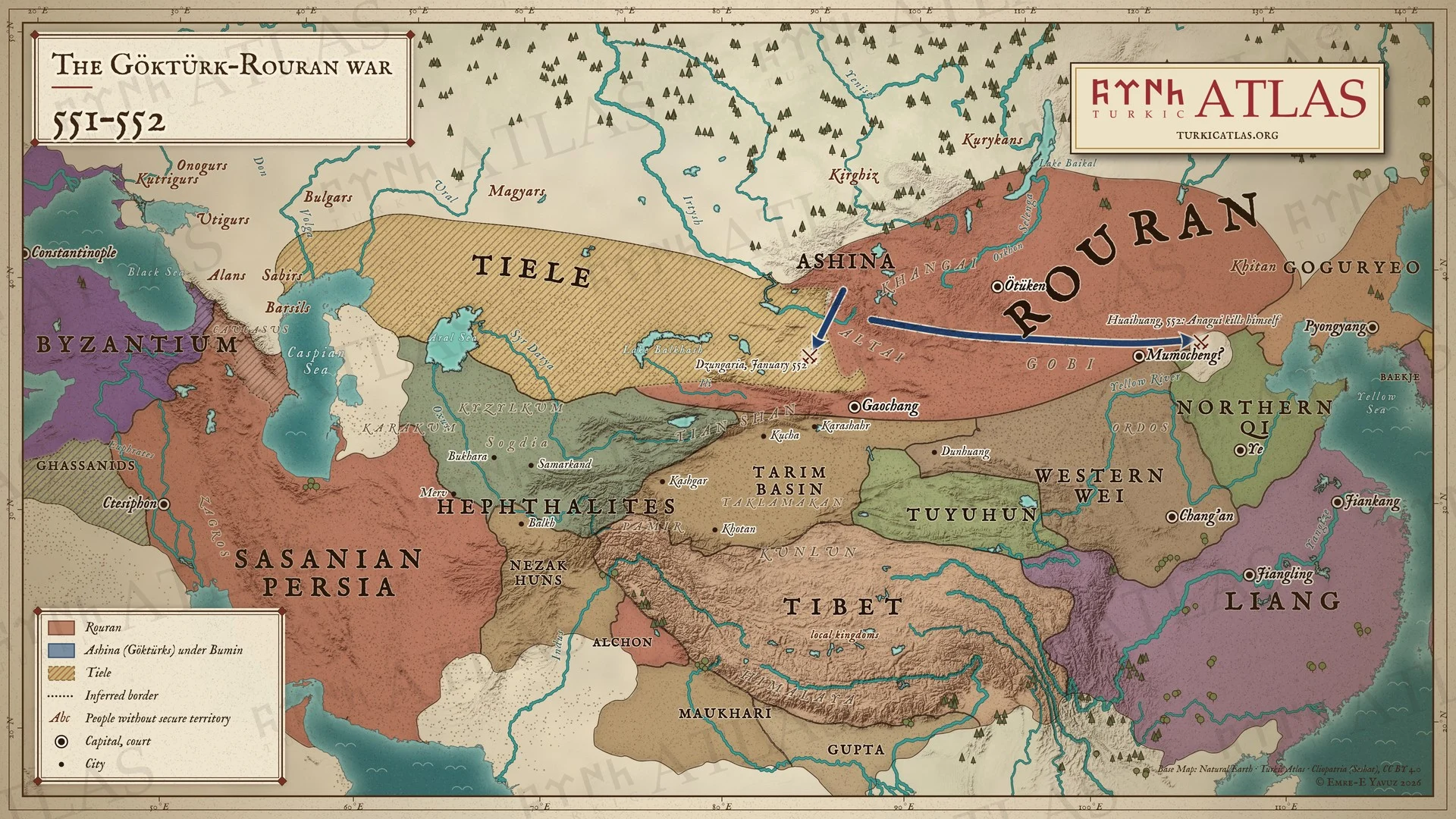
The Göktürk–Rouran Wars were the wars in which the Göktürks destroyed the Rouran Khaganate, their former overlords, and pursued what was left of it. They began in 546. Bumin asked the Rouran khan Anagui for a wife and was called a blacksmith slave.[1] In 552 Bumin destroyed the Rouran army north of Huaihuang. According to the Chinese histories, Anagui killed himself.[1] Bumin’s successors Issik and Mukan broke the remnant. In 555 the last Rouran in the steppe were handed to Mukan’s envoys and killed at Chang’an.[1] A second group had fled west. From it most likely came the khagans and the ruling nobility of the Avars of Europe.[2][3] The Göktürks claimed them as runaway subjects until the end of the century. They made the claim in the steppe north of the Caucasus and at the court of Constantinople.
Background
For a century and a half, the Rouran ruled the eastern steppe. The Turkic-speaking peoples under them served them, from the Tiele in the north to the Ashina in the Altai. The Tiele risings of 487 and 508 had already shaken the Rouran domination. In 546 the Tiele prepared another rising against the Rouran.[1] Bumin, at the head of the Ashina, fell on them on the march. He broke them and took the surrender of more than fifty thousand tents.[1] Then he asked Anagui for a Rouran princess.[1] Anagui sent a man to revile him: “You are my blacksmith slave; how dare you say such a thing?”[1] Bumin killed the messenger. He broke with the Rouran.[1] He turned to the Western Wei instead. In 551 he married a Wei princess, in the Göktürk–Wei alliance.[1]
The war of independence (546–552)
The war of independence was decided in the first months of 552.[1] In January the Göktürks beat a Rouran army in a small battle in Dzungaria.[4] Then they marched east towards Mumocheng, the new Rouran capital.[4] North of Huaihuang a larger Rouran army met them and was destroyed.[1] Anagui killed himself, as the Chinese histories tell it.[1] The suicide is doubted, because no other ruler in the old Turkic or Mongol tradition is said to have taken his own life.[5] Bumin took the title Illig Khan. In April 552 he entered the sacred forest of Ötüken, the old seat of the Rouran.[1][6]
The split of the Rouran (552)
The defeated Rouran went three ways. The largest part of the ruling house went south to the Northern Qi.[5] The Qi annals date the collapse to the second month of 552. They name the men who came over: Anagui’s heir Anluochen, Anagui’s cousin Dengzhu and Dengzhu’s son Kuti.[7] The Rouran who stayed in the steppe set up Dengzhu’s second son, Tiefa, as their ruler.[7] A separate branch raised Anagui’s uncle Dengshuzi as khan.[8]
The third group rode west.[6] It consisted not of the Yujiulü house but of the nobles who had formed the upper ranks of the state. Some twenty thousand people crossed the steppe in panic, probably past the Ashina armies.[6] From them most likely came the khagans and the ruling nobility of the Avars of Europe, and the title khagan went west with them.[2][3] According to some scholars, the nobles were most probably of eastern Turkic origin.[6]
The war against the remnant (553–555)
Issik, Bumin’s son and successor, broke Dengshuzi once more in the battle of Mount Mulai, at Mount Mulai, north of the frontier garrison of Woye.[1] The Zizhi tongjian enters the battle under 553.[9] In the same year the Qi sent Dengzhu and Kuti back north. The Rouran throne changed hands three times in a few months: the Khitan killed Tiefa, Dengzhu’s own chief Afuti killed Dengzhu, and the people set up Kuti.[7] Whether Dengzhu and Dengshuzi were in fact one man, written twice, is not settled.
In the twelfth month of 553 the Göktürks attacked the Rouran again. The whole people fled south to the Qi.[7] The Qi emperor Wenxuan marched north from Jinyang to meet the Göktürks and take the fugitives in.[7] He deposed Kuti and set up Anluochen as ruler. He settled Anluochen on the Mayi river.[7] He then pursued the Göktürks as far as Shuozhou, in the Qi march to Shuozhou. There, the Qi annals say, the Göktürks asked to submit.[7] This clause is the Qi court’s account of its own campaign. No Göktürk or Zhou source confirms it.
The Rouran under the Qi did not survive their protectors. In the third month of 554 Anluochen revolted. The emperor beat him and took his wife and children with more than thirty thousand people.[7] In the summer of 555 the Qi caught what remained at Huaishuo and at Woye.[7] In the steppe, Mukan, who had followed Issik as khan, led an army against Dengshuzi and destroyed him, in Mukan’s destruction of Dengshuzi.[1] Dengshuzi fled with the rest of his people to the Western Wei.[1] The Bei Shi sets their flight into Guanzhong in 555.[10] Mukan’s envoys came one after another to ask for their deaths. The Wei chancellor Yuwen Tai agreed.[11] Dengshuzi and some three thousand of his people were handed over and killed outside the Qingmen gate of Chang’an, in the Qingmen executions.[1] With them the Rouran disappear from the steppe.
The Avars (557–598)
The fugitives who had gone west reappear in the Byzantine histories as the Avars.[12] After many wanderings they came to the Alans north of the Caucasus. Through the Alans, their envoys reached Justinian at Constantinople, in the flight of the Avars.[13] They probably arrived in the steppe north of the Black Sea about 557. Their first embassy came to the emperor in 558.[12] Menander, the historian of the embassies, preserves the answer of Istemi, whom he calls Silzibul, the leader of the Turks.[14] Istemi had learned of the flight of the Avars and of the damage they had done to Göktürk possessions as they left.[14] They were not birds, he said, to escape the swords of the Göktürks through the sky, nor fish, to hide in the depths of the sea. When he had ended the war with the Hephthalites, he would attack them.[14]
The Avars became a matter between the Göktürks and Rome.[15] In 568 Justin II asked the Göktürk envoys of Maniakh’s embassy whether the Avars were their subjects.[16] The envoys answered that some of the Avars still obeyed them. Those who had fled numbered about twenty thousand.[16] The fugitives were one of the reasons the Göktürks sought the alliance with Rome: a Rome bound to the Göktürks could not go on sheltering their runaway subjects.[17]
In 576 the Roman envoy Valentinos came to Türk-shad. Türk-shad charged him with still giving the Avars refuge and so keeping the Göktürks from their revenge.[18] Türk-shad called the Avars “my slaves, the Uarkhonitai”.[19] He charged the emperor with making a treaty with “our slaves who have fled their masters”. Menander adds that he meant the Avars.[19] If they so much as saw his horsewhip, Türk-shad said, they would flee to the lowest reaches of the earth.[19] In the same year the Utigur prince Anagai and the Göktürk general Bokhan, at Türk-shad’s urging, laid siege to Bosporos in the Crimea.[18] The Göktürks kept the Crimea occupied, as a punishment for Rome and to forestall an Avar expansion.[18]
By then the Avars had driven the Gepids out of Pannonia, in 567 and 568. They had become the dominant power on the middle Danube.[12] The Göktürks never reached them there. The Göktürk name still served Rome as a threat. In 579 the emperor Tiberius told the envoys of the Avar khan Baian that the Göktürks were encamped at Cherson. He said they would quickly hear if the Avars crossed the Danube. This is the episode of the Göktürks before Cherson.[20]
Theophylact’s account
A generation later, Theophylact Simocatta told the story from the Göktürk side. He did so in a letter of a Göktürk khan to the emperor Maurice.[21] The khan had beaten the Hephthalites. Then, in alliance with Stembischagan, he had enslaved the Avar nation.[21] Some of the defeated Avars fled to Taugast, others to a people called the Mucri.[22] Theophylact concluded that the Avars of Europe were not true Avars. They were a small section of the Var and Chunni, who had fled in the reign of Justinian and taken the name of the Avars.[23] Theophylact may have misdated the letter. If so, he may have built the story of the name from Menander’s Uarkhonitai.[24]
The flight from the Göktürks did not end with the first fugitives. Two peoples who also came from the Var and Chunni fled from the Göktürks into Europe and joined the Avar khan, ten thousand men in all. This is the flight of the Tarniach and Kotzager.[25] This second flight has been dated to 582, the year of the revolt of Turum.[26]
Result
The wars made the Göktürks the heirs of the Rouran. Bumin took over the title of khan, which first appears as the title of the Rouran ruler. He also took over the seat at Ötüken from which the Rouran had ruled.[27][6] The Rouran house ended in the Qi, as subjects of a Chinese court. It also ended at the Qingmen gate, at the request of the Göktürks.[28] The Göktürk inscriptions of the eighth century still remember the Apar among the peoples who came to mourn Bumin and Istemi.[29] Whether the word means the Rouran, the Avars of Europe or both is argued. The Avars themselves held a khaganate in Pannonia until the Franks broke it in 796.[30] In the Göktürk view of the sixth century, they remained what Türk-shad called them: runaway slaves.[19]
References
- ^ a b c d e f g h i j k l m n o p q Zhou Shu (Book of Zhou), juan 50
- ^ a b Golden 2013, p. 62–63
- ^ a b al. 2022, e6
- ^ a b Yavuz 2025, p. 225
- ^ a b Yavuz 2025, p. 226
- ^ a b c d e Yavuz 2025, p. 227
- ^ a b c d e f g h i Bei Qi Shu (Book of Northern Qi), juan 4
- ^ Zhou Shu (Book of Zhou), juan 50; Zizhi tongjian (Comprehensive Mirror in Aid of Governance), juan 165
- ^ Zizhi tongjian (Comprehensive Mirror in Aid of Governance), juan 165
- ^ Bei Shi (History of the Northern Dynasties), juan 98
- ^ Zhou Shu (Book of Zhou), juan 50; Bei Shi (History of the Northern Dynasties), juan 98
- ^ a b c Golden 1992, p. 111
- ^ Menander Protector; Blockley 1985, fr. 5.1
- ^ a b c Menander Protector; Blockley 1985, fr. 4.2
- ^ Golden 1992, p. 129
- ^ a b Menander Protector; Blockley 1985, fr. 10.1
- ^ Yavuz 2025, p. 289
- ^ a b c Yavuz 2025, p. 321
- ^ a b c d Menander Protector; Blockley 1985, fr. 19.1
- ^ Menander Protector; Blockley 1985, fr. 25.2
- ^ a b Theophylact Simocatta; Whitby 1986, p. 188
- ^ Theophylact Simocatta; Whitby 1986, p. 189
- ^ Theophylact Simocatta; Whitby 1986, p. 189–190
- ^ Whitby 1986, p. 188–189
- ^ Theophylact Simocatta; Whitby 1986, p. 191
- ^ Whitby 1986, p. 191
- ^ Yavuz 2025, p. 437
- ^ Bei Qi Shu (Book of Northern Qi), juan 4; Zhou Shu (Book of Zhou), juan 50
- ^ Kül Tegin inscription
- ^ Savelyev 2020
Sources
- Zhou Shu (Book of Zhou), juan 50
- Bei Shi (History of the Northern Dynasties), juan 98, 99 (after Wei Shu, Zhou Shu and Sui Shu)
- Bei Qi Shu (Book of Northern Qi), juan 4 (after Bei Shi)
- Zizhi tongjian (Comprehensive Mirror in Aid of Governance), juan 165 (after Wei Shu, Zhou Shu, Sui Shu and Bei Shi)
- Menander Protector
- Theophylact Simocatta
- Kül Tegin inscription
Literature
- Emre-E. Yavuz, The Gokturk Empire: 2nd Edition (2025)
- Peter B. Golden, An Introduction to the History of the Turkic Peoples (1992)
- Peter B. Golden, Some Notes on the Avars and Rouran (2013)
- Guido Alberto Gnecchi-Ruscone et al., Ancient Genomes Reveal Origin and Rapid Trans-Eurasian Migration of 7th Century Avar Elites (2022)
- R. C. Blockley, The History of Menander the Guardsman: Introductory Essay, Text, Translation, and Historiographical Notes (1985)
- Michael Whitby, Mary Whitby (trans.), The History of Theophylact Simocatta (1986)
- Alexander Savelyev; Choongwon Jeong, Early Nomads of the Eastern Steppe and Their Tentative Connections in the West (2020)
What links here9
- States
- Rouran Khaganate
- Conflicts
- The Turkic War of Independence
- Battles & Events
- Flight of the Avars (557) · Flight of the Tarniach and Kotzager · Mukan's Destruction of Dengshuzi (553–555) · The Qi March to Shuozhou (553)
- Peoples
- Avars · The Great Empires of the Steppe
- Controversies
- The origin of the Avars
Cite this article
Yavuz, Emre-E. “The Göktürk–Rouran Wars.” Turkic Atlas, revised 8 November 2026. https://turkicatlas.org/conflicts/gokturk-rouran-wars/
Last revised: 8 November 2026

