
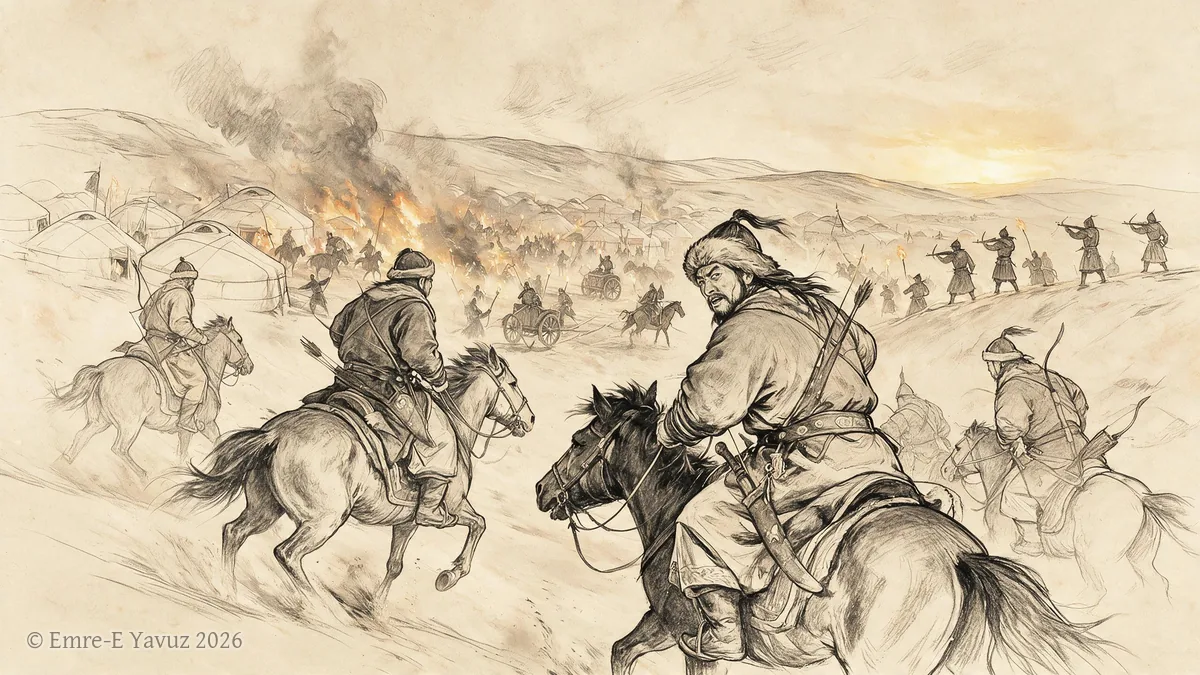
In 119 BC two Han armies under Wei Qing and Huo Qubing crossed the Gobi to find the Xiongnu chanyu Yizhixie north of it.[1] Wei Qing met the chanyu at dusk in a gale. The chanyu broke out through the Han ring with a few hundred riders.[2] Huo Qubing rode more than 2,000 li out of Dai and beat the Left Worthy King.[3] After the campaign, the Shiji says, the Xiongnu had no royal court south of the desert.[4]
The plan on both sides
The Han side acted on a diagnosis. The Marquis of Xi, Zhao Xin, had gone over to the chanyu and was planning for him. According to the emperor Wudi, Zhao Xin had always held that the Han army could not cross the desert and stay there. The emperor told his generals that if the Han now levied soldiers in great numbers, the situation was sure to give them what they wanted.[1][5] The Han fed its horses on grain and sent out 100,000 cavalry.[4] With the privately owned pack and following horses, the total came to 140,000 horses. The grain carts were not counted.[4][6] Wei Qing and Huo Qubing were to have 50,000 horse each. Foot soldiers and carriers followed the cavalry, several hundred thousand by the count of the Shiji and the Han Shu.[7][8] One modern count gives thirty to fifty thousand foot soldiers.[9] The best fighters, those ready to go deep and fight hard, were put under Huo Qubing.[2]
At the chanyu’s court the same man advised waiting. Zhao Xin had been a minor king of the Hu. He had come over to the Han and been made a marquis.[4] In 123 BC he had gone back to the chanyu with 800 riders.[2] The chanyu made him the king next to himself in rank and gave him his own elder sister as wife.[1] Zhao Xin told the chanyu that once the Han army had crossed the desert, its men and horses would be spent. The Xiongnu could then sit and take them.[2][10] The chanyu sent his baggage far to the north and waited north of the desert with picked troops.[1]
The orders were changed at the last. Huo Qubing was first to go out of Dingxiang and meet the chanyu. A captured Xiongnu said that the chanyu lay to the east. Therefore Huo Qubing was sent out of Dai and Wei Qing out of Dingxiang.[2]
Wei Qing and the chanyu
Wei Qing had marched more than 1,000 li beyond the barrier when he saw the chanyu’s troops drawn up and waiting.[2] He had his Wugang chariots linked into a ring camp. He sent out 5,000 horse against the Xiongnu. The Xiongnu sent out about 10,000.[2][11] The sun was going down. A great wind rose. Sand and gravel struck the faces of the men, and neither army could see the other. Wei Qing sent more men round both wings to enclose the chanyu.[1]
The chanyu saw that the Han were many and that their men and horses were still strong. The fighting was going against the Xiongnu. At dusk he took a team of six mules. With some hundreds of strong riders, he broke straight through the Han ring to the northwest.[2][12] It was dark by then. Han and Xiongnu were mixed together. The killing and wounding on both sides was about equal.[2]
A colonel of the Han left wing took a prisoner. The prisoner said that the chanyu had left before dark. The Han sent light horse after him in the night. Wei Qing followed behind. The Xiongnu troops scattered.[2] At dawn the Han had gone more than 200 li without finding the chanyu.[2] They had killed or taken more than 10,000.[2] They came to Mount Tianyan and to Zhao Xin’s city, where the Xiongnu kept stored grain. They fed the army from it, stayed one day and burned what was left.[2][13]
For more than ten days the Xiongnu host had no chanyu. Many of its men had mixed with the Han in the dark and followed the chanyu. He did not meet his main body for a long time. The Right Guli King thought that the chanyu was dead and made himself chanyu. When the true chanyu found his people again, the Right Guli King gave up the title and went back to his old place.[1][14]
While Wei Qing met the chanyu, the front general Li Guang and the right general Zhao Shiqi had gone by the eastern road. Some of them lost the way and came late.[2] Wei Qing turned back across the south of the desert and met them there. He wished to report. He sent his chief clerk to ask Li Guang for a written statement. Li Guang killed himself. Zhao Shiqi was handed to the officials and bought himself off as a commoner.[2][15] Wei Qing’s army returned to the frontier with 19,000 heads and captives in all.[16]
Huo Qubing and the Left Worthy King
Huo Qubing’s army was as large as Wei Qing’s in cavalry and carts but had no subordinate generals. Li Gan and others were made great colonels and did the work of subordinate generals.[2] He went out of Dai more than 2,000 li and met the Left Worthy King in battle. He took more than 70,000 heads and captives. The Left Worthy King’s generals fled.[17][18] The Shiji chapter on Huo Qubing gives the distance as more than 1,000 li. It gives the count of heads as 70,443.[2]
The emperor’s edict names what the army did. Huo Qubing led the Hunyu warriors he had taken, travelling light, and crossed the great desert. He took Zhangqu, killed Bei Cheqi, and turned on the Left Great General Shuang. He captured flags and drums, passed Nanhou and crossed Gonglu. He took the Tuntou king, the Xiongnu king titled Han (韓王) and a third, with 83 generals, chancellors, danghu and commandants.[7] He made the feng sacrifice on Mount Langjuxu and the shan at Guyan, and went down to the Hanhai.[7][19] The army fed on the enemy and did not lack grain on a very long march.[2]
Lu Bode, prefect of Youbeiping, was attached to him and joined him on time at Yucheng. He went with him to Mount Daoyu and took 2,700 heads and captives, by the Shiji’s count.[2] Two kings of the Hu, Fuluzhi and Yijiqian, served under Huo Qubing and were made marquises for it.[7] By the Han Shu, his army lost two in ten of its strength. By the Shiji, it lost three in ten.[20]
The cost
The Han counted its horses at the barrier when the two armies went out. There were 140,000, government and private. Fewer than 30,000 re-entered.[2][21] The Shiji gives the sum of the Xiongnu dead and captured as eight or nine tens of thousands. It gives the Han dead as several tens of thousands, with more than 100,000 horses lost.[4] The two counts of heads, 19,000 and 70,443, add up to 89,443. One modern count has the Han losses in men matching the Xiongnu’s.[22]
Huo Qubing’s officers and men were rewarded richly. His own fief was raised by 5,800 households. Wei Qing received no increase. None of his officers was made a marquis.[2] The post of Grand Marshal was created for the two generals. Huo Qubing’s salary was set level with Wei Qing’s.[2]
The Xiongnu after Mobei
The Shiji and the Han Shu both state the result in one sentence. After this the Xiongnu withdrew far, and south of the desert there was no royal court.[17] A modern account puts it that the Xiongnu moved their court from south of the Gobi, near Han land, to the north of the desert.[23] The Han crossed the river, dug canals and set up fields from Shuofang west to Lingju, with 50,000 or 60,000 officials and soldiers. The text describes this as nibbling at the country like silkworms, until the Han land reached the Xiongnu country in the north.[4][24]
The chanyu acted on Zhao Xin’s advice again. He sent envoys with soft words and asked for the heqin marriage settlement. The emperor put the question to his court, where some argued for heqin and others for treating the Xiongnu as subjects. Ren Chang, the chief clerk of the chancellor, said that the Xiongnu were newly broken and hard pressed. He said they should be made outer ministers who came to court at the frontier. The Han sent Ren Chang to the chanyu. The chanyu heard what he proposed. He was furious and kept him. The Han had earlier taken in Xiongnu envoys who defected to it. The chanyu had always kept Han envoys in return, in equal measure.[4][25] A councillor named Ti Shan, who argued for peace, was asked whether he could hold a commandery against the Xiongnu and then a county, and said that he could not. He accepted the command of a frontier post. A month later the Xiongnu came and cut off his head.[25] The Han meanwhile was collecting horses and men again. Huo Qubing died. The Han did not strike north again for a long time.[4]
The Han could not follow up. The Shiji says that the Xiongnu, though hurt, had gone far away, and that the Han too had few horses and could not go again.[4] One modern account says that from then on the Han made no further attempt to attack the Xiongnu in the desert.[22]
The name
The Shiji and the Han Shu do not give the campaign a name. They call the country where the Xiongnu waited ‘north of the desert’, 幕北. Mobei is the modern name of the campaign, built on that phrase.
References
- ^ a b c d e f Shiji, juan 110; Shiji, juan 111
- ^ a b c d e f g h i j k l m n o p q r s t u v Shiji, juan 111
- ^ Shiji, juan 110; Han Shu, juan 55
- ^ a b c d e f g h i Shiji, juan 110
- ^ Ögel 2015, p. 32, 36
- ^ Ögel 2015, p. 32
- ^ a b c d Shiji, juan 111; Han Shu, juan 55
- ^ Ögel 2015, p. 35
- ^ Sinor 1990, p. 129
- ^ Ögel 2015, p. 36
- ^ Ögel 2015, p. 38–39
- ^ Ögel 2015, p. 39
- ^ Ögel 2015, p. 37, 39–40
- ^ Ögel 2015, p. 37
- ^ Ögel 2015, p. 40–42
- ^ Shiji, juan 111; Shiji, juan 110
- ^ a b Shiji, juan 110; Han Shu, juan 94
- ^ Ögel 2015, p. 43
- ^ Ögel 2015, p. 43–46
- ^ Han Shu, juan 55; Shiji, juan 111
- ^ Ögel 2015, p. 34, 46–48
- ^ a b Sinor 1990, p. 130
- ^ Sinor 1990, p. 129–130
- ^ Ögel 2015, p. 47
- ^ a b Ögel 2015, p. 48–49
Sources
Literature
- Denis Sinor (ed.), The Cambridge History of Early Inner Asia (1990)
- Bahaeddin Ögel, Büyük Hun İmparatorluğu Tarihi II (2015)
What links here10
- Persons
- Emperor Wu of Han · Hunye King · Huo Qubing · Wei Qing · Yizhixie Chanyu · Zhang Qian
- States
- Han dynasty
- Conflicts
- The Xiongnu–Han Wars
- Institutions and Titles
- Warfare of the Steppe Empires · Worthy Kings of the Left and Right
Cite this article
Yavuz, Emre-E. “Mobei campaign, 119 BC.” Turkic Atlas, revised 8 November 2026. https://turkicatlas.org/events/battle-of-mobei-119-bc/
Last revised: 8 November 2026

