
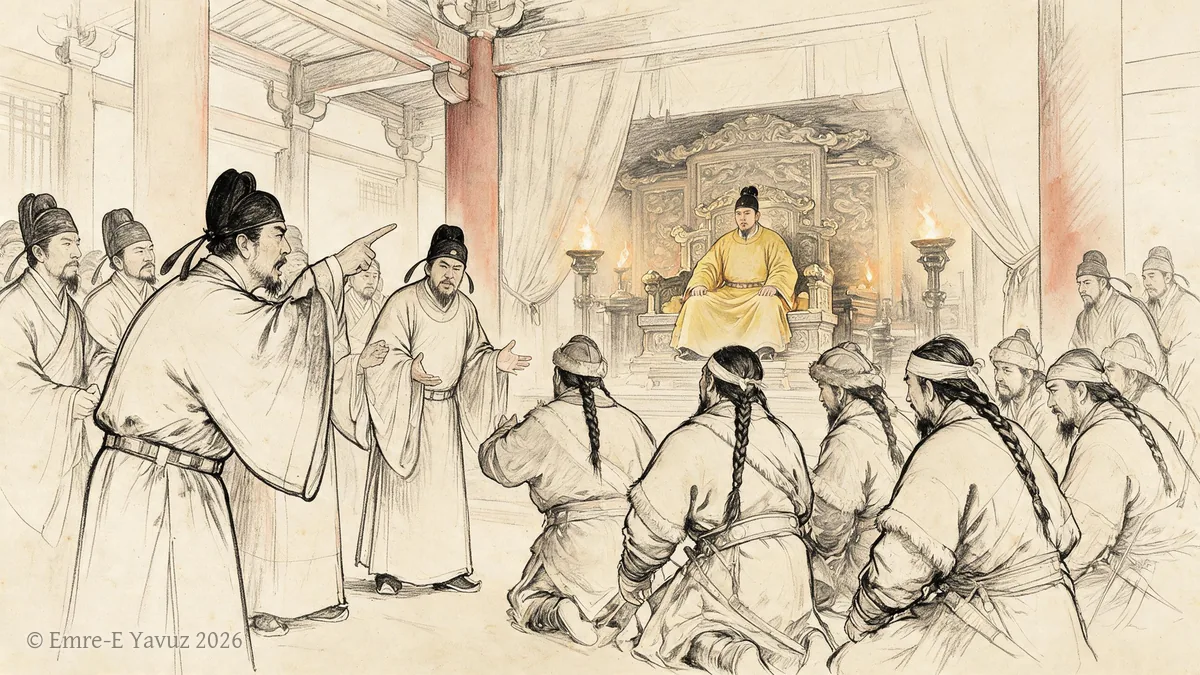
After the fall of Ilig Khan in 630, an edict asked the Tang court how the frontier should be secured.[1] Some of Ilig’s people had fled to the Xueyantuo or into the Western Regions. A great many had surrendered to the Tang.[1] The court had to decide where they should live and how they should be governed.[1] The emperor Taizong took the plan of Wen Yanbo, the director of the Secretariat. Wen Yanbo would keep the Göktürk tribes whole below the frontier as a shield for China.[1][2] His sharpest opponent was Wei Zheng, the director of the Imperial Library. Wei Zheng would send the Göktürks back north of the Yellow River.[1] The debate decided how the Tang would first govern the surrendered eastern Göktürks.
The question
The Tongdian says that most of the surrendered Göktürks were then in the Shuofang country. Nearly ten thousand households had moved into the capital.[3] Wei Zheng put the number who had come over at nearly a hundred thousand.[1][4] The Xin Tang Shu says more than a hundred thousand, and the Zizhi tongjian says a hundred thousand people.[5]
The majority
Most of the officials wanted the Göktürks dispersed.[1][6] The Göktürks had long relied on their strength and troubled China, they said. Now Heaven had destroyed them, and they had come out of need and not out of love of right.[1] Their tribes should be broken up and settled as captives in Yan and Yu, the provinces south of the Yellow River. They should be scattered among the prefectures and counties.[1][6] Taught to plough and weave, a million foreigners would become Chinese subjects.[1] China would gain households, and the land beyond the frontier would stay empty for ever.[1] The Tongdian names Yan and Xu instead of Yan and Yu.[3]
Wen Yanbo and Wei Zheng
Wen Yanbo answered with a precedent from the Han.[1][7] In the Jianwu years, the Han had settled the surrendered Xiongnu below the frontier at Wuyuan.[1][8] The Göktürks should be treated the same way. Their tribes should be kept whole as a shield, and their customs should be left to them.[1] That would fill the empty land and show that the Tang held no suspicion. To send them to Yan and Yu, by contrast, would go against their nature.[1] Wen Yanbo had been a Göktürk prisoner himself after the campaign of 625.[9]
Wei Zheng spoke against him.[1][8] The Göktürks had never been so utterly broken, he said, and Heaven had cut them off.[1] They had raided China for generations, and the people hated them. If the emperor would not destroy them, he should send them back north of the river to their own land.[1] They had human faces and the hearts of beasts and were not of the Chinese kind. When strong, they raided. When weak, they submitted. Kindness meant nothing to them.[1] The Qin and the Han had taken the land south of the river from them and made it into commanderies.[1] Nearly a hundred thousand had now come in. In a few years they would multiply many times over, close to the capital, a disease at the heart.[1]
Wen Yanbo replied that the Son of Heaven, like Heaven that covers and Earth that bears, had to nourish whatever came to him.[1] To turn away a broken people who had come to submit would close the way to all the peoples of the four quarters.[1] To settle them south of the river was to give the dead life and the lost a home. They would remember the favour and never rebel.[1]
Wei Zheng reached for the Jin dynasty.[1] Foreign tribes had been settled in the commanderies near the capital since the Wei.[1] After Jin conquered Wu, Guo Qin and Jiang Tong urged the emperor Wu to drive them beyond the frontier. He did not listen, and a few years later they overthrew Luoyang.[1] To follow Wen Yanbo, Wei Zheng said, was to rear a beast and keep the danger for oneself.[1] The Xin Tang Shu has him say a tiger.[10]
Wen Yanbo had the last word.[1] The way of the sage reached everywhere, he said, and in teaching there were no classes of men.[1] The Tang would take in the remnant of the Göktürks and teach them rites and law. In a few years they would all be farmers.[1] Their chiefs could serve in the palace guard.[1] The Guangwu emperor had settled the southern chanyu in the inner commanderies as a bulwark of the Han, and to the end of that age there had been no rebellion.[1]
Other voices
The Zizhi tongjian and the Xin Tang Shu record further speakers.[11] Yan Shigu, a vice-director of the Secretariat, pointed out that the Göktürks and the Tiele had never been subjects of any earlier dynasty.[12][6] He wanted them all settled north of the river, divided under their own chiefs, each leading his own tribe.[12] Li Baiyao, a vice-president of the Board of Rites, said that the Göktürks were one state only in name, made up of tribes each with its own chief.[12][13] Each chief should rule his own tribe, and none should be subject to another. Even the Ashina, if kept, should rule only their own clan.[12] A divided state was weak and easy to hold, and a protectorate at Dingxiang could oversee them.[12] The Xin Tang Shu adds Du Chuke to these two and calls their plan the way of controlling from afar with a long rein.[10]
Dou Jing, the governor-general of Xiazhou, held that the steppe peoples could be neither awed by punishment nor taught by kindness. They would not forget their homeland.[12][7] He advised giving their chiefs the titles of kings and lords and wives from the imperial house. He also advised dividing their land and their tribes so that they would stay weak.[12]
The Tongdian sets beside the debate a memorial of Li Daliang, the governor-general of Liangzhou.[3] The chiefs who had come in all held rank as generals, it says. Those of the fifth rank and above numbered more than a hundred, nearly half the court. Only the Zhejie had not come, and an edict was sent to summon them.[3] Li Daliang thought the effort a waste.[3] Every newly surrendered man received five bolts of silk and a robe, and the chiefs received high office and rich pay.[3] China’s taxes, he wrote, were feeding an old enemy whose numbers only grew.[3]
The decision
Wen Yanbo was eloquent and cited precedent after precedent, and the emperor took his plan.[1][14] Four governor-generalships were set up in the Shuofang country, from Youzhou to Lingzhou: Shun, You, Hua and Chang.[1][15] Ilig’s own land was divided into six prefectures, under the Dingxiang command on the left and the Yunzhong command on the right.[1] The Zizhi tongjian says that the four governor-generalships were made from the land that Töles had ruled.[12] Töles himself became governor-general of Shunzhou and was sent to lead his people.[5] Ashina Simo, who had stayed with Ilig to the end, was set over Ilig’s old tribes.[16]
The chiefs who came in were made generals and palace officers.[1] The Jiu Tang Shu counts more than a hundred of the fifth rank and above, and several thousand households who moved into Chang’an.[1] The Zizhi tongjian counts the same hundred, nearly half the court, and nearly ten thousand households.[12] The Xin Tang Shu counts five hundred chiefs made generals and palace officers, nearly a hundred attending court, and several thousand households registered in Chang’an.[10]
One modern account calls the settlement realpolitik.[17] Taizong presented himself as the liberator of the tribes from Ilig’s tyranny. In fact, the account says, he separated all the Göktürk tribes from one another and took away their central authority.[17] The same account says that Taizong resettled the greater part of the Ashina in north-western China, south of the Yellow River and the walls.[18] Elsewhere it speaks of thousands of Ashina forcibly resettled in northern China, while the other Turkic peoples came under Chinese protectorates.[19]
The reversal
The settlement held for nine years. In 639 Jieshe Shuai, a brother of Töles, attacked Taizong’s travelling palace with more than forty men.[1] From then on, the Jiu Tang Shu says, the emperor began to worry about the arrangement. Many memorials argued that it was unwise to keep the Göktürks inside China.[20] The Göktürks were moved north of the river, and Ashina Simo was made their khan.[1] The Tang thus did in part what Wei Zheng had advised, nine years late. The interregnum and the loose-rein prefectures grew out of the decision of 630.
References
- ^ a b c d e f g h i j k l m n o p q r s t u v w x y z aa ab ac ad ae af ag ah ai aj ak al am an Jiu Tangshu (Old Book of Tang), juan 194
- ^ Taşağıl 1999, p. 20–24
- ^ a b c d e f g Tongdian, juan 197
- ^ Taşağıl 1999, p. 20, 23
- ^ a b Xin Tangshu (New Book of Tang), juan 215; Zizhi tongjian (Comprehensive Mirror in Aid of Governance), juan 193
- ^ a b c Taşağıl 1999, p. 21
- ^ a b Taşağıl 1999, p. 22
- ^ a b Taşağıl 1999, p. 22–23
- ^ Zizhi tongjian (Comprehensive Mirror in Aid of Governance), juan 191
- ^ a b c Xin Tangshu (New Book of Tang), juan 215
- ^ Zizhi tongjian (Comprehensive Mirror in Aid of Governance), juan 193; Xin Tangshu (New Book of Tang), juan 215
- ^ a b c d e f g h i Zizhi tongjian (Comprehensive Mirror in Aid of Governance), juan 193
- ^ Taşağıl 1999, p. 21–22
- ^ Taşağıl 1999, p. 23–24
- ^ Taşağıl 1999, p. 24
- ^ Jiu Tangshu (Old Book of Tang), juan 194; Zizhi tongjian (Comprehensive Mirror in Aid of Governance), juan 193
- ^ a b Yavuz 2025, p. 379
- ^ Yavuz 2025, p. 380
- ^ Yavuz 2025, p. 386
- ^ Jiu Tangshu (Old Book of Tang), juan 194; Tongdian, juan 197
Sources
- Jiu Tangshu (Old Book of Tang), juan 194
- Tongdian, juan 197 (after Sui Shu and Zhou Shu)
- Xin Tangshu (New Book of Tang), juan 215 (after Jiu Tangshu)
- Zizhi tongjian (Comprehensive Mirror in Aid of Governance), juan 191, 193 (after Wei Shu, Zhou Shu, Sui Shu and Bei Shi)
Literature
- Emre-E. Yavuz, The Gokturk Empire: 2nd Edition (2025)
- Ahmet Taşağıl, Gök-Türkler, Bd. II (1999)
What links here6
- Battles & Events
- The Göktürk Campaign of 625
- Places
- Lingzhou · Shanyu Protectorate · Youzhou · Yunzhong
Cite this article
Yavuz, Emre-E. “The Court Debate of 630.” Turkic Atlas, revised 7 November 2026. https://turkicatlas.org/events/court-debate-of-630/
Last revised: 7 November 2026

