
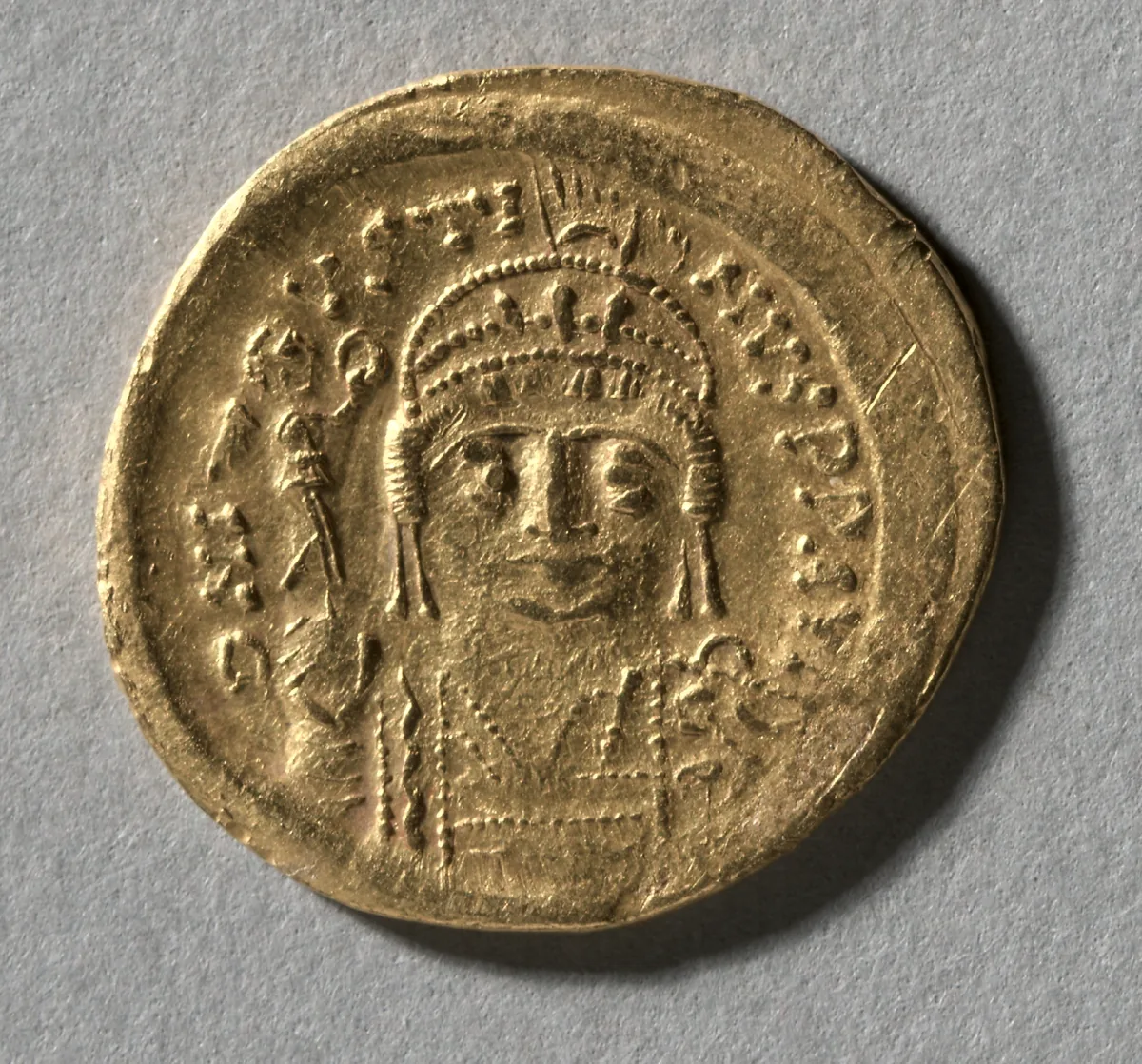
The Göktürk–Byzantine alliance was the pact of friendship and war against Persia that the envoys of Istemi swore with Justin II, emperor of the eastern Romans, in Constantinople in 568.[1] A fairly regular exchange of embassies followed, until the Göktürks took the Roman city of Bosporos in 576.[2] Half a century later Heraclius made it again. A Göktürk army fought beside the Romans against Persia in the Caucasus.[3]
Origins
The alliance grew out of the silk trade.[1] After the Göktürks had subdued the Hephthalites, their Sogdian subjects wanted to sell silk in Persia. Istemi sent them there with Maniakh at their head, in the embassies to Ctesiphon.[1] Khosrow I bought the silk and burned it before the envoys’ eyes. He had most of a second, Göktürk embassy poisoned.[1] From this, Menander writes, began the enmity of the Persians and the Göktürks. Maniakh advised Istemi to turn to the Romans, who used more silk than any other people.[1]
The oath of 568
At the beginning of the fourth year of Justin’s reign, Maniakh reached Constantinople with gifts of silk and a letter in Scythian writing.[1] The embassy asked the emperor for peace and a military alliance between the Romans and the Göktürks. It offered to make war on every enemy of the Roman power in their part of the world.[1] Maniakh and his companions raised their hands and swore the greatest oath. They called curses on themselves, on Istemi and on the whole nation if they lied.[1] In this way, Menander writes, the Göktürks became friends of the Romans.[1]
The pact has been called a defensive and at the same time offensive alliance. It finds three motives for it on the Göktürk side: trade, the war with Persia, and the Avars.[4] Byzantium had reasons for caution.[5] It had begun to make silk of its own. A Göktürk alliance also threatened the arrangement by which it paid the Avars. Therefore the empire did not answer with great haste.[5]
Embassies, 569 to 576
Justin answered with the embassy of Zemarchos, which left Constantinople in August 569.[1] When Zemarchos first came, Istemi and Justin made the treaties. Istemi declared that the friend of the Romans would be his friend and their enemy his enemy.[1] Istemi took Zemarchos with him on his campaign against Persia. He sent him home with a new envoy, Tagma, whose title was Tarkhan.[1] The Göktürk embassy seems to have reached Constantinople in 571.[2]
About 570 the Göktürks invaded Media. They sent an embassy to Justin, urging him to make war on Persia with them so that Persia would be crushed between the two.[6] Menander counts this as the chief cause of Justin’s war with Persia.[1] The Romans incited the Göktürks without cease. This was one of the causes of the twenty years’ war between Rome and Persia that began in 572.[7]
Menander names the envoys who followed: Anankastes, Eutychios, Herodian, Paul the Cilician, and Valentinos, who went twice.[1] Some scholars count five further Roman embassies to Istemi’s court up to 576, all of them attacked on the road by Persian mercenaries.[8] By 576, 106 Göktürks were living in Constantinople, sent by their people at different times.[1] They take most of them for merchants.[9]
Bosporos, 576
In 576 Tiberius Caesar sent Valentinos to renew the alliance against Persia.[2] Turxanthos, a son of Istemi, who had just died, received him with reproaches.[1] The Romans, he said, spoke with ten tongues and one deceit. They had made a treaty with the Avars, the Göktürks’ runaway slaves. They led his envoys through the Caucasus to keep him from their lands.[1] Valentinos reminded him that his father had chosen the Romans over the Persians of his own will.[1]
Turxanthos sent Valentinos on to Tardush and at the same time sent an army against Bosporos.[1] Menander says that the city was taken while the envoys were among the Göktürks. He says that it then became clear that the Göktürks had gone to war with the Romans. Turxanthos, he says, held and mocked the envoys before he let them go.[1] Others see it otherwise. According to it, there was no war with Byzantium. Tardush agreed with Valentinos that the alliance still stood, and the Göktürks kept the Crimea.[10] The date of the siege of Bosporos is counted two ways. One reckoning sets the siege and the fall of the city in 576.[10] A second dates the fall of the city to about 579.[11]
About 580 the emperor still used the Göktürks as a threat. He told the Avar envoys that Göktürks were encamped around Cherson.[1] In 598 a Göktürk khagan sent envoys with a letter to the emperor Maurice, recounting his victories.[12]
Renewal under Heraclius
Some scholars hold that the alliance had apparently broken about thirty years before the two powers fought together again in 627.[13] Tong Yabgu renewed relations with Byzantium and intervened in the war between Byzantium and Persia that had been running since 602.[14] By the time the Avars, the Slavs and the Persians besieged Constantinople in 626, Heraclius had made his alliance with the western Göktürks.[15]
The Armenian history of the Caucasian Albanians tells how it was made.[16] Heraclius sent a noble named Andre north with promises of immense treasure. The ruler it calls Jebu Xak’an answered that he would avenge the emperor on his enemies and come to his aid in person.[16] He sent back about a thousand picked horsemen, who swore oaths with the emperor, each by his own law.[16]
In 627 Börü Shad came before Derbent. The allies besieged Tiflis.[17] Before the fortress the Göktürk ruler kissed the emperor’s shoulder.[18] Heraclius called him his son, crowned him with his own diadem, and promised him his daughter.[18] The alliance’s war in the north was the Caucasus campaign of 627 to 629. It contributed significantly to the Roman victory and to the collapse of the Sasanian state.[19] After the war Göktürk power was exhausted. The Roman and the Persian powers were exhausted too.[20]
Both times the alliance was made against Persia, the one power that bordered on both partners.
References
- ^ a b c d e f g h i j k l m n o p q r s t u Menander Protector
- ^ a b c Golden 1992, p. 130
- ^ Yavuz 2025, p. 359-361
- ^ Yavuz 2025, p. 288-289
- ^ a b Golden 1992, p. 129
- ^ Menander Protector; Dindorf 1871, p. 68-69
- ^ Nöldeke 1879, p. 158
- ^ Yavuz 2025, p. 293
- ^ Yavuz 2025, p. 290
- ^ a b Yavuz 2025, p. 321
- ^ Golden 1992, p. 131
- ^ Theophylact Simocatta; Chavannes 1903, p. 246
- ^ Yavuz 2025, p. 361
- ^ Yavuz 2025, p. 359
- ^ Golden 1992, p. 112
- ^ a b c Movsēs Dasxurancʿi; Dowsett 1961, p. 87
- ^ Yavuz 2025, p. 361-368
- ^ a b Yavuz 2025, p. 368-370
- ^ Golden 1992, p. 135
- ^ Yavuz 2025, p. 372
Sources
Literature
- Emre-E. Yavuz, The Gokturk Empire: 2nd Edition (2025)
- Peter B. Golden, An Introduction to the History of the Turkic Peoples (1992)
- Édouard Chavannes, Documents sur les Tou-Kiue (Turcs) occidentaux (1903)
- Theodor Nöldeke, Geschichte der Perser und Araber zur Zeit der Sasaniden. Aus der arabischen Chronik des Tabari übersetzt und mit ausführlichen Erläuterungen und Ergänzungen versehn (1879)
- Charles J. F. Dowsett (trans.), The History of the Caucasian Albanians by Movsēs Dasxuranci (1961)
- Ludwig Dindorf (ed.), Historici Graeci minores, Bd. II: Menander Protector et Agathias (1871)
What links here18
- Persons
- Anankhast · Heraclius · Istemi · Justin II · Tagma Tarkhan · Valentinos
- States
- Byzantium · Sasanian Persia
- Conflicts
- Göktürk Expansion along the Silk Road · Göktürk Expansion into Europe · The Göktürk–Sasanian Trade Conflict
- Battles & Events
- Embassy of Valentinos (576) · Istemi's campaign against Persia, 569 · Khosrow's gift of maidens (573) · Maniakh's embassy to Constantinople, 568 · Meeting of Heraclius and Ziebel (627) · Siege of Bosporos, 576
- Peoples
- Turkic Tribes in Europe
Cite this article
Yavuz, Emre-E. “The Göktürk–Byzantine alliance.” Turkic Atlas, revised 8 November 2026. https://turkicatlas.org/events/gokturk-byzantine-alliance/
Last revised: 8 November 2026

