
- 400
- 500
- 600
- 700
- 800
- 900
- Rouran 400–554
- First Göktürk 552–630
- Tang rule 630–682
- Second Göktürk 682–744
- Uyghur 744–840
- Kirghiz 840–924
- Huns 370–469
- Western Göktürk 552–659
- Türgesh 699–766
- Karluk 766–800
- Khazar 650–969
In these wars the Göktürks lost a war they had been winning. The decisive instrument of the Sui was not an army.
Origins
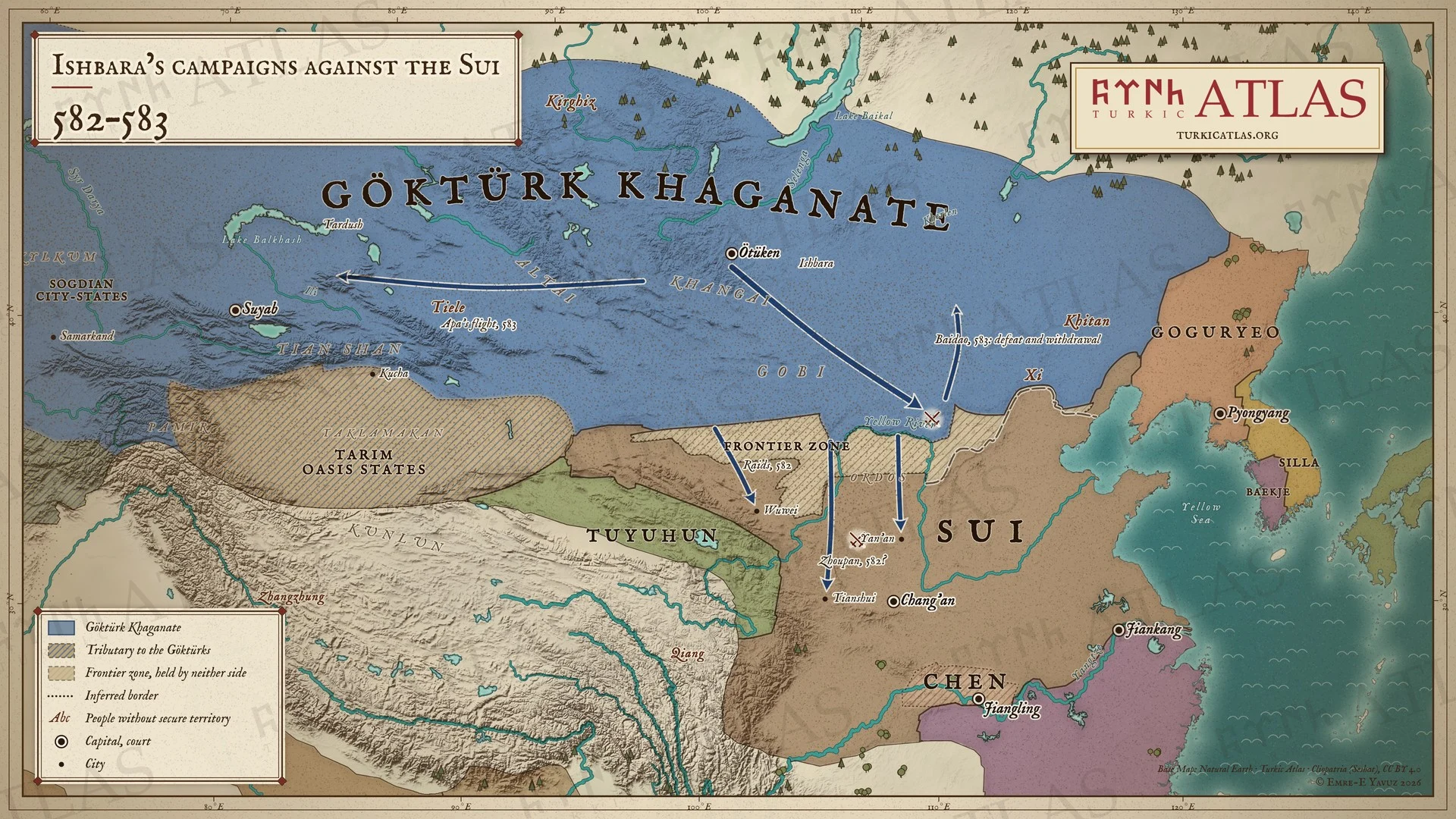
The Northern Zhou had paid the Göktürks to keep the peace. The Sui, who replaced the Zhou in 581, stopped paying. The Zhou princess who had been sent to the khan’s court, Princess Qianjin, had her own reason to want the new dynasty destroyed. The new dynasty had destroyed her house.[1]
In 582 Ishbara invaded. The disputed succession had just been settled in his favour. As a result he came south with a state in which several men thought the throne should have been theirs.[1]
Sui method
The Sui response was to widen the divisions within the khaganate. The Chinese sources state this as a deliberate policy. It worked on what the khaganate offered: rival khans, each with a following and each with a claim. No rule of succession was firm enough to settle which of them was right. Within two years the civil war had begun. From then on the Sui were no longer the Göktürks’ principal enemy. Other Göktürks were.
The second war, from 599, shows the same mechanism at full strength.[1] Tardush in the west fought for the whole khaganate. The Sui raised Yami as khan under their protection and defended him.[1] In 603 Tardush’s following broke up. He went west, and the sources lose track of him.[2]
Outcome
In the end the eastern khaganate had a khan who held his place by Chinese arms. The western khaganate was a separate state. The histories treat the division of 582 as permanent. It was permanent: at no later moment does one khan rule from the Liao to the Oxus.
The recovery came from the same house within fifteen years. Yami’s son Shibi was strong enough to besiege a Sui emperor at Yanmen in 615. Even so, the recovery did not undo the split.[1]
References
Sources
- Sui Shu (Book of Sui), juan 84
- Bei Shi (History of the Northern Dynasties), juan 99 (after Wei Shu, Zhou Shu and Sui Shu)
- Zizhi tongjian (Comprehensive Mirror in Aid of Governance), juan 179 (after Wei Shu, Zhou Shu, Sui Shu and Bei Shi)
Literature
- Peter B. Golden, An Introduction to the History of the Turkic Peoples (1992)
- Liu Mau-tsai, Çin Kaynaklarına Göre Doğu Türkleri (1958, Turkish edition)
- Emre-E. Yavuz, The Gokturk Empire: 2nd Edition (2025)
What links here11
- Persons
- Kuhanzhen · Princess Qianjin · Tanhan Khan
- Battles & Events
- Battle of Baidao (583) · Battle of Zhoupan (582) · Embassy of Yu Qingze (584) · The Sui Campaign of 599
- Places
- Baidao Plain · Shuozhou · Youzhou · Zhoupan
Cite this article
Yavuz, Emre-E. “The Göktürk–Sui wars, 582–603.” Turkic Atlas, revised 20 October 2026. https://turkicatlas.org/conflicts/gokturk-sui-wars/
Last revised: 20 October 2026

