
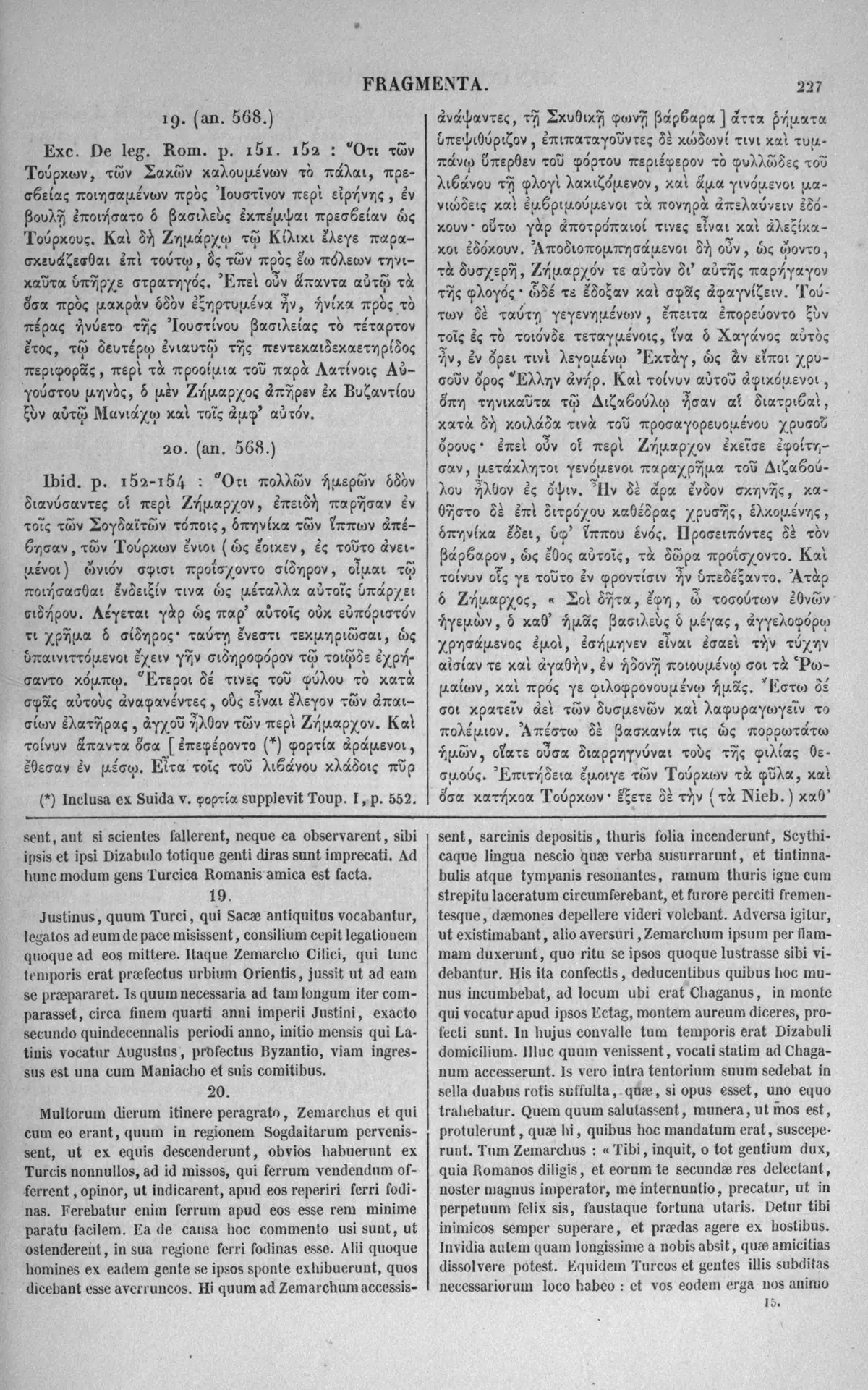
Ektag is the mountain at which the Roman embassy of 569 found Istemi.[1] It is known from one text. Menander says that the envoys were led to the place where the khan was, on a mountain which those people call Ektag, “as a Greek would say, the golden mountain”. Istemi’s residence at that time lay in a valley of it.[1]
The embassy of 569
The account is the only description of a Göktürk court by a man who stood in it. Before Zemarchos was admitted, men who called themselves averters of evil took his baggage. They burned leaves of incense, murmured words in a language he could not follow, rang bells and beat drums. They carried a crackling branch around him. Working themselves into a frenzy, they led the envoy himself through the flame. They took this rite to purify themselves as well.[1]
The khan received him inside a tent. He sat on a chair with two wheels, which a single horse could draw when it was needed.[1] The gifts were presented, and Zemarchos made his speech. The Romans wished the khan lasting good fortune, victory over his enemies and plunder from them. They wished that envy, which dissolves friendships, would stay far away.[1] They then spent the rest of the day at the feast in the same tent. It was hung with silk worked in colours. They were given a drink that was not pressed from grapes, because that country grows no vines.[1]
The next day they met in a second tent, also hung with silk and set with images. There Istemi sat on a bed made entirely of gold. Golden vessels and jars stood in the middle of the room.[1]
Location
The mountain has not been fixed. Menander translates the name as Golden Mountain. This may be a rendering of the Turkic altun. That would point to the Altai, the altun yıs of the later inscriptions. Another suggestion sets the name against a Turkic word for white. That would point to a snow range of the Tian Shan nearer the route the embassy travelled. The second suggestion rejects Menander’s gloss and identifies the name as Ak-tagh, “white mountain”. It finds that mountain in the White Mountain, 白山, which the Chinese know north of Kucha. It holds that the Greek reports have confused this mountain with the Golden Mountain, the cradle of the Ashina.[2][3] In the embassy of Valentinos in 576 the manuscripts name the mountain of Tardush Ektel. It corrects the last letter, lambda for gamma, so that the mountain is the same.[4] The fragment gives a name, a translation and a valley. It gives no bearing.[1]
What the passage does establish is the shape of the western khaganate’s court in 569. The court was mobile, tented and rich in silk and gold. A rite of purification guarded it, and a Roman diplomat had to undergo this rite before he could speak.[1]
References
Sources
Literature
- Édouard Chavannes, Documents sur les Tou-Kiue (Turcs) occidentaux (1903)
- Peter B. Golden, An Introduction to the History of the Turkic Peoples (1992)
- Emre-E. Yavuz, The Gokturk Empire: 2nd Edition (2025)
- Josef Markwart, Wehrot und Arang. Untersuchungen zur mythischen und geschichtlichen Landeskunde von Ostiran (1938)
What links here15
- Persons
- Valentinos · Zemarchos
- Conflicts
- Göktürk Expansion along the Silk Road · Göktürk Expansion into Europe · Kapgan's western war, 709–713
- Battles & Events
- Revolt of Turum · The embassy of Zemarchos, 569 · The khan's letter to Maurice
- Places
- Ikar · Sanmi Mountain
- Institutions and Titles
- Trade Routes of the Steppe
- Religions
- Purification by Fire · Sacred Mountains
- Customs & Pastimes
- The Göktürk Feast
Cite this article
Yavuz, Emre-E. “Ektag.” Turkic Atlas, revised 8 November 2026. https://turkicatlas.org/places/ektag/
Last revised: 8 November 2026

