
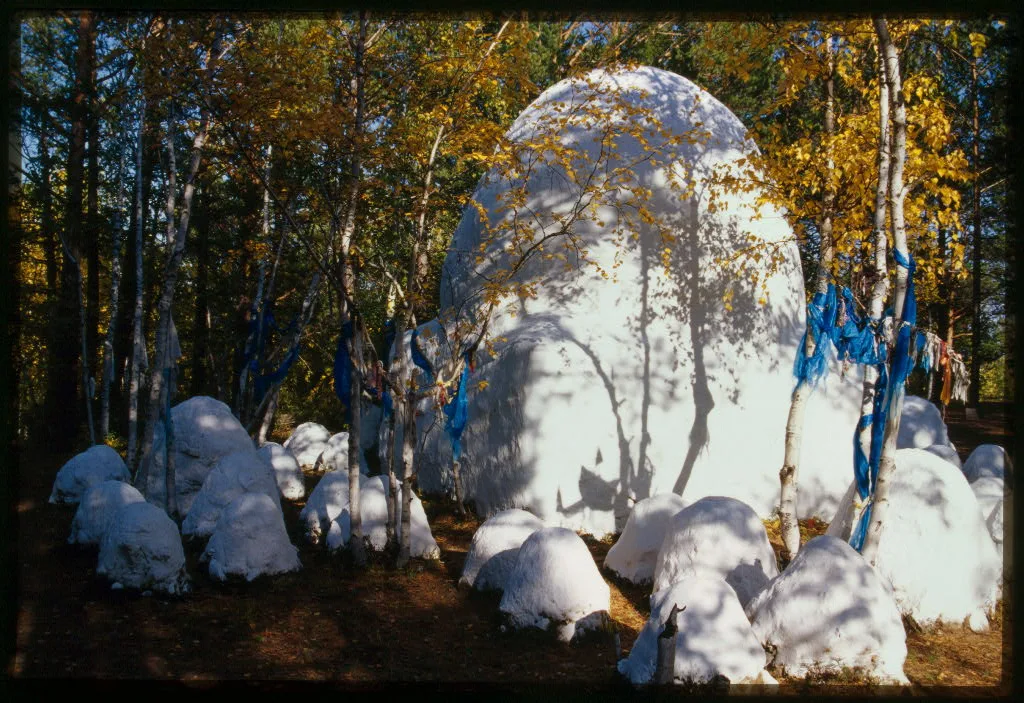
Animism is the modern name for the belief that the world is full of spirits. A mountain, a river, a spring, a stand of trees, the hearth fire, the game of the forest and the dead each have a spirit or an owner. People must address this spirit, thank it and keep it content. Among the Turkic peoples of the steppe and Siberia, the belief is on record for more than two thousand years, from a Chinese notice of the Xiongnu to the field notes of the twentieth century.[1]
In the history of Turkic religion, animism is the base layer. It is the worldview underneath shamanism. Shamanism is the foundation of Tengrism, the sky-centred religion of the khans, which developed out of it. First came the spirits of place, then the specialists who deal with them, then the cult of Tengri, who sets the khan on the throne.
The Göktürk record of this layer is short. It holds a few Chinese lines on spirits and spirit-mediums, a bare mountain called the spirit of the earth and a sacrifice at a river. A Byzantine envoy saw a purification by fire in 569.[2] The inscriptions of the eighth century name the sacred Earth-and-Water, which speaks beside Heaven.[3] The detailed picture comes from reports written down among the Altaians, Tuvans, Yakuts and their neighbours from the eighteenth century onward. It includes the owner of the mountain, the owner of the water and the lord of the fire.[4] How far those reports reach back to the khaganates is an open question.
The term and its theory
The word is not a word of the steppe. Edward B. Tylor used it in Primitive Culture for the doctrine of souls. He then widened it to the doctrine of spirits in general. He argued that souls, demons, deities and every other class of spiritual being are conceptions of one kind, and that the conception of the soul came first.[5] In his words, the “savage” theory of the universe traces the events of the world to the will of pervading personal spirits.[6]
Tylor set this belief at the beginning of a development that runs from the “lower races” to the higher culture.[7] The scheme of stages belongs to the nineteenth century, and scholars disputed early how it was applied in the field. In 1914 an ethnographer of Siberia complained that those working on the region, led by Tylor’s theory, called phenomena animistic. They used the word “soul” for things of a different kind.[8] The word outlived the scheme. Accounts of Siberian shamanism describe it as a religious attitude that rests on the animistic view of nature, the view that the world is pervaded by spiritual forces.[9] A Turkish history of shamanism finds in the Altaians’ belief that the mountain is itself the spirit the memory of a very old animism.[10] A study of the Göktürk nature cults calls them an example of animism.[11]
In the Turkic material, the word names the belief and nothing more: that places and things have spirits or owners, and that people approach these spirits with gifts.
Spirits of place in the oldest sources
The oldest notice comes from the Chinese account of the Xiongnu. In the fifth month, they held a great assembly at Longcheng. There they sacrificed to their ancestors, to Heaven and Earth, and to ghosts and spirits, 鬼神.[12]
In 569, as Menander reports, the embassy of Zemarchos reached the Göktürks in the land of the Sogdians.[13] Men who called themselves exorcists of ill-omened things took the envoys’ baggage. They burned branches of the frankincense tree over it, rang bells and beat drums. They fell into a frenzy and believed that they drove evil spirits away. Then they led Zemarchos himself through the fire.[2] The rite of purification by fire assumes that harmful spirits travel with strangers and their goods. It also assumes that fire and noise drive them off.
Theophylact Simocatta devotes a digression to the east, writing probably in the 620s.[14] He says that the Göktürks honour fire to a quite extraordinary degree and revere air and water. They praise the earth, but they only worship and call god the one who made heaven and earth.[15] The Greek separates the two: the elements are honoured, and one maker is worshipped.
The Chinese histories of the seventh century are fuller. The Zhou Shu, finished in 636, has the khan live at Ötüken with his tent opening to the east, the quarter of the sunrise.[16] Every year he led the nobles to sacrifice at the cave of the ancestors. In the middle of the fifth month, the people gathered at a river and sacrificed to the spirit of Heaven. A high mountain with neither grass nor tree on it stood four or five hundred li from Ötüken. The Göktürks called it 勃登凝黎, and the Chinese glossed the name as the spirit of the earth, 地神.[16] The Sui Shu was compiled in the same century. It sums up the customs of the Göktürks in a line. They revered ghosts and spirits, 敬鬼神, and trusted spirit-mediums, 信巫覡. In most things, they kept the customs of the Xiongnu.[17]
A Tang compilation of the ninth century preserves a story of the same world. A lake west of the cave of the Ashide had a god. The lake goddess, or the god’s daughter, met the ancestor Shemo every evening and took him into the water until a hunt broke the bond.[18] The story belongs to Turkic mythology and shows a lake with a spirit of its own.
The inscriptions of the eighth century are the first record in Turkic. The inscription of Tonyukuk looks back on the battle of Bolchu in 710. In a speech on the march against the Türgesh, Tonyukuk says that Heaven, Umay and the sacred Earth-and-Water had evidently helped the Göktürks.[19][20] The Kül Tegin stone, set up in 732, tells of the fifty years under the Tang.[21] Then the Göktürk Heaven and the sacred Earth-and-Water of the Göktürks said: let the Göktürk people not perish, let them be a people again. Heaven took İltiriš Khan and his katun and raised them up.[21] The stone does not keep the word ıduq, sacred, for this pair. It puts the word before Ötüken, the forest of the Göktürk seat, and before Tamag, the place of a battle against the Karluks.[21]
The same stone speaks of land and water in the language of ownership. Bilge Khan says that he set the Kirghiz in order so that the land and water of the Kögmen would not be left without a master. The word is idisiz, without an idi, an owner.[21] More than three centuries later, Kashgari glosses idi as master and as a name of God. He records the proverb that something left free has no master.[22] His iduq, blessed, is an animal set free. Nobody burdens its back, milks it or shears it, because of a vow that lies on its owner.[23] The owner-spirits of the ethnographers bear what appears to be the same word in a later form.
The owner-spirits in the ethnography
From the eighteenth century onward, collectors recorded a world in which every place has a master. They found it among the Turkic peoples of the Altai, the Sayan mountains and the Lena, and among their Mongolic and Tungusic neighbours.[24] The word is ä, eä or öjä in Tatar, icci in Yakut, edzen in Buryat and amaka in Tungus. All of them mean lord, master of the house, owner.[24] The Altaians say ie, iye or izi, and the Yakuts say iççi. The spirits so named belong to the cult of Yer-Su.[25]
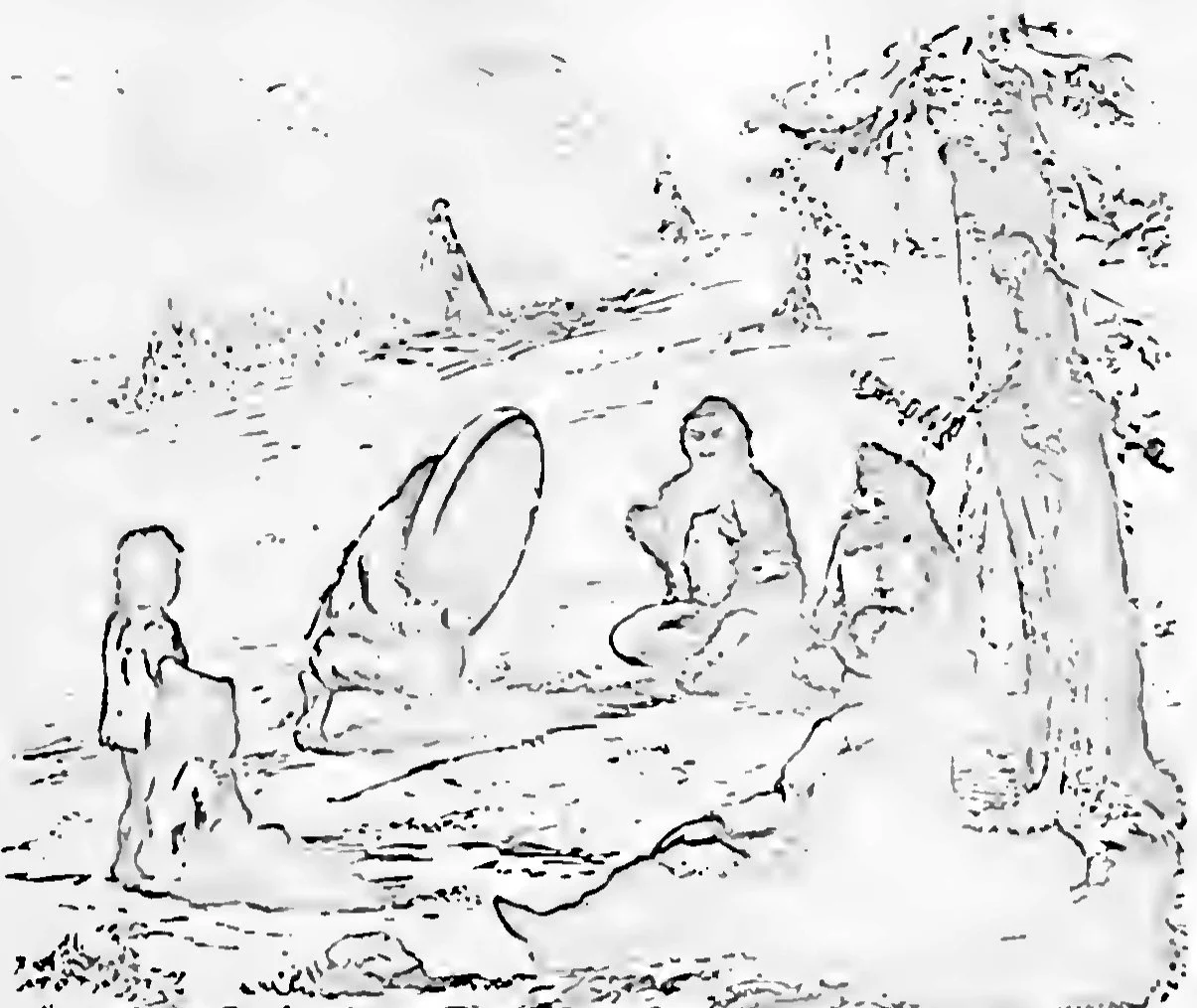
The Yakuts take the idea furthest. Everything there has its icci: water, mountains, stones, forest, grasses, shrubs, meadows, vessels and weapons.[26] The tools of the smith each have an owner, and the bellows has the chief one.[27]
Mountain and forest
The master of the forest is urman öjase among the Kazan Tatars and tya icci among the Yakuts. In mountain country, he is the master of the mountain, dag äzi among the Karagass.[28] Hunters keep silent near a mountain because its master does not bear noise. The Yakuts and the Lamuts pass a mountain without a sound. The Shors do not whistle, sing or quarrel on a hunt. The Altaians ask the women at home to avoid loud talk and laughter.[29] The Yakut master of the forest likes noise instead. When the hunters find an elk dead in a self-acting bow trap, they run and leap and call out, laughing, that the master of the black forest has given them game.[30]
The Karagass honour the master of the mountain three times a year. They honour him in May with tea and fat poured into the fire for the reindeer. They honour him in June after the move to the summer camp, and in autumn when hunting begins.[31] A Yakut hunter may come home without game. Then the Yakuts make a rough wooden image of the forest master, take it into the yurt and smear it with the blood of a slaughtered animal. The man who conducts the rite must wear a woman’s cap and clothes and hold a bow trap in his hand.[32]
In the Altai, the mountains are persons. The range, the rivers and the lakes of the Altaians are not geographical names but beings who speak, hear, marry and have children. A listener cannot always tell whether a man speaks of the mountain or of a person who bears its name.[33] The kam addresses the Altai itself, not the owner of the Altai.[10]
Water and land
The master of the water is sug äzi among the Karagass and ü icci among the Yakuts. The Yakuts say that every river and lake has its own.[34] When the Karagass begin to fish at the weirs, all the fishermen tie coloured ribbons to a birch on the bank and light a fire beside it. They throw tea, milk, fat and butter into the fire, but no bread and no tobacco, which the master does not want. Nothing foul may go into the water, and no water may be drawn in a milk vessel or a sooty pot.[34] When the ice breaks in spring, the Yakuts throw bread and salt into the water and fire their guns, so that the old woman of the river does them no harm.[35] At the autumn fishing, they once purged the lake with torches of wood from a tree struck by lightning and asked its owner for a gift.[36]
Land and water are named together in the Altai too. The Teleuts say that from ancient times they have honoured their land and water, jär-su, and their sky.[37] The Altai Tatars gather the shrines of their country in the phrase “my seven-gated land and water”. Each clan honours the mountains, rivers and lakes of its own ground, and their spirits protect the whole region.[38] A collector in the Altai took jär-su for a company of seventeen khans who live on the snow peaks at the sources of the rivers. Altai Khan lives at the sources of the Katun. Mordo Khan or Abakan Khan, a giver of rain, lives at those of the Abakan. Kyrgys Khan lives at those of the Yenisei.[39] These are the lords of the earth, and a man dares approach them himself, with gifts. People reach the great gods of the sky and the powers of the dark through the spirits of the dead.[40]
Fire and hearth
Fire has a master. The Buryats make wooden figures of a lord and a lady of the fire. They keep them in a box beside the hearth and speak of them in their prayers.[41] Among the Mongols, people do not stab fire with a knife, spit into it or put it out with water. The Yakuts do not stoke it with sharp tools, tread on it or quench it. They hold that it understands human speech and should not be scolded.[42] Many Tungus, Mongol and Turkic tribes sacrifice to fire, and some clans will not eat meat without first throwing a morsel on the hearth.[43] At a ceremony in the Altai, the kam feeds the lords of his drum with the meat of the offering. Then he addresses the master of the fire, who stands for the power of the family of the man who owns the yurt.[44]
The house has an owner too. The Tatars on the Volga know a long-haired being beside the stove or under the floor. He is the master of the house, and people must give him porridge at least once a year, usually in autumn.[45] The Yakuts speak of the master of the yurt and even of the master of its four posts. In the past, they smeared the posts with kumys and horse blood when they raised them.[46] The notion that the house spirit is the oldest inhabitant of the house is probably Russian.[46]
Passes, cairns and rag-trees
The Yakuts call the spirit of a road or a pass suol icci or ättuk icci. They make an offering whenever they cross a high watershed, an isthmus between two waters or a stretch of rapids. They hang the offering on the branches of the nearest trees: horsehair, scraps of clothing, strips of leather, feathers. Horsehair torn from the mane or tail is the most valued gift, and a traveller takes it along even by boat or on reindeer.[47] Where a pass or a ridge is dangerous, travellers pile stones into a heap, the obo. Every passer-by adds one, for otherwise, they fear, misfortune will meet them.[48][49] The Altaians, crossing a mountain or a torrent, thank the local spirit by laying a stone on such a heap or tying a ribbon to a holy tree.[50] The Beltirs lay down a stone or a branch or pour out vodka. The Mongols build their obo on the roads so that every traveller can leave horsehair and gain the spirit beside the heap as a protector.[48]
The Yakuts also hang trinkets of iron and brass on a fine tree. They make their spring sacrifice of horses and cattle under one and set the heads in its boughs. They hang horsehair on the trees along the roadside.[51] In Tuva, the old shaman chose a birch for a candidate’s staff. He tied a white ribbon to it, sprinkled salted milk tea three times towards it and asked the tree to consent.[52]
Animals and the dead
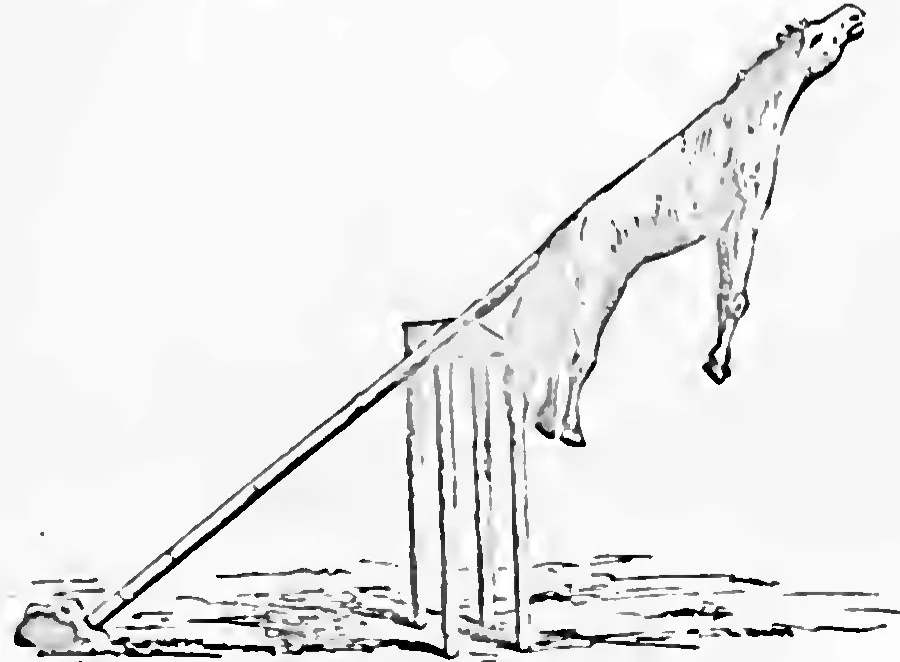
The Göktürk record begins with an animal. In the origin account of the Zhou Shu, a she-wolf fed the child who survived the destruction of his people. The ten sons she bore him founded the families from which the Ashina come.[16] The word of Kashgari lives on in the Yakut custom, recorded in the twentieth century, by which people do not ride an animal given to the gods as idik.[53] The two are probably one custom.
In the forests, game has owners and kin. Hunters speak of the bear by kinship names and secret names: Grandfather, Old Man, Master of the Forest. The Yakuts say that the bear hears everything said of him, even far away, and forgets nothing.[54] Meeting a bear, the Yakuts kneel and say: Master of the forest, think of your forests, go there, we do not touch you.[55] After the kill, the hunters ask pardon and put the blame elsewhere. The Tungus tell the bear that a Yakut has killed him, and the Yakuts accuse their neighbours the Yukaghirs.[56] The Shors set the head on a rowan stick, singe it and turn the muzzle to the east. They say: you climbed an alder, missed your footing and died.[57]
The dead remain in the household. The Zhou Shu describes the funeral of a Göktürk. The body lay in a tent, and mourners killed sheep and horses and set them before it. They rode seven times round the tent and seven times cut their faces at its door. On a chosen day, they burned the dead man’s horse and belongings with the body, and they buried the ashes in season.[16] Among the Altaians, the dead who stay near are the körmös, ancestors who protect the family and can also bring sickness. A dead shaman appears to a descendant, sometimes after years, offers himself as protector and asks for offerings. The family sets up a figure for him in the place of honour in the tent.[58] The Teleuts fear the dead man, üzüt, who lives in the graveyard until the commemoration on the fortieth day and sometimes knocks at the house at night. The family rattles the stove door and shouts: why do you come, go your way.[59]
The Altaian töz are images of the dead, made of felt, rags and birch bark. Each is the memorial of a named ancestor.[60] A Tang compilation is said to record that the Göktürks carved images in felt. They kept them in leather or felt bags and greased them with fat. They set them sometimes on poles and sacrificed to them in the four seasons.[61] A Turkish history of the Xiongnu interprets the golden figure of the eastern principality of Xiutu, beside which sacrifice was made to Heaven, as a tös, one of the small figures used in Turkic ceremonies.[62] The work gives no ground for the equation.
Animism, shamanism and Tengrism
Animism is the worldview underneath shamanism. The world is full of spirits with owners, and for this reason some men and women can speak to them, call them and drive them off. The practice of those specialists is shamanism. Shamanism is the foundation of Tengrism, and Tengrism developed out of it. The Göktürk khans had to say why they ruled. They named Tengri, who installs them, and Kut, the fortune he grants. The sacred Earth-and-Water, the mountain of the earth-spirit and the fire of the purification belong to the older layer that the cult of the sky took up.
The sources show the layers side by side. The Sui Shu pairs spirits with spirit-mediums, the inscriptions pair Heaven with the Earth-and-Water, and the exorcists of 569 work with fire and drum.[63] In the Altai, any man can approach the lords of the earth. The great gods of the sky and the dark can be approached only through the spirits of the dead, and so through the kam.[64]
Scholars also understand the relation of the three in other ways, and these views sit beside the frame above. The first view ranks the spirits of earth, water and mountain below Tengri. They help him and, like him, protect and punish, but they have no creative power.[65] The second view takes yer sub in the inscriptions as the homeland only, without a sacred sense.[66] The third view asks whether the Göktürks revered the natural beings themselves or the hidden powers in them. Scholars have answered it both ways.[67] The fourth view counts animism as one of several systems that shaped Turkic belief beside the sky religion. The others are totemism, naturism, Zoroastrianism and Manichaeism.[68]
Survival and revival
By 1914 most of the peoples of Siberia were registered as Orthodox or Buddhist. Nearly all of them were faithful in practice to their old religion.[8] A report of 1924 called shamanism moribund and rapidly disappearing.[9] The remnants held longest where the Orthodox mission was young and in remote valleys. In the Altai, a mixed form arose in the decades before 1938, the Burkhanists. They rejected the shamans and the sacrifices to evil spirits and honoured one god, Burkhan.[69]
Under Islam, the cult changed its names. Among the Kyrgyz, the holy trees of the shamanist period and the graves of ancestors and great shamans became tombs of saints. Muslim Kyrgyz and Kazakh women sacrifice a sheep at a lone tree, a well or a spring. They do what the Yakut shamanists do at their holy tree, and they differ from them only in the name.[70]
In Tuva, a census of 1931 counted 725 active shamans, one for every twenty households.[71] In the years of political pressure, loud drumming was a reason to fear. Some explain the weakening of the belief in the shamans by the quieter drum.[72] A new period began in the early 1990s, and the Society of Tuva Shamans was founded in 1992.[72] The Tuvan view of the world still holds that trees, mountains and springs have spirit-masters. The shamans call them with the drum, with whistling and with throat-singing.[73] In a healing, people sacrificed a grey horse to the lord of the sky and a chestnut one to the spirit of the mountain. The author who reports it saw sacrifices of this kind himself in 1996.[71] The revival movement that has taken the name Tengrism belongs to modern religious history and to the debate on Turkic origins.
The names
- idiıduq yer subOld TurkicKül Tegin inscription
- animismEnglish
- iyeTurkic
- 鬼神ChineseSui Shu 84
- 地神ChineseZhou Shu 50
Animism is Tylor’s word. It names a theory and not the belief of any steppe people.
Idi is the master, the owner, of the inscriptions, and idisiz is the land without one. A grammar of Old Turkic records that the word appears in later texts as iä or igä. It derives this from idi, by a late change of the intervocalic d to y, through iyä.[74] The Altaian iye and ie and the Tatar öjä are close to this later form.[75][76] The Yakut icci may belong with them. The sources used here do not draw the line from word to word.
Iduq is blessed in Kashgari’s dictionary, an animal set free by a vow. In the inscriptions it means sacred, and the inscriptions say it of a forest, of the Earth-and-Water and of a place.[21] Yer sub is a binome, two complementary words that name one thing together.[77]
The Chinese guishen, 鬼神, ghosts and spirits, is the pair of categories of the Chinese writers, used already for the Xiongnu.[12] The one Turkic name the Zhou Shu gives is 勃登凝黎, glossed as 地神, the spirit of the earth.[16] Scholars have read the name as Böd Teŋri, as But Tengri, the Buddha, and as Budun İnli, the spirit that protects the people. None of the readings is settled.[78]
Reliability of the sources
The Göktürk sources show a land that speaks, a mountain that is an earth-spirit, a fire that cleanses and spirits that travel with strangers. The ethnographers show owners of everything from the tools of the forge to the peaks of the Altai, and gifts of ribbons, horsehair and stones. The first set is short and exact. The second is long and detailed, and it describes Siberia in the nineteenth and twentieth centuries. How far it may be read back is the question of the historiography of Tengrism. One word may link them: the master of land and water in the inscriptions and the owner-spirit of the Altaian hymn seem to go by the same name. What remains from the khaganates is the sacred Earth-and-Water that speaks beside Heaven, a bare mountain called the spirit of the earth and a rite of fire. The owner of the mountain, of the water and of the hearth is recorded about a thousand years later.
References
- ^ Shiji, juan 110; Hoppál 2003, p. 470
- ^ a b Menander Protector; Blockley 1985, fr. 10.3, p. 119
- ^ Zhou Shu (Book of Zhou), juan 50; Sui Shu (Book of Sui), juan 84; Menander Protector; Kül Tegin inscription
- ^ Harva 1938
- ^ Tylor 1871, p. 100
- ^ Tylor 1871, p. 99
- ^ Tylor 1871, p. 99–100
- ^ a b Czaplicka 1914, p. 168
- ^ a b Casanowicz 1924 (Annual Report 1924), p. 415
- ^ a b İnan 2017; first edition 1954, p. 51
- ^ Erkoç 2024, p. 189
- ^ a b Shiji, juan 110
- ^ Menander Protector; Blockley 1985, fr. 10.3, p. 117
- ^ Theophylact Simocatta; Whitby 1986, p. 188
- ^ Theophylact Simocatta; Whitby 1986, p. 191
- ^ a b c d e Zhou Shu (Book of Zhou), juan 50
- ^ Sui Shu (Book of Sui), juan 84
- ^ 段成式 ca. 860, p. 183–184; Erkoç 2024, p. 183–184
- ^ Tonyukuk inscription
- ^ Tonyukuk inscription; Tekin 1968, p. 288
- ^ a b c d e Kül Tegin inscription
- ^ Dīvān Lughāt al-Turk; al-Kāshgharī 1072–1074, p. 123, 262
- ^ Dīvān Lughāt al-Turk; al-Kāshgharī 1072–1074, p. 107
- ^ a b Harva 1938, p. 386–387
- ^ İnan 2017; first edition 1954, p. 41
- ^ Harva 1938, p. 406
- ^ Harva 1938, p. 405
- ^ Harva 1938, p. 389
- ^ Harva 1938, p. 390–391
- ^ Harva 1938, p. 391
- ^ Harva 1938, p. 392–393
- ^ Harva 1938, p. 393
- ^ İnan 2017; first edition 1954, p. 50–51
- ^ a b Harva 1938, p. 400
- ^ Harva 1938, p. 401
- ^ Czaplicka 1914, p. 195
- ^ Harva 1938, p. 245
- ^ Harva 1938, p. 246
- ^ Radloff 1893 (zweite Ausgabe), p. 7
- ^ Radloff 1893 (zweite Ausgabe), p. 8
- ^ Harva 1938, p. 242
- ^ Harva 1938, p. 226–227
- ^ Tylor 1871, p. 254
- ^ Mikhailovskii 1895, p. 75
- ^ Harva 1938, p. 387
- ^ a b Harva 1938, p. 388
- ^ Harva 1938, p. 395
- ^ a b Harva 1938, p. 396
- ^ Holmberg 1927, p. 470
- ^ Radloff 1893 (zweite Ausgabe), p. 15
- ^ Tylor 1871, p. 204
- ^ Hoppál 2003, p. 466–467
- ^ İnan 2017; first edition 1954, p. 167
- ^ Harva 1938, p. 407–409
- ^ Harva 1938, p. 408
- ^ Harva 1938, p. 421–422
- ^ Harva 1938, p. 425–426
- ^ Harva 1938, p. 367–368
- ^ Harva 1938, p. 365
- ^ İnan 2017; first edition 1954, p. 42–43
- ^ 段成式 ca. 860, p. 193; Erkoç 2024, p. 193
- ^ Ögel 2015, p. 451
- ^ Sui Shu (Book of Sui), juan 84; Kül Tegin inscription; Menander Protector
- ^ Casanowicz 1924 (Annual Report 1924), p. 418
- ^ Erkoç 2024, p. 196
- ^ Erkoç 2024, p. 185
- ^ Erkoç 2024, p. 179
- ^ Alsan 2024, p. 1436
- ^ Harva 1938, p. 14–15
- ^ İnan 2017; first edition 1954, p. 167–168
- ^ a b Hoppál 2003, p. 470
- ^ a b Hoppál 2003, p. 476
- ^ Hoppál 2003, p. 475
- ^ Erdal 2004, p. 18,122
- ^ Vámbéry 1879, p. 243
- ^ Holmberg 1927, p. 464
- ^ Erdal 2004, p. 533
- ^ Erkoç 2024, p. 184
Sources
- Kül Tegin inscription
- Tonyukuk inscription
- Zhou Shu (Book of Zhou), juan 50
- Sui Shu (Book of Sui), juan 84
- Shiji, juan 110
- Menander Protector
- Theophylact Simocatta
- Dīvān Lughāt al-Turk
Literature
- Edward B. Tylor, Primitive Culture: Researches into the Development of Mythology, Philosophy, Religion, Art, and Custom. Volume II (1871)
- Marie Antoinette Czaplicka, Aboriginal Siberia: A Study in Social Anthropology (1914)
- Uno Harva, Die religiösen Vorstellungen der altaischen Völker (1938)
- Wilhelm Radloff, Aus Sibirien. Lose Blätter aus meinem Tagebuche. Zweiter Band (1893 (zweite Ausgabe))
- Abdülkadir İnan, Tarihte ve Bugün Şamanizm: Materyaller ve Araştırmalar (2017; first edition 1954)
- Hayrettin İhsan Erkoç, Gök Türklerde Doğa Kültleri (2024)
- Şenay Sayın Alsan, Gök Tanrı İnancının Türk İnanç Sisteminde Yeri ve Mimariye Yansımaları (2024)
- V. M. Mikhailovskii; Oliver Wardrop (trans.), Shamanism in Siberia and European Russia, Being the Second Part of "Shamanstvo" (1895)
- I. M. Casanowicz, Shamanism of the Natives of Siberia (1924 (Annual Report 1924))
- Mihály Hoppál, Tracing Shamans in Tuva (2003)
- Michael Whitby, Mary Whitby (trans.), The History of Theophylact Simocatta (1986)
- R. C. Blockley, The History of Menander the Guardsman: Introductory Essay, Text, Translation, and Historiographical Notes (1985)
- Maḥmūd al-Kāshgharī, Dīwān Lughat al-Turk (1072–1074)
- Marcel Erdal, A Grammar of Old Turkic (2004)
- Duan Chengshi 段成式, 酉陽雜俎 Yǒuyáng Zázǔ (ca. 860)
- Ármin Vámbéry, Die primitive Cultur des turko-tatarischen Volkes, auf Grund sprachlicher Forschungen erörtert (1879)
- Uno Holmberg (Harva), The Mythology of All Races, Volume IV: Finno-Ugric, Siberian (1927)
- Talât Tekin, A Grammar of Orkhon Turkic (1968)
- Bahaeddin Ögel, Büyük Hun İmparatorluğu Tarihi I (2015)
Unresolved source identifiers: youyang-zazu
What links here4
- Religions
- Ancestor Cult · Iye · Sacred Mountains · Shamanism
Cite this article
Yavuz, Emre-E. “Animism.” Turkic Atlas, revised 8 November 2026. https://turkicatlas.org/religions/animism/
Last revised: 8 November 2026

