
Between AD 87 and 93, four armies in six years destroyed the northern half of the Xiongnu. The Han provided the command, the money and a minority of the troops. The rest were Xiongnu, Xianbei and Wuhuan, who fought for the Han against their own kin.[1] The Hou Han Shu is the only witness. It reports the war from inside the Southern court.
87: the Xianbei
The first blow was not a Han operation. In the first year of Zhanghe the Xianbei came into the left territory and broke the Northern Xiongnu heavily. They killed the Youliu Chanyu and went home with his skin.[1] The northern court fell into disorder. Fifty-eight tribes, two hundred thousand people including eight thousand men able to bear arms, came in to Yunzhong, Wuyuan, Shuofang and Beidi and surrendered.[1]
88: the memorial of the Southern Chanyu
The next step was proposed by the Xiongnu, not by the Han. In the seventh month of AD 88 the Southern Chanyu Tuntuhe sent a memorial to the regent empress. The text quotes it in full. It is the longest political argument by a steppe ruler preserved in any Chinese source.[1]
Tuntuhe began with intelligence. Deserters who had newly come in reported that in the third month of the previous year the Northern Chanyu had left his court, wounded by southern troops and afraid of the Dingling and the Xianbei. He had fled far to the west of the Anhou river. They also reported that in the first month of this year the Gudu Marquises had set up the Northern Chanyu’s half-brother, the Right Worthy King, as a rival chanyu. As a result, the brothers were quarrelling over the throne, and their followers were dispersing.[1] Tuntuhe had taken counsel with his kings, his Gudu Marquises and the newly surrendered chiefs. They all said the same thing: strike while the north is divided, break the north and complete the south, make one realm of both, and let the house of Han never again have a care about the north.[1]
Then he described his own position. His father had come over to the Han. For forty years the frontier had been closed and guarded, and the great army had protected them. He and his people had been born and raised on Han soil. In his words, they had opened their mouths and looked upward to be fed, and the yearly gifts ran to hundreds of millions. He was ashamed to have sat with folded hands in comfort, with no service to show for it.[1] He asked that the campaign be given to his own troops. He named the commanders and the columns and set the date: all forces were to assemble on the river by the Dragon sacrifice of the ninth month. He closed with the plainest sentence in the document: “The success or failure of my realm turns on this year.”[1]
The general Geng Bing was asked for his view. He gave the court the argument it wanted. Heaven had granted the moment. The northern enemy was divided. Striking barbarians with barbarians benefited the state.[1]
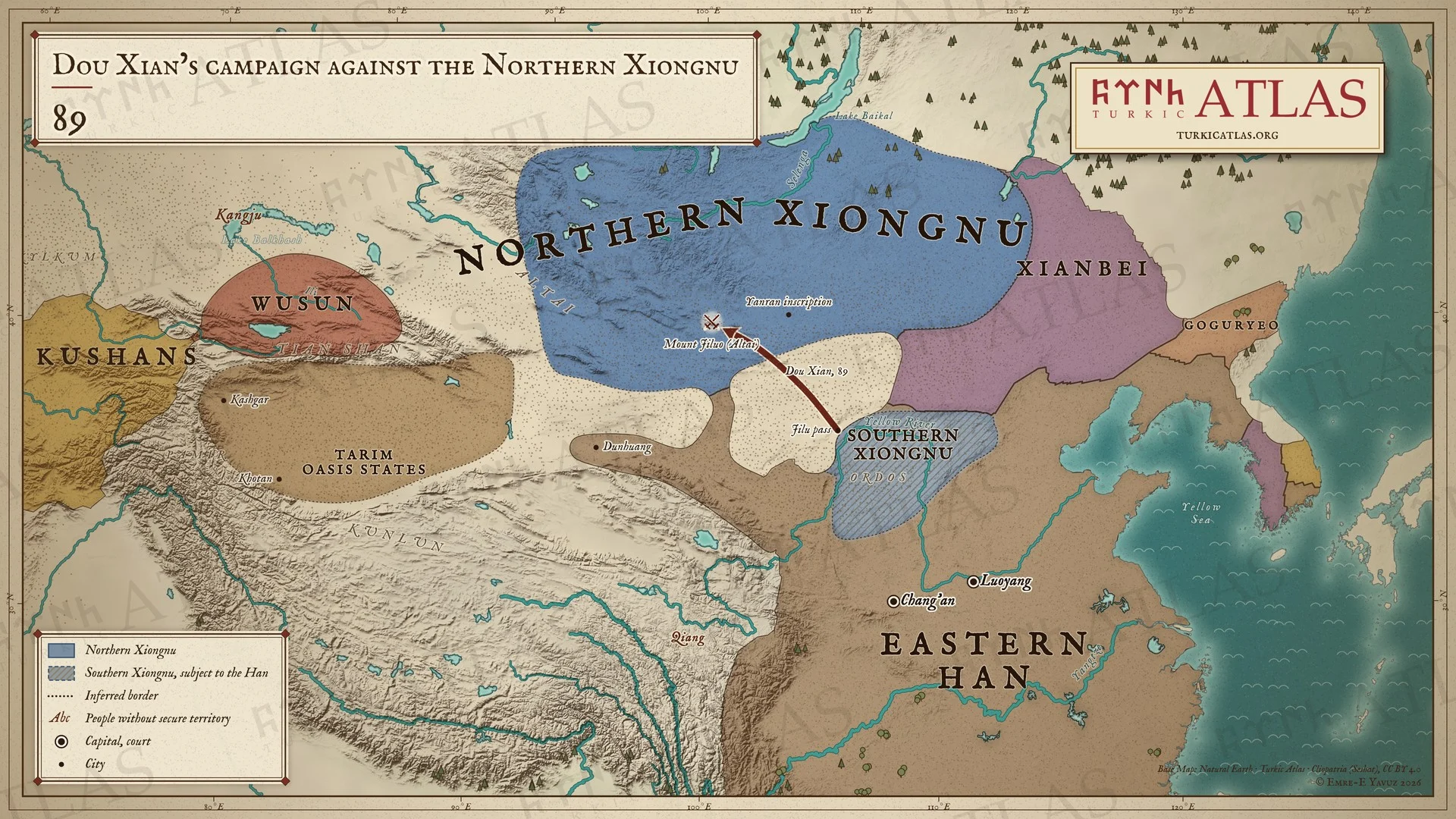
89: Shuofang
In the first year of Yongyuan, Geng Bing was made General Conquering the West. He went out from Shuofang with Dou Xian, eight thousand Han horse, the Duliao command and thirty thousand horse of the Southern Chanyu. They broke the Northern Xiongnu heavily. The Northern Chanyu fled. The chapter puts the killed and taken at more than two hundred thousand.[1][2] A modern account doubts the scale of the victory. Most of what is known comes from the stone that Dou Xian had cut at the end of the first campaign, and the stone records the success of a prince who had been sent out to earn a pardon. The same account puts Mount Jiluo near the Gaoque pass north of the Ordos, on what had long been an ordinary Han frontier, and not in the Altai.[3]
90: the night attack
In the spring of the second year of Yongyuan, the Southern Chanyu asked to finish off the northern court. Eight thousand horse of his left and right divisions went out from the Jilu pass. At Zhuoye Mountain they left the baggage and split into two columns. Each column took light troops by a separate road. The left column went north past the Western Sea to north of Heyun. The right column went west from the Xiongnu river around the Tianshan and south across the Ganwei river. The two columns met and surrounded the Northern Chanyu at night.[1] He was taken completely by surprise. He fought with a thousand picked men, was wounded, fell from his horse, remounted and got away with a few dozen riders. His jade seal, his consort and five of his children were taken. Eight thousand men were beheaded and several thousand taken alive.[1]
The chapter also gives the size of the Southern realm at that moment. It counts thirty-four thousand households, two hundred and thirty-seven thousand three hundred people and fifty thousand one hundred and seventy men able to bear arms.[1]
91 to 93: the end
In the third year the Northern Chanyu was broken again by the Right Colonel Geng Kui and fled. Where he went is not known.[1] By contrast, the chapter’s closing judgement is more definite: it says the chanyu fled to the land of the Wusun and that the country north of the desert was left empty.[1] The biography of Yuan An in the same history also sends him to the Wusun.[4] On one account, he and his people lived on the upper Ili for several decades after 91. They then moved on to the steppe north of Kangju around 158.[5] His younger brother Yuchujian declared himself chanyu with a few thousand followers at Lake Barkol and asked to be admitted at the frontier. Dou Xian proposed that the Han recognise him as Northern Chanyu, and the court agreed. In AD 92 Geng Kui brought him the seal and cords, four jade-hilted swords and a feathered canopy. At Yiwu the Han set an officer over him, as they had over the Southern Chanyu.[1] The plan was to restore him to the northern court. Then Dou Xian fell and was forced to take his own life on his fief.[6] In AD 93 Yuchujian broke away and rode north. A Han officer followed with a thousand horse. He enticed Yuchujian back and beheaded him, and Yuchujian’s people were destroyed.[1]
Consequences
The northern realm was gone. The Xianbei took Northern Mongolia. That region became the seat of every steppe state that followed.[7] Substantial parts of the Northern Xiongnu, or elements of them, moved west. Defeated Xiongnu groups had used the same road before.[7] The Wei Shu has a version of the flight. The Northern Chanyu, driven out by Dou Xian, crossed the Jinwei mountain and went west to Kangju. The weak, who could not go so far, stayed north of Kucha. Their descendants were the Yueban, who numbered more than 200,000 in the Wei Shu’s time.[8][9] The Xiongnu who left in 91 have been placed between Lake Balkhash and the Aral Sea and identified as the ancestors of the Volga Huns.[10] Others call the Wei Shu account of the Yueban a legend. In their argument, the Yueban state existed earlier and that the Xiongnu only subjected it in 91.[11] A third explanation sees in the Yueban a mixture of the old Xiongnu of the Tianshan with the Xiongnu who came from the Orkhon in 91.[11] Under the Huns, Turkic Atlas sets out whether the people who arrived in Europe three centuries later were those groups. Turkic Atlas does not answer the question here.
Scholars have argued that the collapse had causes beyond the defeats in the field. Large-scale desertions weakened the northern court through the 70s and 80s. The largest was the surrender of fifty-eight tribes in 87. From 73, the diplomacy of Ban Chao also detached the Northern Xiongnu’s allies in the Western Regions, among them Shanshan, Khotan and Kashgar.[12] A Han history is reported to say that in 85 the Southern Xiongnu attacked the northern chanyu in front, the Dingling in the rear, the Xianbei on the left and the states of the Western Regions on the right.[13] The same scholars have the Northern Xiongnu return briefly to the Western Regions between 107 and 123, when the Han withdrew from the Tarim basin. Their base no longer lay in the basin or in Outer Mongolia. Jushi, they find, was still the military and economic base of the Northern Xiongnu in 123.[14]
The victory did not settle the south either. Within a year of the last campaign the newly surrendered northerners rose. They were fifteen tribes and more than two hundred thousand people. They set up a chanyu of their own by force and tried to cross the desert northward. It took four Han armies and eight thousand Xianbei and Wuhuan horse to stop them.[1]
The Tianshan after 93
The fighting around the Tianshan went on for sixty years after the last campaign. Chapter 89 ends the northern court in AD 93. Chapters 47 and 88 of the Hou Han Shu still name a northern chanyu and a Huyan king in the 120s, 130s and 150s.[15] The history does not reconcile the two accounts.
After the Han left the Tarim basin, the Dunhuang prefect Cao Zong sent Suo Ban with a thousand men to Yiwu. The kings of Front Jushi and Shanshan came in. A few months later the northern chanyu and the king of Rear Jushi attacked and killed Suo Ban and drove out the king of Front Jushi.[15] In 123, the Xiongnu sent envoys to the oasis states and demanded all taxes that had fallen due and not been paid. They raised the sums and gave a very short term. Shanshan and Jushi were frightened and angry.[16]
In the same year, Ban Chao’s son Ban Yong was made administrator of the Western Regions. He went to Liuzhong with five hundred men and set up a military colony.[17][18] In the first month of the next year he reached Loulan and received the submission of Shanshan. The king of Kucha, Baiying, came with the kings of Gumo and Wensu, hands bound in submission, and surrendered to him.[17] Ban Yong then raised more than ten thousand horse and foot from the oasis states. He drove the Xiongnu Yili king out of the Yihe valley and took more than five thousand people of Front Jushi.[17][19]
In 125, Ban Yong raised six thousand horse from Dunhuang, Zhangye and Jiuquan, with troops of Shanshan, Shule and Front Jushi. He beat Junjiu, king of Rear Jushi, and took more than eight thousand heads and captives and more than fifty thousand horses and animals. He executed Junjiu and a Xiongnu envoy who carried the chanyu’s token at the place where Suo Ban had been killed.[17][19] In the winter of 126 he raised the states against the Huyan king. The Huyan king fled, and more than twenty thousand of his people came over. Ban Yong took a cousin of the northern chanyu. The chanyu himself came with more than ten thousand horse into Rear Jushi as far as the Jinqie valley. He withdrew when the Han relief column came, and the Han officer Cao Jun killed one of his Gudu marquises. The Huyan king then moved to the banks of the Kuwu river.[17][20]
In the summer of 134, the commandant of Rear Jushi and Jiatenu fell with fifteen hundred men on the camp of the northern chanyu at the Changwulu valley. They destroyed the huts and killed several hundred men. They took the chanyu’s mother, his aunt and several hundred women, more than a hundred thousand cattle and sheep, and more than a thousand carts.[21] In the spring of 135, the Huyan king attacked Rear Jushi. The Han sent 6,300 horse from the oasis states and the frontier posts, and their ambush at Mount Le failed. In the autumn the Huyan king came again with two thousand men and defeated Rear Jushi.[21][22] After this the Chinese histories no longer speak of a chanyu. The Huyan, whom the sources call the northern barbarians, may have taken over the chanyu’s role. If so, the Chinese used the name Xiongnu from then on mostly for them.[23]
A Chinese inscription of 137 from Lake Barkol names the Dunhuang commander Pei Cen, who beat and killed the lord of the Huyan and set up a victory stone there. None of the Chinese histories mentions the campaign.[24] In 151 the Huyan king raided Yiwu with three thousand horse. The Yiwu commander sent five hundred men to the east of Barkol, and all were lost. The Dunhuang prefect Sima Da came out with more than four thousand men, the Huyan king withdrew, and the Han went home without result.[21][25] In 153, Alodo, king of Rear Jushi, quarrelled with the Han officer Yan Hao and attacked the Han colony at Qiegu. He fled to the northern Xiongnu. Later he returned and was made king again.[21][26]
References
- ^ a b c d e f g h i j k l m n o p q r Hou Han Shu, juan 89
- ^ Ögel 2015, p. 287–297
- ^ Ögel 2015, p. 290–291
- ^ 内田吟風 1936b, p. 23
- ^ 内田吟風 1936b, p. 24,30
- ^ Hou Han Shu, juan 23
- ^ a b Golden 1992, p. 63
- ^ Wei Shu, juan 102
- ^ Ögel 2015, p. 297–299
- ^ Ögel 2015, p. 297–298
- ^ a b Ögel 2015, p. 299
- ^ Sinor 1990, p. 147–148
- ^ Sinor 1990, p. 148
- ^ Sinor 1990, p. 132, 149
- ^ a b Hou Han Shu, juan 47; Hou Han Shu, juan 88
- ^ Ögel 2015, p. 341
- ^ a b c d e Hou Han Shu, juan 47
- ^ Ögel 2015, p. 344
- ^ a b Ögel 2015, p. 345
- ^ Ögel 2015, p. 346
- ^ a b c d Hou Han Shu, juan 88
- ^ Ögel 2015, p. 362–363
- ^ Ögel 2015, p. 361–362
- ^ Ögel 2015, p. 363
- ^ Ögel 2015, p. 364–365
- ^ Ögel 2015, p. 366–367
Sources
- Hou Han Shu, juan 23, 47, 88, 89
- Wei Shu, juan 102
Literature
- Peter B. Golden, An Introduction to the History of the Turkic Peoples (1992)
- Emre-E. Yavuz, The Gokturk Empire: 2nd Edition (2025)
- Uchida Ginpū 内田吟風, 匈奴西移年表:附・フンネン=匈奴に關する再考察 (1936)
- Denis Sinor (ed.), The Cambridge History of Early Inner Asia (1990)
- Bahaeddin Ögel, Büyük Hun İmparatorluğu Tarihi II (2015)
What links here7
- States
- Southern Xiongnu
- Conflicts
- The Xiongnu–Han Wars
- Battles & Events
- Xiongnu split of 48
Cite this article
Yavuz, Emre-E. “Han campaigns against the Northern Xiongnu.” Turkic Atlas, revised 8 November 2026. https://turkicatlas.org/conflicts/han-campaigns-against-the-northern-xiongnu/
Last revised: 8 November 2026

