
- 400
- 500
- 600
- 700
- 800
- 900
- Rouran 400–554
- First Göktürk 552–630
- Tang rule 630–682
- Second Göktürk 682–744
- Uyghur 744–840
- Kirghiz 840–924
- Huns 370–469
- Western Göktürk 552–659
- Türgesh 699–766
- Karluk 766–800
- Khazar 650–969
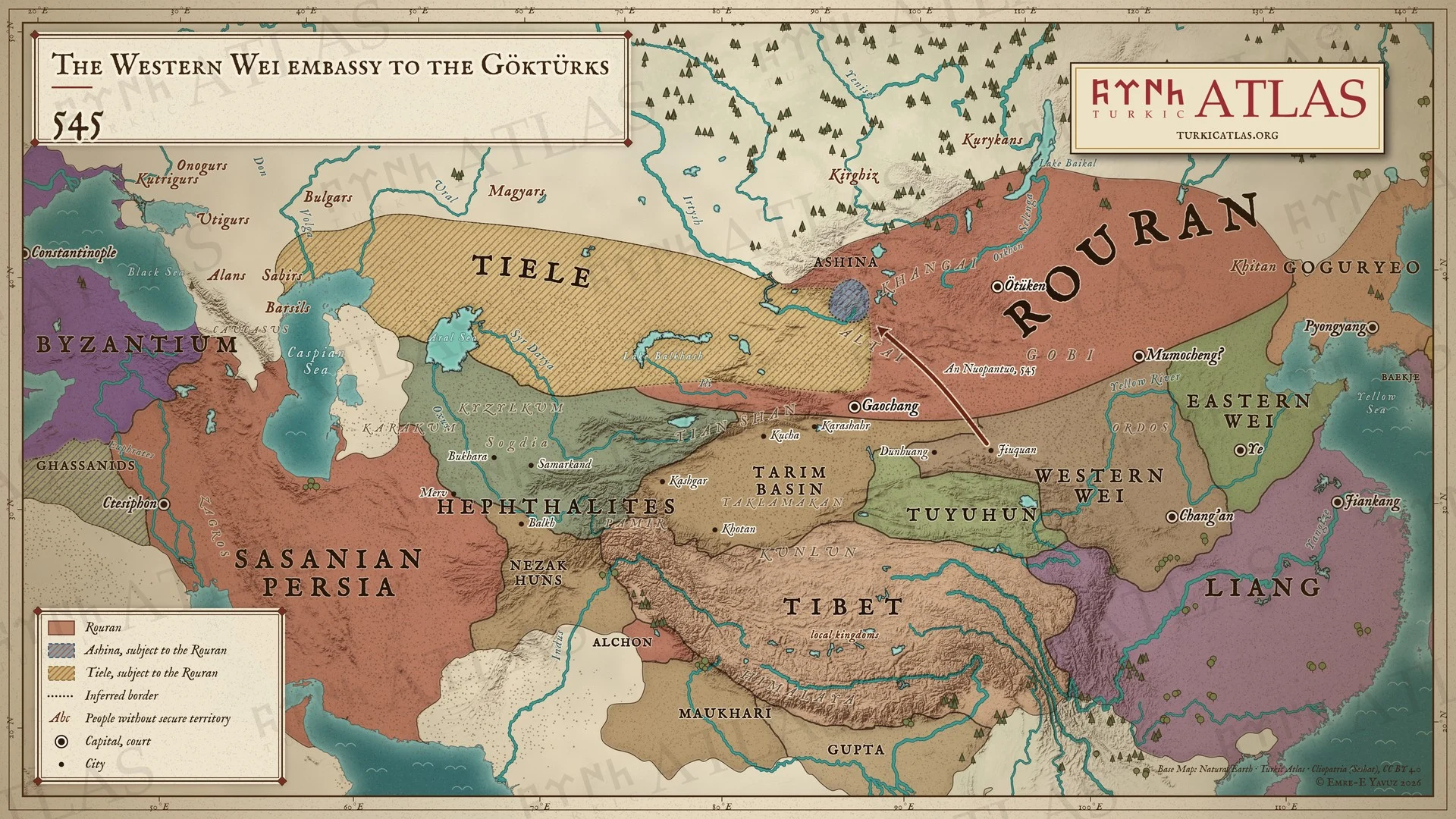
For a century and a half the Rouran khaganate ruled the Turkic-speaking peoples of the steppe, and the history of that rule is a history of risings. The Tiele were its largest subjects and its recurring enemy. They left in 487, killed a khan in 508, were broken in 516 and rose again in 546.[1] The Ashina were its smallest subjects and its smiths.[2] They stayed out of every rising until 546. In that year they took the Tiele over, and six years later they destroyed the khaganate.[3]
Sources
No text of the Rouran, the Tiele or the Ashina from this period survives. The Wei Shu tells the story twice, in its chapter on the Rouran and in its chapter on the Gaoche. The two chapters do not always agree.[4] The Sui Shu and the Zhou Shu tell how the Ashina came to the Altai and how they left it.[2] Two centuries later the Kül Tegin inscription names the Tiele by their Turkic name, Tölis.[5]
Shelun and the Tiele (about 400)
The khaganate began with a victory over the Tiele.[4] Shelun was a fugitive who had gathered a following in the Gobi. About 400 he defeated the Tiele and took the title khagan.[4] The Wei Shu calls the Tiele Gaoche, “high carts”. The name refers to the tall wagons in which they moved.[4] They dressed in fur, ate meat and kept cattle and sheep, exactly as the Rouran did.[4] One modern reckoning dates the final subjection of the Tölös, that is the Tiele, to 460.[6]
The rule was held together from the top. Subject groups kept their own leaders. They owed the khan service and tribute and, in the case of the Ashina, goods. The text describes Shelun’s army as a military order, with thousands under a general and hundreds under a captain.[4] The spoils went to the first man up. The man who flinched was stoned to death.[4] Modern accounts hold that the Rouran khans spent a good part of their strength holding the Tiele down.[6]
Ashina in the Altai (from 439)
The Ashina arrived as refugees. According to the Sui Shu, their ancestors were mixed hu of Pingliang surnamed Ashina.[7] When the Wei emperor Taiwu destroyed the Juqu, the house of the Northern Liang in Gansu, they fled with five hundred families to the Rouran.[7] They lived for generations on the Golden Mountain, the Altai, working iron.[7] The Wei Shu records the capitulation of the Liang in 439.[8] The flight is therefore dated to that year.
The khaganate did not welcome them. It absorbed them. The Ashina worked iron and rendered it to the Rouran. A century later Anagui called their leader his blacksmith slave.[3] Modern accounts give their leaders the title yabgu, a rank above a tribal chief and below a khan.[6] The Altai gave them ore. It also lay on routes that ran west and south, away from the Rouran centre in the Orkhon and toward the Tiele and the Tarim.
Secession of the Gaoche (487)
The first great break, the secession of the Gaoche, came in the west. The Fufuluo clan of the Gaoche had been subject to the Rouran. In the time of Tulun, their chief Afuzhiluo and his cousin Qiongqi commanded more than a hundred thousand tents.[4] In 487, Tulun raided the Wei frontier.[4] Afuzhiluo remonstrated, but he was not heard. Then he led his people west, to the country north-west of Gaochang.[4] There he made himself king with the title “great son of heaven”.[4] Tulun pursued him but was beaten again and again. He then led the Rouran east.[4]
The Rouran chapter tells the same departure under the Wei campaign of 492.[4] There Tulun and his uncle Nagai pursued on two roads. Tulun was beaten repeatedly. His own people killed him and his mother and made Nagai khan.[4] The five-year difference between the two chapters remains unresolved.
Gaoche kingdom and the Rouran (508–521)
The Gaoche kingdom fought the Rouran for a generation. In 508, the khan Futu, whose title was Tahan, marched west and beat the Gaoche king Mi’etu once.[4] Mi’etu fled three hundred li west.[4] The Rouran army saw a Wei column approaching and took fright. Mi’etu turned, routed it and killed Futu north of Lake Puli.[4] For a decade the Tiele were free.[4]
In 516, Futu’s son Chounu marched west and crushed the Gaoche. He captured Mi’etu and killed him.[4] Mi’etu’s people went over to the Hephthalites.[4] Some modern accounts credit this western victory to Anagui after 520. The Wei Shu, by contrast, credits it to Chounu in 516.[6] The west did not stay quiet. In 520, the Azhiluo, the western Gaoche, beat Chounu. On his return, his mother and the great ministers killed him.[4] In the civil war that followed, the Gaoche under Yifu broke the Rouran claimant Poluomen. The way was then open for Anagui to return.[4]
Tiele in the war of the Six Garrisons (525–526)
The Tiele also fought in the revolt of the Six Garrisons on the Chinese frontier. In 525, Mieliehe, chief of the western Tiele, went over to the Wei commander Yuan Shen with more than thirty thousand households.[9] The rebel Poliuhan Baling fell on them and took them. A Wei ambush then won them back.[9] In 526, Hulü Luoyang of the western Chile rose at Sanggan. Erzhu Rong defeated him.[10]
Rising of 546 and the end
In 546 the Tiele prepared another march against the Rouran.[3] Bumin, the Ashina leader in the Altai, fell on them before they had assembled. He defeated them.[3] More than fifty thousand households submitted to him.[3] They submitted to Bumin, not to the khan.
Bumin asked Anagui for a daughter as his reward.[3] Anagui answered that Bumin was his blacksmith slave. He asked how Bumin dared say such a thing.[3] Bumin killed the envoy.[3] Early in 552, in the war that followed, a Rouran army was beaten in Dzungaria.[11] A second army was destroyed north of Huaihuang. Anagui was dead.[3]
Legacy
The Göktürk state was built on the manpower of the Tiele. The Tiele never entirely accepted that. The Kül Tegin inscription says that the founders organised the Tölis and the Tarduš and gave them a yabgu and a šad.[5] The inscription lists the enemies on every side of the restored state. It names the Nine Oguz and, in the same sentence, calls them “my own people”.[5] The Rouran had ruled the Turkic peoples for a century and a half. The Göktürks took over that rule with the khaganate itself.
References
- ^ Wei Shu, juan 103; Zhou Shu (Book of Zhou), juan 50
- ^ a b Sui Shu (Book of Sui), juan 84; Zhou Shu (Book of Zhou), juan 50
- ^ a b c d e f g h i Zhou Shu (Book of Zhou), juan 50
- ^ a b c d e f g h i j k l m n o p q r s t u v Wei Shu, juan 103
- ^ a b c Kül Tegin inscription
- ^ a b c d Yavuz 2025
- ^ a b c Sui Shu (Book of Sui), juan 84
- ^ Wei Shu, juan 4
- ^ a b Zizhi tongjian (Comprehensive Mirror in Aid of Governance), juan 150
- ^ Wei Shu, juan 9
- ^ Yavuz 2025, p. 225
Sources
- Wei Shu, juan 4, 9, 103
- Zizhi tongjian (Comprehensive Mirror in Aid of Governance), juan 150 (after Wei Shu, Zhou Shu, Sui Shu and Bei Shi)
- Sui Shu (Book of Sui), juan 84
- Zhou Shu (Book of Zhou), juan 50
- Kül Tegin inscription
Literature
- Peter B. Golden, An Introduction to the History of the Turkic Peoples (1992)
- Emre-E. Yavuz, The Gokturk Empire: 2nd Edition (2025)
What links here3
- Conflicts
- The Göktürk–Rouran Wars
- Battles & Events
- Rise of Anagui Khan · The Flight of the Ashina (439)
Cite this article
Yavuz, Emre-E. “Rouran Domination of the Turkic Peoples.” Turkic Atlas, revised 8 November 2026. https://turkicatlas.org/conflicts/rouran-domination-of-the-turkic-peoples/
Last revised: 8 November 2026

