
- 400
- 500
- 600
- 700
- 800
- 900
- Rouran 400–554
- First Göktürk 552–630
- Tang rule 630–682
- Second Göktürk 682–744
- Uyghur 744–840
- Kirghiz 840–924
- Huns 370–469
- Western Göktürk 552–659
- Türgesh 699–766
- Karluk 766–800
- Khazar 650–969
In the seventh month of 626 the khan of the eastern Göktürks stood on the north bank of the Wei river with more than a hundred thousand riders. He was close enough to Chang’an that the capital was put under martial law.[1] In the third month of 630 he was taken alive in a kinsman’s camp and sent to that same capital as a prisoner.[1] Between those two dates lies the war that ended the First Göktürk Khaganate. Almost none of it was decided in battle.
The state of the war in 626
Since 621 Ilig had raided the Tang frontier every year. His targets were Yanmen, Taiyuan, Mayi, Fenzhou and Shuozhou. The pattern was always the same: a deep thrust, a Tang offer, a withdrawal with gifts.[1] In 624 he came south with the whole strength of the state. An army did not turn him back. A prince with a hundred horsemen did: he rode out and reminded the khan’s nephew Töles of an oath.[1]
Two years later, the appearance on the Wei river repeated the same calculation, for the last time. Li Shimin had been emperor for eighteen days. Ilig saw the palace coup at the Xuanwu gate as a sign of weakness, as the Sui had once seen the Göktürk civil war.[2] The Tang answered with an army drawn up in array and an emperor who rode alone to the water’s edge. Ilig asked for peace. A white horse was killed on the Bian bridge, and he withdrew.[1] A minister had objected to the emperor’s ride. The emperor explained to him that, had he shut the gates, the Göktürks would have plundered at will. By riding out, he had changed their reckoning. “To subdue the Xiongnu begins from here.”[1]
Collapse from within, 627–629
Three things happened at once. The Chinese chapter names all three.
The subject peoples rose. In 627 the Xueyantuo, the Uyghurs and the Bayirku north of the Yinshan rose together and drove off Ilig’s Yukuk Shad.[1] Ilig sent Töles against them. Töles lost the army and rode back alone. Ilig held him more than ten days in anger, and from that day his nephew was against him.[1] In 629 the Xueyantuo proclaimed a khan of their own north of the desert and sent tribute to Chang’an.[1]
The winter killed the herds. A great snow fell in 627, several feet deep on level ground. The sheep and horses died and the people starved.[1] The measured record agrees. It shows a large eruption in 626, a dimmed sky over the Mediterranean in 626 and 627, and a summer in 627 among the four coldest of fifteen hundred years. Modern accounts disagree on whether that cold caused the collapse or was only a circumstance of it. The article on climate covers the debate.
The khan taxed what was left. The Jiu Tang Shu gives the Göktürks’ own diagnosis. It is not a Chinese moral.[1] Ilig entrusted everything to the Sogdian officials and kept his own kinsmen at a distance. Laws multiplied. The army marched year after year.[1] When the herds were dead and his revenues failed, he taxed the tribes again, “so that inside and out they deserted him.”[1] Raiding was the only means by which he could hold his power. Its failure, with hunger and the tax, was the cause of the end.[3]
Ilig moved into Shuozhou under pretence of a hunt and made ready. The Tang ministers urged the emperor to strike. The emperor refused and waited. He said: “a common man must keep his word, how much more the lord of the world.”[1] In April 628 Töles submitted to the Tang. He was made a Tang general against his uncle.[4] In the twelfth month of 629 Töles, the Yushe Shad and the tegin Yinnai came over with their peoples.[1]
The winter offensive (630)
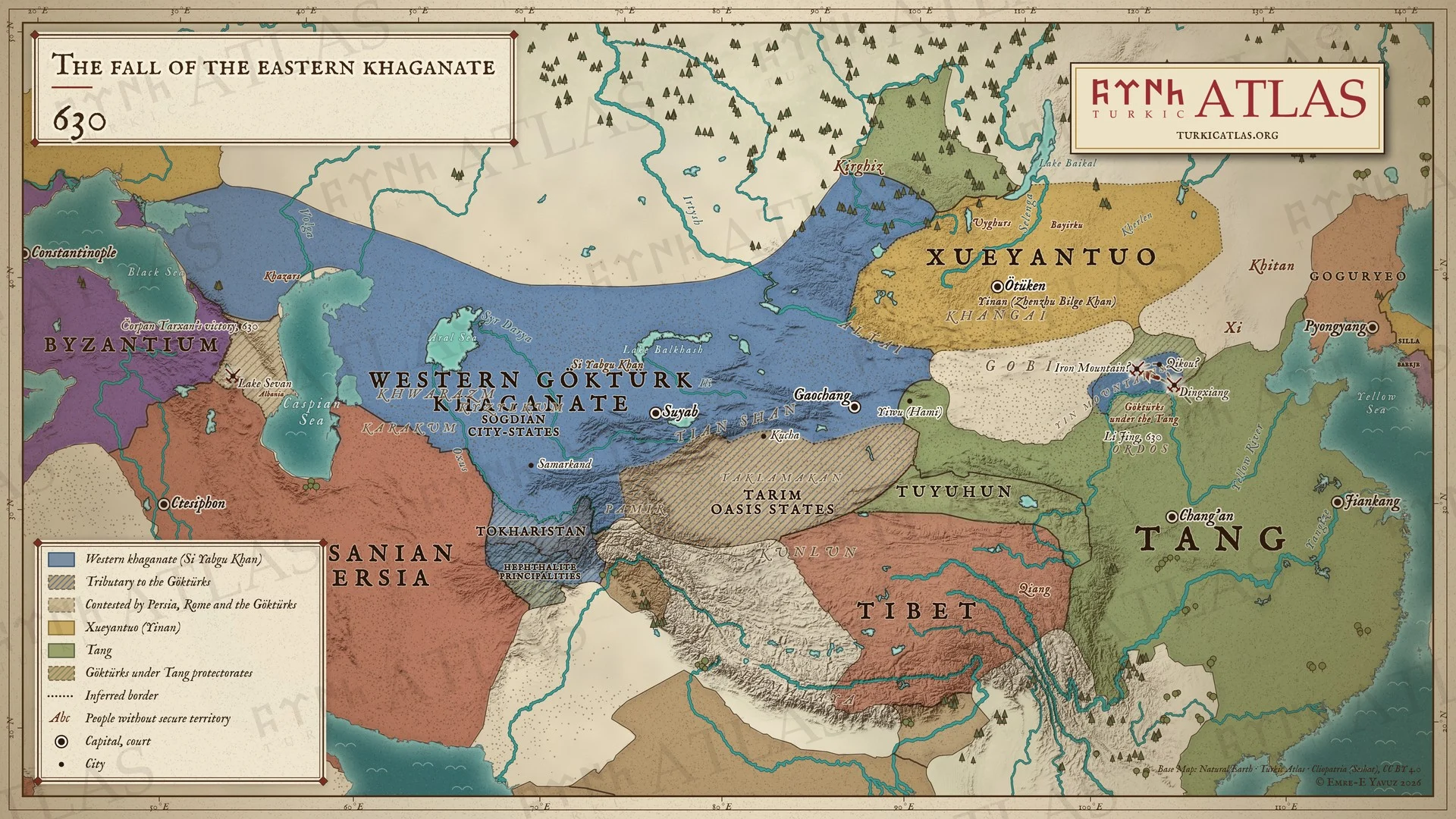
Only now did the Tang march. Li Jing took the Dingxiang road. The commanders of the other roads were placed under him.[5] The Jiu Tang Shu names four other roads. The Xin Tang Shu, by contrast, names five, with one more column under Li Daozong, and counts more than a hundred thousand men.[5] In the first month of 630 Li Jing camped at the Eyang ridge and fell on Dingxiang by night. Ilig fled and moved his camp to the mouth of the desert.[1] It was a winter war of lightly armoured cavalry galloping into the Göktürk bases in December 629. Modern accounts call the timing shrewd.[2]
In the second month Ilig fled to the Iron Mountain with several tens of thousands of men still with him. He sent an envoy to confess his fault and offer the whole state in submission. The emperor sent two officials to receive the surrender, and Ilig relaxed. Li Jing struck while the envoys were in the camp. He broke Ilig utterly and destroyed the state.[1] Ilig rode off alone on a thousand-li horse to the camp of his kinsman Shaboluo. In the third month a Tang deputy commander came upon the camp and took him alive.[1] By contrast, the other account has the Göktürk commanders surrendering one after another. Ilig’s own uncle handed the khan over with his own hands. The two field records stand side by side.[2]
The Tang settlement
Taizong took the title Heavenly Khan. He presented himself as the liberator of the tribes from Ilig’s tyranny and divided them among Tang protectorates. This was realpolitik of the first order: he took the Göktürks’ independence in order to bind them to himself.[2] The settlement was argued at length at court. One minister would keep the Göktürks whole as a shield on the frontier. Another would send them back beyond the river as beasts in human form. The first won in substance. The Ordos loop was divided into protectorates, and several thousand Göktürk families came to live at Chang’an.[1]
Fifty years of Tang rule followed. The Kül Tegin inscription, carved a century later, gives the verdict of the dynasty that came after:
Because their lords and their commons were not straight with one another, the Türk people let slip the realm they had made a realm, and lost the khan they had made khan.
In the inscription the blame falls not on the Tang but on the Göktürks themselves.[6] That judgement is the dynasty’s own. It was written by the grandsons of the men who lost. It is why the restoration of 682 could be told as a return rather than as a new beginning.
Assessment
The war turned on three things. None of them was a battle. The khaganate was destroyed from inside before the Tang attacked it. The tribes had already left, the herds were already dead, and the nephew was already a Tang general. The Tang emperor understood this and waited three years to march. The final step was a breach of a truce under negotiation. The Chinese chapter records it without embarrassment, because to its author a khaganate destroyed needed no apology.
References
Sources
- Jiu Tangshu (Old Book of Tang), juan 194
- Xin Tangshu (New Book of Tang), juan 215 (after Jiu Tangshu)
- Kül Tegin inscription
Literature
- Emre-E. Yavuz, The Gokturk Empire: 2nd Edition (2025)
- Peter B. Golden, An Introduction to the History of the Turkic Peoples (1992)
What links here22
- Persons
- Sijie Irkin · Töles Khan · Yinnai Tegin · Yushe Shad
- States
- Northern Zhou · Tang
- Battles & Events
- Battle of Jingyang (626) · Battle of the Iron Mountain (630) · Night Attack on Dingxiang (630) · Revolt of the Tiele (627) · Taizong's Speech on the Signs of Ruin (628) · The Sui Court in Exile at Dingxiang (620)
- Places
- Baidao Plain · Dingxiang · Eyang Ridge · Heng'an · Iron Mountain · Jin River · Lingzhou · Mayi · Yinshan · Youzhou
Cite this article
Yavuz, Emre-E. “Tang conquest of the eastern Khaganate, 626–630.” Turkic Atlas, revised 8 November 2026. https://turkicatlas.org/conflicts/tang-conquest-of-the-eastern-khaganate/
Last revised: 8 November 2026

