
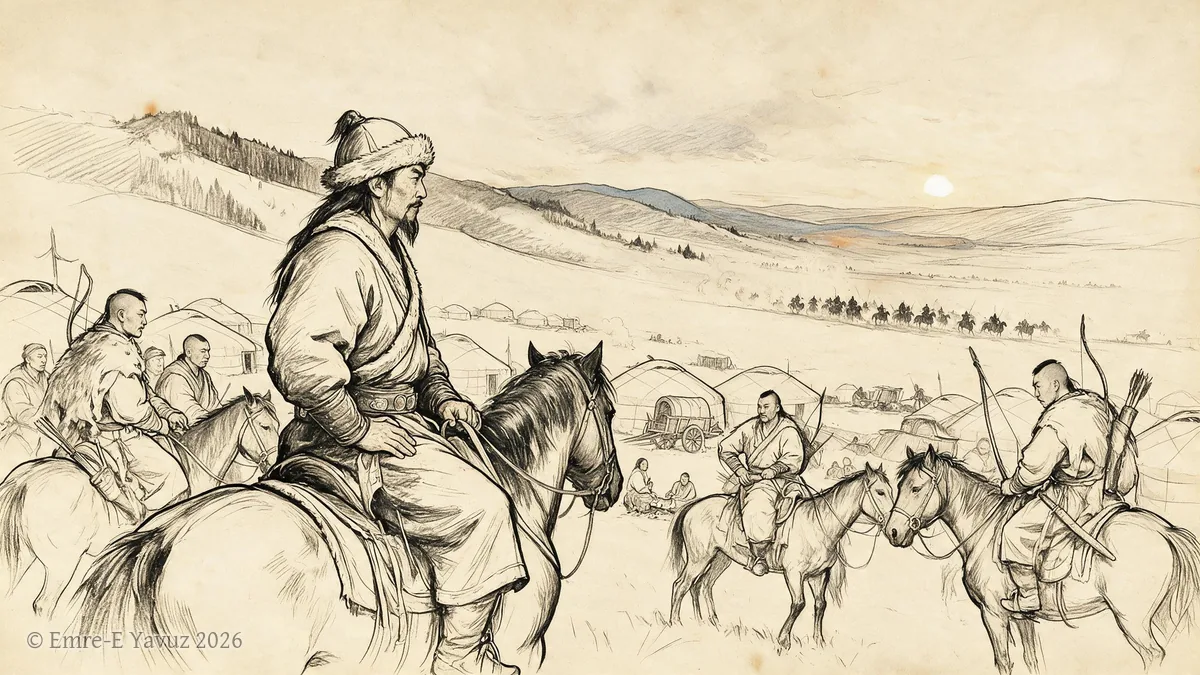
The Donghu were the strongest power on the eastern side of the Xiongnu when Bagatur took the throne. The Shiji says that in the time of Duman the Donghu were strong and the Yuezhi flourishing. It says that Duman, unable to hold out against Qin, withdrew to the north.[1][2] Bagatur broke the Donghu king, took his people and his herds, and turned west. The Hou Han Shu derives the Wuhuan and the Xianbei from what survived of the Donghu.[3] The Wei Shu does the same for the Rouran.[4]
North of Yan
The Shiji names the Donghu among the peoples north of the Chinese states. Each lived in its own valley under its own chiefs. There were more than a hundred of them, and none could unite with the others.[1] The frontier with the state of Yan has one recorded episode. Qin Kai, a Yan general, had lived as a hostage among the Hu, who trusted him. When he went home, he attacked and broke the Donghu. They fell back more than a thousand li.[1] The text adds that Qin Kai was the grandfather of Qin Wuyang, who went with Jing Ke to kill the king of Qin. Yan then built a wall from Zaoyang to Xiangping. It set up the commanderies of Shanggu, Yuyang, Youbeiping, Liaoxi and Liaodong against the Hu.[1] The Shiji does not date Qin Kai’s campaign.[1] It tells it after the account of King Wuling of Zhao, who took up Hu dress and mounted archery.[1] The biography of the Zhao general Li Mu adds that he destroyed the Dan-Lin, broke the Donghu and brought the Linhu to submit.[5][6]
Bagatur’s war
Bagatur had just killed his father. The Donghu king heard of it and sent to ask for Duman’s thousand-li horse. The ministers said it was a treasure of the Xiongnu and should be kept. Bagatur asked why a man should grudge one horse to a neighbour. He gave it.[1] Some time later the king, who took this for fear, asked for one of the chanyu’s consorts. The ministers were angry and asked for war. Bagatur asked why a man should grudge one woman to a neighbour. He gave her.[1]
The king grew bolder and pushed west. Between the two peoples lay a waste more than a thousand li across in which nobody lived. Each side held its own edge as a watch-post (outuo, 甌脫).[1][7][8] The king now sent to say that the Xiongnu could not reach that land and that he wished to have it. Some ministers said the land was empty and might be given or kept. Bagatur answered in anger that land is the foundation of the state and cannot be given away. He had every man who had said to give it beheaded. Then he mounted, ordered that anyone who lagged be beheaded, and rode east.[1][9][8]
The Donghu had held him cheap and had made no preparation. The Xiongnu came. They broke the Donghu king, destroyed him, and took his people and his animals.[1] The Han Shu tells the story again in nearly the same words.[10] From the east Bagatur turned west. He drove out the Yuezhi, took in the Loufan and the king of the Baiyang south of the river, won back the land that Meng Tian had taken from the Xiongnu, and raided Yan and Dai. At that time Han and Xiang Yu were at war, and China was worn out. As a result, Bagatur grew strong, with more than three hundred thousand bowmen.[1] The defeat of the Donghu is put around 206 BC.[11] This story, with its whistling arrows and its demands for the horse, the consort and the land, may rest on a heroic tale told among the Xiongnu themselves.[12]
Descent claimed from the Donghu
The Hou Han Shu says that the Wuhuan were originally the Donghu. When Bagatur destroyed their state in the early years of the Han, the remnant held the Wuhuan mountain and took its name from it.[3][13] It makes the Xianbei another branch of the Donghu. They settled apart by the Xianbei mountain, and their speech and customs, the text says, were those of the Wuhuan.[3] The Xianbei, it adds, were also broken by Bagatur. They fled beyond the Liaodong frontier and were next to the Wuhuan there.[3] The Wei Shu opens its chapter on the Rouran by calling them descendants of the Donghu. It gives their clan name as Yujiulü.[4]
All three claims come from histories written long after the event. The Shiji, which tells the war itself, names neither the Wuhuan nor the Xianbei.[1] In modern scholarship, the Donghu appear to have been Proto-Mongolic in speech, or at least to have contained groups that were later associated with Mongolic.[14]
Name and language
Donghu is Chinese for the Hu of the east. The sources give no name the people used for themselves and no word of their language.[1] Hu is the name the histories give to the peoples of the north, the Xiongnu among them. In the Shiji Meng Tian is sent north against the Hu and takes the land south of the river.[1] In the Han Shu a chanyu writing to the Han court calls the Hu the proud sons of Heaven.[10] Scholars have not studied the Chinese terms Hu, Lin Hu, Donghu and Loufan as terms of identification. Therefore little can be said about what they covered. It is open whether Donghu was ever an ethnonym or only the label of the peoples east of the Xiongnu.[15] The name has been explained in two ways. One explanation takes Donghu as the Chinese “eastern Hu”. The other takes it as a Chinese spelling of Tungus, which would in turn come from a Turkic word for pig. The second explanation has been doubted, because that Turkic word is not known from before the Common Era.[16] The word outuo has been interpreted in more than one way. One proposal sees in it the Xiongnu form of Mongol otog, “territory”. On one conjecture the war with the Donghu was then fought for the control of a garrisoned frontier strip and not only for pasture.[17] A second proposal sees in it an early form of Turkic ordu, “camp” or “garrison”, and derives ordu from the empty strip between the Xiongnu and the Donghu.[18][19][20] The Chinese commentators explain the word as an earth hut or as a waste without people, and the equation with ordu rests on the sound alone.[19] One position holds that the Xiongnu were Turks and that the Donghu to their east were Proto-Mongols, with a desert between the two peoples. It rejects the view that Turks and Mongols were one people.[21]
The sources fix a narrow result: a strong neighbour on the east, ruled by a king, destroyed in one campaign by Bagatur. The descent of the Wuhuan, the Xianbei and the Rouran from it is the claim of later histories.
References
- ^ a b c d e f g h i j k l m n o Shiji, juan 110
- ^ Ögel 2015, p. 118
- ^ a b c d Hou Han Shu, juan 90
- ^ a b Wei Shu, juan 103
- ^ Shiji
- ^ Ögel 2015, p. 60–61
- ^ Lattimore 1951, p. 524
- ^ a b Ögel 2015, p. 158–159
- ^ Lattimore 1951, p. 463–464
- ^ a b Han Shu, juan 94
- ^ Sinor 1990, p. 126
- ^ Lattimore 1951, p. 463–465
- ^ Ögel 2015, p. 178,182
- ^ Golden 1992, p. 69
- ^ Cosmo 2011, p. 36
- ^ Ögel 2000, p. 170–172
- ^ Lattimore 1951, p. 524–525
- ^ Ögel 2000, p. 265
- ^ a b Ögel 2000, p. 1–3
- ^ Ögel 2015, p. 162
- ^ Ögel 2000, p. 167–169
Sources
- Shiji, juan 110
- Han Shu, juan 94 (after Shiji)
- Hou Han Shu, juan 90
- Wei Shu, juan 103
Literature
- Peter B. Golden, An Introduction to the History of the Turkic Peoples (1992)
- Nicola Di Cosmo, Ethnogenesis, Coevolution and Political Morphology of the Earliest Steppe Empire: The Xiongnu Question Revisited (2011)
- Denis Sinor (ed.), The Cambridge History of Early Inner Asia (1990)
- Emre-E. Yavuz, The Gokturk Empire: 2nd Edition (2025)
- Bahaeddin Ögel, Büyük Hun İmparatorluğu Tarihi I (2015)
- Bahaeddin Ögel, Türk Kültür Tarihine Giriş I: Türklerde köy ve şehir hayatı (2000)
- Bahaeddin Ögel, Türk Kültür Tarihine Giriş VII: Türklerde ordu, ordugah ve otağ (2000)
- Owen Lattimore, Inner Asian Frontiers of China (1951)
What links here7
- Persons
- Bagatur (Modu Chanyu) · Duman (Touman)
- Peoples
- Dingling · Eurasian Nomads · Wuhuan · Yuezhi
- Customs & Pastimes
- The Xianbei Spring Assembly
Cite this article
Yavuz, Emre-E. “Donghu.” Turkic Atlas, revised 8 November 2026. https://turkicatlas.org/ethnicities/donghu/
Last revised: 8 November 2026

