
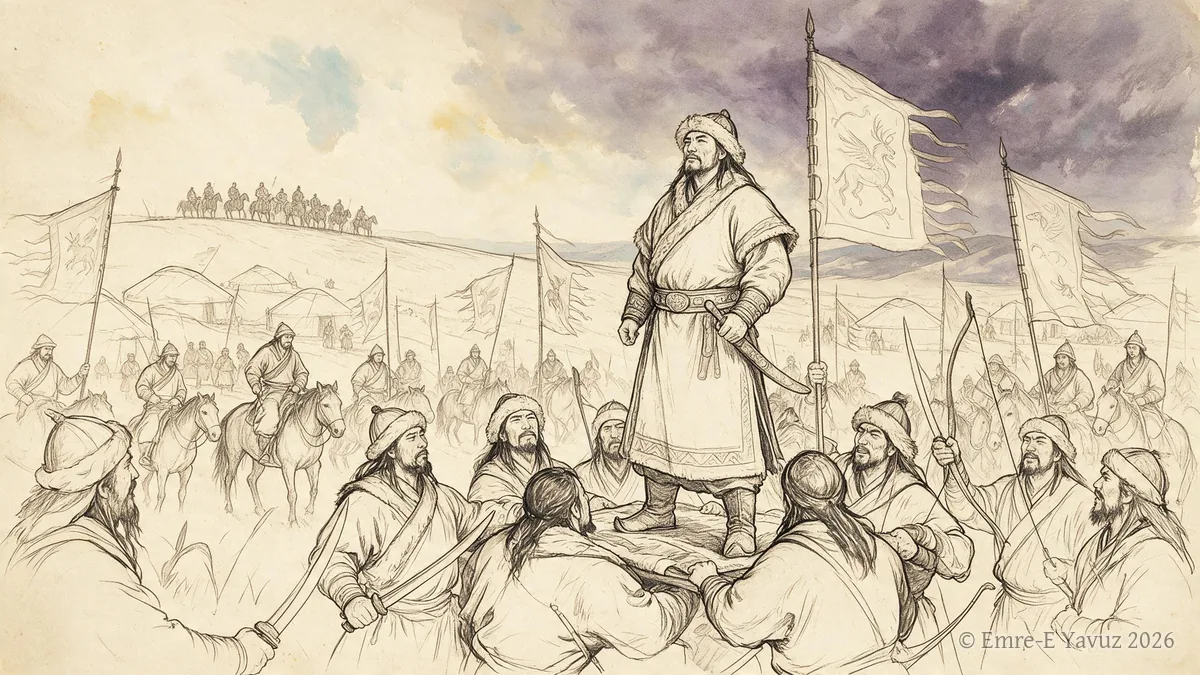
In the winter of AD 48 a Xiongnu prince named Bi took the title of chanyu against the court in the north, with eight tribes of the southern border behind him. The Hou Han Shu gives the quarrel, the famine and the calculation that produced it. The division it made was never undone.[1]
The quarrel over the succession
Bi was a grandson of Huhanye and a son of the Wuzhuliu chanyu. After Huhanye the sons had succeeded one another in order. By the reign of Bi’s uncle Yu, Bi held the office of Right Yujian Rizhu King. He had the southern border and the Wuhuan under his command.[1]
Yu had come to the throne in AD 18, as the younger brother of the previous chanyu.[2][3] When Han envoys brought back the old chanyu’s seal in AD 24, he told them that the Xiongnu and the Han had been brothers. The emperor Xuan had helped to set up Huhanye, he said, and the Xiongnu had therefore honoured the Han. The Xiongnu had now sent troops against Wang Mang and had helped to restore the Han, and so the Han should honour them again.[2][4] In the first years of Guangwu, Yu joined the rebel Peng Chong at Yuyang and set up the pretender Lu Fang at Wuyuan.[1][5] When Guangwu sent envoys in AD 30, Yu compared himself to Bagatur and answered them with insolence.[1][5] He may have done so to raise his standing and to obtain more gifts.[6] A Han army sent against him in AD 33 achieved nothing in a year, and the raids grew worse.[1][5]
The break came over the rule of succession within the royal house. The chanyu’s younger brother, the Right Guli King Yituzhiyashi, stood next in line for the Left Worthy Kingship, which the chapter states is the chanyu’s designated heir. The chanyu wished to pass the throne to his own son. Therefore he killed the brother.[1] Bi saw it and said aloud what it meant for him. In his words: speaking by brothers, the Right Guli King ought to have succeeded; speaking by sons, I am the eldest son of the former chanyu, and I ought to succeed.[1] He stopped attending at court. The chanyu suspected him and sent two Gudu Marquises to watch the troops of his command.[1]
The order of brothers went back to Huhanye himself.[7] The Han Shu says that when he was dying he set up his son Diaotaomogao and bound him to pass the realm to his younger brother.[2] Yituzhiyashi was the son of Wang Zhaojun, the Han palace woman given to Huhanye in marriage.[1] On one reckoning he was born only a year or two before his father’s death. He was then the last of Huhanye’s sons alive when he was killed.[8] The order of brothers may have been the standing law of the royal house. Others hold that it bound Huhanye’s sons alone and ended with Yituzhiyashi’s death.[9] On this view Huhanye had laid down nothing for his grandsons, and Bi’s claim as eldest son of the former chanyu was the claim of their generation.[8]
The famine
Two things happened at once. The chanyu Yu died in AD 46. A son followed him, then a brother, and Bi was passed over twice.[1] The son was the Left Worthy King Wudadihou. He died soon afterwards, and his brother, the Left Worthy King Punu, took the throne.[1][10] In the same years there was drought and locusts in the Xiongnu country for several years running. The chapter says the ground was bare for thousands of li and the grass and trees all withered. Men and animals starved and fell sick. More than half of them died.[1][11] One modern account dates the start of the disasters to AD 41, and holds that they lasted about ten years.[12] The northern chanyu, afraid the Han would take advantage of his weakness, sent to Yuyang to ask for a marriage treaty.[1]
The Hou Han Shu’s chapter on the Wuhuan adds a third event.[13] In the same year 46 the Wuhuan used the disorder among the Xiongnu to break them. The Xiongnu moved several thousand li to the north and left the land south of the desert empty.[13][14] Modern accounts disagree on where they went. Some put the retreat in the northern Altai. Others put it east of the Tianshan.[14] How much the famine weighed is argued. It has been argued that famine and the Wuhuan attack cost the Xiongnu their supremacy south of the desert. If so, the quarrel inside the royal house was what divided them.[15]
Bi was already negotiating on his own. In AD 47 he sent a Chinese resident named Guo Heng south with a map of the Xiongnu lands to the governor of Xihe, asking to be taken in.[1] The two watching Gudu Marquises guessed it and denounced him at the Dragon sacrifice of the fifth month. They said that if he were not put to death he would throw the realm into disorder. Bi’s younger brother, standing in the chanyu’s tent, heard it and rode to warn him. Bi gathered the four or five ten-thousands of the eight tribes of his southern command and waited to kill the two marquises when they came back. The marquises learned of it, got away on fast horses and told the chanyu. The chanyu sent ten thousand horse against Bi. They saw how many men he had and turned back without engaging.[1]
The proclamation
In the spring of AD 48 the chiefs of the eight tribes agreed together to make Bi chanyu. They gave him the title Huhanye. His grandfather had found safety by leaning on the Han. The chiefs wished to take the name along with the policy.[1] They presented themselves at the Wuyuan frontier. They asked to be a screen for the empire for ever and to hold the northern enemy off. The Han court took the advice of Geng Guo and accepted. In the winter Bi declared himself Huhanye Chanyu.[1][16] The annals of the emperor Guangwu in the same history date the proclamation to the tenth month. They say that from then on the Xiongnu were divided into a southern and a northern realm.[17]
The first year
In the spring of AD 49 Bi sent his brother the Left Worthy King north with more than ten thousand men. They went against the northern chanyu’s brother and took him alive. They broke the northern chanyu’s own camp and brought in ten thousand men, seven thousand horses and ten thousand head of cattle and sheep. The Hou Han Shu says the northern chanyu was terrified and gave ground for a thousand li.[1] A northern Yujian Gudu Marquis and a Right Gudu Marquis came over with more than thirty thousand men.[1]
The Han then set the southern court up formally, eighty li from the western frontier post of Wuyuan, with a Chinese Leader of Court Gentlemen attached to it.[1] The chapter preserves the moment the arrangement was made plain. The envoy told the chanyu that he must prostrate himself to receive the edict. The chanyu looked about him for a while, then prostrated himself and called himself a subject. When it was done he had an interpreter speak to the envoy. He was newly set up and ashamed before his own people. He asked that the envoy not humiliate him in front of them. The Gudu Marquises who saw it wept.[1]
Consequences
The southern realm became the Southern Xiongnu. They were settled at Meiji in Xihe, fed with Han grain and used against their own kin.[1] The northern realm held out for forty years. The Han and its Xianbei and Wuhuan allies broke it in the campaigns of 89 to 91. What was left of it went west.[18] The Xianbei took Northern Mongolia. That region became the seat of the steppe states that followed.[18]
References
- ^ a b c d e f g h i j k l m n o p q r s t u v Hou Han Shu, juan 89
- ^ a b c Han Shu, juan 94
- ^ Ögel 2015, p. 218
- ^ Ögel 2015, p. 221–222
- ^ a b c Ögel 2015, p. 222
- ^ Jagchid 1989, p. 57
- ^ 内田吟風 1933, p. 105
- ^ a b 内田吟風 1933, p. 107
- ^ 内田吟風 1933, p. 105,107
- ^ Ögel 2015, p. 233–235
- ^ Ögel 2015, p. 233, 235
- ^ Ögel 2015, p. 222, 233
- ^ a b Hou Han Shu, juan 90
- ^ a b Ögel 2015, p. 236
- ^ 内田吟風 1933, p. 101
- ^ Ögel 2015, p. 234–235
- ^ 内田吟風 1932, p. 584
- ^ a b Golden 1992, p. 63
Sources
- Hou Han Shu, juan 89, 90
- Han Shu, juan 94 (after Shiji)
Literature
- Peter B. Golden, An Introduction to the History of the Turkic Peoples (1992)
- Emre-E. Yavuz, The Gokturk Empire: 2nd Edition (2025)
- Uchida Ginpū 内田吟風, 後漢光武帝の對南匈奴策に就て 上篇:匈奴分裂以前の後漢・匈奴の交渉 (1932)
- Uchida Ginpū 内田吟風, 後漢光武帝の對南匈奴策に就て 下篇:匈奴の分裂と光武帝の南匈奴統御 (1933)
- Bahaeddin Ögel, Büyük Hun İmparatorluğu Tarihi II (2015)
- Sechin Jagchid; Van Jay Symons, Peace, War, and Trade Along the Great Wall. Nomadic-Chinese Interaction through Two Millennia (1989)
What links here10
- Persons
- Bi Chanyu · Huhanye Chanyu · Wang Zhaojun
- States
- Han dynasty · Southern Xiongnu
- Lineages
- Luandi
- Institutions and Titles
- Chanyu · Worthy Kings of the Left and Right
- Customs & Pastimes
- Horse and Camel Races at the Xiongnu Sacrifices · The Three Xiongnu Assemblies
Cite this article
Yavuz, Emre-E. “Xiongnu split of 48.” Turkic Atlas, revised 8 November 2026. https://turkicatlas.org/events/xiongnu-split-48/
Last revised: 8 November 2026

