
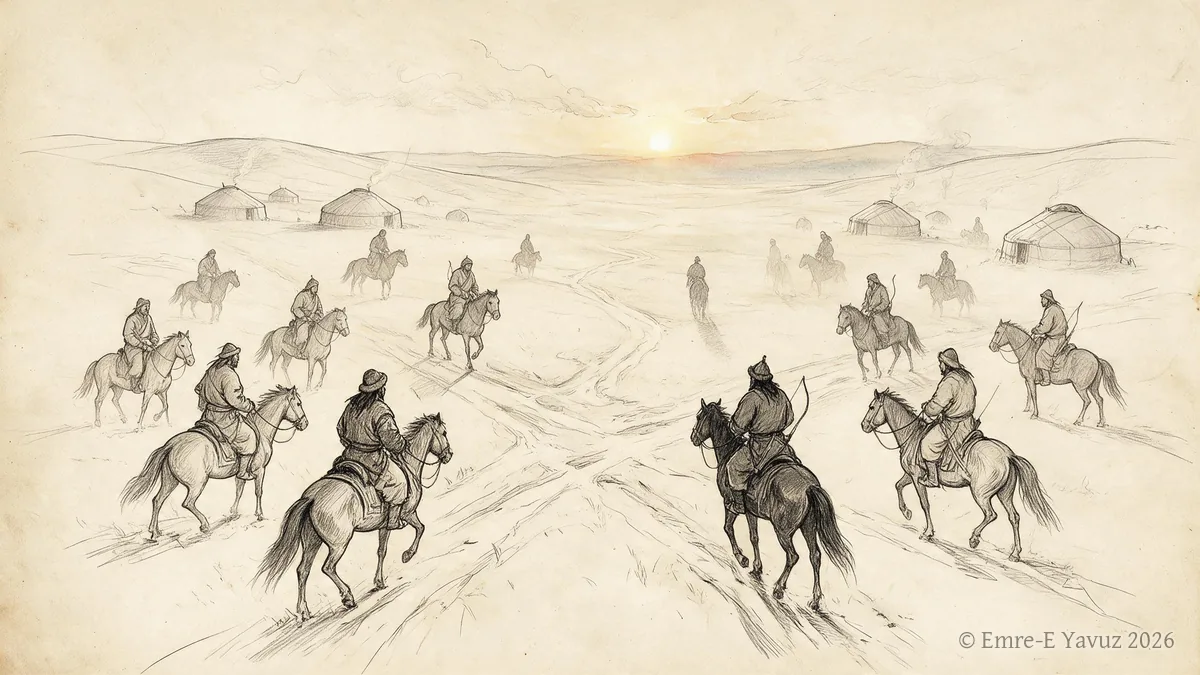
Most claims about where the Turkic peoples came from belong to the historiography of the modern period, not to the sources. The same holds for claims about which earlier peoples of the steppe were “Turkic”. Each of these claims is a position, with an author, a date and a set of grounds. National ethnogenesis narratives are positions of the same kind and not findings. This applies to Turkish, Mongolian, Hungarian, Russian and Chinese narratives alike.
The sixth-century sources make three claims of descent about the Göktürks. Everything else is commentary on them. The Zhou Shu makes the Göktürks a separate branch of the Xiongnu. The Chinese histories tell the wolf legend. The Kül Tegin inscription is the only Turkic-language statement. It says nothing about descent and begins the Göktürks with Bumin.[1] Under the Ashina, Turkic Atlas sets out the origin narratives as the sources give them. The debate concerns what has been made of them since.
Origin of the Turkic languages
The oldest modern position is the Altaic hypothesis. European linguists advanced it in the nineteenth and twentieth centuries. It holds that the Turkic, Mongolic and Tungusic languages, and by some accounts Korean and Japanese, descend from a common ancestor. It has been argued against for as long as it has been argued for.[2] The Turanian variant of the nineteenth century added Hungarian and Finnish to the family. It was the scholarly root of Turanism, the political movement that regards Hungarians, Finns and Turks as kin. Pan-Turkism is a narrower movement. It confines itself to the peoples who demonstrably speak a Turkic language. The Altaic hypothesis was not a Turkish invention but a European one. As against pan-Turkism, the term “Turkic peoples” serves to stress the diversity of the family.[2]
The current form of the hypothesis is the Transeurasian, associated above all with Martine Robbeets. In 2021 she published a study in Nature with some forty co-authors. The study combined linguistics, archaeology and genetics. It argued that Turkic, Mongolic, Tungusic, Koreanic and Japonic spread from a homeland of millet farmers on the Liao river in Manchuria, beginning in the Neolithic. The genetic part rested on Y-chromosome lineages. It found a strong correlation between Turkic-speaking populations and those of north-east Asia. This is the best available account of the origin. The principal rejoinder is a paper of 2022 by Tian and others, largely Chinese scholars. They argue that neither the linguistic, the genetic nor the archaeological data support the Transeurasian narrative.[2] The question is open.
What is generally agreed is smaller. A Turkic language was spoken in the Altai–Baikal region by the time of the Xiongnu. The Turkic languages divided into two branches. One is Oghuric, of which Chuvash is the sole survivor. The other is Common Turkic, to which Old Turkic and every other living Turkic language belong. The westward spread of Turkic speakers from the third century BC onward is a fact, whatever its starting point.
Xiongnu
The claim that the Xiongnu were Turkic, or Turkic-led, is the oldest and the most contested of the continuity claims. Its ancient basis is the Zhou Shu’s statement that the Göktürks were a branch of the Xiongnu, together with the Han histories’ transcriptions of Xiongnu titles and names.[3] Its modern advocates include several scholars. René Grousset held the chanyu to be a Turkic title and the khagan a Mongolian one, and concluded that the Xiongnu were Turkic. Annemarie von Gabain argued from the 1950s that Turkic and Mongol history should be read as a continuation of the Xiongnu. Franz Altheim is another advocate. Jean-Paul Roux argued on linguistic and cultural grounds. Ahmet Taşağıl calls the Xiongnu the first Turkic state in history. A genetic study of 2020 by Savelyev and Jeong finds the greater part of the Xiongnu population likely to have spoken late Proto-Turkic. It regards the Xiongnu genetic profile, a mixture of west-Eurasian and east-Eurasian ancestry, as consistent with that.[2] Two things stand against these claims. Several linguists have identified the Xiongnu language as Yeniseian, on the basis of the few transcribed words. A paper of 2013 by Gao Jingyi identifies Huns and Xiongnu through shared Hungarian and Yeniseian etymologies.[2] The names of the two Xiongnu founders bear on the question directly. The Chinese wrote 頭曼 and 冒頓. The Turkic school takes them to be Duman and baġatur, the second being a word the steppe kept for two thousand years. A second view regards them as personal names that cannot be recovered. The article on Bagatur sets out how the reconstruction is arrived at and what it rests on.[4]
One argument for a Turkic Xiongnu is a derivation. The Han history gives the full title of the Xiongnu ruler as Chengli Gutu Chanyu and glosses it “son of Heaven”.[5] The derivation identifies Chengli with Tengri and Gutu with Kut. It takes Chanyu to stand for an original Tanyu, on the analogy of the first shift. It thereby reconstructs Teŋri Kut Tanyu, “the ruler endowed by Heaven with fortune”, three Turkic words in a row. It compares the title with the Göktürk khan’s teŋri teg teŋride bolmıš. It notes that Kut and tanyu do not appear among the Mongols. It concludes that the Xiongnu ruling elite not only spoke Turkic but had a Turkic identity. The derivation adds three further points. The Chinese chanyu fell out of use with the Xiongnu and was revived by Chinese writers for the Göktürks. A commander of Bagatur’s western wing bore the title Turki. Finally, the Xiongnu worshipped Tengri and derived their rulers’ legitimacy from him, as the Göktürks did. Under the Xiongnu, Turkic Atlas treats that conclusion as an inference and not as a finding. The derivation itself is one position beside the others.
For the Xiongnu language itself, the material is a four-word couplet in the Jin Shu and some fifty glossed terms. Among the fifty-six most transparent etymologies, Anna Dybo found two strata. One is Eastern Iranian, early and confined almost entirely to titles and dairy words. The other is Turkic, running through early and late sources and across every field of meaning.[6] Population genetics now also stands against the Yeniseian theory of Edwin Pulleyblank. The Ket are taken as the modern representatives of the Yeniseian speakers of southern Siberia. They lack exactly the Iranian-related ancestry that marks the Iron Age steppe and the three published Xiongnu genomes.[6] The article on the language sets out all the positions. The making of the first steppe empire treats what the Iranian stratum implies about where the institutions came from. The Göktürks and the Xiongnu sets the likenesses and the positions on kinship side by side.
Huns
Whether the Huns of Europe were the Xiongnu of Asia is a separate question. The Turkic-continuity school answers it together with the first. The identification goes back to Joseph de Guignes in the eighteenth century. It has been affirmed and denied ever since, on the strength of a name, a gap of two centuries, and a handful of Hunnic words. One position treats the question as settled in the affirmative. It holds that the elite of both groups demonstrably spoke an old form of Turkic. In Turkey, all Hunnic states are counted as part of the historical community of Turkic states. The same is claimed for the Kidarites, Chionites, Alkhons and Hephthalites of Central Asia, the “Iranian Huns”. Their Turkic origin is argued from a re-reading of the Chinese sources and from a Kidarite title containing what may be Turkic oglar.[2] The Hungarian national tradition has long claimed Hunnic descent, for its own reasons. The two claims have reinforced each other. The Huns stand in the prehistory of the Göktürks. Their identification with the Xiongnu remains a position.
One strand of the Hun claim concerns writing. Wilhelm Radloff accepted Thomsen’s derivation of the Orkhon script from Aramaic.[7] In 1908 he added that the runic script of the Goths, whom the Huns met in the west, might have left traces in it.[7] In 1598 a Hungarian historian, Telegdi, took signs on antiquities in Transylvania for the script of the old Huns.[8] The Székely of Transylvania count themselves descendants of the Huns. According to one theory, their runic script rests on the Old Turkic one.[8] L. Yu. Tugusheva goes furthest. She derives the Old Turkic script from the writing of an “Old Europe” that existed before the Indo-Europeans. Her ground is Marija Gimbutas’s interpretation of Old European signs as a script. In her account, the Huns took the script over in Europe, and the Göktürks could have received it from them.[9] She argues from likenesses between the two scripts, not from a comparison of inscriptions. Both scripts are said to be phonetic, to have about thirty basic signs, to run from right to left and to serve as a sacred script.[10] The debate on the origin of the script sets out the other derivations.
Ashina and the Wusun
The narrowest claim concerns the ruling house alone. Sergei Klyashtorny argued in 1994 for early and close Turkic–Iranian contact. He argued from the non-Turkic look of the names Bumin, Istemi, Mukan and Taspar, and from a Khotanese-Saka etymology of the name Ashina as “blue”. Others have gone further. They make the Ashina an Iranian or Indo-Iranian clan that Turkicised its followers. The Ashina lived in Gansu beside the Wusun, an Indo-Iranian-speaking people, and shared a wolf legend with them. A study of 1982 derived the legend from the Wusun. On this account, cultural borrowing explains the names, as it explains the Arabic and Hebrew names of the Ottoman sultans.[2]
The newest evidence is a genome. A study of 2023, led by Xiao-Min Yang, sequenced the remains of Empress Ashina, Mukan’s daughter and Bumin’s granddaughter. It found 97.7 per cent north-east Asian and 2.3 per cent west-Eurasian ancestry. The study’s title presents the result as revealing the north-east Asian origin of the Göktürk khaganate. Its abstract presents the result as refuting both a west-Eurasian and a multiple origin of the ruling house. The same abstract reports that she was genetically closest to the Tungusic and Mongolic pastoralists of the post-Iron Age steppe, Rouran, Xianbei and Khitan among them. It also reports that she differed from other ancient Göktürks. The authors take this to suggest several sources for the khaganate’s population. That finding cuts both ways in this debate. Neither side has yet made much of it. One interpretation of the genome draws three conclusions. The Ashina were not Indo-Iranian. The parents and grandparents of the empress had not intermarried with west-Eurasian groups. The Chinese tale of a migration from the Caspian is thereby contradicted. It rejects the contrary claim outright. One genome cannot show the language of a great-grandparent. It cannot show the identity of a clan whose members did not all share the ancestry of one woman. The study gives the north-east Asian percentage as 97.7. The tomb is the Xiaoling mausoleum near Xianyang in Shaanxi.[2]
Xianbei and the Rouran
The Xianbei and the Rouran are generally classed as para-Mongolic. The classification is accepted for the ruling houses. Turkic elements have been argued in both confederations. The Ashina shared language and court dress with “one particular family of the Xianbei”, the Tuoba, called Turko-Mongol. The twenty thousand Rouran nobles who fled west in 552 were most probably eastern Turkic in origin.[2] These are positions, and the Rouran’s own language is unknown. The literature also reports a derivation of the name Rouran from Turkic börü, “wolf”, by the Turkologist Bahaeddin Ögel. The Chinese characters give no evident ground for it.
Two Xianbei cases show what the classification does and does not settle. Tanshihuai took the whole of the old Xiongnu country in the second century AD and held it for about twenty-five years. The Hou Han Shu’s account of his realm divides it into east, centre and west. The Xiongnu had used the same division, and the Göktürks would use it again.[11] That is an argument about institutions and not about language. Continuity of that kind stands on firmer ground, because a form of rule can travel where a people need not. The Murong were the house that ruled northern China as the Yan states. They went the other way. They are among the best-attested Xianbei, and their names are understood as para-Mongolic. No Turkic interpretation of them has held. The same confederation thus supplies the best case for institutional continuity and one of the clearest cases against a linguistic one. That is why the Xianbei are claimed by the Mongolian narrative and the Turkish one alike.
The Korean claim
Korea is the one case where the claim is not about descent at all. Yet the argument runs by the same machinery. Nobody holds that the Göktürks and the Koreans were one people. What is claimed is contact, and from contact a kinship of a different kind.
The textual side is two words. The Kül Tegin inscription lists the mourners who came to the funerals of Bumin and Istemi. At the head of the list stands bökli çölgil or, on another division of the letters, bökli and çöl(l)üg il.[1] There are three interpretations. The first identifies bökli with Koguryŏ and the phrase as “the Bökli of the steppe”. This makes Korea the easternmost of the peoples who sent envoys to Ötüken. The second sees two separate polities, of which only the first could be Korean. The third denies the equation altogether. The article on the question sets the interpretations out. What matters is that the word is the whole of the evidence. It is two syllables in a monument of 732, and no Chinese or Korean source names an embassy to match them.
The pictorial side is the Afrasiab paintings at Samarkand, of about 660.[12] Two figures on the west wall wear round-collared jackets, ring-pommel swords and caps crowned with a pair of feathers. The headdress is the jougwan that Koguryŏ tomb painting shows.[13] Anazawa Wako and Roh Taedon identify the figures as envoys of Koguryŏ. Kim Won-yong first took them for men of Silla. A further doubt asks whether the pair record an embassy at all or reproduce a stock image of Koreans.[13] The two figures stand in a room where long-haired Göktürks serve as the guards who usher the gift-bearers in. This ties the painting to the history of the Göktürks.[14]
That is the whole of it: one disputed word and one disputed pair of figures. What has been built on it is out of all proportion, and the building is recent. The Turkish–Korean friendship narrative took its present shape after the Korean War. It drew the Bökli identification into school textbooks on both sides. It now circulates as a thousand-year brotherhood. The pattern is the one the claims of descent show everywhere else. A thin ancient trace is interpreted in the strongest available sense. The interpretation is repeated until it is a premise. The premise then does political work. The difference is that the Korean trace is thinner than usual and its modern use better documented. That makes the case a useful measure for the others.
National narratives
Every state that now claims the steppe has a version of this history, and each is a position. The Turkish History Thesis of the early republic, formulated in the 1930s, made the Turks the originators of world civilisation and Central Asia its cradle. Its descendants in popular Turkish historiography count every steppe empire from the Xiongnu onward as a Turkic state. That count is widely shared even where the thesis itself is disclaimed.[2] The Mongolian narrative treats the Xiongnu, the Xianbei, the Rouran and the Göktürks as the successive states of Mongolia. It treats the Orkhon as Mongolia’s national ground. The Hungarian narrative claims the Huns, and through the Turanian hypothesis the Turks. The Russian and Soviet literature produced its own ethnogenesis studies. Lev Gumilev’s Drevnie tyurki of 1967 is the best known and the most theoretical. The Soviet school’s habit of assigning each modern nation a steppe ancestor persists in the successor states. The Chinese narrative treats the Tujue as one of the northern minorities of a multi-ethnic Chinese history. It treats their descent from the Xiongnu as a fact of that history. That is where the Zhou Shu’s genealogy came from in the first place.
One name shows how such a tradition is made. It can be followed step by step. Joseph de Guignes, writing in 1756, rendered the Chinese characters of the first great Xiongnu ruler as Mei-Tei. Hüseyin Cahit Yalçın translated de Guignes into Turkish in the years after the republic was founded in 1923. In his translation, Mei-Tei came out as Mete. Mete Han is what the ruler has been called in Turkish ever since, and it is now a common given name.[15] The same happened to his father, who is Teoman in the Turkish tradition.[16] Neither form comes from the sources, and neither is a rendering of the ancient sound. They are eighteenth-century French transcriptions naturalised in twentieth-century Turkish. The article on Bagatur sets the three current forms of his name against one another and says what each rests on. A national tradition can be perfectly sincere and still rest on a printer’s accident. The way to test one is to ask where each of its words came in.
One current account is itself a position within this field. It holds a Turkic Xiongnu, a Turkic Hunnic elite, a north-east Asian Ashina and a continuous Turkic state tradition from Bagatur to the Ottomans.[2]
The beginning in the sources
The Göktürks begin where the sources begin them, with a family of smiths in the Altai in the 540s.[3] The peoples who preceded them stand before them as prehistory: the Xiongnu, the Huns, the Xianbei and the Rouran. Every continuity claimed between those peoples and the Göktürks is a position in the debate, not a premise. The Kül Tegin inscription is the Göktürks’ own account. It begins with the sky and the earth and then with Bumin.[1]
References
- ^ a b c Kül Tegin inscription
- ^ a b c d e f g h i j k Yavuz 2025
- ^ a b Zhou Shu (Book of Zhou), juan 50
- ^ Golden 1992, p. 50
- ^ Han Shu, juan 94
- ^ a b Savelyev 2020
- ^ a b Tuguşeva 2012, p. 79–80
- ^ a b Tuguşeva 2012, p. 80
- ^ Tuguşeva 2012, p. 80–82
- ^ Tuguşeva 2012, p. 82
- ^ Hou Han Shu, juan 90
- ^ Azarpay 2014, p. 50
- ^ a b Lena 2008
- ^ Azarpay 2014, p. 49
- ^ Yavuz 2025, p. 73
- ^ Yavuz 2025, p. 74
Sources
- Zhou Shu (Book of Zhou), juan 50
- Sui Shu (Book of Sui), juan 84
- Shiji, juan 110
- Han Shu, juan 94 (after Shiji)
- Kül Tegin inscription
- Hou Han Shu, juan 90
- Afrasiab paintings
Literature
- Alexander Savelyev; Choongwon Jeong, Early Nomads of the Eastern Steppe and Their Tentative Connections in the West (2020)
- Nicola Di Cosmo, Ethnogenesis, Coevolution and Political Morphology of the Earliest Steppe Empire: The Xiongnu Question Revisited (2011)
- Emre-E. Yavuz, The Gokturk Empire: 2nd Edition (2025)
- Peter B. Golden, An Introduction to the History of the Turkic Peoples (1992)
- Kim Lena, Goguryeo People Wearing Jougwan in Tang Chinese Art (2008)
- Guitty Azarpay, The Afrasiab Murals: A Pictorial Narrative Reconsidered (2014)
- L. Yu. Tuguşeva, Türk Runik Alfabesinin Kökenleri (2012)
What links here28
- Persons
- Bagatur (Modu Chanyu) · Bumin Khan · Empress Ashina
- Places
- Gaochang
- Peoples
- Göktürks · History of the Turkic peoples · Rouran · Saka · Scythians · Sogdians · Wusun · Xianbei
- Lineages
- Ashina
- Institutions and Titles
- Khan (Khagan) · Tuğ
- Religions
- Animism · Riding Round the Dead · Tengrism
- Languages
- The Turkic languages
- Customs & Pastimes
- The Three Xiongnu Assemblies
Cite this article
Yavuz, Emre-E. “The Turkic ethnogenesis debate.” Turkic Atlas, revised 8 November 2026. https://turkicatlas.org/historiography/turkic-ethnogenesis-debate/
Last revised: 8 November 2026

