
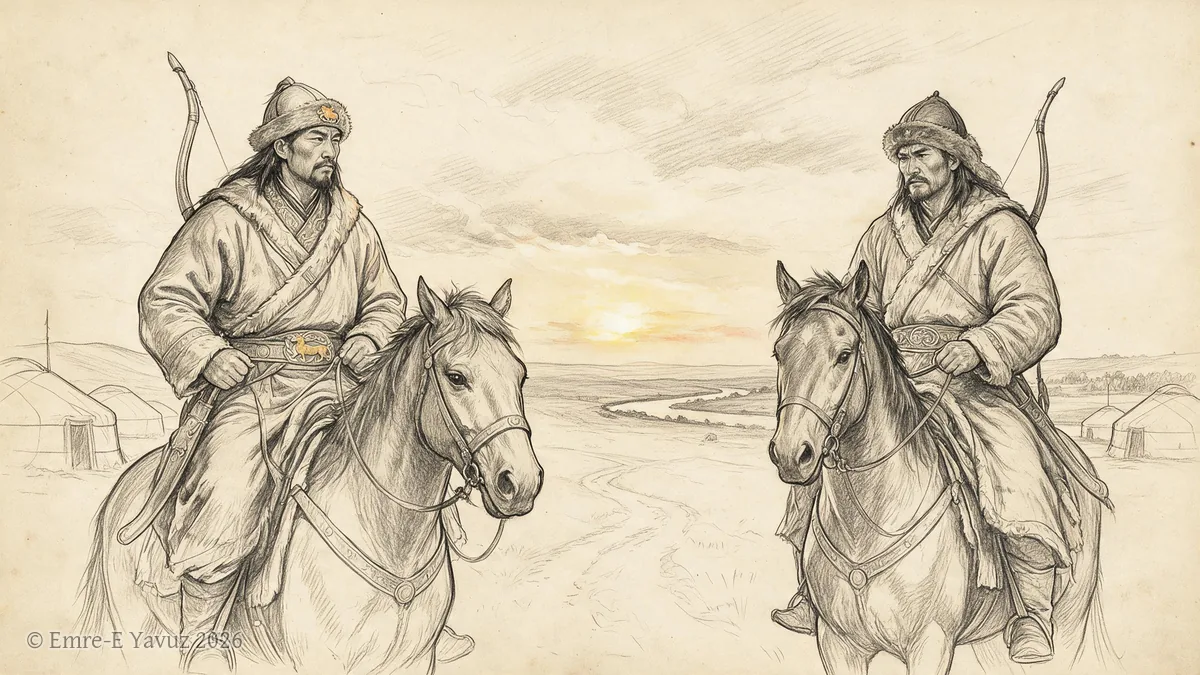
Whether the Huns who entered Europe in the 370s continue the Xiongnu of Inner Asia has been discussed since Joseph de Guignes first proposed the identification.[1] It has been argued from the name, from notices in Chinese and Sogdian texts, from a reconstructed route across the steppe, and from the archaeology, the language and the genetics of the two peoples. The question bears on the debate on Turkic origins and on the language of the Xiongnu.
The positions
The first position identifies the Huns with the Xiongnu and holds that the elite of both was Turkic-speaking.[2] In its telling, a group of nomad warriors left the region of the Altai and Transbaikalia about 370. They were perhaps driven by climate change, demographic problems and political unrest at home. They crossed the steppe belt to the west. These were the same warriors who later formed the Hunnic empire in Europe.[3] The core tribe of the Huns, the original Hun-nu, were migrants from Central Asia, of Turkic descent. They formed the basis of the later Oghuric Turkic peoples, the Bulgars among them. They spoke an early form of Oghuric.[2]
Peter B. Golden finds no unbroken chain of evidence that links the Xiongnu directly to the Huns. He holds, however, that such a chain seems likely. The Xiongnu who were driven out at the end of the first century went to Kangju, between the middle Syr Darya and the Ili. There they absorbed Iranian pastoralists. There also the tribes that formed the core of the European Hun union came together. About 350, under pressure from groups associated with the Rouran, they moved west again.[4]
Otto J. Maenchen-Helfen treats the identity as an assumption of earlier scholarship. Until the 1940s it was rarely questioned. Since the Xiongnu were held to be Mongoloid, the Huns had to be Mongoloid too.[5] He rejects arguments that take the identity for granted. One of them is the claim that the Huns must have spoken the language of the Xiongnu. He compares that claim with saying that the Norman conquerors of England must have spoken Old Norse.[6] Yet the bronze cauldrons of the Huns, he says, originated on the northern and north-western borders of China. They link the Huns with the area of the Xiongnu confederacy.[7]
E. A. Thompson declines to judge. Until the specialists agree, a historian of the later Roman empire is best advised to say nothing of the Xiongnu.[1] He quotes J. B. Bury, for whom the step from the borders of China to the steppes of Russia was “a mortal leap”, supported on the wings of fancy and not on the ground of fact. Bury later inclined to accept the identification.[1]
Denis Sinor calls the identification an unproven theory that has little in its favour beyond the likeness of the two names. In his account the political power of the northern Xiongnu was broken by the middle of the second century. The southern Xiongnu can be followed into the fourth, but nothing shows any of them moving west. Their course leads to complete absorption by the Chinese. The two centuries between the eclipse of the northern Xiongnu and the Huns on the European horizon remain unaccounted for.[8] He allows that descendants of former Xiongnu subjects may have stood in the ranks of the Huns without knowing their origin. He adopts the view that the name Xiongnu in the Han texts has a double meaning. It means a specific people with its own descent, language and culture. It also means the political entity formed under that people’s dominance. The same holds for most steppe states, the Hun state among them. Nothing shows that the dominant element of the Hun state was historically connected with that of the Xiongnu.[9]
Karl Jettmar calls the question whether the Huns of Europe and the Xiongnu are identical unjustified. In his view no ethnic identity can be spoken of. At most there is a probability that the decisive component of the Huns can be traced back to the union of the Xiongnu of the Han period. In the world of the steppe nomads, new tribes crystallised again and again round a newly risen centre of power. The Huns of Europe were not an ethnic unit in themselves. The grave finds of their realm cannot be assigned to one people.[10]
İbrahim Kafesoğlu regards the Huns of Europe as descendants of the Asiatic Xiongnu. He gives four groups of reasons. The first is Greek and Latin notices that place the Huns east of Bactria and on the maps.[11] The second is Hirth’s interpretation of the Wei Shu and Ammianus on the conquest of the Alans in the years 355 to 365.[12] The third is the Sogdian letter on Luoyang.[13] The fourth is the names and language of the ruling house.[14] He holds that the ruling house was Turkic by descent and that the mass of the Huns spoke Turkic.[13] Maenchen-Helfen objected that a gap of two centuries without written evidence does not allow the equation. Kafesoğlu rejects the objection and gives no counter-evidence.[11]
László Rásonyi reads the Sogdian letter in the same sense. The Chinese say that the Xiongnu took the city, and the letter says xwn. Sogdian has no h, so Henning concluded that the word stands for Hun.[15] Rásonyi takes the ruling group of Attila’s Huns to have spoken Turkic. In his picture it ruled over subject peoples that included Germanic, Thracian and Iranian ones, and the court also used Gothic and Latin.[16] Zeki Velidi Togan holds the Huns, the Xiongnu and the Turks to be one line. He regards the Xiongnu state before the Common Era as a union of widely spread Ogur tribes that rested above all on the Oghuz tribes, and gives its general name as Kun.[17]
Other writers state the question with more reserve. Jean-Paul Roux calls the kinship between the Xiongnu and the Huns just as unclear as the language of the Xiongnu. He regards the Huns of Attila as Proto-Turks more than anything else, but as a union of every conceivable group.[18] Bahaeddin Ögel seeks the beginnings of Attila’s Huns in the events of the age of Modu. He cites Parker, who made Attila’s Huns the children of Mete and the Göktürks those who stayed behind. He finds that Parker’s view concerns very distant regions and much later times.[19] Luc Kwanten calls the Sogdian letter evidence of a tenuous relationship at best. He adds that it is not clear whether the sackers of Luoyang descended from the northern or the southern Xiongnu.[20] In the same volume of the UNESCO history, an earlier chapter makes the Huns a branch of the northern Xiongnu who moved north-west. A later chapter says that this view has been seriously challenged since the eighteenth century, and that the language of the Huns is unknown.[21]
Name and continuity
The names of the Xiongnu and of the Huns may well go back to the same word. The Chinese 匈奴, the Sogdian xwn, the Latin Chionitae, the Middle Persian Hyōn, the Indian Hūṇa and the Greek Οὖννοι are best understood as one name travelling.[22] The name Xiongnu has been explained as a word for ‘man’, in Turkic and in Mongolic, and also as the name of a river or of an animal skin.[23] Kafesoğlu holds that the rulers called themselves by a word that means ‘people’ in Turkic, and he sets out a sound history for the name, from Kwan and Gun through Kun to Khun. Maenchen-Helfen objected to the equation, and Shafer defended it.[24] Pulleyblank derived Xiongnu from a form with an initial cluster, close to the Greek Phrounoi of Apollodorus, as Haloun had proposed. He held that this does not exclude a link with the Indian Hūṇa and the Hunni of the western writers.[25] He doubted, however, that the Chinese historians were right to count the early northern peoples called Hunyu and Xunyu among the ancestors of the Xiongnu on the strength of their names. He doubted that Sima Qian thought the names the same.[26] A shared name is not by itself a shared people. The objection made against the equation is that political, cultural, linguistic and ethnic continuity would each have to be shown separately.[27]
Christopher Beckwith holds that no direct connection between the two populations is known. Étienne de la Vaissière has argued from Chinese and Sogdian written sources for a political and, to a degree, cultural continuity between the Xiongnu and the Huns. His position comes nearer the identification of the two.[27]
The westward migration
Friedrich Hirth held that the descent of the Huns from the Xiongnu passed for an axiom of world history, although no proof resting on written records had yet been given.[28] He found that proof in a notice of ninety characters in chapter 102 of the Wei Shu.[29] The notice describes the country of Sute, “the old Yancai”, by a great lake north-west of Kangju. It says that three generations had passed since the Xiongnu killed its king and took the country. It also says that early in the reign of Emperor Wencheng its king sent envoys to ransom the Sute merchants captured at the fall of Guzang.[30] Hirth took Yancai for the Aorsi and the Alans. He counted the three generations back to about 355 for their conquest. He identified the king who sent the envoys as Hernac, the youngest son of Attila.[31] The same notice has a second interpretation, as the conquest of Sogdiana by the Kidarites.[32]
Hirth placed the Xiongnu state of the chanyu Zhizhi, destroyed in 36 BC, near the mouth of the Jaxartes. He held that the northern Xiongnu who vanished from Chinese view after their defeats of 90 and 91 had fled to Zhizhi’s old seats in Kangju.[33] Uchida Ginpū found no reason to reject Hirth’s thesis. He set out to add to it what he himself called circumstantial evidence.[34] His starting point is a discrepancy in the Hou Han Shu.[35] The narrative of the Hou Han Shu loses the northern chanyu after his defeat in 91. By contrast, its closing judgement on the chapter says that he fled to the land of the Wusun and left the north of the desert empty.[36]
Uchida reconstructed the route in stages from that point.[37] After 91 the northern chanyu crossed the Jinwei mountain into the Wusun country on the upper Ili. There his people contended with the Han for the Western Regions for several decades.[38] A notice of about 123 places a northern Xiongnu king between Lake Barkol and the Qin sea. Uchida took the Qin sea for the Black Sea, following the Tang commentary of Li Xian.[39] Around 158 they left a large remnant north of Kucha, the later Yueban. They moved to the Kirghiz steppe north of Kangju.[40] Around 280 they took the northern part of Kangju. Around 350 they overran the Alans. In 375 they reached the Danube.[41]
The Ili stage after 91 rests on the Hou Han Shu. The date of about 158 is Uchida’s own determination.[42] The stages after it are inferences from notices of other peoples. He withdrew one of them himself two years later. He had read the move of the Kangju king’s seat to Suxie as a retreat south under Xiongnu pressure. In 1938, having placed Suxie east of Dayuan, he corrected the argument.[43] The route beyond the Ili is a reconstruction. Bahaeddin Ögel gives the view of Klaproth, Hirth and Franke that the Xiongnu who went west in 91 settled between Lake Balkhash and the Aral lakes. He does not clearly adopt it. He regards the Yueban as the old Xiongnu of the Tian Shan and the newcomers of 91 together.[44]
Short cuts of this kind have been rejected. The Chuni whom Ptolemy places near the north-western shore of the Black Sea were neither “the” Huns nor their ancestors. They were certainly not descendants of Zhizhi’s Xiongnu, whom the Chinese destroyed to the last man.[45] Thompson regards the likeness of the names as a coincidence.[46] Lev Gumilev’s reconstruction, which has the Xiongnu flee from the Xianbei in 155 and stand on the Volga by 160, rests on an elementary miscalculation of the distances.[47]
The name in the Sogdian sources
The Sogdian texts give the name twice, at two ends of Asia. In Ancient Letter II, written most probably in 313, the merchant Nanai-vandak reports from Gansu that the Huns, xwn, “who yesterday were the emperor’s subjects”, had destroyed Luoyang and Ye.[48] The men who sacked Luoyang in 311 were the Xiongnu of the Xiongnu Han state. The letter gives them the name of the Huns sixty years before the Huns crossed the Roman frontier.[49] Some read the letter as proof that Xiongnu and Huns are one. The objection is that the name Hun was used throughout as a generic for barbarian peoples. Byzantine sources called Hungarians and Ottomans Huns. The people who sacked Luoyang in 311, the objection continues, could not be the people who fought the Goths some sixty years later.[50] A second Sogdian letter of the same period, found south-west of Loulan and never edited, also names the Huns.[51]
The second place is the upper Indus. In the Sogdian graffiti there, cut between the third and the fifth century, xwn is, after Nanai-vandak, the commonest personal name. The sixteen men who bear it have Sogdian fathers.[52] These names may be the trace of a Hun conquest of Sogdiana. The conquest came not before the end of the fourth century and more probably in the fifth. A mixing of Sogdians and invaders followed.[53] The Wei Shu has the Xiongnu take Sogdiana and a Xiongnu king rule at Samarkand in 457. These Xiongnu can only be the Kidarites.[54] The Iranian name Hyōn is another point of dispute. It has been argued that it cannot be separated from the Chionitae of the Latin texts, who were allies or enemies of Persia in the middle of the fourth century. The same argument holds that the Chionitae were certainly not Huns, since Ammianus, the main source on both peoples, does not link them.[50] The Pahlavi poem Ayadgar i Zareran, a late compilation, is said to count the Hyōn as Turks.[50] An older survey also holds that the Chionites, whom Procopius calls White Huns, have nothing to do with the Huns of Europe. The coin portraits of their kings show a high cap and no deformed skull.[55]
The European evidence
Ammianus, the first writer to describe the Huns in Europe, knew them only as a people “but little known from ancient records, dwelling beyond the Maeotic Sea near the ice-bound ocean”.[56] Nothing in the Roman sources links them with the Xiongnu.
Some of what the Huns brought points east. Their bronze cauldrons were cast in a crude manner and often deposited near water. They cannot be derived from the Scythian and Sarmatian vessels. If they are not the direct descendants of the cauldrons of the Ordos, they are their cousins.[57] The Huns foretold the future from scraped shoulder blades, a practice of eastern origin.[58] Their cult of a war god in the form of a sword has a parallel among the Xiongnu.[59] The story of the storks leaving Aquileia, which Priscus told of Attila, is a variant of a Chinese story about the siege of Kucha in 384. The Huns must have brought it from the East.[60] The reflex bow stiffened with bone plates is known from the first century AD in graves of Mongolia and Transbaikalia that are commonly assigned to the Xiongnu, at Noin Ula and Ilmovaja Pad. Its form is traced to the hunters of the taiga round Lake Baikal. The wooden saddle was found at Noin Ula too. A handle of the Ordos cauldron type lay in a grave there.[61]
The religious likenesses are set out by a view that treats the Huns of Europe and of the Caucasus as the continuation of the Xiongnu.[62] It sets three things beside the Xiongnu chengli, the golden man of the king of Xiutu and the wu of the Hu. The first is the god T’angri Xan of the Caucasian Huns of 682. The second is the silver and electrum images that a Byzantine chronicle gives the Huns of the Crimea in the sixth century. The third is two Hun names read as Ata Kam and Eš Kam.[63] Each of these is a likeness across four to six centuries. Each rests on a source of its own: the Armenian History for the god (Tengri), a Greek chronicle for the images, and a reading of Priscus’s names that assumes Turkic names (the Hunnic language). The beliefs of the Xiongnu themselves are set out in the Xiongnu article.
Another view looks to the Tian Shan, where a group of graves of the first centuries AD, best known from the cemetery of Kenkol, shows deformed skulls of men, women and children, Chinese silk, bows stiffened with bone plates and a wooden saddle. A. N. Bernštam regards the group as part of the Xiongnu union and as ancestors of the Huns.[64] Against it stand the graves of the Xiongnu themselves at Noin Ula in Mongolia and Ilmovaja Pad in Transbaikalia, which hold no deformed skulls. The date of the Kenkol group, which is uncertain by centuries, also stands against it.[65] The idea has since been largely given up.[66] If the Huns came from those lands, the likeness between their graves and the royal graves of Silla in Korea would go back to a common East Asian root. In the Silla graves the dead wore crowns with trees and caps with bird wings.[67]
The physical evidence pulls the other way. Skulls of Mongoloid and of mixed type appear in Hungary with the Huns. Whether those Mongoloids had anything to do with the Mongoloid Xiongnu is a further question. The core of the Xiongnu confederacy in the Han period was of the Baikal type. That does not make every Mongoloid of that type a Xiongnu. By the fourth century there were Europoids among the Xiongnu too.[68] A second survey adds that the few tombs that can be called Hunnic hold few Mongoloid skulls. No skull can be assigned to the Huns with certainty. Many are artificially deformed, a custom the Alans practised at least as much. The Huns may also have cremated their dead. The written descriptions of the Huns’ appearance, it holds, need not be doubted for that reason.[69] The Alans and Sarmatians of the lower Volga practised the custom before the Huns of Europe came. In most of their typical graves the skull is deformed.[70]
The evidence of the disciplines
Archaeology gives the continuity little to stand on. The components that are properly Hunnic in the European record have few parallels in the regions the Xiongnu dominated. The steppe heritage among the European Huns is in general thin.[27] The finding concerns the graves, not descent. A ruling group can move far without its material culture travelling with it. The survey of the Hunnic-period graves reaches the same conclusion from the finds. Nothing allows the supposition that the bearers of one cultural group set out from Central Asia and carried their equipment, customs and world-view intact across the Volga and the Don to the Danube. The complex of the fifth century took its form in the course of the Hunnic expansion itself, in a new setting.[71]
The linguistic material is sparse and pulls two ways. Priscus, who was there, reports that Hunnic and Gothic were spoken in Attila’s camp. A number of the names are plainly Gothic. Attila’s own is among them: atta, father, with a diminutive. The names of some of his relatives and high officers are Gothic too.[27] Men called Huns in the sources after Attila bear names of Alanic derivation, such as the officer Apsikh in Byzantine service around 540, from the Iranian word for horse.[27] Maenchen-Helfen judged most of the Hunnic names Turkic all the same. He instanced Mundzuc, the name of Attila’s father, beside Proto-Turkic bunčuq, a standard or war-flag.[27] Most of the Turkic etymologies proposed for these names are ambiguous, and no firm conclusion rests on them.[27] Kafesoğlu lists many of them. Mundzuc is explained as boncuk, ‘bead’ or ‘standard’, Dengizich as dengiz, ‘sea’, Ernak as ‘small man’, and Attila as Etil, the Turkic name of the Volga.[14] Rásonyi prefers Etil too. He notes, however, that Schönfeld derives Attila from Gothic Atta-ila, and that Hungarian scholars explain the name in yet another way.[72] Kafesoğlu also reports that a Parthian and Middle Persian inscription from Dura-Europos has been read as naming Huns of the south Caucasus with Turkic names. This interpretation is not secure.[73] He lists other peoples that scholars have made of the Huns: Finno-Ugrians, Slavs, Germans and Caucasians. Pelliot and Grousset saw a mixture of Turkic and Mongolic.[11] The titles are the common stock of the steppe world. They are attested in Turkic but not necessarily Turkic in origin. An Iranian derivation has been proposed for khagan among them.[27] The few Hunnic words that are not names and not titles are all local. They are kamos, a drink of barley; medos, an alcoholic drink; and strava, a funeral feast.[27] A recent proposal derives the ruling stratum of both peoples from one early Yeniseian language, Old Arin. It reads three Hunnic names, among them Attila’s, as Arin. It takes the Hunnic names, the Jie couplet, loanwords in Turkic and Mongolic and the distribution of Yeniseian river names together as evidence that the ethnic core of the Huns came from the Xiongnu.[74] The article on the language of the Xiongnu sets that argument out. A survey of the Hunnic names, for its part, finds no incontrovertible evidence for the language and concludes only that part of the leadership was probably Turkic-speaking.[75] The Hunnic language presents the material in full.
Genetics has so far had nothing to say. No ancient genome from the Hunnic-period Carpathian basin has been published. The eastern Eurasian connection has therefore never been tested where it would count.[27] A study of 2025 is reported to have changed that. It found long shared genomic tracts that connect some of the highest-ranking individuals of the Xiongnu period with persons of the fifth and sixth centuries in the Carpathian basin. Its authors conclude from this that some European Huns descended from them.[76] A survey of Avar genetics draws a line of its own. It notes that the Y lines Q and N, found among the Xiongnu, also occur among part of the Avars, among Huns and among Magyars. It reads this as a continuity from the Xiongnu to the Huns and to later Turkic-speaking peoples.[77] The same N line occurs among Mongolic speakers in western Mongolia, among the Buryats and among the Kalmyks. Another part of the Avars lies in the C2b line of the Rouran.[78] A Y line does not carry a language.
The interdisciplinary verdict on that evidence is that the case for continuity is weak. The eastern component is scarce in every profile the Huns leave: the archaeology, the common nouns, the personal names.[27] What that verdict measures is what reached Europe, not who set out. The two need not be the same. The Xiongnu article presents the archaeological finding that no Xiongnu sites west of the Sayan and Altai are datable after the first century AD.
Assessment
The identification and a Turkic-speaking elite remain the first position.[2] The name, the cauldrons and the eastern customs tie the Huns to the world of the Xiongnu. By contrast, the graves, the names and the absence of ancient genomes do not show a people that came intact from Mongolia. Between the end of the Xiongnu in the north in 91 and the Huns on the Don in the 370s lie nearly three centuries for which no source follows them.
References
- ^ a b c Thompson 1948, p. 1
- ^ a b c Yavuz 2025, p. 90, 105
- ^ Yavuz 2025, p. 89
- ^ Golden 1992, p. 86–87
- ^ Maenchen-Helfen 1973, p. 367
- ^ Maenchen-Helfen 1973, p. 403
- ^ Maenchen-Helfen 1973, p. 337
- ^ Sinor 1990, p. 177–178
- ^ Sinor 1990, p. 178
- ^ Werner 1956, p. 1–2
- ^ a b c Kafesoğlu 1997, p. 70
- ^ Kafesoğlu 1997, p. 70–71
- ^ a b Kafesoğlu 1997, p. 71
- ^ a b Kafesoğlu 1997, p. 71–72
- ^ Rásonyi 1993, p. 68
- ^ Rásonyi 1993, p. 69–70
- ^ Togan 1981, p. 45–46, 164
- ^ Roux 1994, p. 13
- ^ Ögel 2015, p. 112, 122, 218
- ^ Kwanten 1979, p. 14
- ^ Litvinsky 1996, p. 33–34, 312
- ^ Golden 1992, p. 58
- ^ Hassan 1985, p. 81
- ^ Kafesoğlu 1997, p. 59
- ^ Pulleyblank 1962, p. 139
- ^ Pulleyblank 1962, p. 226–227
- ^ a b c d e f g h i j k Savelyev 2020
- ^ Hirth 1899 (printed 1900)b, p. 245
- ^ Hirth 1899 (printed 1900)b, p. 247-248
- ^ Hirth 1899 (printed 1900)b, p. 248-249
- ^ Hirth 1899 (printed 1900)b, p. 249-255
- ^ de la Vaissière 2005a, p. 107-108
- ^ Hirth 1899 (printed 1900)b, p. 272-274
- ^ 内田吟風 1936b, p. 16
- ^ 内田吟風 1936b, p. 23
- ^ Hou Han Shu, juan 89
- ^ 内田吟風 1936b, p. 21,22
- ^ 内田吟風 1936b, p. 24
- ^ 内田吟風 1936b, p. 25
- ^ 内田吟風 1936b, p. 21,24
- ^ 内田吟風 1936b, p. 22
- ^ 内田吟風 1936b, p. 30
- ^ 内田吟風 1938b, p. 414
- ^ Ögel 2015, p. 297–299
- ^ Maenchen-Helfen 1973, p. 449–452
- ^ Thompson 1948, p. 21
- ^ Maenchen-Helfen 1973, p. 447
- ^ Sogdian Ancient Letters
- ^ de la Vaissière 2005a, p. 43
- ^ a b c Sinor 1990, p. 179
- ^ de la Vaissière 2005a, p. 45
- ^ Sogdian inscriptions of the upper Indus
- ^ de la Vaissière 2005a, p. 82
- ^ de la Vaissière 2005a, p. 108
- ^ Werner 1956, p. 11
- ^ Ammianus Marcellinus; Rolfe 1939, xxxi.2.1, p. 381
- ^ Maenchen-Helfen 1973, p. 332, 337
- ^ Maenchen-Helfen 1973, p. 269–270
- ^ Maenchen-Helfen 1973, p. 279–280
- ^ Maenchen-Helfen 1973, p. 134
- ^ Werner 1956, p. 47, 51, 59
- ^ Erkoç 2026, p. 246
- ^ Erkoç 2026, p. 229, 246, 252
- ^ Werner 1956, p. 8–10
- ^ Werner 1956, p. 8, 10
- ^ Maenchen-Helfen 1973, p. 368
- ^ Werner 1956, p. 78
- ^ Maenchen-Helfen 1973, p. 366–373
- ^ Sinor 1990, p. 202–203
- ^ Werner 1956, p. 7, 16–18
- ^ Werner 1956, p. 90–91
- ^ Rásonyi 1993, p. 70
- ^ Kafesoğlu 1997, p. 72
- ^ Bonmann 2025, p. 29–30, 43–44, 48
- ^ Sinor 1990, p. 201–202
- ^ Bonmann 2025, p. 34
- ^ Durmaz 2026, p. 43–44
- ^ Durmaz 2026, p. 42–44
Sources
- Sogdian Ancient Letters
- Sogdian inscriptions of the upper Indus
- Hou Han Shu, juan 89
- Ammianus Marcellinus
- Priscus
Literature
- Emre-E. Yavuz, The Gokturk Empire: 2nd Edition (2025)
- Peter B. Golden, An Introduction to the History of the Turkic Peoples (1992)
- Otto J. Maenchen-Helfen, The World of the Huns: Studies in Their History and Culture (1973)
- E. A. Thompson, A History of Attila and the Huns (1948)
- Alexander Savelyev; Choongwon Jeong, Early Nomads of the Eastern Steppe and Their Tentative Connections in the West (2020)
- Étienne de la Vaissière, Sogdian Traders: A History (2005)
- Friedrich Hirth, Ueber Wolga-Hunnen und Hiung-nu (1899 (printed 1900))
- Uchida Ginpū 内田吟風, 匈奴西移年表:附・フンネン=匈奴に關する再考察 (1936)
- Uchida Ginpū 内田吟風, 月氏のバクトリア遷移に關する地理的年代的考證(下) (1938)
- John C. Rolfe, Ammianus Marcellinus, with an English Translation, vol. III: Books XXVII–XXXI (1939)
- Denis Sinor (ed.), The Cambridge History of Early Inner Asia (1990)
- Svenja Bonmann; Simon Fries, Linguistic Evidence Suggests that Xiong-nu and Huns Spoke the Same Paleo-Siberian Language (2025)
- Hayrettin İhsan Erkoç, Asya Hunlarında Dinî İnançlar (Religious Beliefs of the Xiongnu) (2026)
- Joachim Werner, Beiträge zur Archäologie des Attila-Reiches (1956)
- İbrahim Kafesoğlu, Türk Millî Kültürü (1997)
- László Rásonyi, Tarihte Türklük (1993)
- Jean-Paul Roux, Türklerin ve Moğolların Eski Dini (1994)
- Bahaeddin Ögel, Büyük Hun İmparatorluğu Tarihi II (2015)
- Zeki Velidi Togan, Umumi Türk Tarihine Giriş I (1981)
- Luc Kwanten, Imperial Nomads. A History of Central Asia, 500–1500 (1979)
- B. A. Litvinsky; Zhang Guang-da; R. Shabani Samghabadi (ed.), History of Civilizations of Central Asia, Vol. III (1996)
- Ümit Hassan, Eski Türk Toplumu Üzerine İncelemeler (1985)
- Edwin G. Pulleyblank, The Consonantal System of Old Chinese, Part I (1962)
- Edwin G. Pulleyblank, The Consonantal System of Old Chinese, Part II (1962)
- Batın Durmaz, Avar Etnogenezinin Oluşumunda Akhunların Etkisine Arkeogenetik Üzerinden Bir Bakış (2026)
What links here8
- Persons
- Ernak
- Religions
- Riding Round the Dead
- Languages
- The Hunnic language
Cite this article
Yavuz, Emre-E. “The Huns and the Xiongnu.” Turkic Atlas, revised 8 November 2026. https://turkicatlas.org/historiography/hun-xiongnu-debate/
Last revised: 8 November 2026

