
- 400
- 500
- 600
- 700
- 800
- 900
- Rouran 400–554
- First Göktürk 552–630
- Tang rule 630–682
- Second Göktürk 682–744
- Uyghur 744–840
- Kirghiz 840–924
- Huns 370–469
- Western Göktürk 552–659
- Türgesh 699–766
- Karluk 766–800
- Khazar 650–969
For seventeen years a house that was not Ashina ruled the eastern steppe from Ötüken. The Xueyantuo were a Tiele people. They broke Ilig in the field and took the khanship with a patent from the Tang court. They held the country north of the Gobi until the same court destroyed them.[1] Their offices, their weapons and their customs were much like the Göktürks’.[2] What they lacked was the name. No inscription calls them the people of the realm. When they fell, the Tiele tribes did not follow them into exile but went one by one to Chang’an.
Name
- Sır TardušOld Turkic
- 薛延陀ChineseJiu Tangshu 194
- Zhenzhu Bilge KhaganateEnglish
The Chinese wrote the name as 薛延陀, Xueyantuo. The usual analysis takes it to be two names joined, Xue and Yantuo.[3] Friedrich Hirth equated the pair with the runiform Sır and Tarduš. The equation passed into general use, and much of the literature names the state for it. Paul Boodberg held that the equation rests on a misunderstanding. The objection has never been answered in full.[2] Both forms are current. Neither is a statement about descent. Tarduš is the name of a Göktürk wing, and whether the Xueyantuo bore it is the question, not the answer. Some scholars identify the Xue with the Xinli, a people of southern Siberia whom the Xiongnu ruler Modu had conquered. It equates their name with the Sır of the Orkhon inscriptions.[4]
Origins
The Xueyantuo were one of the Tiele tribes. Before they were a state, they were split between the two Göktürk wings. Six tribes at the foot of Mount Yudujin, which is Ötüken, had submitted in the east to Shibi. The division under Yishibo, at the edge of the Altai, had submitted in the west to the yabgu.[5] A separate notice puts Xueyantuo among the tribes south-west of the Altai with 10,000 men under arms.[6]
In 628 Tong Yabgu died and the western realm fell into disorder.[5] Yishibo’s grandson Yinan brought his people over to the Göktürks. They came to more than 70,000 households.[5]
The rising of 627
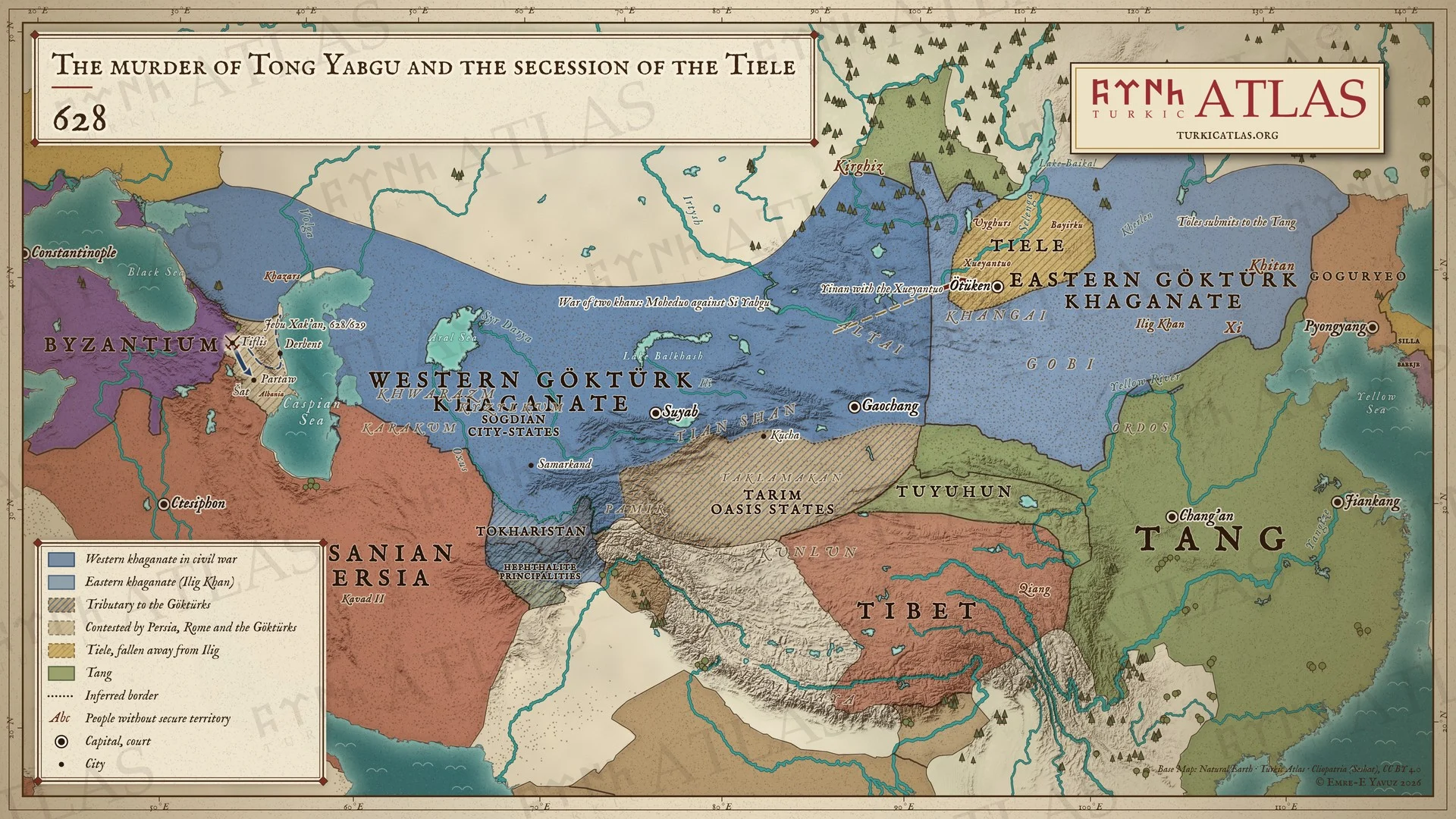
In the first year of Zhenguan, the peoples north of the Yin mountains rebelled together. They were the Xueyantuo, the Uyghurs and the Bayırku. They drove off Ilig’s Yukuk Shad.[3] Ilig sent his nephew Töles against them. That army was beaten as well, and Töles rode back with a handful of horsemen. Ilig had him held for more than ten days. From then on Töles meant to go over.[3]
The chapter sets the rising beside a winter. Snow lay several feet deep on level ground, the sheep and horses were dead, and the people were starving.[3] The sources do not settle which of the two did more. The argument from climate is set out where it belongs.
Accession
When Ilig’s rule began to give way, Yinan rose with his following. He attacked Ilig and beat him decisively.[5] Most of Ilig’s own tribes then turned and submitted to Yinan. They chose him for their ruler, but he did not dare accept.[5] The refusal is the turning point of the whole reign. What he would not take from the steppe, he took from China.
Taizong was at that moment planning how to destroy Ilig. He sent the general Qiao Shiwang north by a secret road with an imperial document. Through it he proclaimed Yinan Zhenzhu Bilge Khan and made him a gift of a drum and a banner.[5] Yinan was delighted. He sent an embassy with the produce of his country.[5] In 629 he proclaimed the khanship north of the desert and sent tribute to Chang’an. In the same sentence the chapter has Ilig call himself a subject and ask for a Tang princess.[3] The order of those two facts is the story of that year.
The realm north of the desert
Yinan pitched a tent-city at the foot of Mount Yudujin, 6,000 li north-west of the capital. This was Ötüken, the seat every claimant to the eastern steppe took.[5] His country ran east to the Mohe, west to the yabgu of the Western Turks, south to the desert and north to the Kerulen.[7] The great tribes that submitted were the Uyghurs, the Bayırku, the Ediz, the Tongra, the Bugu and the Xi. These were six of the peoples that would later be counted among the Nine Oguz.[7]
In 630, when Ilig had been beaten and the northern frontier stood empty, Yinan moved east again to his old country.[7] He set his tent north of Mount Duweijian on the Tula, 3,300 li north of the capital. The Shiwei lay to the east, the Altai to the west, the Göktürks to the south and the Hanhai to the north. The chapter names the ground as the old country of the Xiongnu.[7] He had 200,000 picked troops.[7]
For the first half of the interregnum the Xueyantuo were the power that the Göktürks had to reckon with. The Tang used them as such. After 630 the northern tribes offered Chebi the great khanship. He did not dare take it, because the Xueyantuo held the title, and he submitted to them instead. Then they decided to kill him, and he fled.[3]
The quarrel over Ashina Simo
In 639 the Tang sent Ashina Simo north as khan and settled his people south of the desert. Yinan was furious. He hated Simo.[8] Simo’s own people would not cross the frontier for fear of the Xueyantuo. The emperor had to write north first and draw a line. The Xueyantuo were to hold the country north of the desert and the Göktürks the country south of it. Each was to guard his own borders, and whoever crossed was to be called to account.[3]
Their reply, quoted in the chapter, asked for the opposite. It called the Göktürks treacherous and said that they had killed Chinese by the thousand year after year before they were broken. The emperor, it said, should have taken them as slaves and handed them to his people, and instead he reared them like sons. One of them had rebelled at the imperial camp for thanks. Let the Xueyantuo destroy them on his behalf.[3] The request was refused. The Xueyantuo prepared light cavalry to strike Simo’s people as they crossed anyway.[3]
The campaign of 641
In 641 Taizong went to Luoyang, meaning to sacrifice at Mount Tai.[8] Yinan put it to his chiefs: “The Son of Heaven is sacrificing at Mount Tai. Tens of thousands of soldiers will gather there, every man and horse will be assembled, and the frontier will stand empty. If we beat Simo then, it will be like breaking a rotten tree.”[8] He sent his son Dadu Shad with 200,000 men against Simo’s people. Dadu Shad was to camp on the Baodaochuan and take position at Mount Shanyangling.[8]
Simo sent to the Tang for help. The emperor ordered the Duke of Yingguo and Xue Wanche, governor of Puzhou, to march north with 20,000 to 30,000 foot and horse.[8] They crossed the Baodaochuan, reached Mount Qingshan and met Dadu Shad there. They followed him for months as far as the Nuozhen river. There he saw that he could run no further, and he drew up his men at a distance of 10 li.[8]
What followed is the one passage in which a steppe army is described changing how it fought. The Xueyantuo had beaten Shaboluo and Ashina Sheer by fighting on foot, and they had kept the lesson. They trained their men in infantry warfare, with one man in five holding the horses behind the line.[9] Now they used it again. The Göktürks in Tang service met them first and fell back. The Xueyantuo followed up their advantage. When the Tang counter-attacked, the Xueyantuo loosed tens of thousands of arrows at once and wounded the horses.[10] The Tang commander then took the horses out of the line. He formed his men on foot with long spears in companies of several hundred, and they charged all at once. The Xueyantuo broke.[10] Xue Wanche with a few thousand riders took the horse-holders. An army that had dismounted to fight found it had nothing to ride away on. More than 3,000 were beheaded, and 15,000 horses and armour beyond counting were taken. The dead covered the steppe.[10] Dadu Shad got away.[10]
Yinan asked the emperor’s leave to make peace with the Göktürks. He sent an envoy to apologise.[10]
Yinan then asked for a Tang bride. Taizong weighed a war with 100,000 men that would destroy the Xueyantuo against an arrangement that would keep the frontier quiet for thirty years. Fang Xuanling advised the marriage, since the empire had barely recovered from its wars, and the emperor agreed. He promised the princess of Xinxing.[11][12] Yinan collected the bride-price from his own people in horses and sheep. The goods came late. Many animals died on the crossing of the Gobi, and about half of the herds were lost. The emperor then broke off the marriage.[11]
The end
Yinan died in the autumn of 645, while Taizong was at war in Koguryŏ.[13] Before that he had made two of his sons khans: Yemang in the east, with the title Tuli Shad, and Baizhuo in the west, with the title Si Yehu Khan.[14] Yemang came to the funeral. After the burial he went back to his own people, because he feared that Baizhuo would move against him. Baizhuo followed him, killed him and took the khanship for himself.[13] The new khan relied on his own favourites and put many of his father’s ministers to death. The people turned away from him.[14][15]
Tang columns marched against the Xueyantuo by separate roads, under Zhang Jian, governor of Yingzhou, and the general Qibi Heli. The columns beat the Xueyantuo, and they fled west.[16] The Xueyantuo were broken in 646. The chapter marks the date only by its consequence: after the Xueyantuo were broken, Chebi opened relations with Chang’an.[3]
The collapse itself can be followed in two other accounts. In 646 the Uyghur chief Tumidu, with the Bugu and the Tongra, beat Baizhuo in the field.[13] Baizhuo fled to Ashide Shijian. The Uyghurs killed him there and destroyed nearly all his kin.[14] The two Tang histories disagree on his escort: one gives a few thousand riders, the other a little more than ten.[14] The rest of the Xueyantuo fled west and made Tuomozhi, a nephew of Yinan, their khan.[13] Taizong feared that he would trouble the north, and he sent Li Ji against him. Tuomozhi gave himself up through the envoy Xiao Siye. Li Ji’s men killed more than 5,000 of his followers and took more than 30,000 captive, and Tuomozhi was received at court with a Tang rank.[14][15]
The settlement came two years later. In 648 the Qibi, the Uyghurs and more than ten Tiele tribes submitted one after another. They did so because the Xueyantuo had been all but destroyed or scattered.[16] Taizong made their lands into thirteen prefectures and military governorships, one to a tribe. They were Hanhai for the Uyghurs, Jinhui for the Bugu, Yanran for the Tolanko, Youling for the Bayırku, Guilin for the Tongra, Lushan for the Sijie, Gaolan for the Hun, and six more. He appointed their chiefs governors and gave each an iron fish as the token of his authority. He set a protector-general at Yanran over the whole.[16] Before the chiefs went home, Taizong gave them a farewell banquet. They asked him for a road through their lands to his court.[14]
That was the northern steppe under Chinese administration, tribe by tribe. It lasted until the Göktürks came back in 682. The Xueyantuo had removed the one power that kept the north out of Tang reach. Then they were removed themselves.
Value as a witness
Everything above comes from two Tang histories. The second copies the first where they agree. They were written at the court that patented Yinan’s title and later destroyed him. They record his rise as a favour granted and his fall as a rebellion punished. The Xueyantuo left no inscription, no coin and no monument. Some statements can be checked against something else: the tribes that submitted, the ground on the Tula, the Tiele names of 648. These hold. What cannot be checked is the motive the chapters give, and they give one on every page.
Rulers
- Yinan Khan628–645
Relations with other states
Red is war, blue alliance, gold trade. Where several held at once, the line shows what prevailed; alliance and trade can run side by side. Each line rests on an article. Point at a state to see its weightiest relation, select it to see its events. The slider shows what stood in a given year, and Play runs through the years.
First Göktürk Khaganate628 to 630
- War628 to 630Tang conquest of the eastern Khaganate, 626–630
Tang628 to 630
- Alliance628 to 630Tang conquest of the eastern Khaganate, 626–630
References
- ^ Mau-tsai 1958, Turkish edition, p. 472-477
- ^ a b Mau-tsai 1958, Turkish edition, p. 472
- ^ a b c d e f g h i j k Jiu Tangshu (Old Book of Tang), juan 194
- ^ Pulleyblank 1990, p. 21
- ^ a b c d e f g h i j k l Mau-tsai 1958, Turkish edition, p. 473
- ^ Mau-tsai 1958, Turkish edition, p. 170
- ^ a b c d e Mau-tsai 1958, Turkish edition, p. 474
- ^ a b c d e f Mau-tsai 1958, Turkish edition, p. 475
- ^ Mau-tsai 1958, Turkish edition, p. 476
- ^ a b c d e f Mau-tsai 1958, Turkish edition, p. 477
- ^ a b Xin Tangshu (New Book of Tang), juan 217
- ^ Taşağıl 1999, p. 32–39
- ^ a b c d Zizhi tongjian (Comprehensive Mirror in Aid of Governance), juan 198
- ^ a b c d e f Xin Tangshu (New Book of Tang), juan 217; Zizhi tongjian (Comprehensive Mirror in Aid of Governance), juan 198
- ^ a b Taşağıl 1999, p. 37–39
- ^ a b c Mau-tsai 1958, Turkish edition, p. 478
Sources
- Jiu Tangshu (Old Book of Tang), juan 194
- Xin Tangshu (New Book of Tang), juan 215, 217 (after Jiu Tangshu)
- Zizhi tongjian (Comprehensive Mirror in Aid of Governance), juan 198 (after Wei Shu, Zhou Shu, Sui Shu and Bei Shi)
Literature
- Liu Mau-tsai, Çin Kaynaklarına Göre Doğu Türkleri (1958, Turkish edition)
- Peter B. Golden, An Introduction to the History of the Turkic Peoples (1992)
- Emre-E. Yavuz, The Gokturk Empire: 2nd Edition (2025)
- Edwin G. Pulleyblank, The 'High Carts': A Turkish-Speaking People Before the Türks (1990)
- Ahmet Taşağıl, Gök-Türkler, Bd. II (1999)
What links here32
- Persons
- Ashina Simo · Chebi Khan · Ilig Khan · Shegui Khan · Shiboqu Azhan · Si Yabgu Khan · Töles Khan · Tong Yabgu · Yinan Khan · Yukuk Shad · Zhishi Sili
- Battles & Events
- Banquet of the Wine Fountain (647) · Kirghiz embassy of 648 · Revolt of the Tiele (627) · The Court Debate of 630 · The great snow of 627 · The Wei bridge, 626 · Tiele Revolt (605)
- Places
- Baidao Plain · Ötüken · Tanhan Mountain · Yinshan
- Institutions and Titles
- Drums and Banners for the Khans · Livestock Losses in the Annals
- Sources
- Tonyukuk inscription
Cite this article
Yavuz, Emre-E. “Xueyantuo Khaganate (Syr Tardush).” Turkic Atlas, revised 8 November 2026. https://turkicatlas.org/polities/xueyantuo/
Last revised: 8 November 2026

