
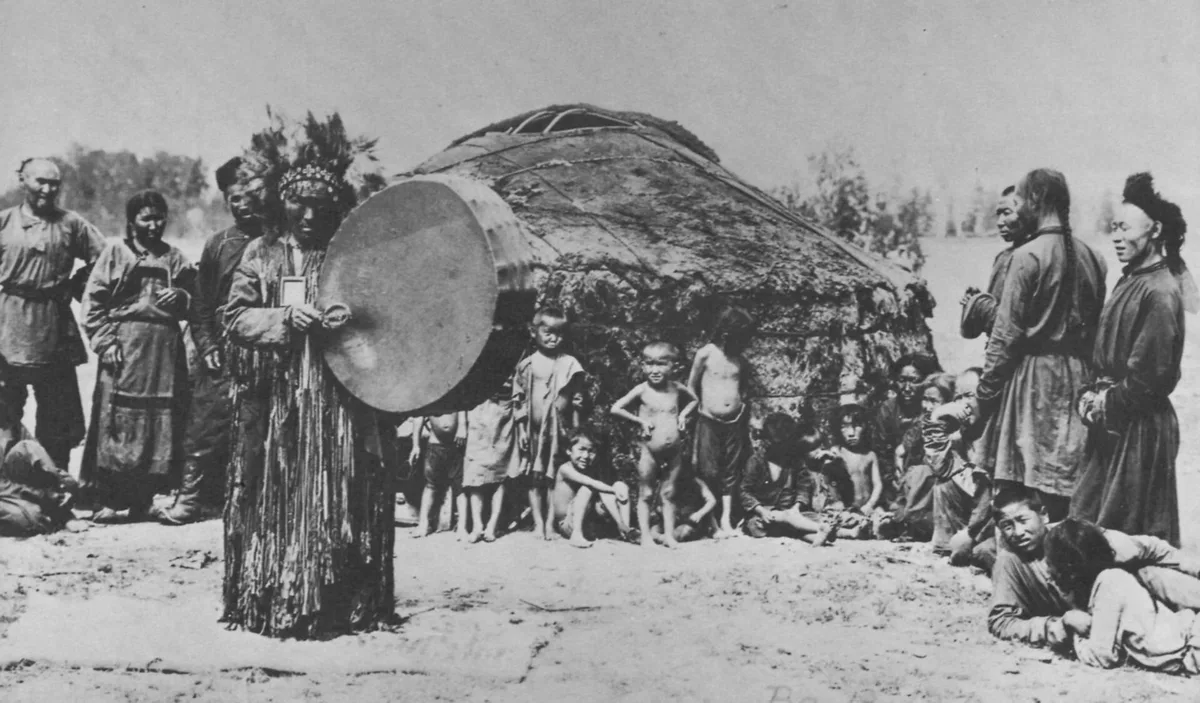
Kam is the Old Turkic word for the ritual specialist. This is the man or woman who deals with the powers, treats the sick, presides at a birth and at a burial, and reads what is coming.[1][2] The office is well attested for the Göktürks.[3] The word is not.
The Chinese accounts
The Sui Shu puts it in four characters.[3] The Göktürks revered spirits and trusted in spirit-mediums, 敬鬼神,信巫覡. The pair of characters covers the female and the male practitioner, as Chinese usage distinguished them.[3] The same passage adds that they honoured death in arms and were ashamed of dying of sickness. It also says that their customs were broadly those of the Xiongnu.[3]
The Zhou Shu does not use the word, but it gives something else. In the Suo origin account, Nishidu, born of a wolf, had received a strange power and could summon wind and rain.[4] A founder’s weather-working is not a description of an office. The Zhou Shu also nowhere says who performed the rites it describes at the cave, at the river in the fifth month or at the grave.[4]
The one eyewitness
The best evidence is not Chinese. In 569 the Roman embassy that Zemarchos led to the Göktürk court was purified before it was received.[5][6] The Byzantines and their goods were passed between fires while attendants made sounds and movements that the report describes as those of possession. The purpose was to keep whatever the strangers might carry from entering the land with them.[7] In Menander, the goods were set down in the middle and censed with burning branches of frankincense. Men of the tribe, whom the Göktürks called drivers-away of misfortune, murmured words in their own tongue. They rang a bell and beat a drum over the baggage, and they worked themselves into a frenzy to drive off evil. Then they led Zemarchos himself through the flame, and thought that they purified themselves as well.[5]
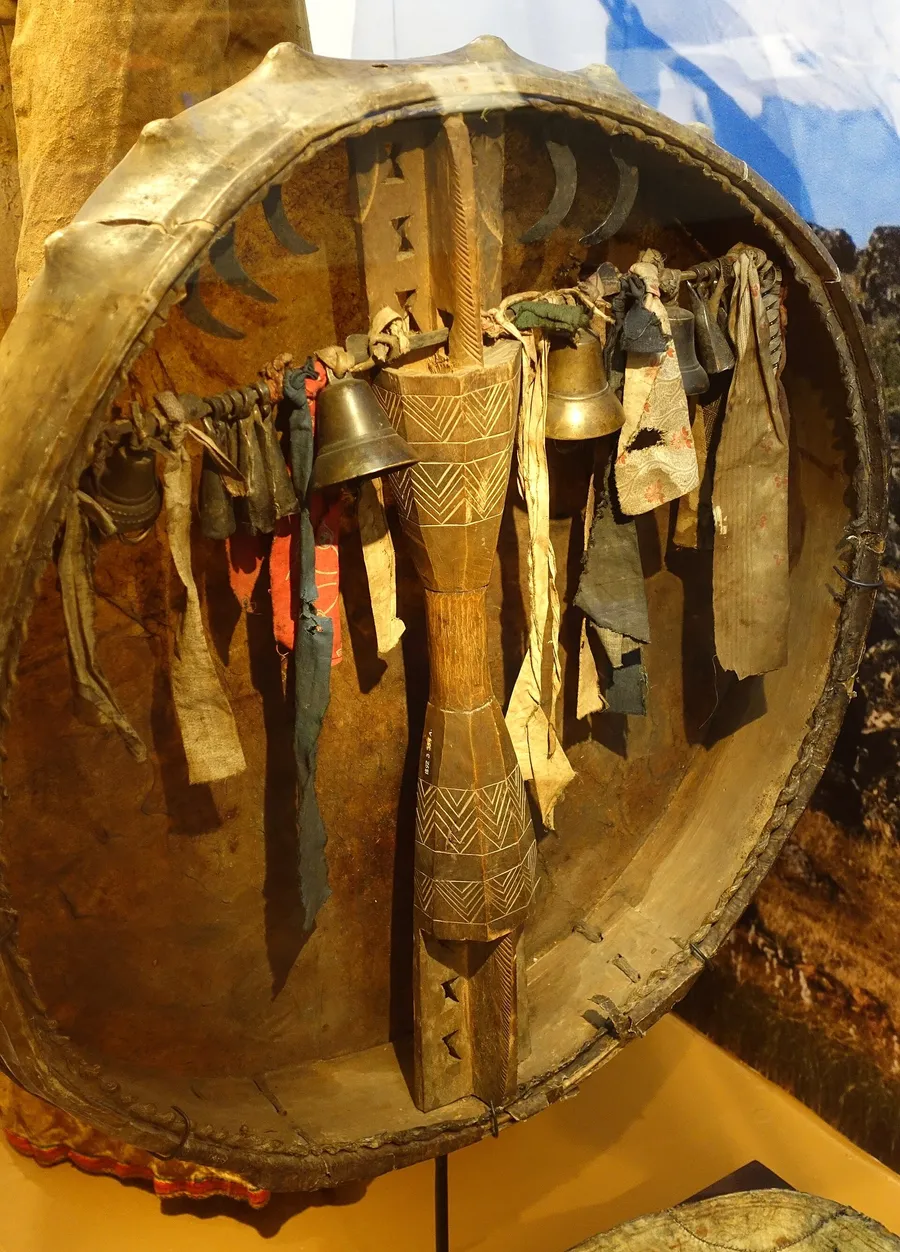
This is the only description of a Göktürk rite by an eyewitness. Short as it is, it establishes three things: purification by fire, a specialist performing it, and a conception of the polity’s own ground as something that can be contaminated. All three fit the sacred Earth-and-Water of the inscriptions better than they fit any part of the later systematised cosmology.
Absence from the inscriptions
No runiform inscription of the khaganates names the specialist.[8][9] This absence is not neutral, because the inscriptions describe at length the one occasion on which a ritual specialist would be expected. The khans set out their own installation. Heaven commanded them, they held their own Kut and their allotted portion, and Heaven raised them up by the crown of the head. No human officiant appears in any of it.[8] The silence may be intended. The khans tell at length of their own ascent to Heaven and of their dealings with it. The texts would thereby show that the shaman holds no advantage over the khan, either on the journey through the universe or in knowledge of what is unseen.[10]
In the Göktürk monuments, the sky makes the khan, and no priest crowns him.[8] The Ashina made themselves khans, and nobody consecrated them into the office. The kam acted at births, at burials and over the sick, but he held no place in the making of a ruler. This distinguishes the Göktürk arrangement from the Rouran one, where ritual specialists stood close to the throne.
The Yenisei stones, which are later and Kirghiz, say more, though the evidence is thin. On them the word bel stands beside tengri. It is probably a spirit that shamans revered, and the Orkhon stones do not have it.[11] The inscription of Uyuk-Arkhan may contain a trace of a shamans’ session. The text has a speaker say that he came to his mother with the soul of a dead man and that he came down into the land.[10] A line of an inscription from Uibat, “he went through the three storeys of the universe”, may be the epitaph of a shaman.[10] The word rendered “three storeys” can also mean “three times”, so the interpretation is not certain.[10]
Ritual specialists before the Göktürks
The Han Shu shows a ritual specialist at the Xiongnu court. The Chinese call him a wu, 巫, the character they also use of the Göktürk specialists. This one is a wu of the Hu, the word that the Han texts mostly use for the Xiongnu.[12][13] Li Guangli had gone over to the Xiongnu, and the chanyu’s mother fell ill. The Han renegade Wei Lü told the wu to say that the former chanyu was angry at a sacrifice left undone. The Xiongnu then killed Li Guangli in sacrifice.[12] The Xiongnu article tells the passage. The wu may have stood high in the Xiongnu state and been a kam.[14]
The Wei Shu and the Bei Shi tell of a second specialist, the huanren, “conjurer”, of the Yueban. He came to the Wei court in 448. He claimed that the sorcerers of his country had brought storms and floods on the Rouran, and that they could heal wounds with herbs.[15] He too may have been a kam.[16] Chinese eyes see both men, as they see the Göktürk wu. Neither notice gives the word of their own tongue for the office.
The word and its date
The word is caught earlier than the eleventh-century dictionary. A Manichaean text from Turfan has ol kam köŋüliŋä ïnča sakïntï, ‘that magician thought as follows in his heart’.[17] The dictionary of Mahmud al-Kashgari has it too. It stands five hundred years downstream of the men it is used to describe.[18] The word is nevertheless used freely of the Göktürk period. Doing so projects a later lexicon backward onto an office that the Chinese describe without naming.
The word may stand earlier than either text. Priscus names two Huns, Atakam and Eskam. The names can be divided as Ata Kam and Eš Kam, which would make them the oldest records of the word.[19] This assumes that the names of the Huns of Attila’s time are Turkic. That is the open question of the Hunnic language. Another account lists Atakam and Eskam among the names of Attila’s house that have been given Turkic etymologies.[20] A third account does not rely on the two names. It holds that the word appears early enough in the Tang annals, among the Kirghiz, at the latest in the ninth century. The Xin Tang Shu says that the Kirghiz called their spirit-medium 巫 by the name 甘, gan.[21][22][23] The equation of gan with kam is a modern interpretation of the Chinese character.[22]
Shaman is a still less suitable word. The word is Tungus, and it entered European scholarship from Siberia in the seventeenth century. It has since been applied to specialists from Lapland to the Amur whose practices differ widely. The philology of the nineteenth century already asked how kam stood to the Tungus šaman. It proposed a comparison with the Chuvash jom, the Yakut oyun and the Tungus sam, and it left the origin of kam an open question.[24] Using the word shaman for the Göktürks imports a model built elsewhere. This model contains the tiered cosmos, the soul journey and the climb up the world tree. None of these appears in the Göktürk-period sources.
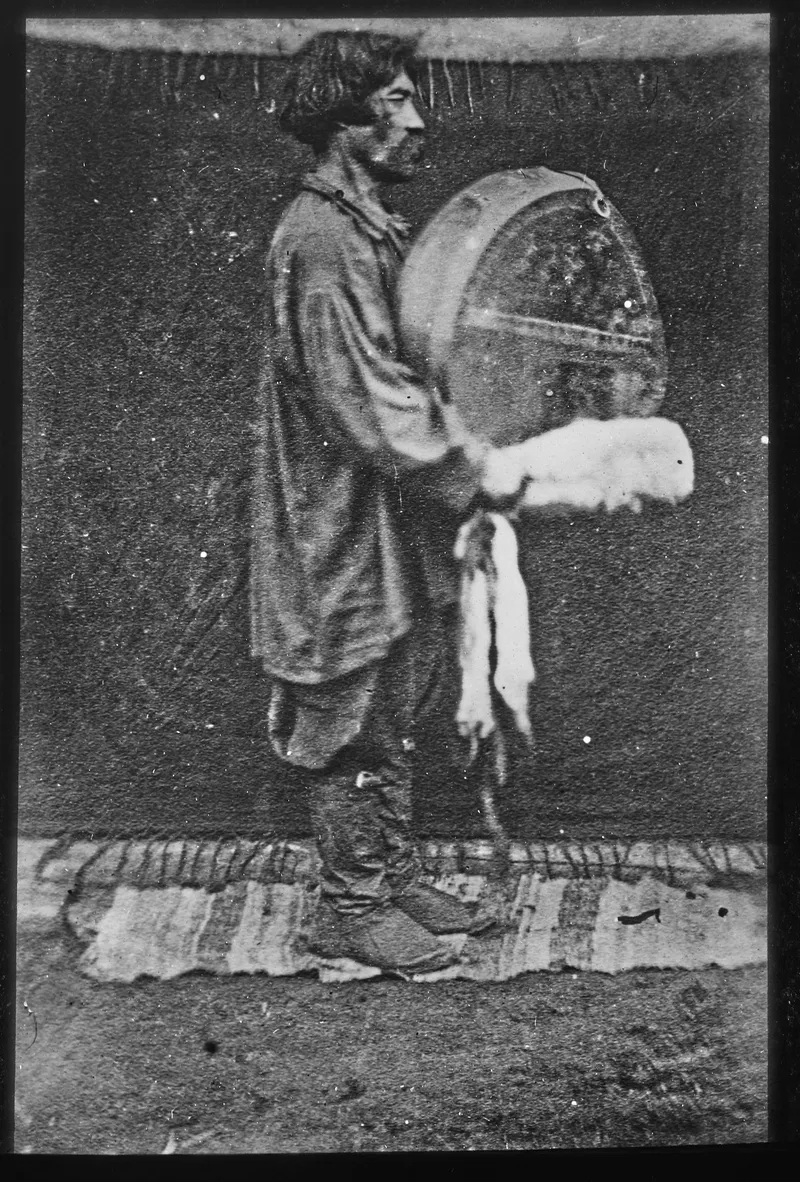
The word has a second witness from the same years. The Kutadgu Bilig of 1069–1070 names the kam beside the physician, otaçı, among those called to a dying man. It says that no remedy helps him.[25]
Later continuity
The fire ritual is the one element where the layers may genuinely touch. The purification that Zemarchos underwent in 569 has a counterpart in the burning cloth passed around the sick among Bashkirs and Kazakhs in the modern period. It has another in the Anatolian Turkish alazlama. A modern account adds the Mongol court, citing the traveller Rubruck: envoys were not admitted to the palace unless they had first been taken over a fire.[6] The continuity there is of a practice rather than of a doctrine. Purification by fire is widespread, and the Zoroastrian fire cult lay directly on the Göktürk south-western frontier. Shared origin is therefore one explanation among several.
References
- ^ Radloff 1893 (zweite Ausgabe), p. 16
- ^ Verbitskii 1893, scan 31
- ^ a b c d Sui Shu (Book of Sui), juan 84
- ^ a b Zhou Shu (Book of Zhou), juan 50
- ^ a b Menander Protector
- ^ a b Ögel 1995, p. 522
- ^ Yavuz 2025, p. 145
- ^ a b c Kül Tegin inscription
- ^ Barthold 2004, p. 17–18
- ^ a b c d Roux 1994, p. 53
- ^ Barthold 2004, p. 18
- ^ a b Han Shu, juan 94
- ^ Laufer 1919, p. 194
- ^ Erkoç 2026, p. 246–247
- ^ Wei Shu, juan 102; Erkoç 2026, p. 247–249
- ^ Erkoç 2026, p. 247
- ^ Erdal 2004, p. 367; 81; Wilkens 2024, p. 367; 81
- ^ Dīvān Lughāt al-Turk
- ^ Erkoç 2026, p. 246
- ^ Kafesoğlu 1997, p. 72
- ^ Xin Tangshu (New Book of Tang), juan 217
- ^ a b Roux 1994, p. 52
- ^ Hassan 1985, p. 238
- ^ Vámbéry 1879, p. 248
- ^ Kutadgu Bilig; Dankoff 1983, couplet 1065
Sources
- Sui Shu (Book of Sui), juan 84
- Zhou Shu (Book of Zhou), juan 50
- Han Shu, juan 94 (after Shiji)
- Wei Shu, juan 102
- Menander Protector
- Dīvān Lughāt al-Turk
- Kül Tegin inscription
- Kutadgu Bilig
- Xin Tangshu (New Book of Tang), juan 217 (after Jiu Tangshu)
Literature
- Emre-E. Yavuz, The Gokturk Empire: 2nd Edition (2025)
- Uno Harva, Die religiösen Vorstellungen der altaischen Völker (1938)
- Abdülkadir İnan, Tarihte ve Bugün Şamanizm: Materyaller ve Araştırmalar (2017; first edition 1954)
- Marcel Erdal, A Grammar of Old Turkic (2004)
- Hayrettin İhsan Erkoç, Asya Hunlarında Dinî İnançlar (Religious Beliefs of the Xiongnu) (2026)
- Jens Wilkens (trans. Celalettin Bulut Bostan), Uygur Budizmi ve Manihaizm ile Yerel Dinlerin Etkisi: Dinî Terminoloji Örneği (2024)
- Wilhelm Radloff, Aus Sibirien. Lose Blätter aus meinem Tagebuche. Zweiter Band (1893 (zweite Ausgabe))
- Vasilii Ivanovich Verbitskii, Алтайские инородцы (Altai Foreigners) (1893)
- Ármin Vámbéry, Die primitive Cultur des turko-tatarischen Volkes, auf Grund sprachlicher Forschungen erörtert (1879)
- Berthold Laufer, Sino-Iranica. Chinese Contributions to the History of Civilization in Ancient Iran (1919)
- V. V. Barthold, Orta Asya Türk Tarihi Dersleri (Orta Asya Türk Tarihi Hakkında Dersler) (2004)
- Jean-Paul Roux, Türklerin ve Moğolların Eski Dini (1994)
- İbrahim Kafesoğlu, Türk Millî Kültürü (1997)
- Bahaeddin Ögel, Türk Mitolojisi (Kaynakları ve açıklamaları ile destanlar) II (1995)
- Ümit Hassan, Eski Türk Toplumu Üzerine İncelemeler (1985)
What links here18
- Persons
- Yizhi Nishidu
- States
- Xiongnu · Yenisei Kirghiz Khaganate
- Peoples
- History of the Turkic peoples · Yueban
- Religions
- Animism · Ay Ata · Gaoche Thunder Rite · Iye · Omens and Divination · Peri · Purification by Fire · Shamanism · Tengri · The three worlds · Turkic Mythology · Ulukayın (Turkic World Tree)
- Customs & Pastimes
- The New Year on the Steppe
Cite this article
Yavuz, Emre-E. “Kam (Turkic Shaman).” Turkic Atlas, revised 8 November 2026. https://turkicatlas.org/religions/kam/
Last revised: 8 November 2026




