
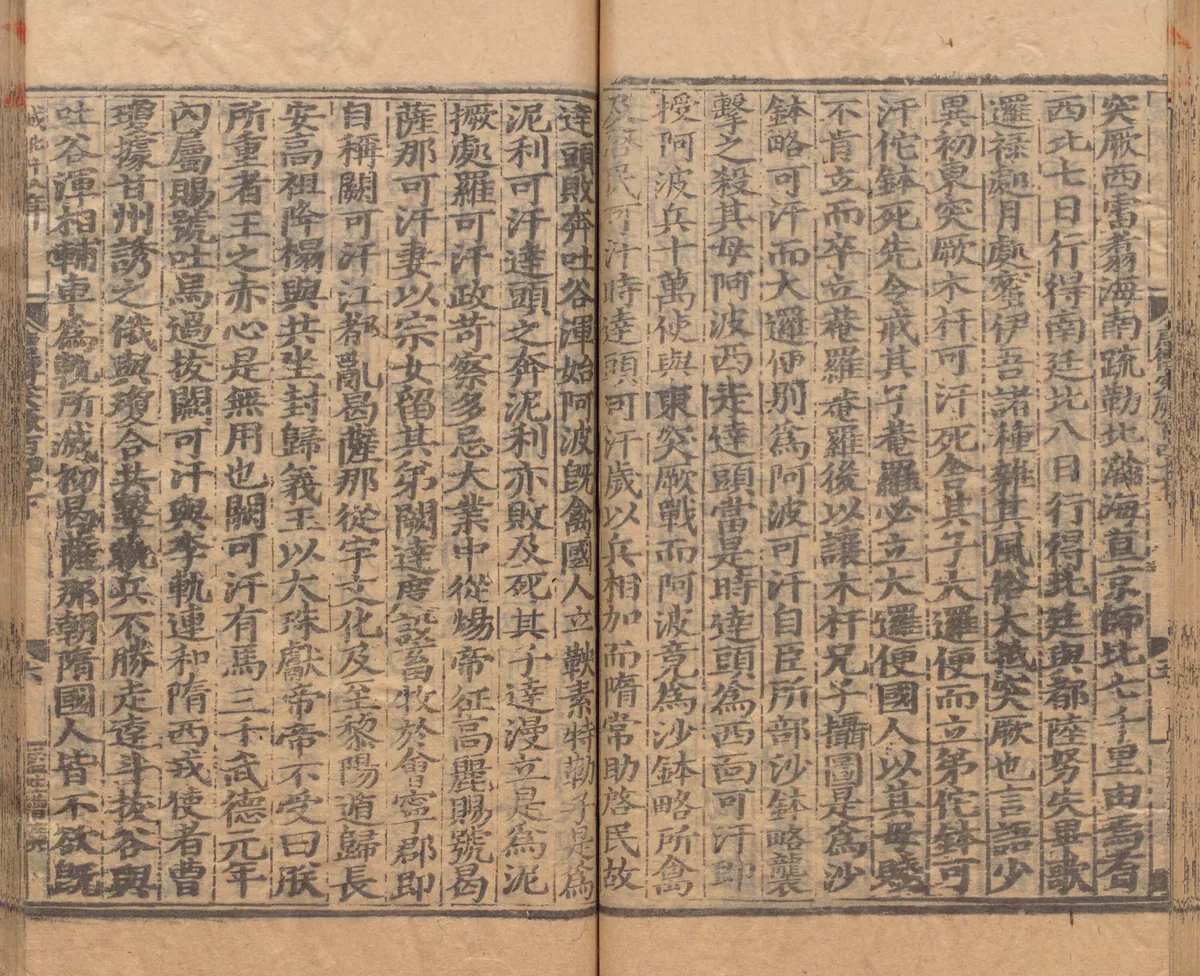
Beiting is not a place name in the ordinary sense. The two characters 北庭 mean the Northern Court. They name a place by its position relative to another place. The Tang chapters on the Göktürks use the name for two things. One is the seat of a Chinese protectorate on the northern slope of the Tian Shan. The other is the camp a khan of the western Göktürks built west of Mount Zuhe. Which of the two a passage means has to be decided from the passage itself.
The name and its pair
- 北庭ChineseXin Tangshu 215
- 北庭大都護府ChineseXin Tangshu 215
- 南庭ChineseXin Tangshu 215
The name is formed against 南庭, the Southern Court. The Xin Tang Shu measures both from the same point. From Yanqi in the Tarim, seven days’ march to the north-west reaches the Southern Court, and eight days’ march north reaches the Northern Court.[1] The same passage gives the bounds of the western khaganate around them: the eastern Göktürks to the east, the Leizhu sea to the west, Kashgar to the south, the Hanhai to the north. It adds seven thousand li due north of the Tang capital.[1]
A court in this usage is a khan’s camp, not a town. The terms are Chinese, and so is the reckoning, taken from a road in the oases. What they describe is the encampment of a steppe court at the end of that road.
The court of the western khan
In 638 the western khaganate broke in two at the Ili. The tribes on one bank took their orders from Yukuk Shad, whom the western tribes had raised as Yipi Duolu Khan. Those on the other bank took theirs from Ishbara Tolis.[1]
Yukuk Shad then built his court west of Mount Zuhe and called it the Northern Court. The Jueyueshi, the Basmïl, the Boma, the Kirghiz, the Hexin and the Chumukun submitted to him.[1] The peoples in that list live north and east. This places his court on the same side of the map as the name.[2] His rival’s successor held the Southern Court with the Ili as its eastern border.[2]
This Beiting appears in the chapter as a khan’s own foundation, with a name he gave it. It is not a Chinese office, and no protector sits in it.[1]
The Tang protectorate
The other Beiting is an office. Tingzhou, the Tang prefecture at Jimsar on the northern slope of the Tian Shan, became the Beiting protectorate. The Xin Tang Shu names its protectors among the officers who fought the Türgesh in the eighth century.[1] It stood over everything north of the mountains, as the protectorate of Anxi stood over the oases south of them.[1]
Three holders of the office are named in the chapters on the Göktürks. In the Chang’an period Ashina Xian was made Grand General of the Right Xiaowei Guard. He inherited the title Xingxiwang Khan, and he held both the commission for the pacification of the Ten Surnames and the grand protectorate of Beiting. In the fourth year Ashina Huaidao was made Khan of the Ten Surnames and protector of Mengchi.[1] Both men were Ashina. Both held Chinese office over the western tribes their family had once ruled.
Ashina Xian used the office. The chapter says that Duodan of the Ten Surnames tribes revolted. It says that Xian struck him down and sent his head to the palace gates, and that thirty thousand tents west of Suyab came over and were commended by letter under seal.[1] Kapgan Khan raided the Karluks, the Huwu and the Shunishi, who had already submitted. Xian was then made grand commander of the Dingyuan road and worked in concert with Tang Jiahui, protector of Beiting.[1]
The third is Guo Qianguan, who held the walls in 714.[1]
The two engagements before the walls
The protectorate seat was attacked twice from the eastern steppe within seven years. In 714 Kapgan Khan sent his son Inel, Tongga Tegin and his sister’s husband, the ilteber Shi Ashibi, with picked cavalry to shut in Beiting. Guo Qianguan held the town, came out, and beheaded Tongga Tegin below the walls.[3] In 721 Tonyukuk followed the retreating Basmïl. He split his force two hundred li from Beiting and took the town by another road. He destroyed the army that ran back to it.[3]
Both belong to the town. Turkic Atlas carries them under Beshbalik.
The Turkic name
The Turkic name of the protectorate town is Beshbalik, “Five Towns”. Painted runiform texts on the Tayhar rock at Hoyto Tamir in Mongolia speak of travelling to a place of that name.[4] Two of these texts carry animal-year dates that have been reckoned as 753 and 756.[5] The readings are preliminary. Turkic Atlas sets out the texts under Beshbalik.
Distinguishing the two
Neither reading can be applied by default. The ambiguity is in the source, not in the modern literature. The test is the passage itself. A Beiting that a Tang protector holds and that a Göktürk army besieges is the town on the northern slope of the Tian Shan. A Beiting that a khan builds and that the Boma and the Kirghiz attach themselves to is his own camp west of Mount Zuhe.
References
Sources
- Xin Tangshu (New Book of Tang), juan 215 (after Jiu Tangshu)
- Jiu Tangshu (Old Book of Tang), juan 194
Literature
- Édouard Chavannes, Documents sur les Tou-Kiue (Turcs) occidentaux (1903)
- Peter B. Golden, An Introduction to the History of the Turkic Peoples (1992)
- Emre-E. Yavuz, The Gokturk Empire: 2nd Edition (2025)
- Osman Fikri Sertkaya; Sartkocaulı Harcavbay, Hoyto Tamir (Moğolistan)’dan yeni yazıtlar (ön neşir) (2000)
What links here5
- Places
- Anxi Protectorate · Beshbalik
- Institutions and Titles
- Trade Routes of the Steppe
Cite this article
Yavuz, Emre-E. “Beiting.” Turkic Atlas, revised 7 November 2026. https://turkicatlas.org/places/beiting/
Last revised: 7 November 2026

