
- 400
- 500
- 600
- 700
- 800
- 900
- Rouran 400–554
- First Göktürk 552–630
- Tang rule 630–682
- Second Göktürk 682–744
- Uyghur 744–840
- Kirghiz 840–924
- Huns 370–469
- Western Göktürk 552–659
- Türgesh 699–766
- Karluk 766–800
- Khazar 650–969
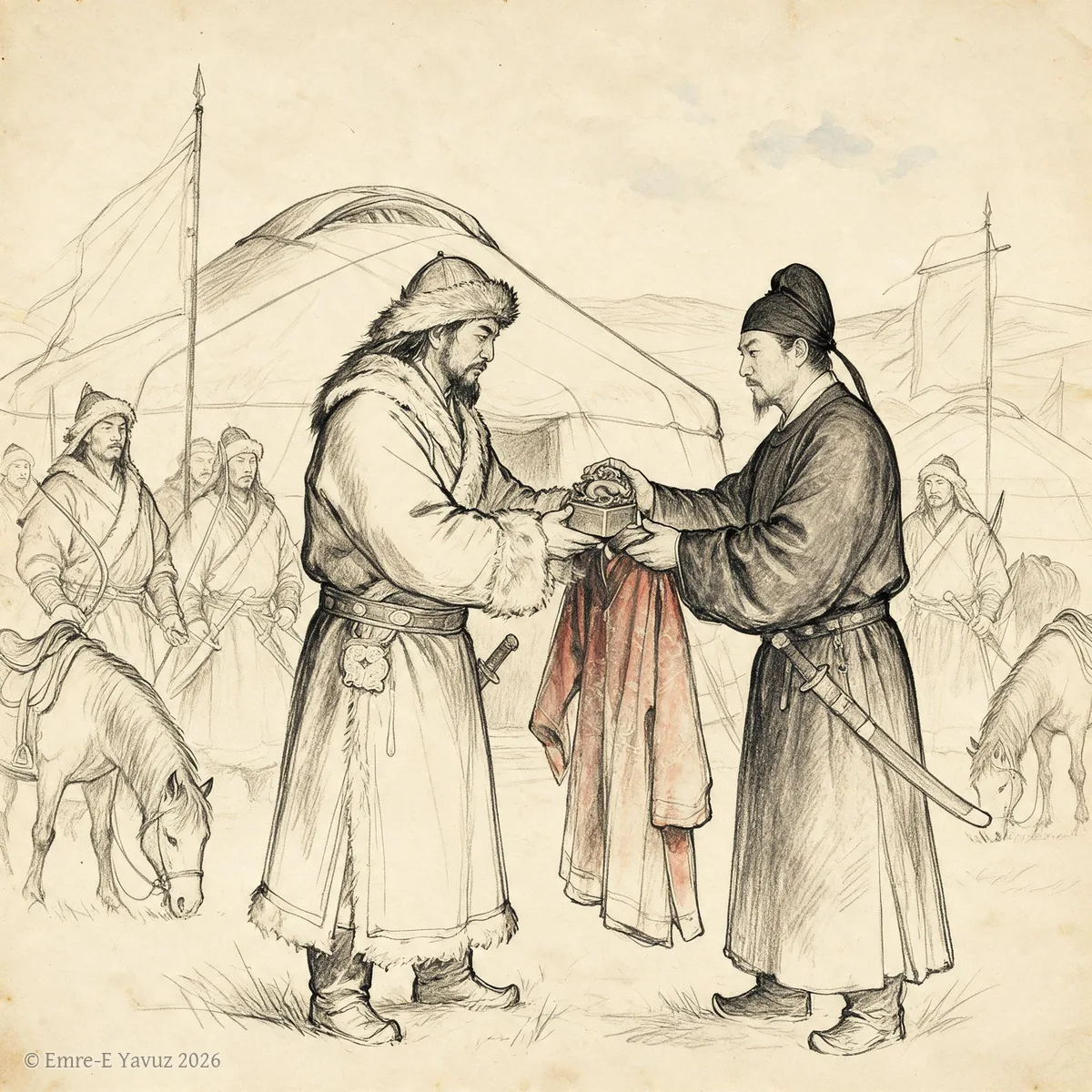
After 630 the Tang governed the eastern Göktürks by a device that was neither conquest nor annexation.[1] A tribe that surrendered was entered on the imperial register as a prefecture or a command. Its chief was appointed commander or prefect of it. The tribe went on being the tribe it had been.[1] The Chinese name for the arrangement comes from harness. The halter and the tether steer an animal without breaking it. China had practised indirect rule over subject nomads since the first century BC. It supported and bribed their local aristocracies, and it sometimes interfered directly in their affairs.[2] For the Han period, the aim of Chinese statecraft in Central Asia is stated in similar terms. China sought a situation in which the small oasis rulers found it more profitable to look to China for support than to submit as vassals to the nomads.[3]
The court debate of 630
The Tang chose the system against an alternative in a court debate of 630. The interregnum article sets out the debate in full.[1] The majority wanted the tribes broken up and settled as farmers in the interior. Wen Yanbo argued for the Later Han precedent. The tribes should be kept whole below the frontier, they should serve as a shield, and they should not be cut from their customs. Wen Yanbo won the debate.[1]
The immediate result was four commands from Youzhou to Lingzhou. The territory of Ilig himself was divided into six prefectures under two commands, Dingxiang on the left and Yunzhong on the right.[1] The chiefs who came in received Tang ranks. More than a hundred held the fifth grade or above. Several thousand households settled in the capital.[1]
The full extent
After Chebi was taken in 650, two protectorates were laid over the commands.[1] Shanyu held Langshan, Yunzhong and Sanggan and fourteen prefectures. Hanhai held Hanhai, Jinwei, Xinli and four more, and eight prefectures. In both, the chapter specifies, the chiefs themselves were the commanders and prefects.[1] The Xin Tang Shu adds a change of names. In the first years of the Linde era, which began in 664, the protectorate of Yanran was renamed Hanhai and put over the Uyghurs.[4] The old Hanhai protectorate moved to the ruins of Yunzhong and was called the Yunzhong protectorate, and was then renamed Shanyu.[4] The two protectorates of 650 are placed at Yunzhong and Yanran, and the names Shanyu and Hanhai are given only from 664.[5]
The system worked on its own terms for a generation. The emperor performed the Feng sacrifice at Mount Tai. The commander of Langshan and more than thirty other chiefs rode in the imperial train, and their names were cut into the stele.[1] From 650 onward, the chapter says, the northern border had nearly thirty years without trouble.[1][5]
Effect on the tribes
The rising of 679 shows what the device had kept alive.[1] Two Ashide chiefs raised a khan, and twenty-four prefectures rebelled with them.[1] A prefecture is an administrative unit and does not rebel. Only a tribe does. The units that went over were the tribes the system had left standing, and they went over whole.
The same holds for the man who ended the period. The grandfather of Ilterish had been a chief under the commander of Yunzhong in the Shanyu protectorate. He held the rank of tudun by inheritance.[1] Three generations of Tang office had dissolved neither the following nor the rank nor the claim.
The Kül Tegin inscription looks at the arrangement from the other side. It states what the arrangement cost: the lords who went over to China took Chinese titles and became subjects of the Chinese khan.[6] Both accounts describe the same registers.
In the west
The Tang carried the device across the western countries as well. In 661 they decreed a division of the lands west of the Pamirs into sixteen commands under the protectorate of Anxi at Kucha. Most of this division stayed on paper.[7] The Jiu Tang Shu lists among them the Taihan command. It was set up in the country of the Hephthalites, with its seat in the town of Huolu. Fifteen prefectures stood under the Great Khan of the command.[8][9][10] Where the command lay is not settled. Some scholars identify it with Badakhshan and the country south and east of it, which would make it the old Jaftal.[9] Others doubt that it lay there at all, since the names of the fifteen prefectures cannot be identified.[10] One proposal finds the Turkic word ordu, “camp”, in Huolu, the name of the seat. The name begins like Huo.[11]
References
- ^ a b c d e f g h i j k l m Jiu Tangshu (Old Book of Tang), juan 194
- ^ Khazanov 1994, p. 216
- ^ Lattimore 1951, p. 495
- ^ a b Xin Tangshu (New Book of Tang), juan 215
- ^ a b Taşağıl 1999, p. 48–50
- ^ Kül Tegin inscription
- ^ Markwart 1938, p. 38,46
- ^ Jiu Tangshu (Old Book of Tang)
- ^ a b Markwart 1938, p. 47
- ^ a b Herrmann 1925, p. 576
- ^ Markwart 1938, p. 48
Sources
- Jiu Tangshu (Old Book of Tang), juan 194
- Xin Tangshu (New Book of Tang), juan 215 (after Jiu Tangshu)
- Kül Tegin inscription
Literature
- Liu Mau-tsai, Çin Kaynaklarına Göre Doğu Türkleri (1958, Turkish edition)
- Peter B. Golden, An Introduction to the History of the Turkic Peoples (1992)
- Josef Markwart, Wehrot und Arang. Untersuchungen zur mythischen und geschichtlichen Landeskunde von Ostiran (1938)
- Albert Herrmann, Die Hephthaliten und ihre Beziehungen zu China (1925)
- Anatoly M. Khazanov, Nomads and the Outside World (1994)
- Owen Lattimore, Inner Asian Frontiers of China (1951)
- Ahmet Taşağıl, Gök-Türkler, Bd. II (1999)
What links here21
- Persons
- Ashide Yuanzhen · Chebi Khan · Nishufu Khan · Töles Khan
- States
- Goguryeo · Tang · The Göktürk interregnum, 630–682
- Battles & Events
- Banquet of the Wine Fountain (647) · Defection of Töles (628) · The Court Debate of 630
- Places
- Dingxiang · Lingzhou · Shanyu Protectorate · Yunzhong
- Lineages
- Ashide
Cite this article
Yavuz, Emre-E. “Loose-rein prefectures.” Turkic Atlas, revised 8 November 2026. https://turkicatlas.org/institutions/jimi-prefectures/
Last revised: 8 November 2026

