
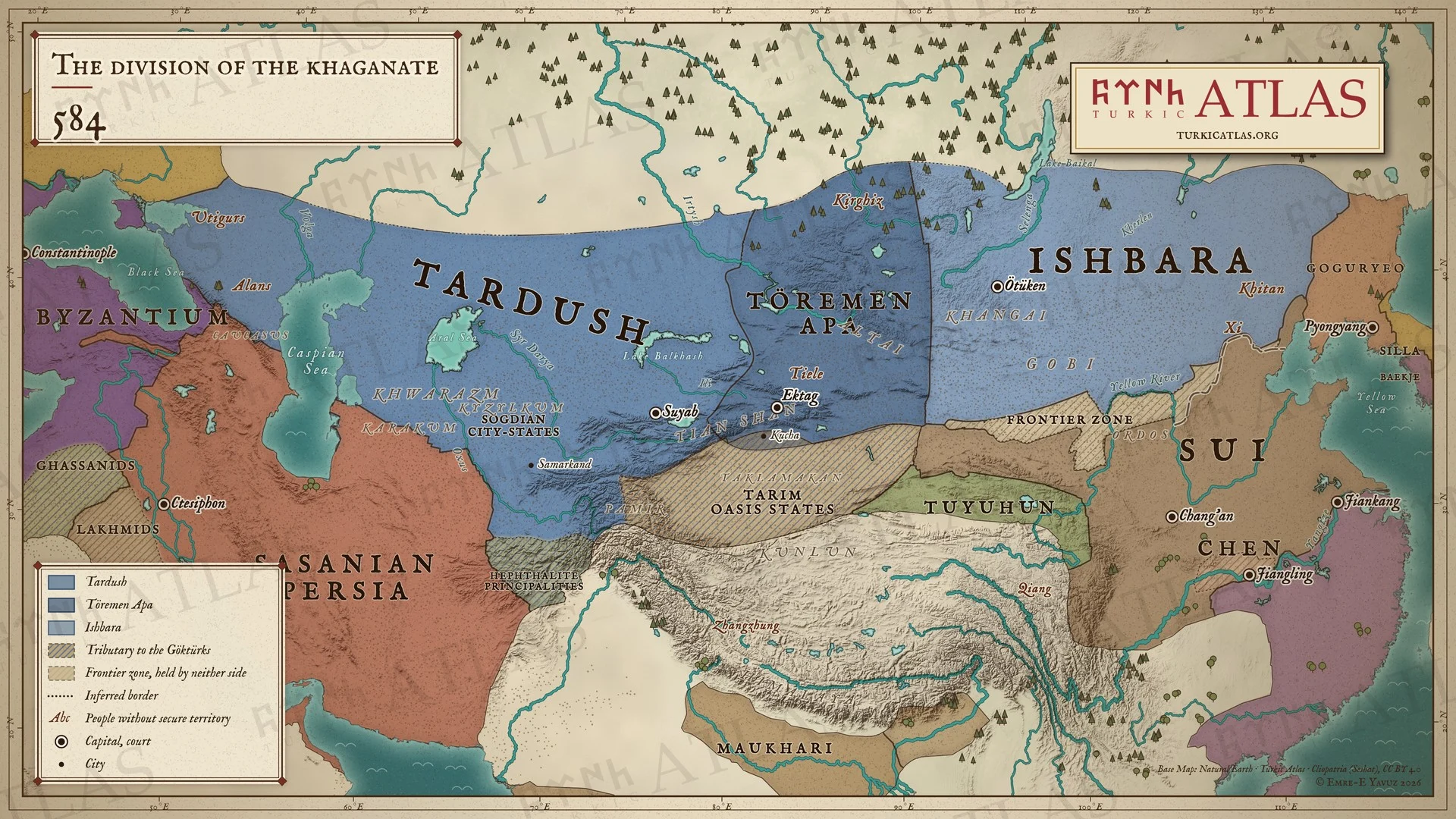
Töremen was the son of Mukan Khan. Taspar wanted him as his successor, and the Göktürk nobility refused. The refusal made him a rebel. The title he was given to placate him made him Apa Khan. He fought Ishbara with the western wing behind him, and this war was the first campaign of the civil war that divided the khaganate. In 587, the year of his enemy’s death, Ishbara’s brother Bagha took him alive.[1]
Names
- TöremenOld Turkic
- 大邏便ChineseSui Shu 84
- 阿波可汗ChineseSui Shu 84
The Chinese histories give his personal name as Daluobian and his title as Apa Khan.[1] The reconstruction Töremen, after Taşağıl, is formed on törü, the customary law. It is glossed here as the upright one, the keeper of the law. It is a reconstruction and is not attested in a Turkic source. Apa is an old Turkic honorific, “elder brother” or “venerable lord”. It was given to high princes of the Ashina and lent his claim its legitimacy in the war.
Succession crisis (581)
Taspar was dying in 581. He wished the throne to pass to Töremen and not to his own son Amrak.[1] A khan of the Göktürks had no right to name his successor. The succession ran laterally so that no single line should keep the throne.[1] The nobility assembled at Ötüken. There Ishbara, the lesser khan of the east and the son of the eldest line, objected on those grounds. He objected on another ground as well: Töremen’s mother had not been a Göktürk and had, he claimed, been of low rank.[1] The second objection followed from the character of the state. A state founded to make the Göktürks independent was expected to have a Göktürk khan. Local rulers of any origin had a voice in the choice, but most of the nobility were Göktürks. The Sogdians specialised in trade, not rule. Ishbara threatened revolt and proposed Amrak, and the assembly accepted.[1]
Töremen rejected the election as illegitimate. He enjoyed great standing among his following and raised it for a revolt. Amrak abdicated in Ishbara’s favour, believing he had averted the revolt. He had not.[1] Töremen was given the title Apa Khan in the same settlement that made Amrak second khan on the Tola and Ishbara supreme at Ötüken. Others have him declare war on Ishbara outright.[2] In either account Töremen began the war.
Flight to the west (583)
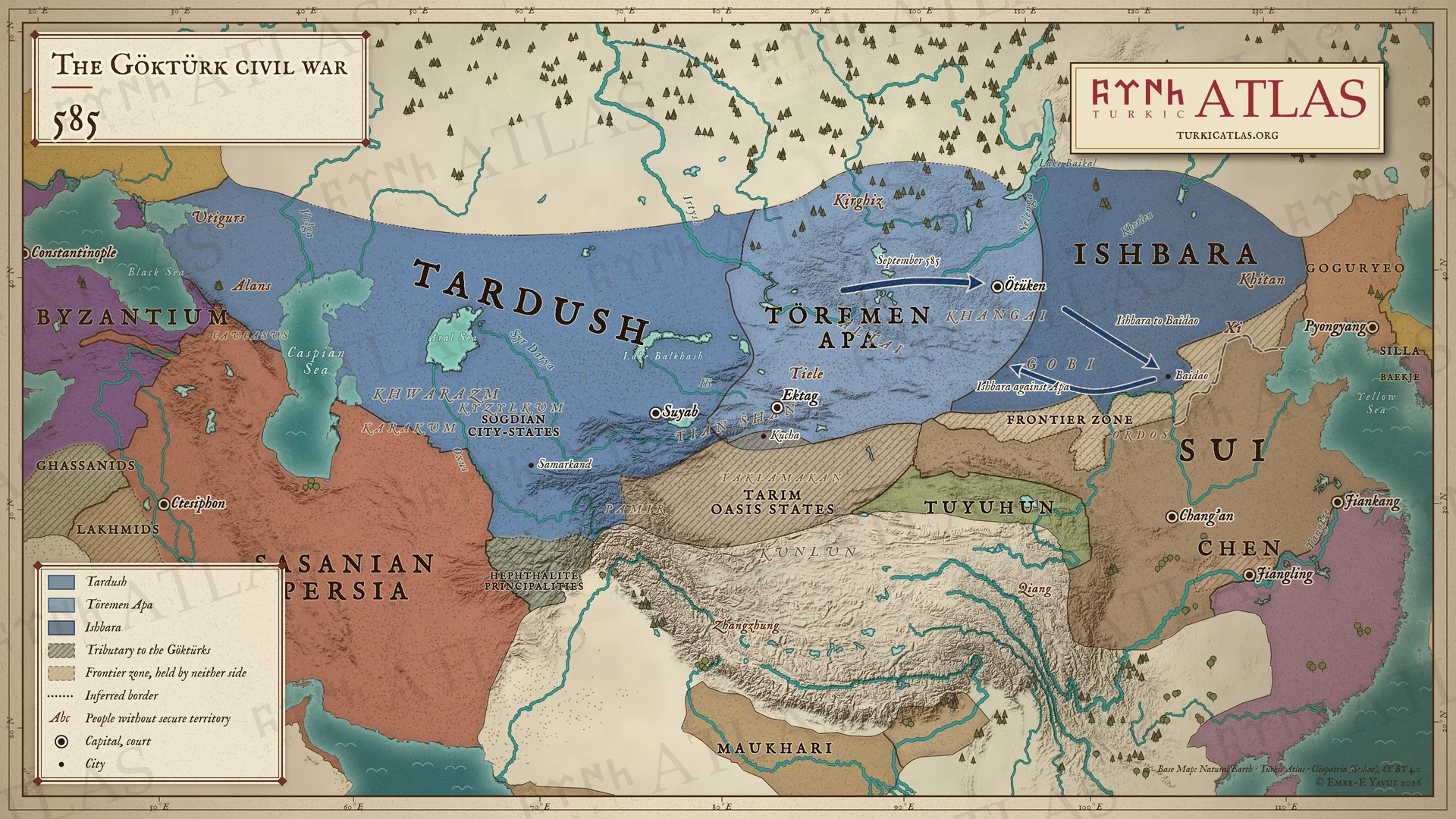
Apa rode with Ishbara into China in 583. He held the front with him and Bagha after Tardush withdrew to meet the Tiele rising. The Sui broke the Göktürk army near Baidao in June. Disease followed. Chinese agents in the retreating army set the commanders against each other, Apa and Ishbara first. Ishbara grew fearful of Apa, who appears to have been dealing with the Sui. He turned on him suddenly, raided his camp and killed his mother. Apa fled to Tardush in the west.[3] A second account tells it differently. Apa lost two skirmishes on the way west and arrived in panic at Suyab, where Tardush was still occupied with the Tiele. Ishbara returned to Ötüken and killed the mother afterward. The sequence differs between the accounts, the killing does not. Apa’s mother was Ishbara’s aunt.
Apa Khan (583–587)
From Suyab Töremen fought on as Apa Khan with Tardush’s support. The begs who were appalled by Ishbara’s purge went over to him. Tardush had his own ambition, dated from about 582 and aimed at nothing less than the whole khaganate. It made Apa’s cause his instrument. On the best view, the rebellion gave Tardush the perfect opportunity to grow from a viceroy into a khan.[2] In 585 the western army pressed Ishbara so hard that he submitted to the Sui. In September it marched on Ötüken.[4] Whether Apa rode with it is not recorded.
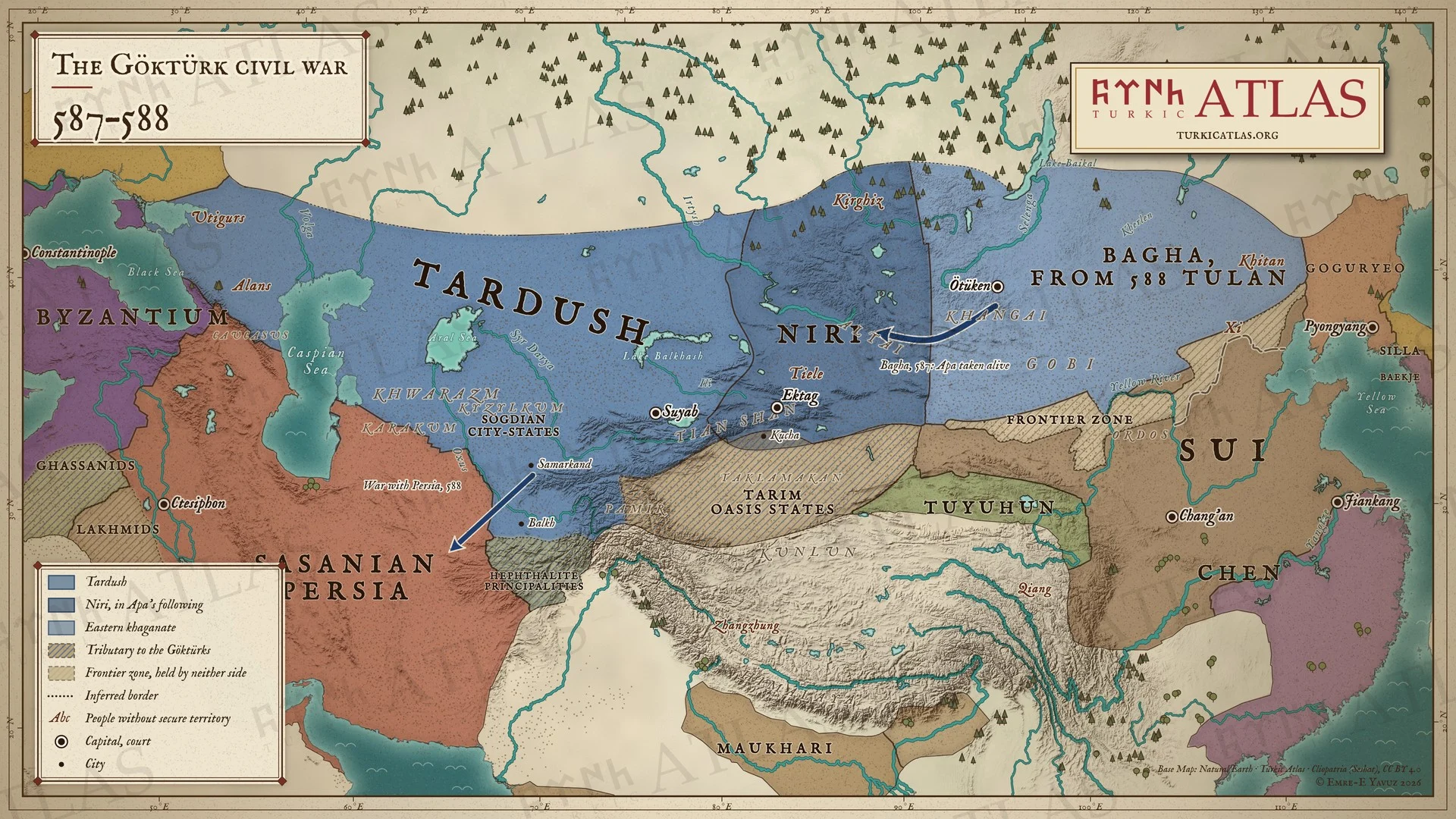
In 587 Ishbara died. His brother Bagha, raised as khan by Ishbara’s will, marched west against Apa under the drums and banners the Sui emperor had sent him.[1] Apa’s men took the banners for a sign that Sui troops were with him. They came over in great numbers, and Bagha took Apa alive.[1] Bagha asked the emperor whether the captive should live or die. The chancellor Gao Jiong answered that kin destroying kin was a canker, and the emperor spared him.[1] The Sui Shu says nothing more of Apa. In the west his people raised Niri, the son of Yangsu Tegin, as their khan.[1] According to some scholars, the Sui Shu derives the later khans of the western Göktürks from him rather than from Istemi. A recent attempt to reconcile the sources has him drive Tardush out of his western holdings and hold the west for a time. Istemi’s line then reasserted itself. The western article sets out the positions, and none of them has prevailed.
Assessment
Töremen is the prince the sources built the war around and then lost interest in. He counts among the four princes whose greed for power made the war unavoidable. Of the four, his claim was the best, since the dead khan had named him. His cause was the weakest, since the assembly had not. The Kül Tegin inscription says that the Chinese set brother against brother. It does not say which brothers.[5]
References
Sources
- Sui Shu (Book of Sui), juan 84
- Zhou Shu (Book of Zhou), juan 50
- Kül Tegin inscription
Literature
- Emre-E. Yavuz, The Gokturk Empire: 2nd Edition (2025)
- Peter B. Golden, An Introduction to the History of the Turkic Peoples (1992)
What links here31
- Persons
- Amrak · Bagha Khan · Diqincha · Ishbara Khan · Mukan Khan · Niri Khan · Tanhan Khan · Tardush · Taspar Khan · Yangsu Tegin
- Conflicts
- The Göktürk Civil War
- Battles & Events
- Battle of Baidao (583) · Capture of Apa (587) · Göktürk Succession Crisis (581) · Submission of Ishbara (585)
- Places
- Baidao Plain · Beihai · Tanhan Mountain
- Institutions and Titles
- Apa Tarkan · Daluobian · Drums and Banners for the Khans · Great Khan · The Western and Southern Khans · Töre · Toy · Warfare of the Steppe Empires
- Religions
- Turkic Mythology
- Sources
- Cefu yuangui · Tongdian
Cite this article
Yavuz, Emre-E. “Töremen Apa.” Turkic Atlas, revised 8 November 2026. https://turkicatlas.org/persons/toremen-apa/
Last revised: 8 November 2026

