
- 400
- 500
- 600
- 700
- 800
- 900
- Rouran 400–554
- First Göktürk 552–630
- Tang rule 630–682
- Second Göktürk 682–744
- Uyghur 744–840
- Kirghiz 840–924
- Huns 370–469
- Western Göktürk 552–659
- Türgesh 699–766
- Karluk 766–800
- Khazar 650–969
The Yenisei Kirghiz Khaganate was the realm of the Kirghiz khans on the upper Yenisei in southern Siberia. It is dated from 840 to about 924.[1] It begins with the Kirghiz victory over the Uyghurs.[2] In 840 the Kirghiz khan, whom the Tang histories call Are, led his army to the Uyghur capital, Ordu-Balık, on the Orkhon. He burned the camp of the Uyghur khans and took the Tang princess Taihe.[3] The Kirghiz did not take the Uyghurs’ place on the Orkhon. They stayed centred on their homeland on the upper Yenisei, and their authority over the plateau was brief.[4]
Almost all the evidence was written outside the Kirghiz realm. The main accounts are the notice on the Kirghiz in chapter 217B of the Xin Tangshu and the chapter on the Uyghurs in the Jiu Tangshu, number 195.[5] Further sources are the letters that the Tang chief minister Li Deyu wrote to the Kirghiz khan between 843 and 845.[6] The Persian geography Ḥudūd al-ʿĀlam of 982 is another.[7] The runic gravestones of the upper Yenisei are almost all epitaphs. They are undated and report no history.[8]
Before 840
The Kirghiz had lived under steppe empires since the sixth century. The Zhou Shu says that Mukan subdued them in the 550s.[9] The inscriptions of the restored Göktürk state tell of a winter march across the Kögmen range. During this march the Kirghiz khan was killed in a night attack, about 710.[10] The name of the Kirghiz occurs often in the Orkhon inscriptions. In the early eighth century they lived north of the Kögmen range, and they struggled for power first with the Göktürks and then with the Uyghurs.[2]
After 744 the Uyghurs ruled the steppe and turned north.[11] On one account they put the Kirghiz, with the Karluk, Telengut, Tatar, Khitan and others, in a position of vassalage and tribute.[12] In 758 they reported a victory over 50,000 Kirghiz.[13] From then on, the Xin Tangshu says, the Kirghiz could no longer reach China.[3] The Uyghurs gave the Kirghiz ruler the title 毗伽頓頡斤. It is understood as Bilga Ton Irkin, with irkin, a chief’s rank, as its last word.[14] The Kirghiz looked for support elsewhere, to the Arabs, the Tibetans and the Karluks. Tibetan travellers waited among the Karluks for a Kirghiz escort. The Arabs sent the Kirghiz heavy brocade, twenty pieces every three years.[3]
When the Uyghurs weakened, Are took the title of khan, about 820 by the usual count.[14] His wife was the daughter of a Karluk yabgu, and the Xin Tangshu gives her the rank of khatun.[3]
The twenty years’ war and 840
The war with the Uyghurs ran from about 820 to 840.[15] The Uyghurs sent a chief minister against Are, and he did not win. The fighting went on for twenty years without a decision.[3] Are, sure of his advantage, reviled the Uyghurs: “Your fortune is spent. I shall take your golden tent, ride my horse before your tent and plant my banner. If you can resist, come quickly. If not, go at once.”[3]
In 839 the Uyghur state broke apart from within.[3] Famine, plague and heavy snow killed the sheep and horses. The court fell into a struggle over the throne, and the khan died.[3] A Uyghur general, called Julu Mohe in the Chinese texts, hated the minister Jueluowu, who had set up a new khan. He fled to the Kirghiz.[13] His name is usually given in Turkic as Külüg Bagha.[15] He led the Kirghiz back with 100,000 horsemen, the number the Chinese give.[16] They broke the Uyghur city, killed the khan, beheaded the minister and burned the court. The Uyghurs scattered.[16]
Are came in person. He burned the camp of the Uyghur khans and the golden tent in which the princess had lived. He took all their treasure and seized Taihe.[3] Then he moved his own camp to the south of Mount Lao, fifteen days’ ride from the old Uyghur camp.[3] The Kirghiz did not move into the ruined capital.[17]
Embassies to the Tang, 842–848
Are sent Taihe back to the Tang court, because the Kirghiz claimed descent from Li Ling and with it kinship with the Tang house. The Jiu Tangshu names ten dagan, officers of the court, as her escort. Wujie, whom the surviving Uyghurs had made khan, met them on the way. He killed the envoys and carried the princess south across the desert.[16] With his envoys dead, Are had no means of reaching the Tang court.[3]
The Tang record knows four Kirghiz envoys between 842 and 844.[18] The first, Ta-bu-he-zu, came to the frontier post of Tiande between 6 November and 5 December 842. He reported that a great army had set out to look for the princess.[19] The second, Zhu-wu Alp Sol, whom the Xin Tangshu calls Zhuwu Hesu, reached the capital on 16 March 843.[20] Emperor Wuzong was delighted and gave him a place above the envoy of Bohai.[3] The third envoy, Wen-wu Alp, came in July 843. The fourth, Tatik Iznanchu, came in the autumn of 844.[21]
Li Deyu did not trust the court interpreters, who were of the Uyghur nation. On 12 February 843 he asked for two men from the border districts who understood Turkic and were not Uyghurs.[22] The men he distrusted were probably Sogdians, some of whom passed as Uyghurs.[23] The envoy was questioned about the mountains, rivers and customs of his country. Li Deyu proposed a Picture of the Gathering of Kings.[3] Wuzong ordered that Are’s name be entered in the register of the imperial clan.[3]
Are asked for the title Heavenly Khan, in Turkic with Tengri. Li Deyu refused it in the letter that Wen-wu Alp took home in the summer of 843, and offered the old Tang titles of the Kirghiz chiefs instead.[24] In June 845 the court named Li Shi envoy and prepared an edict giving the title Zongying Xiongwu Chengming Khan. Wuzong died in April 846, before Li Shi left.[25] When Wuzong’s successor Xuanzong took the throne, his ministers advised against a second title. The Uyghurs had received one in their prime, and another would breed trouble.[3] In 847 the court still sent Li Ye with the credentials. It invested the Kirghiz as Yingwu Chengming Khan, a shorter title than the one planned.[3] According to one interpretation of the Xin Tangshu, the ruler who had taken Ordu-Balık had probably died before 6 February 847, murdered by one of his officials.[26]
The Kirghiz derived their ruling house from Li Ling, the Han general who went over to the Xiongnu in 99 BC.[27] The Xin Tangshu says that Kirghiz with dark eyes were called his descendants.[3] Li Deyu’s letter says that the Tang house descended from Li Guang, the Han governor of Youbeiping, and the Kirghiz khan from Li Guang’s descendant Li Ling. It concludes that the two houses were therefore of one clan.[28] The descent from Li Ling is a claim that both courts made. The sources give no means to test it. The claim may be rhetoric on both sides, used for political ends.[29] A separate argument finds three strata in the Kirghiz country: a red-haired Europoid one, a Mongoloid one from Lake Baikal and a Turkic one from the Altai and the Kem. It holds that the Turkicisation of the Göktürk period reached only the ruling class.[30]
In 848 the Kirghiz minister Apa, 阿播 in the Chinese texts, marched with 70,000 men against the Shiwei. The Shiwei had divided the Uyghur remnant among their seven tribes.[16] Apa beat them and brought the Uyghurs back north of the desert.[16]
Extent of Kirghiz power
Michael R. Drompp read the Tang letters and concluded that the Kirghiz did not replace the Uyghurs on the Orkhon but stayed centred on the upper Yenisei.[17] An older account puts it the same way. After their victory the Kirghiz went back to the north and to their traditional way of life, and the victory produced no strong confederation and no new empire.[31] In 842 the first envoy announced that the Kirghiz would move to He-luo-chuan, occupy the old Uyghur land and win Anxi, Beiting and five tribes of Tatars.[32] This was only an announcement. The Kirghiz never attacked or ruled Anxi or Beiting.[33] In the spring of 845 they complained that the road past the old steles was blocked. A standing Kirghiz post of any size would have kept it open.[34] The Kirghiz asserted their influence beyond the homeland “for a few years”. There is “no evidence whatsoever” that their control reached over the plateau “in anything more than an ephemeral manner”.[35] Their request for the title Heavenly Khan shows that they saw themselves as heirs of the Göktürks and Uyghurs, at least politically. They pursued the title from the Yenisei.[36]
Three reconstructions stand against Drompp’s. The first, Kyzlasov’s, gives the Kirghiz a state that held the Khakas-Minusinsk basin, the Altai, the middle Irtysh, the Ob and Angara, Tuva, north-western Mongolia and Lake Baikal. Some Uyghur tribes would have remained in Mongolia under Kirghiz overlordship. The reconstruction rests largely on conjecture.[37] The second is the Great Kirghiz State of 840 to 924 of national historiography in Kyrgyzstan and Khakassia, a power reaching from Mongolia to eastern Turkestan.[38] The third has the Kirghiz empire last until about 917, when the Khitan united northern China and Mongolia and the khan went back to his old seat on the Yenisei. A variant has it last until 924, when the Khitan pushed the Kirghiz back from the Orkhon.[39] Turkish handbooks give this account as an event, dated 920 in one and 924 in another, and name no source for it.[40]
The graves show a wide spread. Kirghiz cremation graves of the ninth and tenth centuries lie in the Minusinsk basin and Tuva, in the Altai and in eastern Kazakhstan. The Usinsk basin was settled once the sharpest phase of the war was over.[41] Chinese coins found in the Minusinsk basin begin in 544 and run through the Tang period to 846.[42] Graves of the seventh to the ninth century at Kopen, Uybat and Kapchal show the Kirghiz as farmers and smiths. They held ploughshares, sickles and, at Uybat, an irrigation canal. The princely grave at Kopen held a gold and a silver vessel with runic writing and scenes of hunting.[43] A silver bowl from a grave of the Chaa-tas culture at Uybat, dug in 1928, carries a few runic signs.[44] The scholars date the grave by its finds to the end of the eighth century and the first half of the ninth.[45]
Land, seat and economy
The Xin Tangshu puts the country three thousand li north-west of the Uyghurs. It gives the road from Are’s camp to the Uyghur camp as forty days by camel.[3] Are made his camp at the Blue Mountain, with a palisade instead of a wall and felt tents joined together. His own tent was called Midizhi, and the other chiefs lived in small tents.[3][46] Are set up a single standard, and everyone beneath it held red in honour.[3][46] The Ḥudūd places the khan’s residence in a town it calls K.m.jkath, the only settlement in the country.[47] Its editors take the name as a corruption of Midizhi. Kyzlasov identifies it as Kemijkat, a town on the Kem, and counts it among the former Uyghur fortress towns on the Ulug-Khem in Tuva.[48]
The Kirghiz sowed millet, wheat and barley. They kept large horses, camels, sheep and above all cattle, of which the rich held thousands.[3] They ground the grain in mills and made flour and gruel from it.[3] Two Turkish handbooks render the word for the mills differently, once as foot mills and once as small hand mills.[49][50] There was gold, iron and tin. After every rain, the text says, iron was found, and the Kirghiz made it into weapons.[3] The Ḥudūd lists musk, furs, khadang and khalanj wood and knife handles of khutu horn among the exports of the country. Its Kirghiz are hunters who wander along rivers and meadows with tents and felt huts.[51]
Cloth came from outside. The Xin Tangshu says that Kirghiz women wore wool, brocade, woollen fabric and twill, which Anxi, Beiting and the Arabs sold them.[3] Anxi was the Tang protectorate in the Tarim basin, seated at Kucha. Beiting was a protectorate whose seat was Beshbalik.[52][53] The Arabs, the text adds, had a heavy brocade of which a single piece took twenty camels to carry. Since no one could carry it whole, it was cut into twenty lengths, and once in three years one such lot was sent to the Kirghiz.[3][54] The same passage says that the Kirghiz leaned on the Arabs, the Tibetans and the Karluks. Tibetan travellers feared Uyghur raiders and waited among the Karluks until the Kirghiz escorted them.[3]
The two accounts do not describe one time. The notice of the Xin Tangshu is a patchwork of reports from different periods. The iron that it says went regularly to the Göktürks belongs to the time before 840.[55] One account adds that the Kirghiz sent the Göktürks the hard metal for the points of their weapons, and that gold, iron and tin were their wealth.[49] The notice probably draws in part on the questioning of the envoys in 843. Which part is not said.[56]
Writing and belief
The Kirghiz wrote in the Old Turkic runic script, in a regional variety of the script of the Orkhon inscriptions. It was not the Uyghur script of the later centuries, which came from the Sogdian script.[8] The Xin Tangshu says that the Kirghiz writing and language were exactly those of the Uyghurs.[3] The sentence does not mean the alphabet that was then spreading among the Uyghurs and that the Mongols took over later. It means the older script whose key the Orkhon inscriptions gave. The many inscriptions of the Yenisei basin show that the Kirghiz knew this script.[8] Beside the Yenisei alphabet, a second runiform alphabet is known from the Sayan–Altai uplands, which scholars call South Yenisei.[57] Some seventeen short texts are written in it. They were cut on rock faces, on stelae and a menhir, and on objects from graves.[58] The scholars who described them date the texts between the eighth and the tenth century, by the graves and stelae that carry them, and none of the texts is dated.[59] None has been read with confidence.[60] The same scholars tie the texts to the Göktürks of Tuva, but they say that the texts name no people and that the script need not have had a single bearer.[61]
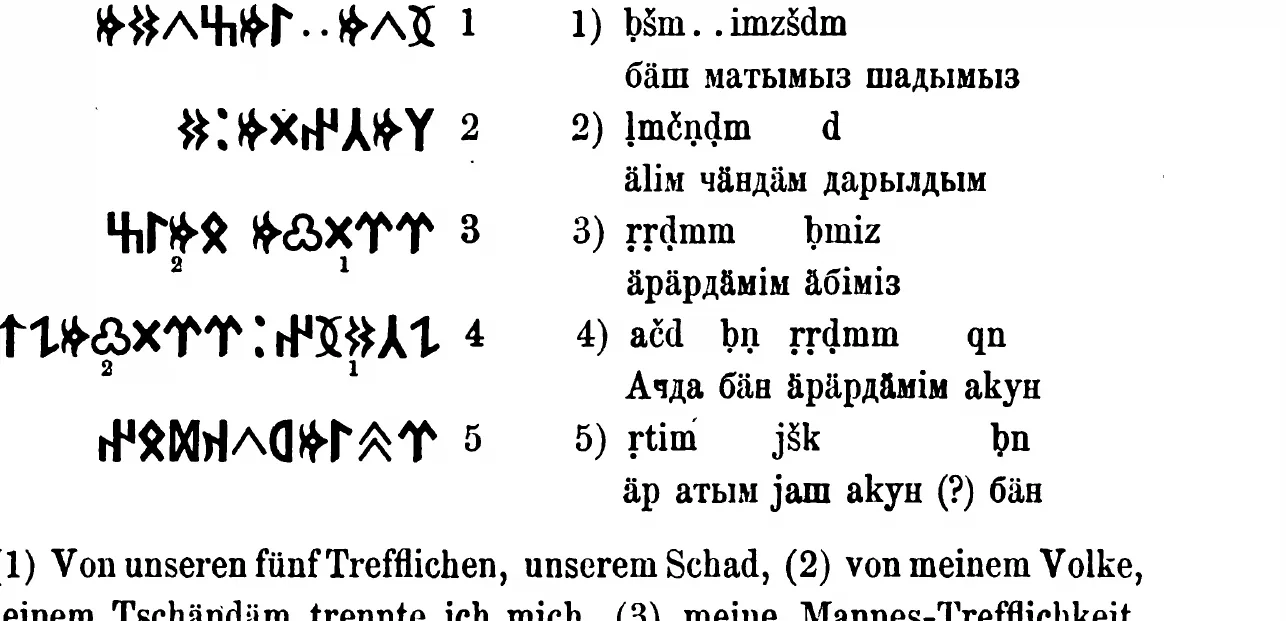
More than 150 monuments with runic text, the Yenisei inscriptions, are known from the upper Yenisei.[62] None is dated. The Xin Tangshu says, however, that the Kirghiz reckoned the years by the cycle of twelve animals.[63] The dating of the stones is argued. Most of them have been put in the seventh century. Another proposal puts them two or three centuries before the Orkhon inscriptions. The stele of Begre has been dated to the second half of the ninth century.[64] S. G. Klyashtorny reads the stone of Suji in northern Mongolia as naming a Kirghiz officer who took part in the fall of the Yaglakar khans, the Uyghur ruling house. He dates it after 840.[65] Another dating puts the stone at the end of the eighth century.[66]
The Xin Tangshu says that the Kirghiz worshipped only the spirits of water and grass and called their shamans gan.[3] The word is the Turkic kam, which the epitaphs do not use.[8] At a death the Kirghiz walked three times around the body, weeping. They burned the body, gathered the bones and built the grave after a year.[3] The Ḥudūd, too, says that they venerate fire and burn their dead.[51] Marvazī, in the twelfth century, adds that a man called faghīnūn was questioned each year on a fixed day. In a faint, he foretold the events of the year.[67] The Ḥudūd and Marvazī go back to one lost geography, that of Jayhānī, and count as one witness.[68] No source reports a success of Buddhist or Muslim missions.[8]
The stone of Suji has the Syriac word mar, lord or teacher. The teacher may have been a Nestorian. The nobility would favour such a teacher after its alliance with the Karluks and its war against the Manichaean Uyghurs, so the word would be a sign of the Church of the East. A different explanation takes him for a Manichaean and makes Manichaeism the state religion of the Kirghiz for five centuries.[69]
After 848 and the end
After 848 the sources thin out.[70] Three Kirghiz embassies came in the Xiantong period, between 860 and 873. After them, the Xin Tangshu says, the court historians did not preserve the embassies and investitures.[71] The Zizhi Tongjian adds an investiture under Yizong in 867.[70] The Xin Tangshu names no Kirghiz khan after Are. The later khans are not known by name.[3]
The year 924 belongs to the Khitan.[72] In that year Abaoji, the Khitan ruler, led an army into Mongolia, to the old royal grounds of the Göktürks and Uyghurs. He had the inscriptions of Bilge Khan replaced by his own.[73] He met no organized state there, only fragmented groups that could not resist him.[72] No known source reports a Khitan victory over the Kirghiz, and the Kirghiz do not appear in the accounts of the campaign.[74] The year 924 is therefore a convention for the end of the period, not the date of an event in Kirghiz history.[72]
The Kirghiz on the Yenisei did not vanish in 924.[75] The Liao annals record tribute missions from them in 952 and 977.[75] The Ḥudūd of 982 still names a Khirkhiz-khāqān.[51] Its notes on the Turkic peoples probably go back to the early tenth century. The editors do not agree on which of these notes rest on older material.[76]
Name and titles
- 黠戛斯ChineseXin Tangshu 217
- 堅昆ChineseXin Tangshu 217
- KhirkhizPersianḤudūd al-ʿĀlam
The Tang histories write the name 黠戛斯, Xiajiasi, and say that it is the old country of Jiankun, also called Jiegu.[3] It is argued in a debate of 1992 whether the name stands for the Kirghiz or for an older state with the name of the later Khakas. S. G. Klyashtorny, S. E. Yakhontov and V. Ja. Butanaev take Jiankun, Jiegu and Xiajiasi as spellings of one people, the Kirghiz. They take the name Khakas as a self-designation of 1917 and 1918. I. L. Kyzlasov takes Xiajiasi as the Chinese form of Khakas, the name of the medieval state, with Kirghiz as the name of its ruling stratum.[77]
The Xin Tangshu says that their lord was called Are, 阿熱, and that the ruling clan took its name from him.[3] There are five explanations of the word, in its Turkic form aco or ace. The first sees in it a Chinese writing of inal. The second takes it for a Samoyedic word asse, “father”. The third takes it for the tribal name Az. The fourth takes it for Turkic idi, “lord”, which Anvarbek Mokeev argues.[78] The fifth takes it for the ruler’s own name, since no Old Turkic word corresponds to it.[79] A Kazakh scholar adopted the second explanation. In his view, aco first meant the head of a large patriarchal family and became the title of a ruler when the state arose.[80] Mokeev’s reply to the derivations from inal and from the tribal name makes three points. The Xin Tangshu names tribal heads after their tribes and the Kirghiz lord by a different word. There is no sound link between inal and the tribe Az. And inal elsewhere names the head of a principality, not of a state.[81] On his account, aco was the highest rank of the Kirghiz before the title of khan came into use.[82]
The Chinese record gives the ruler several titles. They run from Bilga Ton Irkin, given by the Uyghurs, through khan, taken about 820, and the Yingwu Chengming Khan of 847, to the Khirkhiz-khāqān of the Ḥudūd.[83] Rashīd ad-Dīn, in the thirteenth century, says that the title of the Kirghiz princes was inal and that of high nobles idi.[84] Mokeev holds that the Kirghiz lost the title of khan when the great state ended in the first quarter of the tenth century. This sits ill with the khāqān of the Ḥudūd.[85]
Rulers
Relations with other states
Red is war, blue alliance, gold trade. Where several held at once, the line shows what prevailed; alliance and trade can run side by side. Each line rests on an article. Point at a state to see its weightiest relation, select it to see its events. The slider shows what stood in a given year, and Play runs through the years.
Karluk Yabgu State758 to 840
- Alliance758 to 840the Karluks and the Kirghiz leaned on each other
- Marriage820the khan's wife, a daughter of a Karluk yabgu
The Abbasid Caliphate758 to 840
- Trade758 to 840brocade from the Arabs, twenty pieces every three years
The Tibetan Empire758 to 840
- Alliance758 to 840the Tibetans and the Kirghiz leaned on each other
Uyghur Khaganate820 to 840
- War820 to 840The fall of Ordu-Balık, 840twenty years of war, ended by the sack of the Uyghur capital
Tang842 to 867
- Embassy842 to 867four envoys in 842 to 844, an investiture in 847
References
- ^ a b c Drompp 2005, p. 36
- ^ a b Tekin 2003, p. 93
- ^ a b c d e f g h i j k l m n o p q r s t u v w x y z aa ab ac ad ae af ag ah ai aj Xin Tangshu (New Book of Tang), juan 217
- ^ Drompp 2005, p. 38,197,200
- ^ Xin Tangshu (New Book of Tang), juan 217; Jiu Tangshu (Old Book of Tang), juan 195
- ^ Drompp 2005, p. 125,182
- ^ a b Ḥudūd al-ʿĀlam
- ^ a b c d e Barthold 1927, p. 22
- ^ Zhou Shu (Book of Zhou), juan 50
- ^ Kül Tegin inscription; Golden 1992, p. 180
- ^ Golden 1992, p. 180
- ^ Khazanov 1994, p. 257
- ^ a b Jiu Tangshu (Old Book of Tang), juan 195
- ^ a b Xin Tangshu (New Book of Tang), juan 217; Drompp 2005, p. 36
- ^ a b Drompp 2005, p. 37
- ^ a b c d e Jiu Tangshu (Old Book of Tang), juan 195; Xin Tangshu (New Book of Tang), juan 217
- ^ a b Drompp 2005, p. 38
- ^ Drompp 2005, p. 103,131,138,145
- ^ Drompp 2005, p. 103,276
- ^ Drompp 2005, p. 131
- ^ Drompp 2005, p. 138,145–146
- ^ Drompp 2005, p. 130,131
- ^ Drompp 2005, p. 292; Lung 2010, p. 292
- ^ Drompp 2005, p. 139–141
- ^ Xin Tangshu (New Book of Tang), juan 217; Drompp 2005, p. 149,151
- ^ Drompp 2005, p. 158
- ^ Drompp 2005, p. 126
- ^ Drompp 2005, p. 290–291
- ^ Drompp 2005, p. 183,190
- ^ Ögel 1984, p. 209–210
- ^ Kwanten 1979, p. 53
- ^ Drompp 2005, p. 103,277
- ^ Drompp 2005, p. 104,132
- ^ Drompp 2005, p. 147
- ^ Drompp 2005, p. 197,200
- ^ Drompp 2005, p. 140,141
- ^ Golden 1992, p. 181
- ^ Mokeev 2019, p. 34,87; Kalkan 2005, p. 34,87
- ^ Minorsky 1970, p. 282,78; Minorsky 1942, p. 282,78
- ^ Kafesoğlu 1997, p. 138–139, 107; Rásonyi 1993, p. 138–139, 107
- ^ Savinov 1978, p. 212,110–112; Mitko 2025, p. 212,110–112
- ^ Ögel 1984, p. 210
- ^ Ögel 1984, p. 210–217, 222
- ^ Kızlasov 1990, p. 104
- ^ Kızlasov 1990, p. 124
- ^ a b Ögel 2000, p. 19
- ^ a b Ḥudūd al-ʿĀlam; Minorsky 1970, p. 97
- ^ a b Golden 1992, p. 182
- ^ a b Ögel 1984, p. 208
- ^ Ögel 2000, p. 147
- ^ a b c Ḥudūd al-ʿĀlam; Minorsky 1970, p. 96
- ^ Chavannes 1913, p. 201
- ^ Laufer 1919, p. 488
- ^ 樂史 10th c., p. 489; Laufer 1919, p. 489
- ^ Golden 1992, p. 178
- ^ Drompp 2005, p. 133
- ^ Kızlasov 1990, p. 116,129
- ^ Kızlasov 1990, p. 104–105,109–116
- ^ Kızlasov 1990, p. 124–125
- ^ Kızlasov 1990, p. 127–128
- ^ Kızlasov 1990, p. 131–133
- ^ Butanaev 2015, p. 5
- ^ Barthold 1927, p. 22; Xin Tangshu (New Book of Tang), juan 217
- ^ Barthold 1927, p. 22,200; Tishin 2019, p. 22,200
- ^ Butanaev 2015, p. 9–10
- ^ Barthold 1927, p. 15
- ^ Minorsky 1942, p. 30,104
- ^ Minorsky 1955, p. 262
- ^ Butanaev 2015, p. 10
- ^ a b Drompp 2005, p. 155
- ^ Xin Tangshu (New Book of Tang), juan 217; Golden 1992, p. 181
- ^ a b c d Drompp 2005, p. 203
- ^ Golden 1992, p. 183
- ^ Barthold 1927, p. 24,183; Golden 1992, p. 24,183
- ^ a b Golden 1992, p. 186
- ^ Golden 1992, p. 182,262–263; Minorsky 1955, p. 182,262–263
- ^ Klyashtorny 1992, p. 59–60,61,63–65; Yakhontov 1992, p. 59–60,61,63–65; Butanaev 1992, p. 59–60,61,63–65
- ^ a b Mokeev 2019, p. 31–34
- ^ Golden 1992, p. 177–178,37; Drompp 2005, p. 177–178,37
- ^ Mokeev 2019, p. 31
- ^ Mokeev 2019, p. 32
- ^ Mokeev 2019, p. 28–29
- ^ Xin Tangshu (New Book of Tang), juan 217; Drompp 2005, p. 36,154; Ḥudūd al-ʿĀlam
- ^ Mokeev 2019, p. 33
- ^ Mokeev 2019, p. 30
Sources
- Xin Tangshu (New Book of Tang), juan 217 (after Jiu Tangshu)
- Jiu Tangshu (Old Book of Tang), juan 195
- Ḥudūd al-ʿĀlam
- Zhou Shu (Book of Zhou), juan 50
- Kül Tegin inscription
Literature
- Michael R. Drompp, Tang China and the Collapse of the Uighur Empire: A Documentary History (2005)
- Peter B. Golden, An Introduction to the History of the Turkic Peoples (1992)
- V. V. Barthold, Kirgizy: istoričeskij očerk [Киргизы: исторический очерк] (1927)
- V. Minorsky, Ḥudūd al-ʿĀlam, "The Regions of the World": A Persian Geography 372 A.H. – 982 A.D., translated and explained, with the preface by V. V. Barthold, 2nd ed. (1970)
- V. Minorsky, Addenda to the Ḥudūd al-ʿĀlam (1955)
- V. Minorsky, Sharaf al-Zamān Ṭāhir Marvazī on China, the Turks and India (1942)
- D. G. Savinov, Etnokul'turnye svjazi enisejskich kyrgyzov i kimakov v IX–X vv. [Этнокультурные связи енисейских кыргызов и кимаков в IX–X вв.] (1978)
- Oleg A. Mitko, «This Long Ninth Century»: Yenisei Kyrgyz in the Usinsk Basin (2025)
- V. Ja. Butanaev, Literaturnoe nasledstvo enisejskich kyrgyzov vremën drevnetjurkskich kaganatov [Литературное наследство енисейских кыргызов времён древнетюркских каганатов] (2015)
- V. V. Tishin, K datirovke enisejskoj runičeskoj nadpisi Begre (E 11) [К датировке енисейской рунической надписи Бегре (Е 11)] (2019)
- Anvarbek Mokeev, Yenisey ve Altay Kırgızlarında siyasi unvan olarak aco ve idi terimlerinin menşesi ve anlamı (2019)
- Mustafa Kalkan, Kırgız Boylarının Yenisey'den Çıkarılmaları ve Coğrafî Dağılımları (2005)
- S. G. Klyashtorny, O stat'e I. L. Kyzlasova [О статье И. Л. Кызласова «О самоназвании хакасов»] (1992)
- S. E. Yakhontov, Slovo chakas v istoričeskoj literature [Слово хакас в исторической литературе] (1992)
- V. Ja. Butanaev, Vopros o samonazvanii chakasov [Вопрос о самоназвании хакасов] (1992)
- Rachel Lung, Sogdian Translators in Tang China: An Issue of Loyalty (2010)
- Berthold Laufer, Sino-Iranica. Chinese Contributions to the History of Civilization in Ancient Iran (1919)
- Édouard Chavannes, Les documents chinois découverts par Aurel Stein dans les sables du Turkestan oriental (1913)
- Yue Shi 樂史, 太平寰宇記 Tàipíng Huányǔ Jì (10th c.)
- Talât Tekin; Mehmet Ölmez, Türk Dilleri: Giriş (2003)
- Anatoly M. Khazanov, Nomads and the Outside World (1994)
- Luc Kwanten, Imperial Nomads. A History of Central Asia, 500–1500 (1979)
- Bahaeddin Ögel, İslâmiyetten Önce Türk Kültür Tarihi. Orta Asya Kaynak ve Buluntularına Göre (1984)
- Bahaeddin Ögel, Türk Kültür Tarihine Giriş II: Türklerde ziraat kültürü (2000)
- Bahaeddin Ögel, Türk Kültür Tarihine Giriş VI: Türklerde tuğ ve bayrak (2000)
- İbrahim Kafesoğlu, Türk Millî Kültürü (1997)
- László Rásonyi, Tarihte Türklük (1993)
- Leonid R. Kızlasov; İgor L. Kızlasov, Sayan-Altay Türklerinin Yeni Runik Yazısı (1990)
What links here19
- Conflicts
- Uyghur–Kirghiz War
- Battles & Events
- Kirghiz Embassies to the Tang (842–848)
- Places
- Minusinsk Basin
- Peoples
- Az · Eurasian Nomads · History of the Turkic peoples · The Great Empires of the Steppe · Yenisei Kirghiz
- Lineages
- Are
- Institutions and Titles
- Raw Materials and Trade among the Turkic Peoples · Women among the Turkic Peoples
- Religions
- Shamanism
Cite this article
Yavuz, Emre-E. “Yenisei Kirghiz Khaganate.” Turkic Atlas, revised 8 November 2026. https://turkicatlas.org/polities/kirghiz-khaganate/
Last revised: 8 November 2026

