
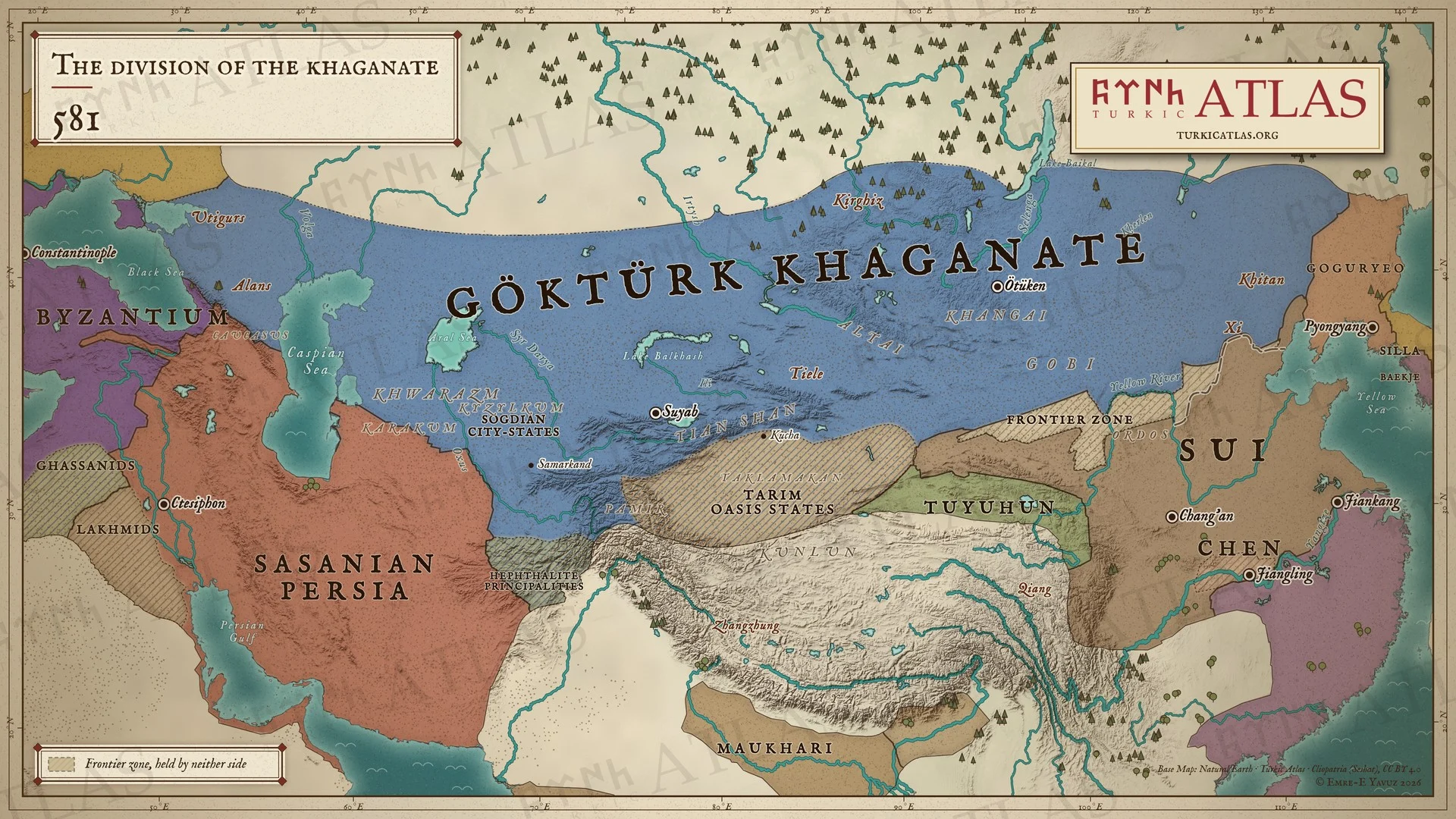
When Taspar Khan died in 581, he left the largest state the steppe had produced and a wish about who should rule it. The nobility of the Göktürks gathered at Ötüken in assembly and refused the wish.[1] What followed over the next three years was an election, an abdication, a rebellion and an intervention from the west. It turned into the civil war of 584 to 603, which divided the khaganate for good. The crisis is known from the Chinese histories, above all the Göktürk chapter of the Sui Shu. The Sui court had every reason to compile that chapter with care, since it was the Sui who profited.
Rule of succession
The Göktürk succession ran laterally. On the death of a khan the throne went to his next younger brother. Only when the brothers were exhausted did it go to the eldest son of the eldest. In this way the house as a whole, and not one line of it, held the throne. Taken as a rule, it had been followed by Bumin’s three sons in turn. Its purpose was most likely to prevent the throne from settling in a single line. The sources show the pattern. Whether they show a rule is an open question. A khan had no right to name his successor. In a disputed case the nobility assembled and chose. Turkic Atlas sets out what is known of the customary law under Töre and what is known of the assembly under the toy.
Taspar’s wish was that the throne go to Töremen, the son of his brother Mukan, and not to his own son Amrak.[1] All Taspar’s brothers were dead. By the lateral rule the throne should therefore have gone to the eldest man of the next generation. By one reckoning, the eldest of Bumin’s grandsons was Ishbara, the son of Bumin’s eldest son Issik. Taspar had made him a lesser khan in the east nine years before.
Assembly at Ötüken
The assembly at Ötüken was tense. Ishbara objected to Taspar’s choice on two grounds. A khan had no right to designate a successor, and Töremen’s mother had not been a Göktürk and had, he claimed, been of low rank.[1] Local rulers of the khaganate, Göktürks or not, may have had a voice in the choice. Most of the nobility were Göktürks or had gone over to the Göktürks. A state founded to make the Göktürks independent was expected to have a Göktürk khan. The objection to Töremen’s mother turned on that. Ishbara threatened the assembly with revolt if Töremen were chosen. He proposed Amrak instead, as the eldest prince and Taspar’s own son. The delegates accepted, and Amrak was elected khan.[1]
Amrak reigned less than a year. Töremen rejected the election as illegitimate and raised his following for a revolt. Amrak, cautious, chose diplomacy. He abdicated and proposed Ishbara as khan in his place, believing that he had averted the rising.[1] The rising was not averted. The nobility’s discontent turned into open, armed rebellion against Ishbara. Töremen, known from now on as Apa Khan, declared war on him.
Intervention of the west
Töremen found support in the west. Tardush, the son of Istemi and his successor as yabgu, had ruled the western wing for six years from Suyab rather than from the Altai. He may have come to want the whole khaganate after receiving the Byzantine envoy Valentinos in 576. By taking Apa’s side he intervened east of the Altai in the affairs of the khan, which no yabgu had done. He thereby broke an unwritten rule of the house. The rebellion gave him the opportunity.
Consequences
The best explanation is that the four princes, Apa, Ishbara, Amrak and Tardush, were responsible for what followed. No foreign power had put the state at risk before they did. The civil war proper is dated from 584. After the failed joint invasion of Sui China in 583, Sui agents set the commanders against each other. Ishbara drove Apa west into Tardush’s arms. He had Apa’s mother, his own aunt, killed at Ötüken. In September 585 the western army marched on Ötüken, while Ishbara fled to China. Ishbara died in 587. His brother Bagha took Apa alive in the same year. The khaganate was now divided in two.[1]
The crisis had one further participant, in the wings. The Zhou general Yang Jian took the Chinese throne in 581, the year of Taspar’s death. He founded the Sui. His refusal to defer to the khan, his agents at both Göktürk courts and his princess at Ishbara’s side turned a quarrel of cousins into the end of the state. The Kül Tegin inscription, two centuries later, describes the process in its own terms. The younger brothers were not like the elders, the sons not like the fathers, and the Chinese set brother against brother.[2]
-
581 Taspar's succession
Taspar dies with the khaganate undivided, from the Black Sea to the Khingan. The assembly at Ötüken passes over his choice, Töremen, and after Amrak stands down it raises Ishbara, the son of Issik. Töremen takes the title Apa Khan, and Tardush, the son of Istemi, holds the west as yabgu.
-
583 The campaign against the Sui
Ishbara invades China with Apa, Tardush and Bagha beside him. A rising of the Tiele draws Tardush off, and a Sui surprise attack near Baidao breaks the Göktürk army. Ishbara then raids Apa's camp and kills his mother, and Apa flees west to Tardush.
-
584 Three powers
Apa, with Tardush behind him, holds a coalition from the Kyrgyz to Kucha and Hami. Ishbara keeps the east around Ötüken, with Amrak on the Tola as second khan. Tardush's western dominions reach from the Black Sea to Suyab.
-
585 Ishbara turns to the Sui
Pressed by Tardush, Ishbara declares himself a vassal of the Sui. In September the western army marches on Ötüken, and Apa's power reaches it; Ishbara has withdrawn south to Baidao under Sui protection. Later in the year he strikes back at Apa.
-
587 Apa taken alive
Ishbara dies, and by his will his brother Bagha succeeds him. Bagha marches west under drums and banners sent by the Sui emperor; Apa's men take them for a Sui army and come over, and Apa is taken alive. In the west Apa's people raise Niri as their khan.
-
588 Tulan, and the war with Persia
Bagha falls to a stray arrow on a second campaign in the west, and Ishbara's son Yongyulü succeeds him as Tulan Khan. In the same year a Göktürk army crosses the Oxus, takes Balkh and Herat, and is destroyed by Bahram Chobin. The division of the khaganate is complete.
-
c. 603 Two khaganates
Tulan is killed by his own followers in 599. About 603, facing a revolt of the Tiele and other tribes, Tardush flees to the Tuyuhun and disappears. Yami, a Sui client since 597, marches into Ötüken with Göktürk and Chinese troops, and the realm stays divided into an eastern and a western khaganate.
- Place named in a source (position as commonly identified)
- Position disputed or approximate
- Zone drawn after the editor's maps of the civil war and the Sui Shu
- Area as the modern literature gives it
- Frontier zone between the steppe and China, held by neither side (hatched)
- Movement named in a source (route drawn)
References
Sources
- Sui Shu (Book of Sui), juan 84
- Zhou Shu (Book of Zhou), juan 50
- Kül Tegin inscription
Literature
- Emre-E. Yavuz, The Gokturk Empire: 2nd Edition (2025)
What links here15
- Persons
- Amrak · Ishbara Khan · Issik Khan · Mukan Khan · Rudan Khan · Tardush · Taspar Khan
- Battles & Events
- Taspar's Appointment of the Lesser Khans (572)
- Places
- Ötüken
- Lineages
- Ashina
Cite this article
Yavuz, Emre-E. “Göktürk Succession Crisis (581).” Turkic Atlas, revised 8 November 2026. https://turkicatlas.org/events/succession-crisis-581/
Last revised: 8 November 2026

