
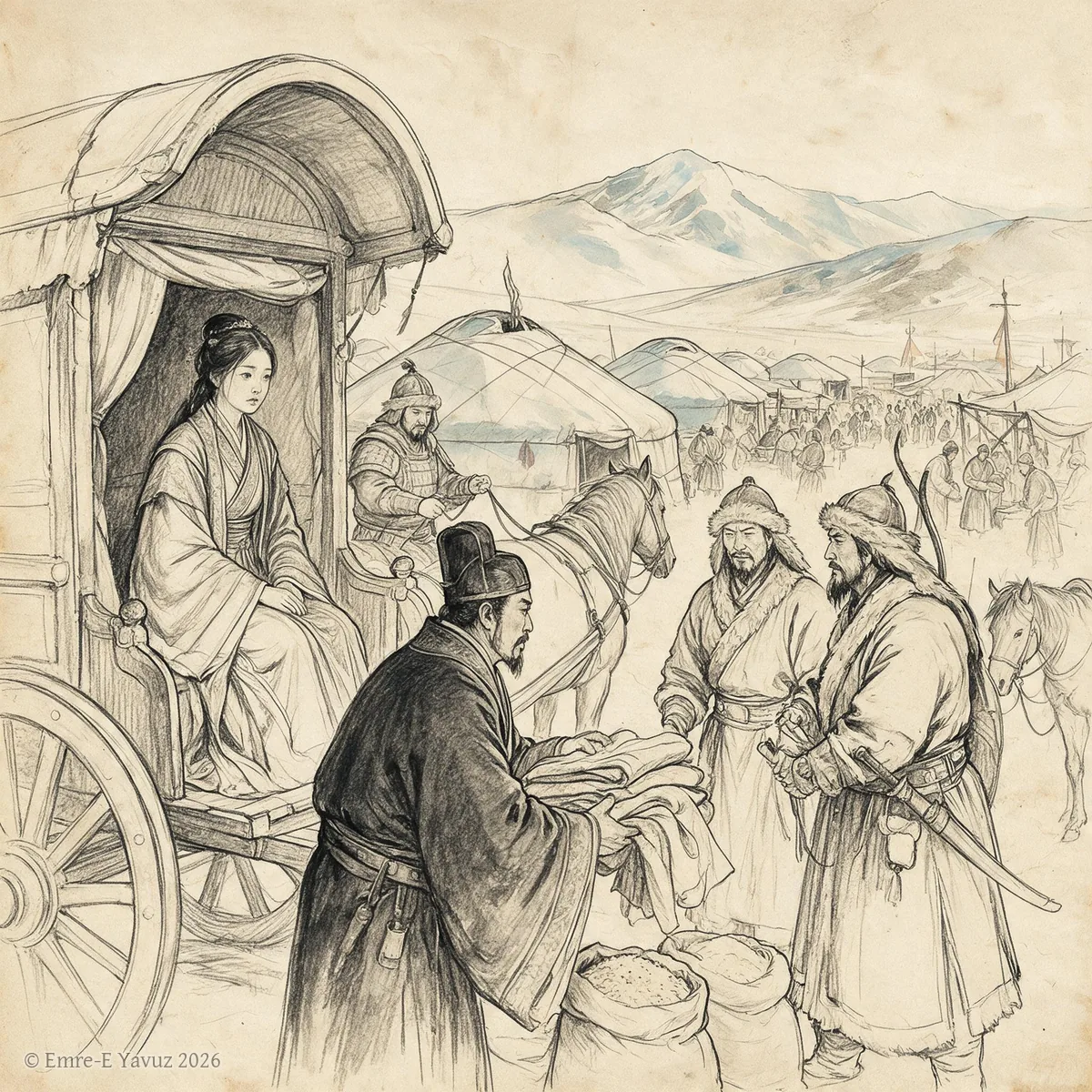
Heqin was the arrangement by which the Han bought quiet on the northern frontier for seventy years. The Shiji names its four parts together. A woman of the imperial house was sent to be the chanyu’s consort. The Han delivered fixed yearly quantities of floss, silk, wine, rice and other food. The frontier markets were kept open. An oath made the emperor and the chanyu elder and younger brother.[1][2] The arrangement began after the siege of Baideng in 200 BC and ended at the failed ambush of Mayi in 133 BC.[1]
The terms
Liu Jing made the first agreement immediately after Baideng. A second and fuller one followed a few years later, when raiding continued. It provided a princess of the imperial house as the chanyu’s consort, yearly deliveries each of a fixed quantity, and the oath of brotherhood. The Shiji reports the effect in four characters: Bagatur then let up a little.[1] Liu Jing had advised sending the emperor’s eldest daughter. The empress Lü refused to part with her, and a girl of the imperial house was sent in her place as the eldest princess.[3] The agreement was renewed at every change of ruler on either side and after every serious breach. The empress Lü renewed it after an insolent letter that she wanted to answer with war. In the Han Shu version of the letter, the chanyu calls himself a lonely ruler who grew up in the marshes and the pastures of cattle and horses and wishes to visit China. The empress, he writes, is a widow living alone, neither ruler has any pleasure, and he would exchange what he has for what he lacks.[4] Some scholars take the offer of marriage for an offer to exchange gifts and bring the two courts closer, as a marriage did.[5] The emperor Wen renewed it at his accession. It was renewed again after Laoshang came to the throne, again after the raid of 166 BC, and again under Junchen.[1]
The two interpretations
The clearest statement of the Han interpretation is in the letter of 162 BC.[1] The former emperor, the letter says, laid down a division. North of the wall, the states that draw the bow receive their orders from the chanyu. Within the wall, the house of cap and sash, the emperor rules. Let each keep to his own, and the people of both will be as the children of one family.[1] That is a settlement between two sovereigns, and the letter says so.
The Xiongnu interpretation is in the letters of the chanyus, and it is not the same. The letter of 176 BC opens with the chanyu set up by Heaven. It closes with all the peoples who draw the bow united into one family. The Xiongnu court under Zhonghang Yue then deliberately enlarged its own tablet and seal so that both would be bigger than the Han ones. It also adopted the style ‘born of Heaven and Earth and ordained by the sun and moon’.[1] On the Xiongnu view, the deliveries are what a lesser court sends to a greater one.
A third view belongs to the Han archive rather than to either court. The Han called the goods gifts and treated the marriage as a favour. The frontier officials who kept the accounts recorded quantities that rose at every renewal. Some scholars note that for the Xiongnu side the Shiji uses a word that means to present or to offer tribute. For the Han side it uses words for sending and presenting, and it avoids the word for bestowing, which later accounts use for a gift from a superior.[6]
Modern accounts add three interpretations of the settlement. The first holds that the Han paid regular tribute after humiliating negotiations. On this view the subsidy of silks, wine, grain and food can be called tribute.[7][8] The second holds that the Xiongnu raided when they could not get grain and cloth by peaceful means, and gave up raiding when the Han supplied them through marriage, yearly deliveries and markets.[9] The third holds that the goods exchanged at the founding were for the most part tokens of friendship, and that the quantity given by the Han far exceeded what the Xiongnu gave.[10]
The argument against it, from inside the Xiongnu court
The one contemporary criticism of heqin comes from neither side’s diplomats. Zhonghang Yue was a eunuch of Yan. He was sent north with a Han princess about 174 BC and went over to the chanyu on arrival. He told his new master that the Xiongnu could not match the population of a single Han commandery.[11][12] Their whole strength, he said, lay in eating and dressing differently and needing nothing from the Han. Chinese goods amounted to no more than two parts in ten of what the Xiongnu used, but a taste for them would deliver the Xiongnu wholly into Han hands.[1] He had the chanyu ride through thorn scrub in Chinese silks until they tore, to show that they were not the equal of felt.[1] He also told Han envoys plainly what the arrangement looked like from where he stood. Let the Han send no more speeches, he said, and see only that the silk, floss and grain sent to the Xiongnu are of full measure and good quality. If they are not, then when the autumn harvest ripens the Xiongnu will ride through the standing crops.[1]
The end
The Han ended the settlement. In 133 BC a merchant of Mayi offered to sell the town to the chanyu, and three hundred thousand Han troops lay in ambush around it.[1] The chanyu discovered the trap a hundred li short of the town and withdrew.[1] After that, the Shiji says, the Xiongnu broke off the heqin and attacked the passes on the roads, and the raids could not be counted. The markets stayed open on both sides even then. The Xiongnu still wanted Han goods, and the Han kept the markets open in order to hold them by that.[1][13] The oath of brotherhood was still remembered centuries later. In 304 Liu Yuan took the style of Han and claimed, under the old treaties, that the Xiongnu house and the Han house had been like elder and younger brother, so that when the elder died the younger succeeded.[14]
References
- ^ a b c d e f g h i j k l m Shiji, juan 110
- ^ Jagchid 1989, p. 26,116–117
- ^ Jagchid 1989, p. 57–58,142
- ^ Han Shu, juan 94
- ^ Jagchid 1989, p. 26–27
- ^ Jagchid 1989, p. 117–118
- ^ Khazanov 1994, p. 224,254
- ^ Lattimore 1951, p. 467
- ^ Jagchid 1989, p. 24,40
- ^ Jagchid 1989, p. 27,41
- ^ Jagchid 1989, p. 25
- ^ Lattimore 1951, p. 487–488
- ^ Jagchid 1989, p. 28–29
- ^ Lattimore 1951, p. 526–527
Sources
Literature
- Peter B. Golden, An Introduction to the History of the Turkic Peoples (1992)
- Emre-E. Yavuz, The Gokturk Empire: 2nd Edition (2025)
- Nicola Di Cosmo, Ethnogenesis, Coevolution and Political Morphology of the Earliest Steppe Empire: The Xiongnu Question Revisited (2011)
- Sechin Jagchid; Van Jay Symons, Peace, War, and Trade Along the Great Wall. Nomadic-Chinese Interaction through Two Millennia (1989)
- Anatoly M. Khazanov, Nomads and the Outside World (1994)
- Owen Lattimore, Inner Asian Frontiers of China (1951)
What links here26
- Persons
- Bagatur (Modu Chanyu) · Emperor Gaozu of Han · Emperor Wu of Han · Junchen Chanyu · Laoshang Chanyu · Princess Qianjin · Tanshihuai · Wuwei Chanyu · Yizhixie Chanyu · Zhonghang Yue
- States
- Han dynasty · Northern Zhou · Xiongnu Han
- Conflicts
- The Xiongnu–Han Wars
- Battles & Events
- Bilge Khan's Tent Banquet (725) · Göktürk Aid to Li Yuan (617) · Mayi ambush · Siege of Baideng · The Han–Xiongnu heqin treaties · The Marriage of Princess Qianjin (580) · The Uyghur Demand for the Prince's Dance (762)
- Peoples
- Eurasian Nomads
- Institutions and Titles
- Diplomacy of the Steppe Empires · Han Bestowals on the Chanyu · Women among the Turkic Peoples
- Controversies
- The Göktürks and the Xiongnu
Cite this article
Yavuz, Emre-E. “Heqin.” Turkic Atlas, revised 8 November 2026. https://turkicatlas.org/institutions/heqin/
Last revised: 8 November 2026

