
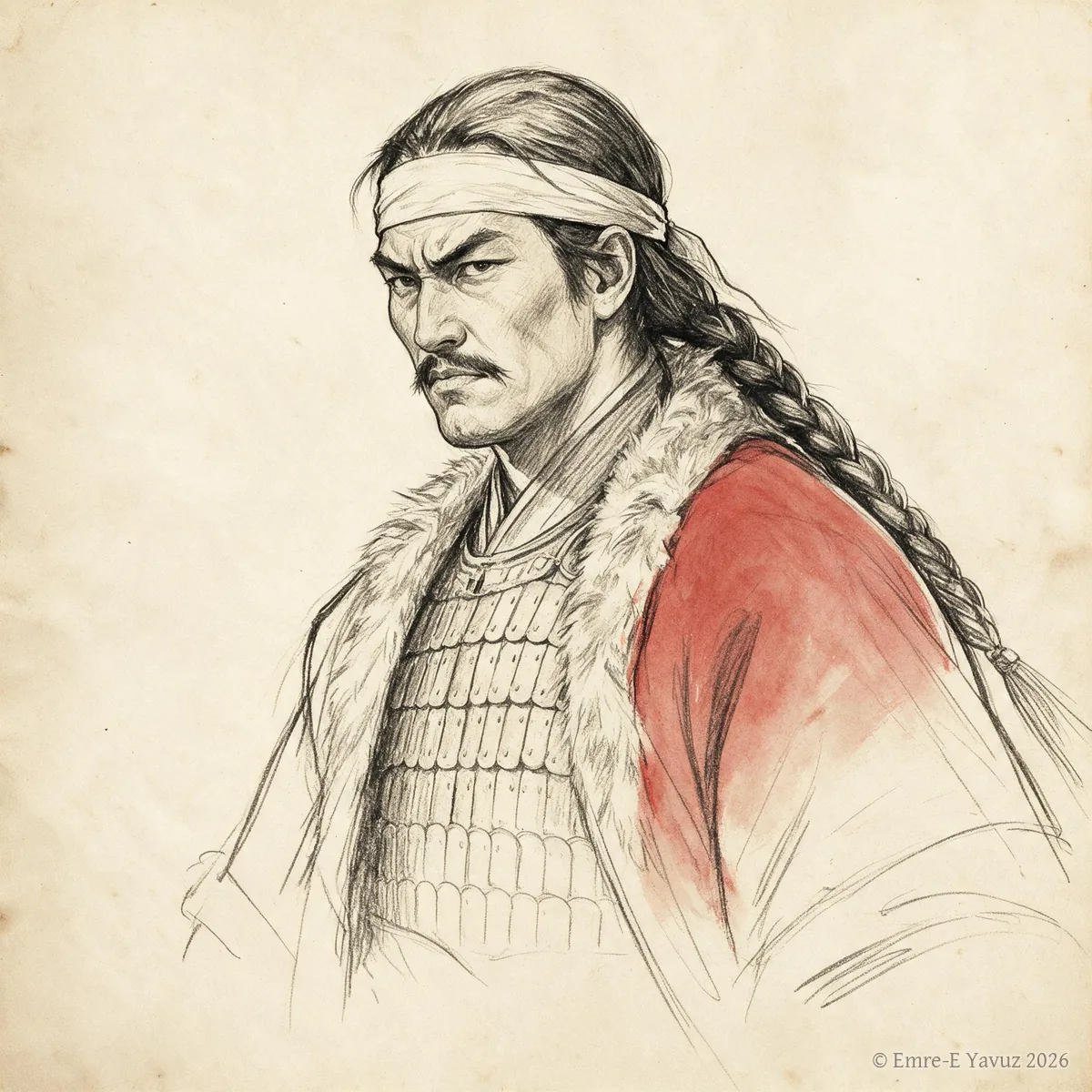
Issik Khan was the eldest son of Bumin and the second khan of the Göktürks. He succeeded his father in 552, within months of the founding of the khaganate. He reigned for about a year.[1] That year was enough to finish what Bumin had begun. Under Issik the last army the Rouran could raise was broken on the Ordos. When he died, the dynasty that had ruled the steppe for a century and a half no longer existed as a power.
Name
- KaraOld Turkic
- 乙息記可汗ChineseZhou Shu 50
- 科羅ChineseZhou Shu 50
- Issik KhaganEnglish
The Chinese histories give him under a title, as they give his father. The title is what they record: 乙息記可汗, conventionally read Issik Khan.[1] The Zhou Shu makes him Bumin’s son, 子科羅立. The Sui Shu makes him Bumin’s younger brother, 弟逸可汗立. The two statements have not been reconciled.[2] They may go back to two documents, with only one khan standing between Bumin and Mukan. The sources call this khan Keluo, Yixiji, Ayi and Yi.[3] The quarrel between son and brother would then mirror a change in the order of succession, from father-to-son succession to brother-to-brother succession.[4] His personal name is transcribed 科羅, Keluo. It is reconstructed as Turkic Kara, “black” or “dark”, a word that in an abstract sense stands for land. Issik itself is understood as a title, ruler of the state, as distinct from his father’s Illig, ruler of the land. This interpretation rests on the Chinese transcription alone. No Turkic-language source names him. The Kül Tegin inscription passes from the founders to “the younger brothers and the sons” who became khan after them, and it names none of them.[5] Turkic Atlas sets out the forms under the title.
His age is not recorded. Bumin was about forty-five in 552, and men of the steppe became fathers at sixteen to twenty. On that ground Issik can be estimated at twenty to twenty-five at his accession. That estimate is an inference from other inferences.
Accession and the Qi attack (552)
Bumin died in 552, and the succession passed to Issik without recorded dispute. His uncle Istemi, who held the west, did not contest it.[1] The two of them most likely averted a crisis of the state at the founder’s death. The lapse of the Tiele from Ashina allegiance in these years is taken as the price of it.
The first test came from the south. The Rouran nobility who had fled to the Northern Qi after Anagui’s death did not mean to stay refugees. In the second half of 552, by the chronology of the Zizhi tongjian, the Qi attacked Göktürk territory on their behalf.[6] The date can be narrowed to late summer or autumn, because no one campaigned on the Mongolian frontier in winter. The attack achieved nothing that the sources record.
The Qi were the enemy for a reason. They had taken in the Yujiulü, and the emperor Wenxuan answered the new power in the steppe with walls. In the tenth month of 552, the year Bumin broke the Rouran, he came to the Huanglu pass. He had a long wall built northward to the Shegan garrison, over four hundred li, with thirty-six garrisons on it.[7] In 554 he rode the northern frontier himself to choose the line for another wall. In 555 he levied a million eight hundred thousand men and built it from Xiakou north of Youzhou to Hengzhou, over nine hundred li.[7] Counted together, front and rear, the Qi walls ran three thousand li from west to east, with a garrison every ten li.[7] The Western Wei, the other Chinese state, did the opposite. At the request of Issik’s brother Mukan, the Wei seized the Rouran who reached their territory and handed them to his envoys. Some three thousand were killed outside the Qingmen gate of Chang’an.[1]
Ordos campaign (553)
In February 553 the Qi emperor forced Dengzhu to march against the Göktürks. Dengzhu was the leader of the exiles. In the Zhou Shu he is Anagui’s paternal uncle, and in another account his son. The emperor wanted to keep Qi influence in the steppe alive after the dynasty it had sheltered was gone. Dengzhu set out late in the spring. Göktürk resistance pushed him west, and he was caught. Issik overtook his army and destroyed it on the Ordos. The Ordos is the steppe within the great bend of the Yellow River, from which every Chinese wall could be turned. The Rouran, themselves a steppe people, were the first in centuries to try the passage from China into the steppe rather than the reverse. They failed at it, even with Qi supplies and Qi backing behind them. The failure was the Qi’s as much as theirs.
The remnant turned on its hosts. Anluochen, the last of Anagui’s sons, was set up as ruler under Qi patronage in the twelfth month of 553. In time he understood that he was being used.[7] In the third month of 554 he rose against the Qi themselves and was beaten. In the fourth month his wife and children were captured, with more than thirty thousand of his people.[7] The last Göktürk victory over the Rouran is dated to 20 January 554. It is not certain whether Issik lived to see it. He died in 553, of an illness according to the Sui Shu. The Sui Shu adds that he passed over his son Ishbara for his brother. Nothing more is recorded of the death.[2]
Khaganate under Issik
The year was not only a war. In April 553 the Göktürks sent the Western Wei some fifty thousand horses. They received several hundred thousand bolts of silk in return. The Rouran had never commanded such a volume of exchange. It shows the khaganate as an economic weight in the first year of its existence. The alliance with the Wei that Bumin had made was kept. The Wei’s surrender of the Rouran refugees was most likely its price.
Issik’s son was Ishbara. He would take the throne in 581 over the objections that made the succession war. In that quarrel Ishbara’s claim was that of the eldest line of Bumin’s house.[2]
Assessment
The sources give Issik one year and two facts: he beat the Rouran and he died. He can be credited with securing the frontier with the two Chinese states and preventing the return of the former overlords to the steppe. That credit is fair. His brother Mukan, who followed him, took over a state whose southern flank was closed. He could turn north and east.
References
- ^ a b c d Zhou Shu (Book of Zhou), juan 50
- ^ a b c Sui Shu (Book of Sui), juan 84
- ^ Ecsedy 1968, p. 155,156,157
- ^ Ecsedy 1968, p. 157
- ^ Kül Tegin inscription
- ^ Zizhi tongjian (Comprehensive Mirror in Aid of Governance), juan 164
- ^ a b c d e Bei Qi Shu (Book of Northern Qi), juan 4
Sources
- Zhou Shu (Book of Zhou), juan 50
- Sui Shu (Book of Sui), juan 84
- Bei Qi Shu (Book of Northern Qi), juan 4 (after Bei Shi)
- Zizhi tongjian (Comprehensive Mirror in Aid of Governance), juan 164 (after Wei Shu, Zhou Shu, Sui Shu and Bei Shi)
- Kül Tegin inscription
Literature
- Emre-E. Yavuz, The Gokturk Empire: 2nd Edition (2025)
- Ildikó Ecsedy, Trade-and-War Relations between the Turks and China in the Second Half of the Sixth Century (1968)
What links here28
- Persons
- Anagui · Bagha Khan · Bumin Khan · Dengzhu · Ishbara Khan · Istemi · Mukan Khan · Rudan Khan
- Battles & Events
- Battle of Mount Mulai (553) · Göktürk Succession Crisis (581) · Mukan's Destruction of Dengshuzi (553–555) · Proclamation of Bumin Khan (552) · Taspar's Appointment of the Lesser Khans (572) · The Göktürk–Wei alliance · The Qingmen Executions (555)
- Places
- Mount Mulai · Ordos · Woye
- Lineages
- Ashina
- Institutions and Titles
- Khan (Khagan) · Levirate · Töre
Cite this article
Yavuz, Emre-E. “Issik Khan.” Turkic Atlas, revised 8 November 2026. https://turkicatlas.org/persons/issik-khan/
Last revised: 8 November 2026

