
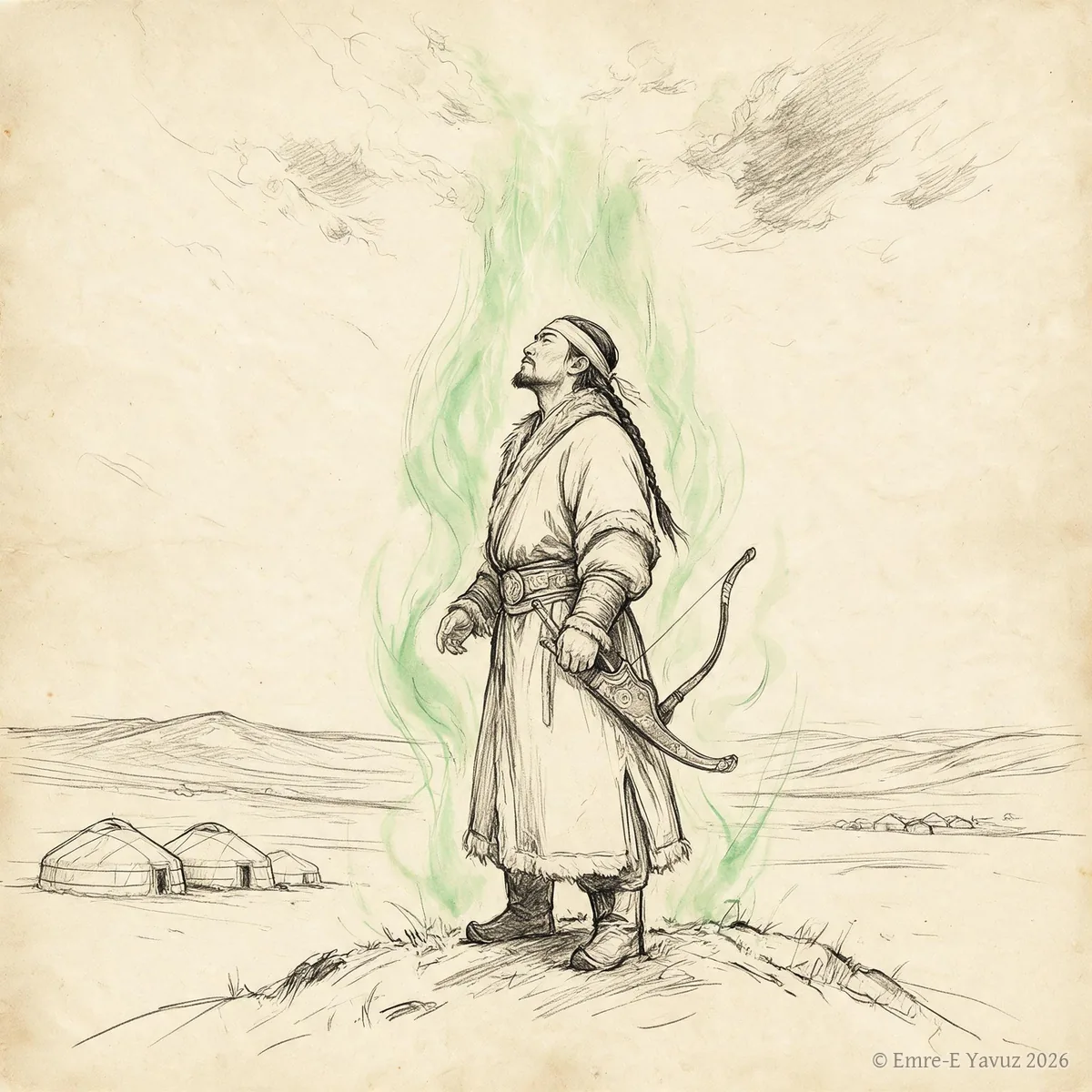
Descent made a man eligible to rule the Göktürks. The toy confirmed him. Neither of these made him a khan in the eyes of the people he ruled, and the inscriptions are exact about what did. A khan ruled because he had Kut. When he lost it, he was no longer a khan, whatever he was still called.
The word is usually translated “fortune”, “blessing” or “heavenly favour”. Each of those catches part of it. Kut was the thing Tengri gave to the man he chose. It was the charge to rule, the luck that went with it, and the force in the man himself that made others follow him. It was not an office, and one could not confer it. It was recognised, not awarded.
Earliest attestation
On the best view, the concept is older than the Göktürks by six centuries. The Han Shu records the full style of the Xiongnu ruler as Chengli Gutu Chanyu and explains it as “son of heaven”.[1] Chengli is Tengri. Gutu, which the Han court took for a word meaning “son”, is Kut. The title therefore reads Teŋri Kut tanyu, the sovereign who holds the fortune the sky grants. The Chinese gloss is what one would expect from a court that called its own emperor the son of heaven and heard the same idea in a neighbour’s title. The Turkic reading is what one would expect from the word itself.
If that is right, the Xiongnu rulers of the second century BC already held their throne on the terms the Göktürks would state on stone in the eighth century AD. They held it not by birth alone, but by a grant from above. That continuity is one of the grounds for placing the Xiongnu ruling house in the Turkic line.
The equation is contested. It goes back to F. W. K. Müller, who interpreted the title as the Old Turkic täŋri qut, “holy majesty”, and set it beside the Old Uyghur title täŋridä qut bulmış.[2] Some scholars reject it, because the Han Shu glosses gutu as “son” and a Turkic kut would have been written with a single character. These scholars set gutu beside the Tungusic word for “son”, hutta.[2] Others set the Han-period form of gutu, something like *kwala, beside the Yeniseian words for “son”, among them Arin bikjal. They hold that Müller’s qut does not fit the sounds of the Han period.[3] Further proposals concern the last word of the title: shanyu is the Turkic yabgu, or a Xiongnu word for “broad, great”, or a title of the khan type.[4] On the other side, one account finds the concept of Kut already in this title and sees the same idea in the fortune that Jordanes ascribes to Attila. The same account holds a link with the Iranian khvarenah to be ever more likely.[5] The title may instead be Tengri kutu, “Tengri’s Kut”, with the second word kut and not “son”.[6]
In the inscriptions
The Göktürk inscriptions use the word twice. Both times it stands in the khan’s own mouth, and both times he is claiming the credit for his reign.
The first use is personal. The khan explains his own accession in a single sentence: he sat on the throne because Tengri commanded it and because his Kut was there, kutum bar üçün.[7] Kut here is something he has, a property of the man. The text names it beside the divine command and on a level with it. The command is Tengri’s part. The Kut is his own.
The second use repeats the claim on the south face, in the speech to the living. There the pairing is with ülüg, the allotted portion: because Heaven ordained it, and because I had Kut and my allotted portion, I brought back to life a people that was going to die.[8][9] Together, Kut and ülüg are as close as the Göktürks came to a doctrine of the mandate to rule. The khan invokes them at exactly the point where the credit is being claimed.
Both attestations put Kut in the man. Where the inscription speaks of the Ötüken forest, it uses another word: ıduq, sacred, the word it also gives the Earth-and-Water. It says that the forest is the one place from which the realm can be held.[10] A modern interpretation joins the two. In that case Ötüken is where Kut is concentrated, and holding the centre is what confers it. A Manichaean Turkic text of Turfan speaks of the Kut of the Ötükän of the land.[11] It describes the politics of the place well.[12] Whoever holds Ötüken rules. Whoever rules must hold Ötüken. Read as politics, this is a circle. The circularity is a fair description of how the steppe worked and of why every confederation that rose in the east sat in the same valley: Xiongnu, Xianbei, Rouran, Göktürks, Uyghur. The text, by contrast, keeps the two words apart. The place is sacred, and the man is fortunate. The text does not say that the second flows from the first.
The word also stands in a title. On the Bilge Khan stone, Bilge Khan says that at twenty he marched against the Basmil Iduq Kut, his kinsman, because he sent no caravan.[13] Iduq kut means “holy fortune” or “holy majesty”. After 774 the Uyghur ruler took the same title from the Basmil.[14] The Uyghur rulers of the thirteenth century still bore it.[15]
The choice of Bumin in 552 should be seen in this light. The Rouran were broken and their khan was dead. Bumin did not stay in the walled Rouran town with its Chinese-style buildings. He went to Ötüken. Anagui’s family had fled. The sacred forest had no khan in it, and whoever sat there next would rule the steppe. Bumin was right, and the choice held for the next century.
Meaning
The sources never define Kut. The definition in the literature is a reconstruction, and a good one. A man with Kut was the man others rallied to. He was more resolute, further-seeing and more persuasive than those around him. His word carried when the toy was divided, and his luck held when the campaign turned. Max Weber’s charismatic authority is the nearest modern description, and the fit is close enough to be useful. The charisma is personal, it is proved in action, and it has to keep being proved.
Kut was not permanent, and its impermanence is where the concept did its political work. Tengri granted it, and Tengri took it back. The inscriptions’ account of the half-century under the Tang is the story of a fortune forfeited. The khans were foolish and cowardly, the begs took Chinese names, and the people gave up its order. As a result, there was no state and no khan. The Göktürks did not describe their subjection as a defeat that befell them. They described it as a loss they had incurred.
Because Kut was in the man and not merely in the office, the man was sacrosanct. The blood of a khan was not to be spilled, for the Kut in it was the dynasty’s and not his alone. The Töre shared the rule with later steppe polities, where royals condemned to death were killed without bloodshed for the same reason. The rule also explains why a khan deposed by the toy was a graver matter than a khan killed in battle.
Kutluk as a name
The clearest sign of what the word meant is the name the Göktürks gave to the man who restored their state. After fifty years under the Tang, the founder of the Second Khaganate took the throne-name Ilterish, “gatherer of the realm”. The Chinese sources, and the scholarship that follows them, remember him by another name: Kutluk, the one who has Kut. The Turkic name Ilterish is explained as il teriş, and il means both “realm” and “tribes”. One analysis therefore renders it “the one who gathers the tribes”.[16] A people that had spent two generations without fortune named its restorer after the thing he had brought back. His son Bilge later carved the account of how it was done. It opens with Tengri giving his father strength, so that his father’s men were like wolves and his enemies like sheep.[10]
In the Kutadgu Bilig
The Kutadgu Bilig, which Yusuf Khass Hajib wrote at the Karakhanid court in 1069–1070, is built around four figures. Two of them stand for Kut and törü.[17] Kün-Toğdı, “Rising Sun”, the king, is named outright as törü, law. Ay-Toldı, “Full Moon”, his minister, is Kut.[18] Ay-Toldı greets the king as “blessed Kut” and “good törü” in the same line.[19]
In the book Kut is God’s gift, and it does not stay.[20] Ay-Toldı makes the point before the king with a ball: it has no fixed place and keeps rolling, and so does fortune.[21] Fortune cannot be trusted and leaves as it came. Ay-Toldı names what holds it: gentleness, humility, soft speech and a hand that does not squander.[22] A just prince, the book says, is Kut itself. Through his Kut a share, ülüg, reaches his people.[23] The inscriptions also join Kut and ülüg. In them, by contrast, the khan claims both for himself. The book turns the share outward to the subjects and makes the keeping of Kut a matter of conduct, which the inscriptions do not say. Its idea of fortune is shaped by the Persian farr. It therefore cannot show what Kut meant to the Göktürks four centuries earlier.[24]
Later history
The word is common in the Old Uyghur texts, which are later than the inscriptions. There it is a mark of respect in speaking to a person, as in kaŋım kutı, “my honoured father”. The kut of the Buddha is buddhahood. Kutlug is “blessed”, said of a day or of a king.[25] The Uyghur khans put Kut into their reign titles. The second son of Moyun Chur bore the title täŋridä kut bulmış … alp külüg bilge kagan, that is, the khan who found Kut in Heaven.[26]
The word spread with the Turkic peoples. It survives in the title of the first great work of Islamic Turkic literature, the Kutadgu Bilig of 1069, “the wisdom that brings Kut”. That book is a mirror for princes. It takes over the old idea of the fortune that makes a ruler fit into a Muslim court, with the word unchanged. It also survives among the Teleuts of the Altai. There the soul of an unborn child, sent down from the fourth storey of the world tree, is called kut. This is fortune as the spark of life itself, in a people that never had a khan. It survives in modern Turkish as well, where kutlu is simply “blessed” and is said of a birthday. In Kazakh, qut means blessing, wealth and good luck.[27]
Across that range, the core meaning of the word did not change. The range runs from a royal title in the second century BC through a khan’s justification in the eighth century AD and a Karakhanid book of statecraft to a Siberian child’s soul and a birthday greeting. Kut is the good fortune that comes from above and shows itself in a life that goes well. The Göktürks, who had a state to justify, made it the thing a khan had to have.
References
- ^ Han Shu, juan 94
- ^ a b Kurakichi 1926, p. 38
- ^ Pulleyblank 1962, p. 244–245
- ^ Hassan 1985, p. 283, 296–297, 301
- ^ Roux 1994, p. 133–134
- ^ Kafesoğlu 1997, p. 62, 250–251
- ^ Kül Tegin inscription; Tekin 1968, p. 348, 392–393
- ^ Kül Tegin inscription; Tekin 1968, p. 392–393
- ^ Roux 1994, p. 91–92, 95–96
- ^ a b Kül Tegin inscription
- ^ Pelliot 1929, p. 217–219
- ^ Yavuz 2025
- ^ Bilge Khan inscription; Tekin o. J., p. 71
- ^ Kwanten 1979, p. 309
- ^ Barthold 2004, p. 46
- ^ Tekin 2003, p. 97, 243
- ^ Dankoff 1983, p. 2
- ^ Kutadgu Bilig; Dankoff 1983, couplet 355
- ^ Kutadgu Bilig; Dankoff 1983, couplet 939
- ^ Kutadgu Bilig; Dankoff 1983, couplets 1267, 5901
- ^ Kutadgu Bilig; Dankoff 1983, couplets 657–662
- ^ Kutadgu Bilig; Dankoff 1983, couplets 667–670, 702
- ^ Kutadgu Bilig; Dankoff 1983, couplets 3461, 5586
- ^ Dankoff 1983, p. 10–11
- ^ Erdal 2004, p. 141,155,528
- ^ Kwanten 1979, p. 50, 309
- ^ Elmira 2013, p. 232
Sources
- Kül Tegin inscription
- Bilge Khan inscription
- Han Shu, juan 94 (after Shiji)
- Dīvān Lughāt al-Turk
- Kutadgu Bilig
Literature
- Emre-E. Yavuz, The Gokturk Empire: 2nd Edition (2025)
- Marcel Erdal, A Grammar of Old Turkic (2004)
- Talât Tekin, A Grammar of Orkhon Turkic (1968)
- Shiratori Kurakichi, A Study on the Titles Kaghan and Katun (1926)
- Edwin G. Pulleyblank, The Consonantal System of Old Chinese, Part II (1962)
- Ümit Hassan, Eski Türk Toplumu Üzerine İncelemeler (1985)
- Jean-Paul Roux, Türklerin ve Moğolların Eski Dini (1994)
- İbrahim Kafesoğlu, Türk Millî Kültürü (1997)
- Talât Tekin, Orhon Yazıtları. Kül Tigin, Bilge Kağan, Tunyukuk (o. J.)
- Luc Kwanten, Imperial Nomads. A History of Central Asia, 500–1500 (1979)
- V. V. Barthold, Orta Asya Türk Tarihi Dersleri (Orta Asya Türk Tarihi Hakkında Dersler) (2004)
- Talât Tekin, Orhon Türkçesi Grameri (2003)
- Robert Dankoff (trans.), Wisdom of Royal Glory (Kutadgu Bilig): A Turko-Islamic Mirror for Princes (1983)
- Paul Pelliot, Neuf notes sur des questions d'Asie Centrale (1929)
- Kaljanova, Elmira, Eski Türk Yazıtları ve Kazakçadaki Ortak Kelimeler (2013)
What links here43
- Persons
- Bilge Khan · Boyla Kutlug Yargan · Ilterish Khan · Kutluk Tegin
- Conflicts
- Göktürk war of restoration, 679–687
- Places
- Ötüken
- Peoples
- Eurasian Nomads · History of the Turkic peoples · Uyghurs
- Institutions and Titles
- Atabeg · Beg · Çigşi · Khan (Khagan) · Khazar Dual Kingship · Tuğ
- Religions
- Animism · Ay Ata · Iye · Kam (Turkic Shaman) · Kün Tengri · Sacred Mountains · Shamanism · Soul Words · Tengri · Tengrism · Turkic Mythology · Umay · Yol Tengri
- Languages
- Old Turkic
- Customs & Pastimes
- Culture of the Turkic Peoples · Er At
- Sources
- Han Shu · Irk Bitig · Kül Tegin inscription · Kutadgu Bilig
Cite this article
Yavuz, Emre-E. “Kut.” Turkic Atlas, revised 8 November 2026. https://turkicatlas.org/institutions/kut/
Last revised: 8 November 2026

