
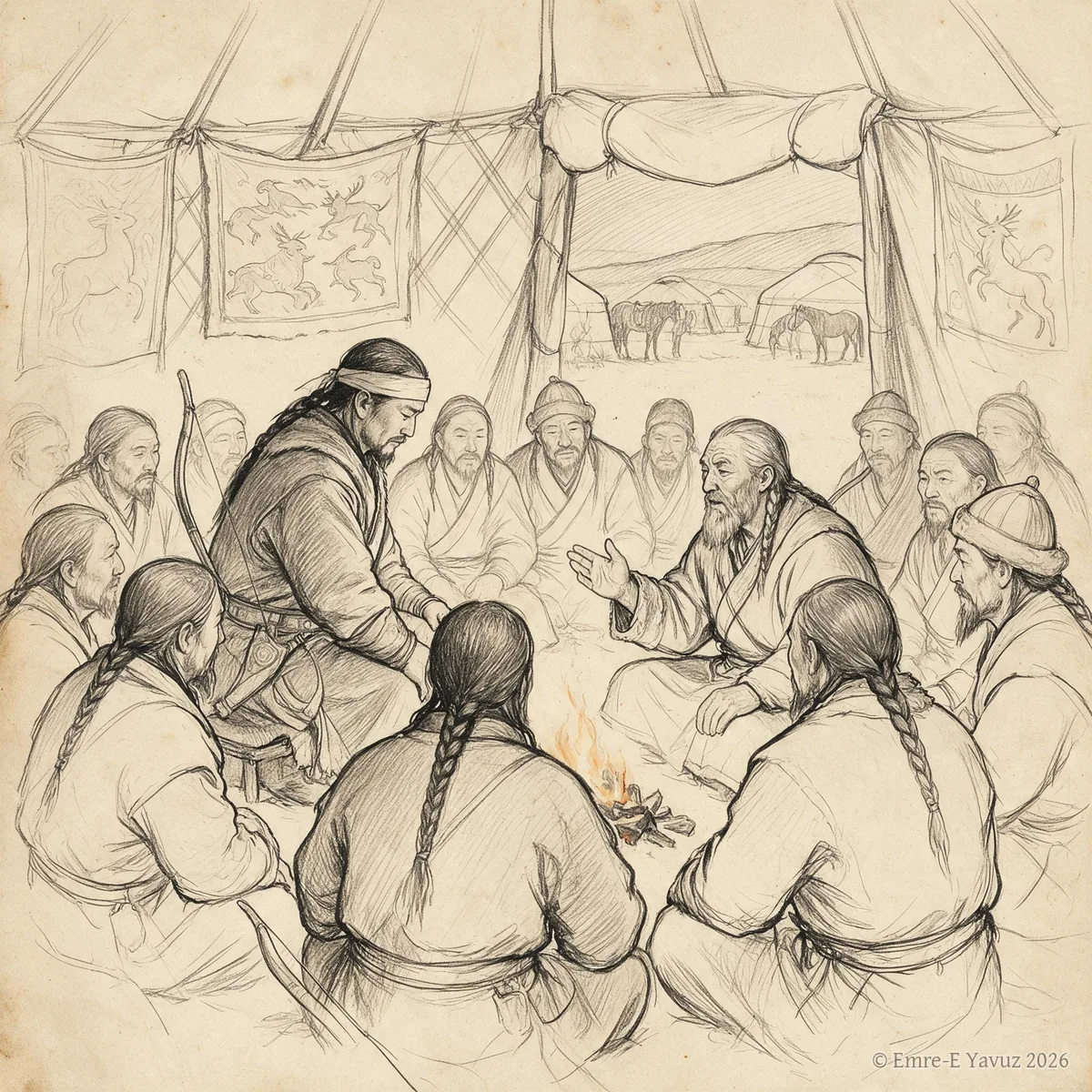
The Göktürks had two words for what held them together, and they were not the same word. Teŋri was the sky and the power in it. Törü, Töre in the modern form, was the law. It was the accumulated custom that said who succeeded whom, what was punished and how, whom a widow married, how the dead were buried, and how much a man might take from the land. It was not written down. It did not need to be, and that is a fact about it rather than a gap in it.
The inscriptions fix its rank. When Bumin and Istemi mounted the throne, they took in hand the el and the törü of the Göktürk people. These words name the realm and its right order, which were named together and governed together.[1] The pairing is not ornamental. A ruler who held territory without the order was not held to be ruling. When the Göktürks lost their state, they are said to have lost the törü with it and to have ceased, in the process, to be recognisably themselves.[2]
Töre and Göktürk identity
That last point is the strongest thing the Töre says about the Göktürks. It suggests that being Göktürks in the sixth century was less a matter of descent than of conduct. Whoever wanted to belong lived as those already belonging lived, and to learn what that meant was to learn the Töre. A confederation that absorbed peoples at the pace the khaganate did needed a membership test of exactly this kind. A legal-cultural test does the work that a genealogical one could not do.
The word is productive enough to turn up in names. Töremen means something like the upright, the one who keeps the law. The man passed over for the throne in 581 was called Töremen, and his exclusion tore the khaganate in two.
Scholars have argued whether törü, Teŋri and Türk go back to one root, and the question is not settled. The link between law and people is the more plausible of the two. The link between law and god is the less plausible, since the Töre is conspicuously the part of Göktürk life that owes nothing to belief.
Marriage, kinship and the limits on it
The Chinese recorded the Töre’s rules about who might sleep with whom in more detail than any other part of it. They show a system with two halves: a wide obligation and a hard boundary.
The obligation is the levirate. On the death of a father, an elder brother or an uncle, the Zhou Shu says, the sons, younger brothers and nephews took the widows as wives. These were stepmothers, aunts and sisters-in-law.[3] To a Chinese official this was the most shocking thing about Göktürk custom, and he reports it as barbarism. In a society without a state to keep widows and orphans, it is the opposite. It is a rule that guarantees every woman a household and every child a father. It keeps the property and the people of a dead man inside the family that owed them protection.
The boundary is in the same sentence, and it is easy to read past. Every woman on that list is related by marriage and none by blood. A stepmother is the father’s wife, an aunt the uncle’s, a sister-in-law the brother’s.[3] A man’s mother, his sisters and his daughters are not on the list, and they are nowhere in the permitted set.[3] The rule that looks like licence is in fact a precise map of affinity, and the line it does not cross is the line of descent.
The Zhou Shu then states the one restriction inside the levirate outright: a senior might not take a junior’s wife.[3] Seniority governs the direction in which a woman may pass. She may pass downward through the generations, never upward. That is a rule about rank as much as about sex. It makes sense only if the whole arrangement was understood as ordered rather than free.
Read together, the three provisions describe a kinship system with clan exogamy at its base. Marriage inside the blood line was not regulated but excluded. The Chinese never say so in as many words, because a Chinese observer had no reason to remark on the absence of something his own society also forbade. He wrote down the part that surprised him.
Offences against the person
The Göktürk penal scale is short, and it is preserved twice. The two versions agree on where the top of the scale lies.
The Zhou Shu puts four offences at the level of death: rebellion, murder, intercourse with another man’s wife, and the theft of a hobbled horse.[3] The Sui Shu gives the same shape and is harsher in the wording. Those who plot rebellion or kill a man all die. The man guilty of illicit intercourse is castrated and cut in two at the waist.[4]
The placing of the offence in the scale makes the point. The Göktürk legal order settled almost everything else by payment in livestock. A man who blinded another in a brawl compensated him, a thief repaid tenfold, and injury was assessed by its gravity.[3] A sexual offence is one of the four things that could not be paid for.[3] It stands beside treason and killing, and the Sui Shu’s penalty for it is the most elaborate in the whole scale.[4] A society that prices a man’s eye and does not price this has made a statement about it.
The Zhou Shu’s fourth provision goes the other way and is harder for a modern reader. A man who took an unmarried girl paid a heavy fine in goods and was then given her as his wife.[3] That is a rule about restitution to her family and about her future, not about her consent. It was not the protection a modern reader might take it for. The severity falls where a household has been violated. The remedy falls where a woman’s prospects have been.
The Göktürk material will not support a claim that these rules were a Turkic peculiarity. Severe penalties for adultery and a blood-kin taboo are near-universal. Their presence in that material says that the Göktürks had a functioning legal order, not that they had an unusual one. What is unusual is that a steppe confederation kept such an order without writing, without courts and without a priesthood to enforce it. When the khan himself broke a rule in 581, there was nothing to appeal to.
The Oghuz and the later tradition
Scholars usually trace the same norms forward into the Oghuz world and into the Book of Dede Korkut, where kinship, honour and the standing of women are the recurring subject. That literature lies four to six centuries after the khaganates and in a Muslim setting. It is therefore a separate body of evidence and not a continuation of this one. The Göktürk norms are known from the Göktürk-period sources alone. The Oghuz material is the place where the question goes on, not evidence for what preceded it.[5]
Succession and the crisis of 581
The Töre’s hardest rule concerned the throne, and it was a rule of restraint on the man who sat on it. The Chinese record the sequence rather than the rule. Bumin was followed by Issik, then by Issik’s brother Mukan, then by Mukan’s brother Taspar, each passing over his own sons.[3] The Zhou Shu calls Issik Bumin’s son, and the Sui Shu calls him Bumin’s brother. The Sui Shu also has Ishbara’s brother Bagha say that since Mukan’s day the Göktürks had mostly let a younger brother replace the elder and the lowborn supplant the legitimate, against the law of the ancestors.[4] Lateral succession was the rule of the Töre: the younger brother, then the elder’s son, then the younger’s. Some scholars find two laws of succession in the two legends of origin. They take the legend of the she-wolf and the cave for the state’s own account of its origin, and the story of the Suo for a popular tale. In the second it finds both laws: the eldest son leads first, and the youngest wins at the tree.[6] The one Göktürk voice the Chinese preserve on the subject calls the practice a breach of the ancestral law. That voice is Bagha arguing his own case in 587, not a statement of the rule.[4] There were also no designated heirs. A khan had no right to name his own successor, not even in his lifetime. In 581 the choice fell to the assembly of the nobility, the toy, which set the dying khan’s wish aside.[4]
The reason for the restraint is plain enough. A ruler who could name his successor could found a personal line and detach the office from the people who filled it. The rule kept the khaganate the property of the Ashina as a house rather than of any khan as a man.
Taspar broke the rule. He died in 581 and left an empire that had survived thirty years without a serious revolt, with its economy intact and its nobility loyal. He also left a wish that the throne should pass to his nephew Töremen Apa, son of Mukan.[4] The toy assembled and refused. Töremen’s mother was of low birth, and the assembly would not have him. Amrak’s mother was noble, and the Göktürks had always honoured her.[4] Ishbara, son of Issik, arrived last. He declared that he would serve Amrak with his brothers, but would meet Töremen at the frontier with sharp blade and long spear.[4] Ishbara was the elder and the stronger, and no one dared oppose him. Amrak, Taspar’s own son, was installed.[4]
The election settled nothing. Töremen rebelled against it and declared it unlawful. Amrak preferred negotiation to war, and he resigned within the year and proposed Ishbara in his place. This produced the rebellion he had stepped aside to prevent, now aimed at Ishbara. Töremen took the title Apa Khan. Tardush in the west, Istemi’s son, took his chance and intervened in the affairs of the east. In doing so he broke a second unwritten rule of the house. The Sui court, watching, fed both sides. The war that followed ran for twenty years and left the khaganate permanently in two halves.
The episode does not show that the Göktürks were factious. It shows how much depended on the Töre. The Töre survived one violation from a dying khan and then failed, and the failure was structural rather than moral. An unwritten constitution has no court to appeal to. When the rule and the ruler’s wish diverged, there was nothing to decide between them but force.
Content of the law
The substance of the law is known from the Chinese. They described Göktürk custom in some detail and, on the evidence of how they wrote it down, with less condescension than one might expect.
Rebellion, murder, adultery with another man’s wife and the theft of a hobbled horse carried death.[3] A man who seduced an unmarried girl paid a heavy fine in goods and was given her as his wife. Wounding in a brawl was compensated according to its gravity. Theft of horses or goods was repaid more than tenfold.[3] Some rules are sometimes added to this list: banishment for cattle-raiding, the protection of a beaten enemy and of widows and orphans, and the distinction between disgrace and crime. They are not in the Zhou Shu.[7]
The marriage rule looks strange until one sees what it is for. On the death of a father, an elder brother or an uncle, the sons, younger brothers and nephews took the widows: stepmothers, aunts and sisters-in-law. The one limit was that a senior might not take a junior’s.[3] Among the Göktürks this was a duty and not a licence. It was not a union in the marital sense, because the man took the household, not the woman. The Chinese texts write it with the verb for marrying, which is what a Chinese writer would put for an arrangement his own law had no word for. Whatever else it was, it kept a widow and her children inside the household that had lost its head.
Burial is described in the same account. The body was laid in a tent, and the kin each killed sheep and horses and set them before it. They rode seven circuits of the tent and cut their faces seven times at its door.[3] On a chosen day the body was burnt with the horse the man had ridden and the things he had used, and the ashes were buried in season. Where a stone marker was raised, its stones numbered the men he had killed, and the heads of the sacrificed animals were hung on it.[3] The excavated graves do not bear the account out. They show inhumation: the man laid beside his horse, which was to carry him onward. Either the rite changed, or the Chinese described one practice among several, or they described what they had been told rather than what was done. One account reads from later practice that the khans, who were held to descend from the Ashina, were buried apart from the common people, who called themselves “black bone”.[8]
Last and least like a law, the Töre limited what might be taken. The earth was to be used only as far as need went, and the hunt was to continue only until the family was fed. A rule of that kind is unenforceable and was presumably not enforced. It belongs to the same conception as the ıduq Yer-Sub of the inscriptions, the sacred land-and-water that a people holds in trust and can be deprived of.
Calendar
An ordered society has to agree what year it is. The Göktürks used the twelve-year animal cycle. They named the years rather than the months, and the cycle began again after twelve. The eleventh-century dictionary of Mahmud al-Kashgari preserves the story they told about its origin. A khan wanted to know the year of a war fought before his time, and no one was able to tell him. He put it to an assembly that time be divided into twelve as the sky is divided into twelve. Then he drove the game towards the Ili, and the animals that crossed gave their names to the years in the order they reached the far bank.[5]
The same dictionary gives the seasons: oğlak for spring, uluğ oğlak for summer, uluğ for autumn and kadır kış for winter. These were quarters of ninety days, and toksan, ninety, was the word for the quarter itself.[5]
The cycle outlasted everything else. Kirgiz herdsmen in the 1870s gave their age not in years but by naming the animal of their birth-year and leaving the questioner to count the cycles. Villagers of the Çakallı in southern Anatolia lived a continent away. They had lived under a Muslim calendar for centuries and a Gregorian one besides, yet they still called 1984 the year of the rat and expected an ill year of it.
In the Uyghur texts
In the Old Uyghur texts, the word means teaching and doctrine as well as law. A follower of wrong teachings is a töröči in one text, and a törö bitig, a “book on ethics”, is quoted in another.[9] The Uyghur sources written in Brahmi script write their vowels out. They give the word as törö, with o in the second syllable.[10]
The word in the Kutadgu Bilig
In the Kutadgu Bilig, written at the Karakhanid court in 1069–1070, törü is the ground of rule. Princely office is good, the book says, but better is the law the prince must carry out, and rule stands only through it.[11] The book calls law and justice the pillar that holds up the sky.[12] The word also reaches beyond law. Törü hem toku, law and custom, is the usage a servant must learn before he serves the prince: how to act and speak, how to enter and leave, where to sit and where to stand. By both together the princes keep the realm and the people in order.[13] The book is a Muslim mirror for princes, written four centuries after the khaganates. The inscriptions do not say whether the Göktürk törü also covered the ceremonial of the court.
Later history
The Töre was never the exclusive property of the Ashina, and much of it was shared across the steppe. One account goes further. It holds that the customary law of the steppe was a single system from the Scythians through the Göktürks, Oghuz, Bulgars, Khazars and Uyghurs to the Mongols. In this view the system kept the old law of the local community inside the conquered states.[14] Its most consequential afterlife is Mongol. When Genghis Khan built a state out of the tribes, he took over a great deal of this customary law and gave it a Mongol name, the Yasa.
Its end among the Göktürks themselves was slower and more corrosive. The Chinese connection that made the later khans rich also made them foreign to their own. The Ashina of the seventh century were caught between the Töre and Tengri on one side and Chinese ceremony and Buddhism on the other, and they lost the standing their people measured them by. The court whose manners they had adopted never accepted them as equals. A khan trusted by neither side did not remain a khan for long.
References
- ^ Kül Tegin inscription; Tekin 1968, p. 385
- ^ Kül Tegin inscription
- ^ a b c d e f g h i j k l m n Zhou Shu (Book of Zhou), juan 50
- ^ a b c d e f g h i Sui Shu (Book of Sui), juan 84
- ^ a b c Dīvān Lughāt al-Turk
- ^ Zhou Shu (Book of Zhou), juan 50; Ögel 1993, p. 25–29
- ^ Yavuz 2025
- ^ Togan 1981, p. 112
- ^ Erdal 2004, p. 140,202
- ^ Erdal 2004, p. 89
- ^ Kutadgu Bilig; Dankoff 1983, couplets 454, 5285
- ^ Kutadgu Bilig; Dankoff 1983, couplet 3463
- ^ Kutadgu Bilig; Dankoff 1983, couplets 4001–4002, 4010
- ^ Togan 1981, p. 112–115
Sources
- Kül Tegin inscription
- Zhou Shu (Book of Zhou), juan 50
- Dīvān Lughāt al-Turk
- Sui Shu (Book of Sui), juan 84
- Kutadgu Bilig
Literature
- Emre-E. Yavuz, The Gokturk Empire: 2nd Edition (2025)
- Marcel Erdal, A Grammar of Old Turkic (2004)
- Talât Tekin, A Grammar of Orkhon Turkic (1968)
- Bahaeddin Ögel, Türk Mitolojisi (Kaynakları ve açıklamaları ile destanlar) I (1993)
- Zeki Velidi Togan, Umumi Türk Tarihine Giriş I (1981)
- Robert Dankoff (trans.), Wisdom of Royal Glory (Kutadgu Bilig): A Turko-Islamic Mirror for Princes (1983)
What links here24
- Persons
- Bagatur (Modu Chanyu) · Taspar Khan
- Conflicts
- The Göktürk Civil War
- Battles & Events
- Göktürk Succession Crisis (581)
- Institutions and Titles
- Beg · Buyruk · Khan (Khagan) · Kut · Levirate · Shad · Toy · Tuğ · Women among the Turkic Peoples · Yabgu
- Religions
- Tengrism
- Languages
- Old Turkic
- Customs & Pastimes
- Culture of the Turkic Peoples
- Sources
- Kül Tegin inscription
- Controversies
- The Göktürks and the Xiongnu
Cite this article
Yavuz, Emre-E. “Töre.” Turkic Atlas, revised 8 November 2026. https://turkicatlas.org/institutions/tore/
Last revised: 8 November 2026

