
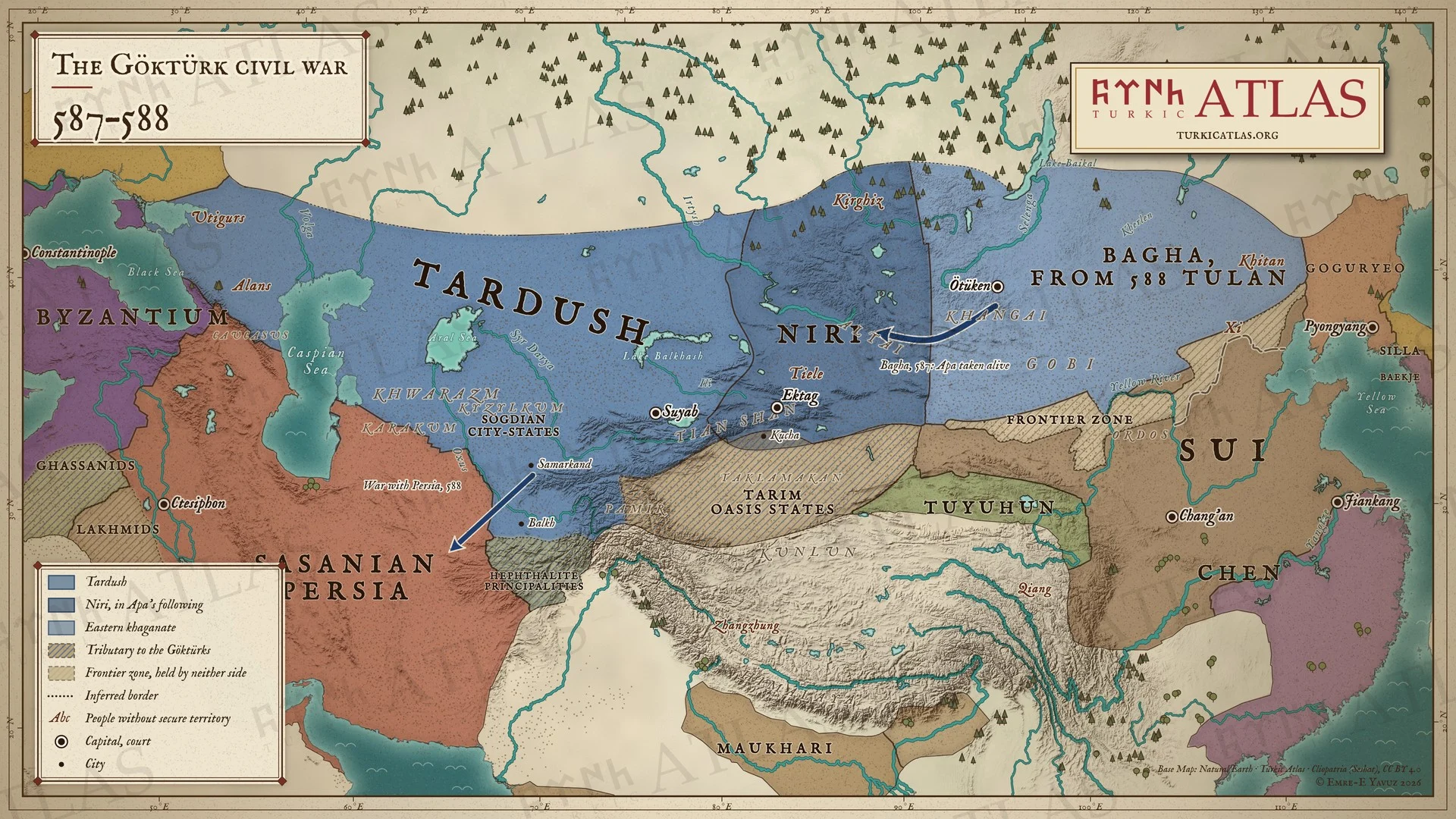
Bagha was the brother of Ishbara and a son of Issik. He was a lesser khan of the khaganate in the years of the civil war, and from 587 to 588 its khan in the east.[1] In 582 he rode into China with Ishbara, Apa and Tardush. After Tardush withdrew, he held the front with his brother. The Sui broke the army near Baidao in June 583, and Chinese agents then set even Bagha against the khan. Of the four princes who made the war he had, on one view, the most honourable end, free of fratricide and treachery. The end itself is disputed.
Khan of the eastern Göktürks (587–588)
Ishbara died in 587.[1] He had judged his son Yongyulü, the later Tulan, to be weak of character. He had left orders that his brother, then the yabgu, should succeed him.[1] Yongyulü sent envoys to fetch his uncle. The two yielded the throne to each other five or six times. In the end Bagha took it as Yehu Khan and made Yongyulü his yabgu.[1] He reported his accession to the Sui court. The emperor sent him drums, pipes and banners.[1] The Sui Shu describes him as long-jawed and stoop-backed, with wide-set brows and eyes, brave and resourceful.[1]
With the Sui banners he marched west against Apa. Apa’s men took the banners for a sign that Sui troops were with Bagha. They came over in great numbers, and Bagha took Apa alive.[1] He asked the emperor whether the captive should live or die. The emperor spared him.[1] Later Bagha campaigned in the west a second time. A stray arrow killed him. His people raised Yongyulü as Tulan Khan.[1] The Sui Shu gives the death no year.[1]
War of 588
By one account, Bagha led a great Göktürk and Hunnic army across the Oxus into Iran in 588. He was a lesser khan, driven by the disastrous state of the khaganate and possibly by drought. He took Balkh, Herat, Talakan and Badghis, the cities of Bactria.[2] He advanced into Hyrcania on the Caspian, where a second Göktürk army was also moving.[2] The Sasanian king Hormizd IV sent Bahram Chobin against him.[2] In April 588, at the Hyrcanian rock, Bahram defeated the Göktürks decisively. He pursued them to the Oxus. By the Persian epic, he killed Bagha with an arrow.[2] The arrow appears to be a typical topos of Persian storytelling. The epic’s numbers, twelve thousand Persians against three hundred thousand Göktürks, are exaggerated. The Göktürks left no record of the war. The war has its own article.
The other account differs on the leader and the year.[3] In this second account the army destroyed by Bahram was Tardush’s. It was led by Tardush’s son, the Šāba whom the Perso-Islamic tradition calls the greatest king of the Turks. The defeat was at Herat in 589. That account reports Lev Gumilev’s identification of Šāba with a younger son of the Göktürk ruler of the Bukharan tradition and with a figure of the Chinese sources. It says this identification cannot be established. The first account rests on the identification of the Chinese Baga Khan with the Persian Šāba. This identification is old. It remains a hypothesis.
Names
- 處羅侯ChineseSui Shu 84
- 莫何可汗ChineseZizhi tongjian 176
- Šāba, SāwaPersianTabari
The Chinese histories give the personal name Chuluohou and the title Mohe. Mohe is read Baga, an old Turkic honorific from an Iranian word for the divine. It is one of the borrowed titles of the Göktürks.[3] Bagha is counted among the four great princes who fought the Persian empire in 588. He took Balkh, Herat and Talakan, was beaten at the Hyrcanian rock and, reportedly, killed on the Oxus.[4] The Persian name Šāba, if it is his, is the only name a non-Chinese source gives any Göktürks of the civil war.
References
Sources
- Sui Shu (Book of Sui), juan 84
- Zizhi tongjian (Comprehensive Mirror in Aid of Governance), juan 176 (after Wei Shu, Zhou Shu, Sui Shu and Bei Shi)
- Tabari
- Shahnameh
Literature
- Emre-E. Yavuz, The Gokturk Empire: 2nd Edition (2025)
- Peter B. Golden, An Introduction to the History of the Turkic Peoples (1992)
What links here31
- Persons
- Bahram Chobin · Hormizd IV · Ishbara Khan · Niri Khan · Šāba · Tardush · Töremen Apa · Tulan Khan · Yami Khan · Yangsu Tegin
- Conflicts
- Göktürk Expansion along the Silk Road · Göktürk–Persian war, 588–589 · The Göktürk Civil War
- Battles & Events
- Battle of Baidao (583) · Battle of Zhoupan (582) · Capture of Apa (587) · Death of Princess Dayi · Göktürk Succession Crisis (581) · Ishbara's Hunt (587) · The Archery Match at the Wu'an Hall (599) · The Succession of 587
- Institutions and Titles
- Baga · Drums and Banners for the Khans · Töre · Warfare of the Steppe Empires
- Customs & Pastimes
- Hunting among the Göktürks
Cite this article
Yavuz, Emre-E. “Bagha Khan.” Turkic Atlas, revised 8 November 2026. https://turkicatlas.org/persons/bagha-khan/
Last revised: 8 November 2026

