
- 400
- 500
- 600
- 700
- 800
- 900
- Rouran 400–554
- First Göktürk 552–630
- Tang rule 630–682
- Second Göktürk 682–744
- Uyghur 744–840
- Kirghiz 840–924
- Huns 370–469
- Western Göktürk 552–659
- Türgesh 699–766
- Karluk 766–800
- Khazar 650–969
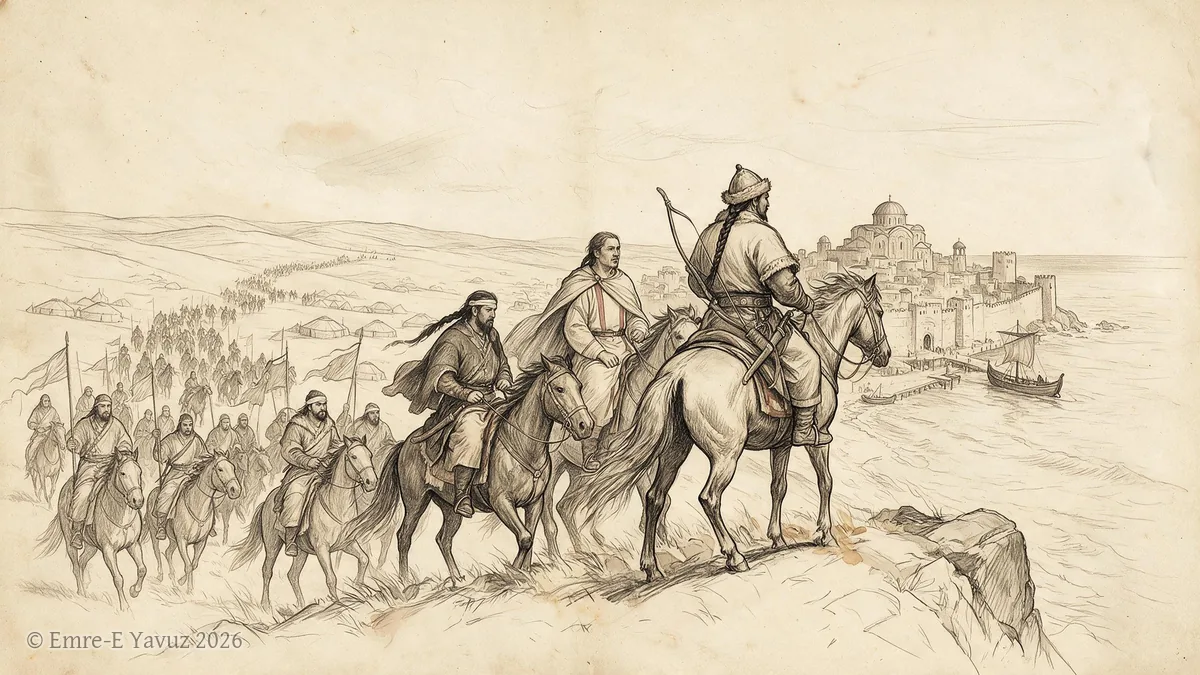
The Göktürk expansion into Europe carried the western Göktürks across the Volga into the Pontic–Caspian steppe, the northern Caucasus and the Crimea in the second half of the sixth century.[1] It began as the pursuit of a fugitive people, the Avars. It ended with Göktürk forces before the Byzantine cities of the Crimea. Between the two lay the first alliance between a steppe empire and Byzantium. It was concluded in 568 against Sasanian Persia and carried by a series of embassies across the Caspian steppe and the Caucasus.[1] By 576 Göktürk power reached the Sea of Azov.[2]
Almost everything known of these events comes from the fragments of Menander Protector. He was a Greek historian of the late sixth century and recorded the embassies between Constantinople and the Göktürk court. His last mention of the Göktürks falls about 580.[3] The khagan’s letter preserved by Theophylact Simocatta takes the story further. So do a Persian tradition transmitted by Tabari and a few lines in other Greek writers. The western steppe stayed under the overlordship of the western Göktürks into the seventh century. The Khazar state grew out of it.[4]
The Avars
The first people of the west whom the Göktürks pursued were the Avars. A saying preserved among Menander’s maxims gives the occasion.[5] Silziboulos, “the leader of the Türks”, had heard that the Avars had fled after doing harm to the Göktürks.[5] He answered that they were neither birds, to escape the Göktürk swords through the air, nor fish, to vanish into the depths of the sea.[5] They wandered on the surface of the earth. Once his war against the Hephthalites was finished, he would fall on the Avars too.[5] With that boast he pressed on against the Hephthalites.[5] The saying gives no year. It places the flight of the Avars before the end of the Hephthalite war.[5] Some scholars date it to 562.[6]
Silziboulos is Menander’s name for Istemi, ruler of the western Göktürks within the First Göktürk Khaganate.[6] The embassy fragments write Dizaboulos. The Arabic tradition knows the same ruler as Sinjibu.[6] Some scholars understand the name as a title, the yabgu khan, which Istemi and his successors in the west bore.[7]
According to Menander, the Avars came to the Alans after much wandering. They became suppliants of Sarosios, the Alan ruler, so that through him they might become known to the Romans.[8] Sarosios informed Justin, son of Germanus, who commanded in Lazica. Justinian received the Avar envoy Kandikh at Constantinople.[8] Kandikh called his people the greatest and most valiant of nations. He asked for gifts, yearly payments and fertile land.[8] The margin of the edition dates the embassy to 558.[9] The Avars had probably reached the Pontic–Caspian steppe about 557.[10] The khagans and the ruling nobility of the fugitives most likely came from the nobility of the fallen Rouran state, some twenty thousand people.[11][12]
Justinian sent the Avars gifts and the envoy Valentinos, one of the imperial sword-bearers, to win them as allies.[13] The Avars then made war first on the Ouigouroi and then on the Zaloi, “a Hunnic people”. They also destroyed the Sabirs.[13] The first name stands so in the manuscript. An old emendation reads it as Utigurs.[14] By 568 the Avar khagan Baian claimed the yearly payments that Justinian had made to the Kutrigurs and the Utigurs. His ground was that he had subdued both peoples.[15] In the same year he sent ten thousand of the so-called Kutrigur Huns across the Save to ravage Dalmatia.[16] Allied with the Lombards, the Avars drove the Gepids out of Pannonia in 567 and 568.[10]
The Avars thus stood between the Göktürks and Byzantium from the beginning. The Avar question remained a source of conflict between the Göktürks and Constantinople.[17]
The peoples of the Pontic steppe
Beyond the Volga, the Göktürks met peoples of the Oghuric branch of Turkic. These peoples had held the steppe north of the Caucasus since about 463.[18] The Ogurs and the Onogurs had come from the east in that year, driven out by the Sabirs.[19] The Kutrigurs held the steppe west of the Don and the Sea of Azov. The Utigurs held the steppe east of it.[20] The Sabirs had reached the lower Volga by 515.[21] According to one view, the Onogurs were a federation that took in the Kutrigurs, the Utigurs and the Bulgars. In that case their name means the ten tribes.[22] Their history before the Göktürks belongs to the Turkic tribes in Europe.
The Avars had broken these peoples before the Göktürks arrived.[23] After the Kutrigur raid of 558, the Kutrigurs and the Utigurs fought each other until both were weakened. The Avars then brought their remnants under their own rule.[23] Kutrigur elements went west with the Avars.[23] The Utigurs came under Göktürk rule. In 576 their ruler Anagaios fought for the Göktürks at Bosporos.[23] The Ogurs and the Onogurs fell first under the Avars and then under the Göktürks.[24] The Sabirs were absorbed by the Göktürks and appear again in the making of the Khazars.[25] Sabir groups in the Caucasus still dealt with both empires.[26] In 576 Sabir envoys came with Alan envoys to Tiberius at Constantinople.[26] In 578 Sabirs rode in Khosrow’s army against Roman Mesopotamia.[27] Elements of the Bulgars also came under Göktürk organisation. How far and how long Göktürk rule over them reached is unclear.[1]
The Alans were an Iranian people of the northern Caucasus.[28] Their country lay on the road between the steppe and the Black Sea coast. The peace between Byzantium and Persia of 562 bound the Persians not to let “Huns or Alans or other barbarians” through the Caspian Gates against Roman territory.[29] The Avars reached the Romans with Alan help in 558.[10] Maniakh crossed the lands of the Alans in 568.[1] In 569 and 570 the Alans still kept some independence. By 576 Turxanthos counted them among the Göktürks’ slaves.[30]
By 568 the Göktürks held the hegemony over the nomads of the western steppe, the Sabirs, the Utigurs, the Ogurs and the Onogurs.[1]
Askel’s embassy, 563
Theophanes the Confessor records envoys of Askel, king of the Hermichiones, at Constantinople in July 563.[31] Menander does not mention Askel or the Hermichiones.[3] Some scholars identify Askel with a western Göktürk chief known in Chinese as A-hsi-chieh. That would make his embassy the first from the Göktürks to Byzantium.[1] Others take Askel for a king of the Avars, on the ground that the first Göktürk embassy came in 568.[32]
The name of his people is just as uncertain.[32] Theophanes of Byzantium, a Greek writer of the same century, places the Göktürks east of the Don.[32] He says that the ancients called them Massagetae and that the Persians call them Kermichiones in their language.[32] Some scholars regard the Kermichiones as a Hunnic people of the Iranian frontier. If so, the passage says only that both lived in the same country.[32] The Latin poet Corippus, in his praise of Justin II, names a Scultor.[33] Some scholars identify him with Askel. Others identify him with Silziboulos.[33] The first contact with Byzantium that Menander records is therefore the embassy of 568.
Maniakh’s embassy, 568
The road to Constantinople opened through a quarrel with Persia. This trade conflict belongs to the Göktürk expansion along the Silk Road.[34] Once Göktürk power had grown great, the Sogdians asked their ruler to let them sell silk in Persia. They had formerly been subjects of the Hephthalites and were now subjects of the Göktürks.[34] Dizaboulos sent them under Maniakh to Khosrow I of Sasanian Persia.[35] The Persian king bought the silk and burned it before the envoys’ eyes.[35] A second embassy was poisoned, all but three or four of its men.[35] “From this began the enmity of the Persians and the Türks,” Menander writes.[36] One reckoning dates the embassies to Ctesiphon to 568.[37] Menander gives them no year.[3]
Maniakh then advised Dizaboulos to court the Romans and carry the silk to them, because they used more of it than any other people.[36] He offered to go himself.[36] Dizaboulos agreed. He sent him with greetings, a gift of silk of great value and a letter.[36] Maniakh crossed high mountains, plains, lakes and rivers, and then the Caucasus. In this way he reached Byzantium.[38] His road crossed the lands of the Alans.[1] Some scholars trace it across the Volga, through the country of the Onogurs and the Bulgars.[39]
Maniakh reached Constantinople in the summer of 568. Justin II received him warmly.[40] Menander dates the embassy to the beginning of the fourth year of Justin’s reign.[34] The emperor had “the Scythian letter” read through interpreters. He questioned the envoys about their state.[38] They told him there were four principalities among them. Power over the whole nation, however, lay with Dizaboulos alone.[38] They had made the Hephthalites tributary and become masters of their cities.[38]
The emperor then asked how many of the Avars had thrown off Göktürk rule and whether any were still with them.[38] The envoys said that some still held to the Göktürk side. Those who had run away were about twenty thousand.[38] The envoys listed the peoples subject to the Göktürks. The excerpt does not preserve the list.[38] They asked for peace and an alliance in arms. They said they were ready to destroy whatever was hostile to Rome in their part of the world.[41] Maniakh and his companions raised their hands and swore the greatest oath.[41] They called down curses on themselves, on Dizaboulos and on their whole nation if their promises proved false.[41] “Thus the Türk people became friends of the Romans and came into our state in no other way,” Menander writes.[41]
According to Theophanes of Byzantium, Justin showed the envoys the silkworms that had been brought to Constantinople under Justinian.[42] The Göktürks were astonished, because they then held the markets and the harbours of the Seres.[42] Byzantium had begun its own silk production. The Göktürk silk therefore mattered less to it than the alliance.[17] The Göktürks had three motives for the treaty: the trade, the war with Persia, and the Avars.[43] The embassy of 568 opened the Göktürk–Byzantine alliance. The Avar question stood in it from the first audience.
Zemarchos, 569–571
Justin answered with an embassy of his own.[41] He chose Zemarchos the Cilician, then general of the eastern cities, and sent him back with Maniakh.[41] In the same fragment Menander calls the Göktürks the people “anciently called Sakai”.[41] The embassy set out at the beginning of August 569. Menander dates the departure to the beginning of August, as the fourth year of Justin’s reign was coming to its end, in the second year of the indiction.[41] Counted from Justin’s accession in November 565, that wording falls in August 569. An older count puts the departure in August 568.[44]
In the country of the Sogdians, some Göktürks offered the envoys iron for sale. Menander thought they did this to show that they had iron mines.[45] Other Göktürks, whom he calls drivers-away of ill omen, set the baggage in the middle. They carried burning frankincense round it with a bell and a drum.[45] Then they led Zemarchos himself through the flame.[45]
The embassy found Dizaboulos in a valley of a mountain called Ektag, which Menander renders as golden mountain.[45] The Turkic name is understood as Ak Tag, the white mountain. It has been placed in the Altai and in the Yulduz valley.[17] Dizaboulos received them in a tent, seated on a golden chair with two wheels that one horse could draw.[46] On three days he feasted them in three different dwellings.[47] There were silk hangings, statues, a couch of beaten gold held up by four golden peacocks, and wagons laden with silver vessels and silver figures of animals.[47] He gave Zemarchos a captive slave girl of the people called Kherkhis. Some scholars identify the Kherkhis with the Kirghiz.[48]
Dizaboulos was then marching against Persia.[47] He took Zemarchos and twenty attendants with him. He sent the other Romans to wait in the country of the Kholiatai.[47] At a place called Talas a Persian envoy met the Göktürk ruler.[49] Dizaboulos seated the Romans on the more honoured couch and charged the Persians with the wrongs he had suffered from them.[49] The Persian envoy broke the law of silence that held at their feasts and answered him hotly.[49] Dizaboulos then made ready for the campaign against Persia.[49] Maniakh had died in the meantime.[49] His successor as envoy was Tagma, whose rank was Tarkhan. Maniakh’s young son, who had inherited his father’s rank, came next after him.[49]
The return led through the western steppe. Its description is the fullest account of the country between Central Asia and the Caucasus that survives from the sixth century. The leader of the Kholiatai was allowed to send men of his own to see the Roman state.[50] The embassy crossed the river Oekh and rested three days by a vast lake.[50] From there a courier named George rode ahead with twelve Göktürks by a shorter road through waterless desert.[50] Zemarchos went twelve days along the sandy shore of the lake and crossed the Ikh, the Daikh and the Attila.[51] The three names render the Turkic names of the Emba, the Ural and the Volga.[17]
Beyond the Volga the embassy came to the Ugurs.[51] Their leader, Menander says, “maintained there the power of Dizaboulos”.[51] The Ugurs warned that four thousand Persians lay in ambush in the thickets by the river Kophen. Their leader gave the travellers water-skins for the desert crossing.[51] The Kophen is the Kuma.[52] The Ugur ruler acted as the principal deputy of the Göktürk ruler west of the Volga.[30] Scouts found no Persians.[51] The embassy nevertheless reached Alania in fear. It feared above all the tribe of the Oromouschoi.[51] That fear suggests that the Oromouschoi were still resisting Göktürk authority.[30]
In Alania the ruler Sarodios received Zemarchos gladly. He would admit the Göktürk envoys, however, only if they laid down their arms.[51] The dispute lasted three days, with Zemarchos as arbiter, before the Göktürks gave way.[51] The Alans under their ruler thus kept some independence.[30] Sarosios of 558 and Sarodios of the return are probably one man, written two ways. Sarodios warned that the Persians waited near Suania on the Mindimian road.[53] Zemarchos sent ten porters with silk down that road as a decoy. He went himself by the road of Darene.[53] He came to Apsilia and the Black Sea. He sailed to the Phasis and Trapezus and rode the public post to Constantinople.[53]
Some scholars think that the Alans, loyal to the Göktürks, and an unnamed Hunnic people under Göktürk authority saw the embassy through the ambush in the Kuban.[54] Two later Greek writers report Persian plots on the same road.[55] Theophylact says that the Persians tried to bribe the Alans to poison Göktürk envoys. John of Epiphania tells of an attempt on the life of Zemarchos.[55] The Göktürk embassy under Tagma seems to have reached Constantinople in 571.[30] Menander gives no date for the return.[3] The embassy of Zemarchos went home by the Caucasus, and the Göktürk envoys kept to that road. In 576 Turxanthos complained that the Romans led his envoys through the Caucasus.[56]
Istemi’s campaign against Persia, 569
The march on which Zemarchos rode with Dizaboulos was Istemi’s campaign against Persia. It was a smaller expedition into Persian country, aimed at plunder.[57] It was the bold attack that Silziboulos made on Persia in 569 or 570, while Zemarchos was with him.[33] The Romans kept urging the Göktürks on. That became one of the causes of the twenty years’ war between Byzantium and Persia.[33]
Menander names the Göktürks as the chief cause of the war that Justin then began against Persia.[58] There were many other causes, he writes, but what most roused Justin was the Göktürks.[58] They invaded Media and ravaged the country. They also sent an embassy to Justin to draw him into the war.[59] With the Romans attacking on one side and the Göktürks on the other, they argued, Persia would be destroyed in the middle.[59] Justin was elated by these hopes. He thought he would overthrow the Persian power with ease, and he did everything to keep the Göktürk friendship firm.[59] The fragment stands under the year 570 in the margin of the edition.[60] It names none of the Göktürk envoys.[3]
The Persian tradition tells of pressure from the north as well.[61] According to Tabari, the khan Sinjibu, the boldest and mightiest of the Göktürks, marched with 110,000 men to the pass of Sul.[61] He demanded for himself, and for the Abkhaz, the Banjar and the Balanjar, the payments that the kings of Persia had made to those peoples.[61] Khosrow refused, because he had fortified the pass and garrisoned the Armenian frontier.[62] Sinjibu heard of the fortifications and turned back.[62] A clash between the Göktürks and Persia became possible only after the fall of the Hephthalite realm.[33] Some scholars place Sul in Gurgan. They argue that Sinjibu’s arm did not reach the Caucasus.[33] Others place it at the Caucasus pass of Čor by Derbent. In that case Sinjibu was the overlord of the Khazars, the Bulgars and the Balanjar.[63]
In the Roman–Persian negotiations of the following years Menander does not mention the Göktürks.[3] In his account the Göktürks stand at the beginning of that war, not in its course.
The later embassies
After Zemarchos, embassies passed between the two courts fairly regularly.[30] Menander names them in a single sentence.[64] When Valentinos left for the Göktürks in 576, he took with him 106 Göktürks who had lived in Constantinople for a long time, sent by their nation at different times.[64] Some had been brought by Anankastes, who had gone there as envoy.[64] Some had come with Eutychios. Some had come earlier with Valentinos himself, “for Valentinos had gone twice as envoy to the Türks”. Others had come with Herodian and with Paul the Cilician.[64] Menander gives neither the dates nor the order of these missions.[3]
Scholars disagree about whose envoy Anankastes was.[55] Some take him for a Göktürk envoy to Constantinople.[55] Others note that the name looks Germanic. They suggest that he may have been in Byzantine service.[30] Up to 576 five further Byzantine embassies went to the court of Istemi. All of them fell victim to attacks by Persian mercenaries on the road.[54] Some scholars identify most of the 106 Göktürks in Constantinople with merchants and traders.[44]
Valentinos and Turxanthos, 576
Valentinos, one of the imperial sword-bearers, set out again “about the second year of the rule of Tiberius Caesar, a little before the events concerning Khosrow”.[64] The second year of Tiberius as Caesar began in December 575. The embassy therefore falls in 576.[65] He sailed in fast merchant ships by way of Sinope and Cherson and past the southern mountains of the Taurike.[66] Then he rode through lagoons, reed beds and marshes and through the country of Akkagas, “the name of a woman ruling the Scythians in those parts, appointed to this at that time by Anagaios, who ruled the tribe of the Utigurs”.[66] At last he reached the war standards of Turxanthos.[66]
According to Menander, Turxanthos was one of the leaders among the Göktürks.[66] Those whose lot it was to lead the people had divided everything there into eight portions. The passage continues: “Arsilas was the name of the older monarch of the Türks”.[66] His name is identified with Türk-shad.[30] He was a son of the western ruler and administered one of the eight portions.[30] In rank he stood one step below Tardush, as a governor.[67] Some scholars connect the name Arsilas with Ashina.[68]
Valentinos had come to greet the Göktürk leaders on Tiberius’s elevation to Caesar.[69] He was also to confirm the treaties made between Dilzibulos and Justin when Zemarchos first came. By these treaties, the friend of the Romans was the friend of the Göktürks, and their enemy was the same.[69] Because Rome was then at war with Persia, he asked Turxanthos to attack the Persians at the right moment.[69]
Turxanthos answered at once: “Are you not those Romans who use ten tongues and one deceit?”[69] As he spoke he stopped his mouth with his ten fingers.[69] With one tongue, he said, the Romans deceived him, and with the other his slaves the Ouarkhonitai.[56] Lying was alien to a Göktürk man. He would kill the envoys at once.[56] Their emperor spoke words of friendship to him. At the same time he had made a treaty with the Ouarkhonitai, “our slaves who ran away from their masters”.[56] Menander adds that Turxanthos meant the Avars.[56] If the Ouarkhonitai saw his horsewhip sent against them, they would flee to the lowest depths of the earth.[56] If they stood, they would be trampled under the hooves of his horses like ants.[56] Turxanthos charged Valentinos with still sheltering the Avars and so keeping the Göktürks from their revenge.[67]
The Romans led his envoys through the Caucasus, he said. They claimed there was no other road, so that the hard country would keep him from attacking them.[56] He knew very well where the Dnieper ran, where the Danube and where the Hebros, and from where the Avars had crossed into Roman land.[56] All the earth submitted to him, from the first rays of the sun to the limits of the west.[56] The Alan nations and the tribes of the Utigurs had trusted their own strength and set themselves against the Göktürks.[56] Now they obeyed and stood in the place of slaves.[56] Menander calls him a man of lofty speech who delighted in boasting.[70]
The second people in that passage is named in two ways.[56] The Greek text names the Utigurs, the people of Anagaios.[56] Others give the Onogurs.[30] The Alans and the Onogurs had fallen to the Göktürks only in the years since Zemarchos, after serious fighting.[71] No account of how the Utigurs were subdued survives.[72]
Valentinos answered that the killing of envoys had never been done and would disgrace Turxanthos among all men.[70] Envoys, he said, were workers of peace.[70] Turxanthos had inherited his father’s land and ought to inherit his father’s friends.[70] His father Dilzibulos had come to the Roman state of his own will and preferred the Romans to the Persians.[70]
Turxanthos then told the envoys that they had found him in the deepest mourning, because his father Dilzibulos had just died.[73] They were to slash their faces with knives, as the custom of his people required for the dead.[73] Valentinos and all his companions cut their cheeks with their own daggers.[73] On one of the days of mourning Turxanthos brought four captive Huns in chains into the middle, together with his father’s horses.[73] He ordered them in his own tongue to go and tell his father something that the manuscript has lost.[73] Menander adds that the Göktürks call the rites for the dead dochia.[73] The cutting of the face and the sacrifice of the four Huns are the fullest account of a Göktürk funeral that survives in a Greek source.
The dead father was Istemi.[74] Istemi died in 576.[75] When the rites were over, Turxanthos sent Valentinos on to the leaders further inland. Above all he sent him to his brother Tardou, who had his seat on the mountain Ektel, which means golden.[73] Tardou is Tardush, Istemi’s son and successor.[76] He is the brother of Turxanthos.
Bosporos
As Valentinos left for the mountain, Turxanthos threatened to besiege and take Bosporos at once.[73] The words that gave the reason are lost in a gap in the text.[73] He sent Bochanos with a very large force of Göktürks to destroy the city.[73] Anagaios was already encamped in that country with another force of Göktürks.[73] Bosporos, the ancient Panticapaeum near the modern Kerch, was a Byzantine holding in the Crimea.[30][77]
Anagaios ruled the Utigurs. His presence at Bosporos shows that the Utigurs had come under Göktürk rule.[23] Some scholars compare his name with that of Anagui, the last great Rouran khan.[65] The woman Akkagas, whom he had set over one of the peoples in his charge, bears a name understood as Ak Kagan.[23] The name Bochanos is taken to be Bokan.[30]
Turxanthos let Valentinos go on to Tardush’s court. He then set Anagaios, prince of the Utigurs, and Bochanos, a Göktürk general, to invade Byzantine land.[67] In a surprise attack their combined forces besieged Bosporos the same year.[67] Menander’s next fragment tells the outcome: “At the time when the city of Bosporos was captured, the Roman envoys happened to be with the Türks.[78] From this it became clear that the Türks had turned to war against the Romans.”[78] Turxanthos therefore held the envoys, Valentinos among them. He insulted and mocked them and treated them badly in other ways.[78] Then he let them go.[78]
Two dates are given for the fall.[3] Menander places it while Valentinos was still with the Göktürks, and so in 576.[3] By one reckoning, the siege and the capture both fell in 576.[79] A second reckoning dates the attack to 576 and the fall of the city to about 579.[76] The siege of Bosporos is the first fighting between the Göktürks and Byzantium that the sources record. It came eight years after the oath of 568.
The Crimea after 576
Shortly after Bosporos, the Göktürks joined the attack and besieged the old Greek fortress city of Chersonesos.[67] With it the Göktürk realm reached its westernmost limit.[67] There was no war against Byzantium. Tardush agreed with Valentinos that the alliance stood.[67] The Göktürks kept their hold on the Crimea as a punishment for the Roman conduct and to forestall an Avar expansion.[67] Tribes of Europe, probably Turkic, served the Göktürks as allies of lesser rank. They conquered parts of the peninsula for them, after the Byzantines had refused to hand over the Avars.[80] The Göktürks besieged and occupied the Crimea until 598.[81]
Menander’s wording stands beside this.[78] In his account the Göktürks had turned to war against the Romans when Bosporos fell. Turxanthos held the envoys before he released them.[78] He mentions the Göktürks once more, about 580.[82] The Avar envoys then asked Tiberius for ships to carry their army across the Danube against the Slavs.[82] The emperor, whose armies were all in the Persian war, answered that the moment was unfavourable, “since the Türks were already encamped around Cherson” and would soon learn if the Avars crossed the river.[82] The Avar envoy saw that the emperor had invented this to hold the Avars back through fear of the Göktürks.[83] He pretended to be persuaded.[83] Menander calls the use of the Göktürks a pretext. He neither affirms nor denies that they stood before Cherson.[3] It is his last mention of them.[3]
The alliance of 568 appears to have broken down about thirty years before it was renewed in 627.[84]
The khagan’s letter to Maurice
A generation later the Göktürks wrote to Constantinople once more.[85] Theophylact records that at the beginning of a summer the khagan “famous in the east among the Türks” sent envoys to the emperor Maurice with a letter full of his victories.[85] The khagan styled himself the great lord of the seven races and master of the seven climes of the world.[85] Some scholars date the letter to 598. They take Tardush for its sender.[86] Others ascribe the letter to Istemi himself.[87] The letter, however, names Stembis kagan as the sender’s comrade in arms and not as its sender.[85]
The letter tells how the khagan had defeated the chief of the Abdel, whom Theophylact explains as the Hephthalites.[85] With “Stembis kagan” as his comrade in arms he had then enslaved the nation of the Avars.[85] Stembis kagan is Istemi.[86] The defeated Avars fled, some to Taugast and some to the Mukri.[85] Theophylact concludes that the people who had come into Europe under Justinian were not true Avars.[88] The Barsilt, the Onogurs and the Sabirs had mistaken the newcomers for the Avars and so given them the name.[88] Others take the Abdel for the Tiele and not the Hephthalites.[89]
The khagan then subdued all the Ogor, a people living towards the east on the river Til, which the Göktürks call the Black.[90] The oldest chiefs of that people were called Uar and Chunni.[90] He put the chief of the Kolkh to the sword. Theophylact gives three hundred thousand as the number of that people who died.[90] If the Til is the Volga and the Kolkh are the people of Colchis, the Ogor are the Ogurs near the Caucasus.[91] Some scholars identify the Til with the Tola in Mongolia.[92] Others regard Ogor as a garbled form of Uyghur.[91]
A kinsman of the khagan named Turum then rebelled. The khagan called on three other great khagans, Sparzeugoun, Kounaxolan and Touldikh.[93] The decision fell in the region of Ikar.[93] Some scholars date the revolt to 581 and 582.[94] Others place it in the 590s. They see it as a revolt of the Ogurs and connect it with the flight of Ogur tribes to the Avars in Pannonia.[94] The Tarniakh and the Kotzageroi, who also descended from Uar and Chunni, fled from the Göktürks into Europe and joined the Avar khagan. The Zabender were said to be of the same race.[93] The reinforcement came to ten thousand men.[93] The Kotzageroi are the Kutrigurs.[95] If the letter belongs to 598, it shows the Göktürks at the end of the century still driving peoples of the Pontic steppe west into the Avar realm.
The end of Göktürk rule in the west
Tardush recovered from his defeats by 598. From about 600 he held supreme power over both halves of the Göktürk realm.[96] About 603 a great revolt of the Tiele and other tribes drove him out. He disappeared.[94] The Onogur and Bulgar peoples of the far west probably took part in that revolt.[97] The revolt very likely weakened the Göktürk overlordship in the west.[98] The name of the Utigurs disappears from the east shore of the Sea of Azov. That of the Kutrigurs ends with the century.[72] About 635 the Onogundur-Bulgars appear in their place.[72]
The breakdown of Göktürk power in the western steppe was one of the preconditions for the Bulgar state of Kubrat on the Kuban.[99] Kubrat was baptised at Constantinople about 619.[98] About 635 he threw off Avar overlordship and allied himself with the emperor Heraclius.[98]
The Göktürks returned to the Caucasus in 627.[100] Tong Yabgu had renewed relations with Byzantium.[100] In the Caucasus campaign his army came through the Caucasus from the north while Heraclius attacked Persia from the west.[84] Theophanes calls Heraclius’s allies “the Türks from the east, whom they call Khazars”.[101] With the Göktürk conquest the Sabir union had been reorganised. The Khazars emerged at its head.[4] Tong Yabgu and his nephew Börü Shad laid the foundation of the Khazar empire in that campaign.[102] The Khazar Khaganate took over the steppe between the Volga and the Crimea. With it the Khazars took over the alliance with Byzantium that the Göktürks had built.
Sources
Menander Protector is the one contemporary narrative. His history survives only in the tenth-century collections of excerpts on embassies and on maxims. The Göktürk passages therefore stand as separate pieces, from the flight of the Avars to the Göktürks near Cherson. The fragments of the embassies of 568, 569 and 576 are reports of what the envoys saw, heard and were told. Much of the detail comes from men who stood in the Göktürk camp. Menander gives the Göktürk ruler three forms of one name: Silziboulos, Dizaboulos and Dilzibulos.[3]
Theophylact Simocatta wrote a generation later. He preserves the khagan’s letter to Maurice with his own commentary on the Avars. Theophanes the Confessor records the envoys of Askel in 563 and the embassy of 568.[1] Theophanes of Byzantium adds the silkworms and the Kermichiones.[42] Tabari preserves the Persian tradition of Sinjibu, his war with the Hephthalites and his demand at the pass of Sul.[61]
The Göktürks’ own inscriptions remember the western neighbours at the funeral of the founding khans.[103] Among the peoples who came to mourn them, the Kül Tegin inscription names the apar and the purum.[103] The two names are understood as the Avars and the Romans.[104] In the memory of the second khaganate, the Avars whom Istemi had sworn to pursue and the Romans with whom he had allied against Persia both came to mourn the founders.
References
- ^ a b c d e f g h Golden 1992, p. 128
- ^ Marquart 1903, p. 46
- ^ a b c d e f g h i j k l Menander Protector
- ^ a b Golden 1992, p. 236
- ^ a b c d e f Menander Protector; Dindorf 1871, p. 9
- ^ a b c Chavannes 1903, p. 226
- ^ Golden 1992, p. 127
- ^ a b c Menander Protector; Dindorf 1871, p. 4
- ^ Dindorf 1871, p. 4
- ^ a b c Golden 1992, p. 111
- ^ Golden 2013, p. 62–63
- ^ al. 2022, e6
- ^ a b Menander Protector; Dindorf 1871, p. 5
- ^ Dindorf 1871, p. 5
- ^ Menander Protector; Dindorf 1871, p. 63
- ^ Menander Protector; Dindorf 1871, p. 62
- ^ a b c d Golden 1992, p. 129
- ^ Golden 1992, p. 95
- ^ Golden 1992, p. 92
- ^ Golden 1992, p. 99
- ^ Golden 1992, p. 105
- ^ Yavuz 2025, p. 105
- ^ a b c d e f Golden 1992, p. 100
- ^ Golden 1992, p. 101
- ^ Golden 1992, p. 106
- ^ a b Menander Protector; Dindorf 1871, p. 83
- ^ Menander Protector; Dindorf 1871, p. 102
- ^ Golden 1992, p. 50
- ^ Menander Protector; Dindorf 1871, p. 21
- ^ a b c d e f g h i j k l Golden 1992, p. 130
- ^ Chavannes 1903, p. 231
- ^ a b c d e Chavannes 1903, p. 232
- ^ a b c d e f Nöldeke 1879, p. 158
- ^ a b c Menander Protector; Dindorf 1871, p. 45
- ^ a b c Menander Protector; Dindorf 1871, p. 46
- ^ a b c d Menander Protector; Dindorf 1871, p. 47
- ^ Yavuz 2025, p. 280
- ^ a b c d e f g Menander Protector; Dindorf 1871, p. 48
- ^ Yavuz 2025, p. 284
- ^ Yavuz 2025, p. 285
- ^ a b c d e f g h Menander Protector; Dindorf 1871, p. 49
- ^ a b c Chavannes 1903, p. 233
- ^ Yavuz 2025, p. 289
- ^ a b Yavuz 2025, p. 290
- ^ a b c d Menander Protector; Dindorf 1871, p. 50
- ^ Menander Protector; Dindorf 1871, p. 51
- ^ a b c d Menander Protector; Dindorf 1871, p. 52
- ^ Golden 1992, p. 179
- ^ a b c d e f Menander Protector; Dindorf 1871, p. 53
- ^ a b c Menander Protector; Dindorf 1871, p. 54
- ^ a b c d e f g h Menander Protector; Dindorf 1871, p. 55
- ^ Marquart 1903, p. 32
- ^ a b c Menander Protector; Dindorf 1871, p. 56
- ^ a b Yavuz 2025, p. 293
- ^ a b c d Chavannes 1903, p. 239
- ^ a b c d e f g h i j k l m n Menander Protector; Dindorf 1871, p. 87
- ^ Yavuz 2025, p. 292
- ^ a b Menander Protector; Dindorf 1871, p. 68
- ^ a b c Menander Protector; Dindorf 1871, p. 69
- ^ Dindorf 1871, p. 68
- ^ a b c d Tabari; Nöldeke 1879, p. 158
- ^ a b Tabari; Nöldeke 1879, p. 160
- ^ Marquart 1903, p. 491
- ^ a b c d e Menander Protector; Dindorf 1871, p. 84
- ^ a b Chavannes 1903, p. 240
- ^ a b c d e Menander Protector; Dindorf 1871, p. 85
- ^ a b c d e f g h Yavuz 2025, p. 321
- ^ Golden 1992, p. 121
- ^ a b c d e Menander Protector; Dindorf 1871, p. 86
- ^ a b c d e Menander Protector; Dindorf 1871, p. 88
- ^ Marquart 1903, p. 504–505
- ^ a b c Marquart 1903, p. 505
- ^ a b c d e f g h i j k Menander Protector; Dindorf 1871, p. 89
- ^ Chavannes 1903, p. 227
- ^ Yavuz 2025, p. 427
- ^ a b Golden 1992, p. 131
- ^ Blockley 1985, p. 277
- ^ a b c d e f Menander Protector; Dindorf 1871, p. 90
- ^ Marquart 1903, p. 504
- ^ Yavuz 2025, p. 428
- ^ Yavuz 2025, p. 388
- ^ a b c Menander Protector; Dindorf 1871, p. 125
- ^ a b Menander Protector; Dindorf 1871, p. 126
- ^ a b Yavuz 2025, p. 361
- ^ a b c d e f g Theophylact Simocatta; Chavannes 1903, p. 246
- ^ a b Chavannes 1903, p. 249
- ^ Ögel 1995, p. 163
- ^ a b Golden 1992, p. 109
- ^ Chavannes 1903, p. 250
- ^ a b c Theophylact Simocatta; Chavannes 1903, p. 247
- ^ a b Golden 1992, p. 102
- ^ Chavannes 1903, p. 251
- ^ a b c d Theophylact Simocatta; Chavannes 1903, p. 248
- ^ a b c Golden 1992, p. 133
- ^ Marquart 1903, xxvi
- ^ Golden 1992, p. 132–133
- ^ Golden 1992, p. 134
- ^ a b c Golden 1992, p. 245
- ^ Golden 1992, p. 135
- ^ a b Yavuz 2025, p. 359
- ^ Chavannes 1903, p. 252
- ^ Yavuz 2025, p. 372
- ^ a b Kül Tegin inscription
- ^ Yavuz 2025, p. 398
Sources
Literature
- Peter B. Golden, An Introduction to the History of the Turkic Peoples (1992)
- Peter B. Golden, Some Notes on the Avars and Rouran (2013)
- Guido Alberto Gnecchi-Ruscone et al., Ancient Genomes Reveal Origin and Rapid Trans-Eurasian Migration of 7th Century Avar Elites (2022)
- Emre-E. Yavuz, The Gokturk Empire: 2nd Edition (2025)
- Édouard Chavannes, Documents sur les Tou-Kiue (Turcs) occidentaux (1903)
- Theodor Nöldeke, Geschichte der Perser und Araber zur Zeit der Sasaniden. Aus der arabischen Chronik des Tabari übersetzt und mit ausführlichen Erläuterungen und Ergänzungen versehn (1879)
- Josef Marquart, Osteuropäische und ostasiatische Streifzüge (1903)
- Ludwig Dindorf (ed.), Historici Graeci minores, Bd. II: Menander Protector et Agathias (1871)
- R. C. Blockley, The History of Menander the Guardsman: Introductory Essay, Text, Translation, and Historiographical Notes (1985)
- Bahaeddin Ögel, Türk Mitolojisi (Kaynakları ve açıklamaları ile destanlar) II (1995)
What links here7
- Persons
- Istemi
- States
- First Göktürk Khaganate
Cite this article
Yavuz, Emre-E. “Göktürk Expansion into Europe.” Turkic Atlas, revised 8 November 2026. https://turkicatlas.org/conflicts/gokturk-expansion-into-europe/
Last revised: 8 November 2026

